Nurse Guide: Effective At Home Hair Growth Treatments 2026
Let's be honest—seeing more hair in your brush or in the shower drain is unsettling. But the days of thinking your only options were expensive, in-clinic procedures are over. The real secret to reclaiming thicker, healthier hair is building a smart, consistent routine right in your own bathroom.
It's about attacking the problem from all angles: from the inside out and the outside in. This means combining clinically-backed supplements, targeted scalp topicals, and even advanced light therapy devices to create a powerful, sustainable system.

Why At-Home Treatments Are a Game Changer
As a nurse practitioner, I've seen a massive shift in how we approach hair thinning. More people want effective, non-invasive solutions they can manage privately and conveniently. And the market has responded in a big way.
The demand is undeniable. The global market for hair loss treatments is on track to grow by USD 2.84 billion by 2030, with a steady annual growth of 5.1%. A huge piece of that puzzle is the supplement market, which was valued at over USD 4 billion in 2026 alone. It shows just how many people understand that hair health starts from within.
Your Blueprint for Thicker, Fuller Hair
Building a routine that actually works doesn’t need to feel overwhelming. It all comes down to understanding the core pillars of at-home hair care and how they work together to create the perfect environment for hair to thrive.
This guide will walk you through my proven three-part strategy:
- Powerful Supplements: To tackle internal triggers like nutritional gaps and stress that are known to cause hair thinning.
- Targeted Topicals: To deliver potent, active ingredients directly to your scalp and follicles, stimulating growth where it counts.
- Advanced Devices: To use technologies like low-level light therapy to energize follicles and supercharge circulation for better, faster results.
My most critical piece of advice? Consistency is everything. You can have the best products in the world, but if you only use them sporadically, you’ll get sporadic results. A dedicated daily and weekly ritual is what creates real, lasting change in your hair's density and strength.
Think of it like building a great skincare routine—your scalp deserves that same level of dedicated attention. If you're interested in applying this same philosophy to your skin, our guide on at home facial treatments follows similar principles. Your journey to healthier hair starts now, with a commitment to a simple, effective plan.
The Inside-Out Approach: Why Supplements Are Non-Negotiable

While topicals and devices are fantastic for stimulating the scalp, they're only half the battle. True, lasting hair revitalization starts from within. If your body is dealing with stress, nutritional gaps, or hormonal shifts, no amount of scalp serum can fully fix the problem.
This is where a high-quality supplement becomes a game-changer. It’s about creating the right internal environment for your hair follicles to thrive, addressing the root causes of shedding and thinning before they even start.
Key Ingredients For True Hair Support
When you're looking at a supplement bottle, it's easy to get lost in the marketing claims. What you really need to do is turn it around and read the ingredient list. Look for clinically-backed components that are known to work. To get started, I always recommend my clients familiarize themselves with the 7 best vitamins for thinning hair to build a strong foundational knowledge.
Some of the non-negotiables I look for are:
- Saw Palmetto: A powerhouse botanical that helps block DHT, the pesky hormone directly linked to common hair thinning in both men and women.
- Marine Collagen: This isn't just for skin. It provides the essential amino acid building blocks your body needs to produce keratin—the very protein your hair is made of.
- Ashwagandha: A fantastic adaptogen that helps your body regulate cortisol. Chronic stress is a huge trigger for hair shedding, and this helps take the edge off.
These ingredients work in synergy to not just feed the follicle, but to shield it from the internal stressors that can force it into a premature shedding phase.
To help you understand what to look for on a label, here's a quick breakdown of some of the most effective ingredients you'll find in top-tier hair supplements.
| Ingredient | Primary Benefit | How It Works |
|---|---|---|
| Biotin (Vitamin B7) | Keratin Production | Essential for the production of keratin, the primary protein that makes up hair. |
| Saw Palmetto | DHT Blocking | Helps inhibit the 5-alpha-reductase enzyme, which converts testosterone to DHT. |
| Marine Collagen | Building Blocks | Supplies amino acids like proline, which are crucial for building new hair strands. |
| Ashwagandha | Stress Reduction | An adaptogen that helps lower cortisol levels, reducing stress-related hair shedding. |
| Vitamin C | Collagen Synthesis & Antioxidant | Protects follicles from free radical damage and is crucial for creating collagen. |
| Iron | Oxygen Transport | Ferritin (stored iron) deficiency is a well-known cause of hair loss. Iron helps red blood cells carry oxygen to follicles. |
| Zinc | Follicle Health & Repair | Plays a vital role in hair tissue growth and repair, and keeps the oil glands around the follicles working properly. |
Remember, a great supplement will have a multi-targeted formula that includes several of these key players, because hair thinning rarely has just one cause.
My Go-To Recommendation: Nutrafol
In my practice, I’ve seen countless supplements come and go, but I consistently recommend Nutrafol. It’s the medical-grade choice I trust for my clients because its formulas are physician-developed and backed by clinical studies that prove they improve hair growth, thickness, and strength.
What sets Nutrafol apart from a basic biotin pill is its multi-targeted blend of over 20 potent ingredients. It tackles the multiple root causes of thinning—hormones, stress, environment, metabolism, and nutrition—all at once.
A Note on Patience: Supplements are a marathon, not a sprint. The hair growth cycle is slow. You need to give the ingredients at least 3-6 months of consistent use to build up in your system and produce visible changes in shedding and new growth. Don't give up after one month!
How To Get The Most From Your Supplement Routine
Consistency is everything, but how you take your supplement matters, too. Make it a non-negotiable part of your daily routine, just like brushing your teeth.
Here's my pro tip: Always take your hair supplement with a meal that contains some healthy fat—think avocado, nuts, or a drizzle of olive oil. Key hair-boosting vitamins like A, D, and E are fat-soluble, which means your body can't absorb them properly without fat. Taking them on an empty stomach is like throwing money away.
If you're still exploring your options, our detailed guide on supplements for hair growth offers a deeper dive into choosing the right formula for your specific needs.
Mastering Topicals for Direct Scalp Health
If supplements are your inside-out strategy, topicals are your direct-to-the-source solution. They deliver potent, active ingredients right to the scalp—exactly where follicle activity happens. Think of it as tending to the garden; you can’t expect healthy growth from depleted soil. A healthy scalp is non-negotiable.
This targeted approach is a major reason why the at-home hair growth market is booming, projected to hit $25 billion by 2033. Specifically, the demand for effective topical treatments is set to climb to $1.6 billion by 2030 with an 8.8% CAGR. You can read more about these market trends to see just how massive this movement is.
From Advanced Serums to Natural Oils
The world of topicals can feel overwhelming, but it really boils down to two key players: high-tech serums and powerful natural oils. Each has a specific job in your routine.
-
Advanced Serums: These are your daily workhorses. They're typically water-based, lightweight, and packed with cutting-edge ingredients like peptides, growth factors, and caffeine. Designed for fast absorption, they get to work without leaving your hair greasy, making them perfect for morning application. Our very own BARB N.P. Follicle Stimulating & Thickening Serum is formulated with this in mind.
-
Natural Oils: Ingredients like rosemary oil have become superstars for a reason. Research even suggests it can rival minoxidil for stimulating growth, often without the same risk of side effects. Because they are richer, these are best used as a pre-wash treatment.
Perfecting Your Application Technique
How you apply your topicals matters just as much as which ones you choose. Just slathering product on your hair won't do the trick—the goal is to get it to your scalp.
Start with a clean, dry, or towel-dried scalp. This ensures there's no product buildup, dirt, or oil blocking the formula from reaching your follicles.
Next, use the dropper to apply the product directly onto your scalp, parting your hair as you go. Make sure to hit the areas where thinning is most noticeable.
Finally, use your fingertips (never your nails!) to gently massage the product in for 1-2 minutes. This not only spreads the formula evenly but also stimulates blood flow, bringing a fresh supply of oxygen and nutrients to the area.
Expert Tip: Don't rinse! Most modern serums are leave-in treatments designed to work over several hours. The only exception is oil treatments, which should be shampooed out after 30 minutes to a few hours.
A smart real-world strategy is to use different topicals on different days. For example, apply a lightweight serum like the BARB N.P. Follicle Stimulating & Thickening Serum every morning since it won’t weigh your hair down. Then, save a nourishing rosemary oil treatment for the evening before a wash day to give your scalp a deep, restorative boost.
Incorporating Advanced Devices Into Your Routine
Once you’ve built a solid foundation with topicals and supplements, it’s time to bring in the heavy hitters: advanced at-home devices. These tools are the next frontier in hair restoration, using targeted energy—like light and micro-injuries—to awaken dormant follicles and seriously amplify the results of your entire routine.
We’re seeing a massive shift as technology that was once confined to professional clinics is now becoming accessible for home use. The hair growth device market is projected to see a blistering 15.3% compound annual growth rate, rocketing to $1.5 billion by 2030. This boom is all thanks to user-friendly laser caps and masks that bring clinical-grade power right into our bathrooms. You can explore more about this growing market trend and see just how much these devices are changing the game.
The Power of Red Light Therapy
One of the most effective technologies you can use at home is Low-Level Light Therapy (LLLT), especially red light. Think of it like a power-up for your scalp. Specific wavelengths of red light penetrate deep enough to reach the base of your hair follicles, where the magic happens.
This light energy gets absorbed by the mitochondria in your cells—their tiny powerhouses—spurring them to produce more energy. The results are impressive:
- Boosted Circulation: It ramps up blood flow, bringing a fresh rush of oxygen and vital nutrients directly to the follicles.
- Reduced Inflammation: It helps calm the low-grade scalp inflammation that often contributes to shedding and hair loss.
- Extended Growth Phase: It nudges follicles to stay in the anagen (growth) phase longer, which translates to thicker, stronger strands over time.
For a multi-purpose device that delivers, I always recommend the BARB N.P. LED Facial Mask. While it's brilliant for skin, its red light setting is fantastic for invigorating the scalp. Its wireless design and comfortable fit on the face mean you can easily wear it for a 15-20 minute session while you read or relax—no being tethered to a wall. It also features 2 other lighting settings: blue light for acne and amber light for skin rejuvenation, making it a true all-in-one wellness tool.
Amplify Your Results With Microneedling
Another powerhouse tool to add to your arsenal is scalp microneedling, sometimes called derma rolling. This technique uses a small, handheld roller covered in fine needles to create tiny, controlled micro-injuries on the scalp.
Don't let the word "injuries" scare you. This process is incredibly beneficial in two key ways. First, it triggers your body’s natural wound-healing response. Your body rushes growth factors and stem cells to the area to repair the skin, and in doing so, helps rejuvenate the hair follicles.
Second, and perhaps most importantly, it creates micro-channels that dramatically boost the absorption of your topical treatments. Serums and oils that might otherwise just sit on the surface can now penetrate deeper, right where they can make a real, measurable difference.
Creating Your Personal Hair Growth Ritual
Knowing which at-home hair growth treatments to use is one thing. But weaving them into a simple, sustainable ritual you can actually stick with? That's where the real magic happens.
Consistency is the secret ingredient that turns powerful products into visible results. Let's design a plan that feels less like a chore and more like an empowering act of self-care. The goal is to build a smart, layered approach that tackles hair thinning from every angle, without overwhelming your schedule.
A Sample Hair Growth Schedule That Works
Here’s a practical, easy-to-follow routine that combines daily support, targeted topicals, and advanced devices. Think of it as a flexible template you can adapt to your own life.
Your Daily & Weekly Plan
Daily Essentials (Morning & Evening)
- Morning: Start your day by taking your hair supplement with a healthy breakfast. A medical-grade choice like Nutrafol works from the inside out to help balance stress, nutritional gaps, and hormonal shifts. Taking it with food that contains healthy fats is key for maximum absorption.
- Evening: Before bed is the perfect time to apply a lightweight, non-greasy scalp serum. I often recommend the BARB N.P. Follicle Stimulating & Thickening Serum. Gently massage it into the scalp as you wind down for the night—this not only helps with application but also boosts circulation.
Weekly Power-Up Sessions
- Three Times a Week: This is when you bring in the tech. Set aside 15-20 minutes for a red light therapy session. The BARB N.P. LED Facial Mask is excellent for this; its comfortable, wireless design means you can easily wear it while reading or relaxing. The red light helps energize follicles and encourage blood flow right where you need it.
- Once a Week (On Wash Day): Before you shampoo, give your scalp a nourishing oil treatment. I’m a big fan of rosemary oil for its conditioning properties. Let it sit for at least 30 minutes to an hour to deeply hydrate the scalp and follicles before you wash it out.
The Monthly Check-In
- Track Your Progress: On the first of every month, take progress photos. It sounds simple, but it’s crucial. Use the same lighting and angles each time, focusing on your areas of concern like the part line, hairline, and crown. This visual diary is the best way to see the subtle but powerful changes happening over time.
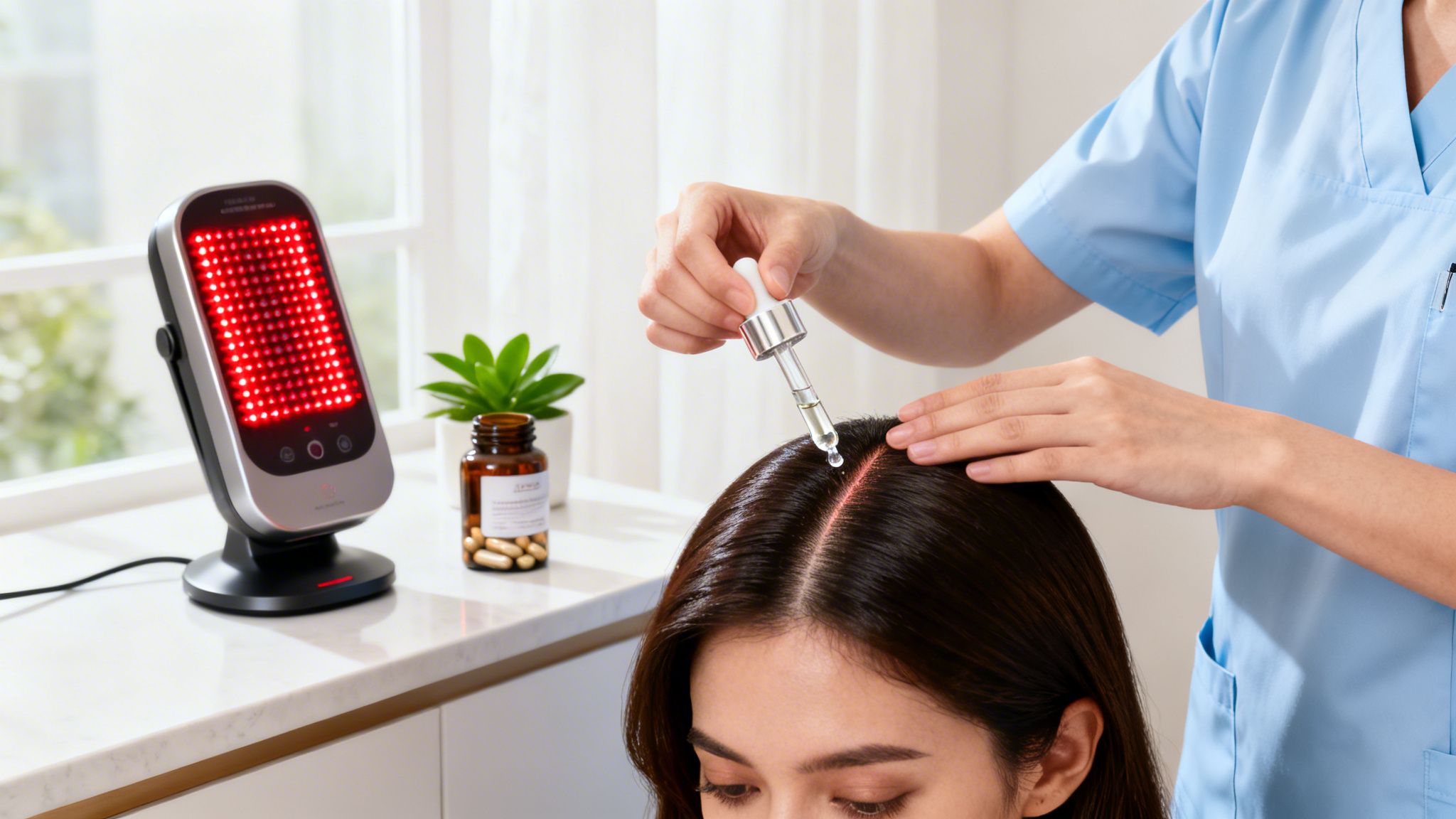
This visual shows how devices prepare the scalp to make the most of your topical treatments—first by energizing the follicles, then by enhancing absorption.

The process highlights how energizing the scalp with light therapy prepares it to better absorb the active ingredients from your serums.
Recognizing The Signs Of Progress
Patience is a must on any hair growth journey. Results don't appear overnight, but knowing what to look for will keep you motivated and confident that you're on the right track.
The very first sign of success isn't new growth—it's reduced shedding. You'll start to notice less hair in your brush, on your pillow, and in the shower drain. This typically happens within the first 1-3 months and tells you the routine is successfully strengthening your hair's anchor.
After that initial phase, you’ll begin to see the really exciting stuff. Look closely for a fuzzy halo of new, fine hairs along your hairline and part. These "baby hairs" are a clear sign that dormant follicles are waking up.
Over the next 3-6 months, these will mature into thicker, stronger strands, contributing to visible improvements in overall density and volume. It’s a slow build, but it’s so rewarding when you see it.
When to Seek Professional In-Clinic Care
Your at-home hair growth routine is a powerful tool. When you're consistent, you can absolutely achieve thicker, healthier hair. But it’s just as important to know when a home routine has reached its limit and it's time to bring in a professional.
Sometimes, hair loss isn't just about aging or genetics; it can be a sign of an underlying medical issue that topical products alone can't fix. Knowing when to escalate your care is the key to getting real, lasting results.
Signs You Need to See a Professional
If you notice any of the following symptoms, it's time to book an appointment with a dermatologist or a specialized nurse practitioner. Think of these as red flags that your body is sending up.
- Sudden or Rapid Hair Loss: A dramatic increase in shedding that seems to happen overnight or over a few weeks.
- Patchy Hair Loss (Alopecia Areata): Finding distinct, round bald spots on your scalp.
- Scalp Pain, Itching, or Inflammation: Any persistent discomfort, redness, or tenderness could point to an infection or inflammatory condition.
- No Improvement After 6-9 Months: You've been diligent with a solid home routine and see absolutely no change.
When you've done all you can at home, understanding professional hair restoration options is the next logical step. A professional can run diagnostic tests to rule out issues like thyroid disorders or autoimmune diseases, ensuring you’re on the right treatment path.
How In-Clinic Treatments Complement Your Home Routine
Seeking professional care doesn’t mean you should abandon your at-home ritual. In fact, the two are designed to work together. Think of in-clinic procedures as a powerful way to accelerate the results you're working so hard for at home.
It’s a partnership. Your home routine provides the daily support and healthy scalp environment, while in-clinic treatments deliver a concentrated therapeutic boost to wake up stubborn follicles and speed up progress.
One of the most effective in-clinic options we offer is Platelet-Rich Plasma (PRP) therapy. This procedure uses the powerful growth factors from your own blood, which are concentrated and then injected back into the scalp to kickstart cell repair and new growth. We cover this groundbreaking treatment in our article on PRP treatment for hair loss.
The great news is that these professional treatments are becoming more accessible than ever. The rise of procedures like PRP has also inspired better at-home devices and topicals, making 2026 a pivotal year for science-backed hair care. This combination of professional guidance and dedicated home care is truly the future of hair restoration.
At BotoxBarb, we believe in a combined approach. Whether you need a professional diagnosis, an advanced in-clinic procedure like PRP, or a curated at-home routine featuring products like the BARB N.P. LED Facial Mask, we are here to guide you.