Article: Best Cleanser for Mature Skin: What Actually Works
Best Cleanser for Mature Skin: What Actually Works
The best cleanser for mature skin is a fragrance-free, low-irritant, non-soap formula formulated near the skin's mildly acidic range, approximately pH 5 to 6.5. Choose it to preserve the skin barrier, not to remove every trace of oil.
You wash your face, rinse, pat it dry, and within seconds your skin feels pulled tight. Maybe the cheeks sting slightly, or the area around your mouth looks papery before you've even applied serum. That reaction isn't a sign that your cleanser is working harder. It's useful feedback that the formula, water temperature, friction, or cleansing frequency may be asking too much of mature skin.
The best cleanser for mature skin is the one that removes the day's residue without leaving burning, persistent redness, roughness, or a squeaky film. The right choice depends on your symptoms and exposure, including whether you wear water-resistant sunscreen, makeup, or occlusive treatments. A comfortable cleanse is the foundation for every product that follows.
Why Your Skin Feels Tight After Cleansing
That familiar morning pull usually appears before you've had time to apply moisturizer. It can feel like cleanliness, but mature skin often tells a different story. Tightness immediately after washing may indicate that the cleanser has removed too many protective lipids or that the washing process has created unnecessary friction.
A 2024 review reports that xerosis, or dry, rough, often itchy skin, affects approximately 30% to 85% of people over age 50, while related pruritus affects about 20% to 60%. The same review describes a significant decline in sebum production with age, with the lowest skin-surface lipid levels found in participants older than 70. These findings help explain why older skin can feel less tolerant of aggressive cleansing. The review of mature-skin care recommends mild, non-alkaline cleansers that help maintain or replenish moisture.

Clean does not mean stripped
A normal cleanse should leave your face comfortable and ready for moisturizer. It shouldn't leave you reaching for a heavy cream because your skin feels stretched, hot, or unusually dry.
Use this simple distinction:
- Comfortable and supple: The cleanser probably matches your skin's needs.
- Tight for a few minutes: The formula may be too strong, or the water may be too hot.
- Burning, itching, or prolonged redness: Stop treating the reaction as normal and reassess the product.
- Roughness or scaling that keeps returning: Your routine may need barrier support, and persistent symptoms deserve professional evaluation.
A cleanser can be effective without producing foam, fragrance, or a “squeaky” finish. For mature skin, a syndet, cream, emulsion, or amphoteric-surfactant formula is generally a more sensible starting point than conventional alkaline soap. If you're rebuilding tolerance after over-cleansing, this guide to repairing a damaged skin barrier can help you evaluate the rest of your routine.
Practical rule: If your skin feels worse immediately after cleansing, choose a milder process before adding more treatment products.
Make barrier preservation your first filter
Read the front label, then check the ingredient list. Look for fragrance-free, moisturizing, non-soap, low-foaming, or non-foaming language. Those terms don't guarantee perfection, but they point you toward a lower-irritancy starting point.
Don't choose a cleanser because it removes the most oil. Choose the least aggressive option that removes what you put on your face. That may mean a cream cleanser in the morning and a slightly more effective, still mild cleanser at night when sunscreen or makeup is present.
How Mature Skin Differs From Younger Skin
Mature skin is not just younger skin with more visible lines. Aging changes how the outermost layer holds water, responds to surfactants, and recovers after disruption. Reduced stratum-corneum hydration and lower barrier resilience can make the same cleanser feel comfortable in one decade and irritating in another.
The skin's buffering capacity also declines, while surface pH tends to rise modestly with age. An acidic stratum-corneum environment supports barrier homeostasis and the normal microbiome, so cleanser formulation matters beyond whether it removes surface debris. Evidence on cleanser pH and surfactant behavior shows why pH should be considered alongside the surfactant system rather than treated as a stand-alone pass or fail test.
Why soap can be a poor match
Conventional soap is typically alkaline. Harsh anionic surfactants can also remove stratum-corneum lipids and increase transepidermal water loss. In practical terms, that can translate into more dryness, roughness, and discomfort after washing, particularly when the skin has less reserve.
A systematic review of skin care in older adults found that syndet and amphoteric-surfactant cleansers improved dryness and offered greater protective effects than soap-and-water washing, although the authors considered the overall evidence base methodologically limited. The systematic review of cleansing in older adults supports moving away from traditional harsh soap when dryness or sensitivity is already present.
That doesn't mean every foaming cleanser is automatically unsuitable. A formula can foam and still be tolerated, while a low-foam product can still irritate if its surfactants or fragrance don't suit you. Judge the entire formula and your skin's response.
pH is a useful clue, not a verdict
A practical target for mature skin is a cleanser near the mildly acidic range, approximately pH 5 to 6.5. The evidence on the exact ideal value is mixed. Some research reports better barrier recovery with formulations around pH 4, while another comparison found greater hydration and less visual dryness with pH 6.7 than with pH 4.7. The relevant point is that lower isn't automatically better.
A cleanser near the right pH can still be too aggressive if it relies heavily on irritating surfactants or requires vigorous rubbing. Conversely, a well-tolerated cleanser may not publish its exact pH. Treat pH as one specification within a larger decision that includes fragrance, surfactant chemistry, texture, rinse feel, and your symptoms.
The clinical priority is tolerance. A theoretically ideal pH won't help if the cleanser leaves your face burning or tight.
Cream, Oil, Gel, and Micellar Cleansers Compared
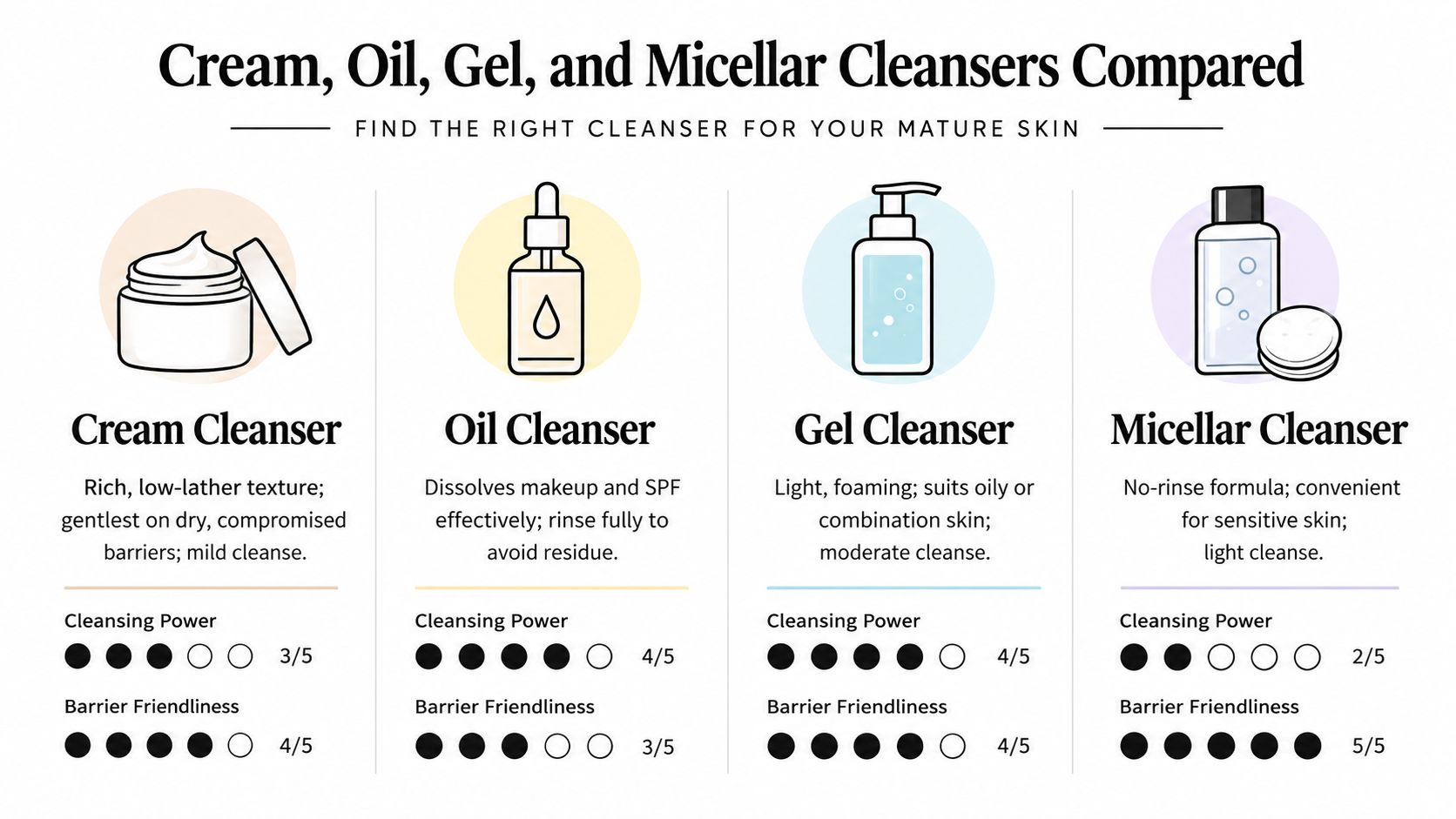
Texture gives you a useful first impression, but it doesn't tell the whole story. A cream cleanser often reduces friction, an oil cleanser can dissolve oil-based residue, a gel may provide a more substantial rinse, and micellar water offers convenience. The best option is the one that matches your exposure without exceeding your skin's tolerance.
Cream cleansers
Cream and emulsion cleansers are usually the most comfortable starting point for dry, reactive, or visibly compromised skin. Their low-lather texture can reduce the temptation to scrub for a “deeper” clean, and they're often suitable for morning use when the main goal is to remove overnight residue.
Choose this texture when your face feels tight after washing, when the cheeks are rough, or when you're temporarily simplifying a routine after irritation. A cream cleanser may not be enough for heavy makeup or water-resistant sunscreen unless you massage carefully or use a separate first step.
Oil cleansers
Oil cleansers dissolve oil-based products, including some makeup and sunscreen, with less need for repeated rubbing. Look for a formula that emulsifies and rinses clean rather than leaving a heavy film. A solid oil format can be useful for travel or controlled application, and Fillaree's solid oil cleanser bar is one resource to consider when you want an oil-based cleansing option.
Oil doesn't automatically mean non-irritating. Eye-area rubbing, incomplete rinsing, fragrance, or a second cleanse that is too forceful can still create problems. Use oil when it solves a specific removal challenge, not because “deep cleansing” sounds more thorough.
Gel cleansers
Gel cleansers can suit combination or oilier mature skin, especially at night after sunscreen or makeup. The trade-off is cleansing strength. A light, mild gel may be comfortable, while a strongly foaming gel can leave dry areas tight.
If you prefer gel, choose a fragrance-free, low-irritant formula and monitor the skin after rinsing. A product that removes residue efficiently but leaves no burning, prolonged redness, or tightness may be a reasonable night option.
Micellar cleansers
Micellar water is convenient for light cleansing, travel, or removing a small amount of makeup. It provides a relatively light cleanse, but “no-rinse” convenience doesn't mean every person should leave the product on the skin. If your face feels tacky, itchy, or irritated, rinse with lukewarm water and follow with moisturizer.
For more detail on how a gel cleanser can fit into an anti-aging routine, see this clinical-grade cleansing guide for SkinCeuticals Simply Clean Gel. Your decision rule is simple: use a gentle cream or micellar product for low exposure and a mild oil or gel approach when the day's products require more removal.
Ingredients to Look For and Avoid
Ingredient lists are more useful when you read them according to function. A cleanser's job is brief, so a promising ingredient shouldn't distract you from the overall surfactant system, fragrance content, or rinse experience.
Start with the ingredients that support comfort:
- Ceramides: These lipid-supportive ingredients are worth considering when dryness, roughness, or a weakened barrier is part of the picture.
- Glycerin and other humectants: They help attract water and can reduce the dry sensation that follows cleansing.
- Emollient lipids: Oils and other emollients can improve glide and soften the post-rinse feel, provided the formula rinses appropriately for your skin.
- Niacinamide: This can be useful in a well-tolerated routine, but a cleanser won't remain on the skin long enough to function like a leave-on treatment.
- Peptides: They may appear in premium formulas, but they shouldn't outweigh basic criteria such as low irritation and comfortable cleansing.
Ceramides have particularly relevant clinical context for mature, dry skin. In a four-week study of older adults with xerosis, participants used a ceramide-containing cleanser at least daily and a ceramide-containing moisturizing cream at least twice daily. Because the intervention included both products, the results cannot isolate the cleanser's contribution, but the combination supports considering ceramides within a broader barrier-care routine.
Ingredients and signals to question
Choose fragrance-free when your skin is dry, itchy, or reactive. Fragrance can irritate already vulnerable skin, and essential oils are not a safer substitute just because they sound botanical. Alcohol can also be counterproductive for dry skin. The American Academy of Dermatology's guidance on dry-skin care recommends gentle, moisturizing products and avoiding alcohol because it can increase dryness.
Don't assume “natural,” “detoxifying,” or “deep cleansing” means appropriate for mature skin. Strong fragrance, a high-foam experience, abrasive particles, and a rinse that leaves a squeaky film are more important warning signs than the marketing language.
Minimal-effective cleansing means removing the day's products with the least irritation, not proving that your skin can tolerate the strongest wash.
Test one change at a time. Use the new cleanser consistently enough to notice whether tightness, burning, redness, or itching improves, then stop if symptoms worsen. A cleanser can be technically well formulated and still not suit your individual skin.
The Cleanser and Moisturizer Sequence That Works
If your face feels tight, itchy, or sore after washing, changing the moisturizer alone may not solve the problem. Cleansing removes surface residue, while a leave-on moisturizer supports the barrier afterward. The useful sequence is a brief, low-irritation cleanse followed by moisturizer before discomfort develops.
A four-week clinical study included 30 men and women older than 70 with mature-skin xerosis. Participants used a ceramide-containing cleanser at least once daily and a ceramide-containing moisturizing cream at least twice daily. Mean physician-rated roughness and scaling fell from 3.1 to 0.6 on a five-point scale, an 82% reduction. Xerosis-related discomfort fell from 2.9 to 0.2, a 93% reduction, and fissure scores fell from 2.3 to 0.1, a 97% reduction. The clinical study of ceramide-containing cleansing and moisturizing evaluated the cleanser and moisturizer together, so the results cannot establish what the cleanser contributed on its own.
Apply moisturizer while the skin is comfortable
After rinsing, pat your face dry without rubbing. Apply a leave-on moisturizer while the skin retains slight dampness, particularly if tightness appears within minutes of washing. This timing helps you avoid leaving the skin exposed while it is already uncomfortable.
A richer cream may suit mature or dry skin better than a very light lotion. The American Academy of Dermatology's moisturizer guidance for aging skin explains that skin holds less moisture with age and recommends cream-based moisturizers for people in perimenopause and those aged 50 or older. Choose fragrance-free products, and look for non-comedogenic labeling if clogged pores are also a concern. For product selection beyond cleansing, see these best moisturizers for dry mature skin.
Keep the order simple:
- Cleanse briefly: Use lukewarm water and enough product to reduce friction.
- Rinse fully: Remaining residue may feel irritating.
- Pat, don't scrub: A soft towel is sufficient.
- Moisturize promptly: Apply a leave-on cream suited to your level of dryness.
- Add actives cautiously: Introduce retinoids, acids, or other irritating products only after basic cleansing and moisturizing feel comfortable.
This sequence also matters after procedures or during active treatment. If cleansing leaves burning or persistent tightness, retinoids and acids may become harder to tolerate. Reduce the cleansing burden first rather than adding more soothing products to compensate.
Where an LED mask fits
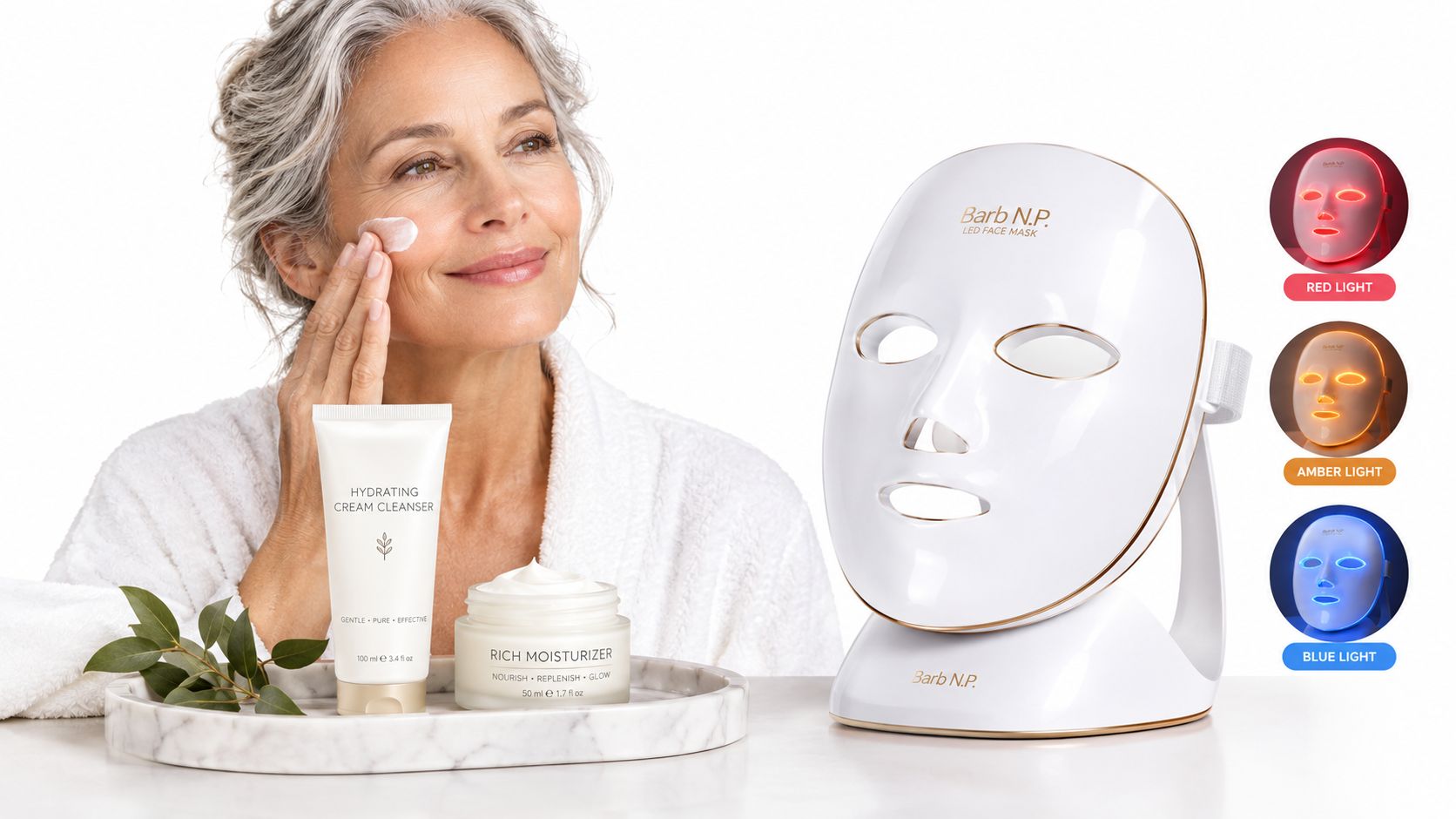
An LED facial mask is not a cleanser or a substitute for barrier care. Use it after cleansing, on clean, dry skin, and follow the manufacturer's instructions.
The Barb N.P. Facial Mask is a wireless device designed for wear across the face, with three lighting settings for different treatment goals. FDA-cleared device documentation describes anti-wrinkle treatment with red light at approximately 630 nanometers and near-infrared light at approximately 830 nanometers. An acne mode may combine red 630-nanometer light with blue 415-nanometer light. The documentation also identifies removable eye protection for light exposure. The FDA device documentation supports using the device as directed, including eye protection when specified.
How to Build a Gentle Daily Cleansing Routine
A good routine should be easy to repeat and easy to adjust. Start with the lowest level of cleansing that removes your actual exposure, then increase only when sunscreen, makeup, sweat, or residue requires it.
Morning
Use a gentle cleanser if you wake with oil, overnight product residue, or discomfort that a light cleanse improves. If your skin is very dry and comfortable, you may prefer a brief rinse followed by moisturizer. Don't turn morning cleansing into an automatic stripping step.
Night
Cleanse before bed, particularly after sunscreen, makeup, or a day of sweating. Use your fingertips and lukewarm water. A dermatology-focused guide to nonabrasive cleansing mechanics recommends an alcohol-free cleanser, fingertip application, lukewarm water, and gently patting the face dry with a clean, soft towel.
If makeup or water-resistant sunscreen remains after a mild first cleanse, use an oil or emulsion cleanser first, then follow with a brief second cleanse only if your skin needs it. Double cleansing isn't a badge of thoroughness. If the second step causes tightness or burning, it's creating more irritation than value.
A practical schedule is cleansing twice daily, with an additional cleanse after heavy sweating. Keep each cleanse brief and avoid brushes, rough cloths, and hot water. For broader lifestyle context that complements a low-irritation routine, this vegan-friendly skin health guide offers a separate perspective.
Know when cleanser advice isn't enough
Persistent itch, fissures, rash, burning, or suspected dermatitis shouldn't be managed indefinitely by switching products. Rosacea, eczema, and contact dermatitis can all require a more specific assessment, especially when symptoms continue after removing fragrance and reducing cleansing intensity.
Your routine can include medical-grade skincare and a wireless LED device with three treatment settings, but comfort remains the deciding measure. Choose a fragrance-free, non-soap cleanser, keep the process brief, moisturize immediately, and adjust based on what your skin does over several days.
BotoxBarb offers medical-grade skincare, aesthetic services, LED light therapy, and practical guidance for building a routine that supports mature, dry, or sensitive skin. Visit BotoxBarb to explore skincare products and book professional services that complement a gentle cleansing and barrier-care plan.