What's the difference between retina and retinol?
It’s a question I hear more often than you’d think, especially from clients new to medical-grade skincare: “What’s the difference between the retina and retinol?” They sound almost identical, but one is a vital part of your eye, and the other is a skincare superstar.
Getting them straight is crucial. One helps you see the world, while the other helps you look your best. Let's clear up the confusion once and for all.
Biology Vs. Beauty: The Core Distinction

The difference between the retina and retinol is simple: one is anatomy, the other is aesthetics.
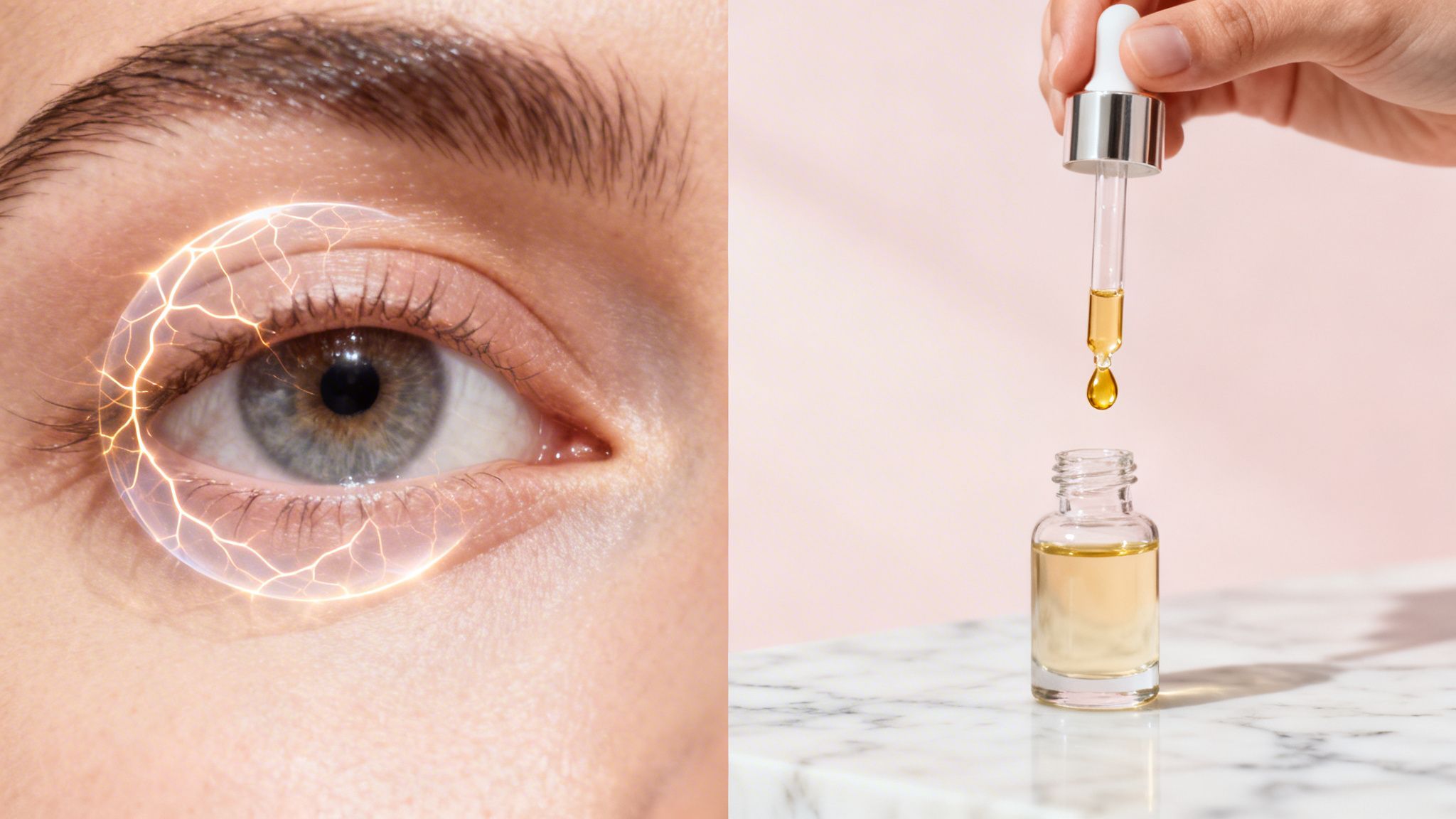
Think of your retina as the biological “film” in the camera of your eye. It’s the light-sensitive layer of tissue at the very back of your eyeball that captures everything you see and sends those signals to your brain. It’s a non-negotiable part of your vision, belonging to the world of ophthalmology.
Retinol, on the other hand, is a cosmetic ingredient—a form of Vitamin A that belongs to a family of compounds called retinoids. When applied to the skin, it’s a powerhouse for accelerating cell turnover, boosting collagen, and reducing the signs of aging like fine lines and uneven texture.
Retina vs Retinol At a Glance
Let’s break it down to make the distinction crystal clear.
| Attribute | Retina | Retinol |
|---|---|---|
| Category | Anatomical Structure | Skincare Ingredient |
| Primary Function | Converts light into neural signals for vision | Accelerates skin cell turnover and boosts collagen |
| Location | At the back of the human eye | Applied topically to the skin |
| Related Field | Ophthalmology & Biology | Dermatology & Aesthetics |
| Connection to Vitamin A | Uses a form of Vitamin A (retinal) to function | Is a form of Vitamin A |
So, while both have a connection to Vitamin A, their roles are worlds apart. One is essential for sight; the other is a celebrated tool for skin rejuvenation.
My Key Takeaway: The retina is a non-negotiable part of your eye's anatomy. Retinol is an optional—though highly effective—addition to your skincare routine for achieving a smoother, more youthful appearance.
For clients looking to improve their skin with proven ingredients, integrating a quality retinol is one of the best steps you can take. Here at BotoxBarb, my curated BARB N.P. brand of medical-grade skincare includes options that deliver real results, ensuring you use products that are both safe and powerful enough to meet your goals.
Understanding the Retina: Your Eye's Vision Center

Before we can talk about skincare, we need to clear up a common mix-up. Let's start by looking inside the eye. The retina is a delicate layer of tissue that lines the very back of your eyeball. Think of it as the high-tech sensor in a digital camera—its entire job is to create vision.
This amazing structure is packed with millions of tiny, light-sensitive cells. When light enters your eye, the retina instantly captures it and starts a complex process, converting that light into electrical signals. These signals zip along the optic nerve to your brain, which then translates them into the images you see.
How Your Retina Lets You See
The retina’s magic comes from two types of specialized photoreceptor cells: rods and cones. Each has a very specific job.
- Rods are your low-light experts. They’re what allow you to see shapes in a dim room or navigate at dusk, but they only see in black, white, and shades of gray.
- Cones are for bright light. They’re responsible for giving you sharp, detailed central vision and, most importantly, for perceiving color. You can thank your cones for appreciating a vibrant piece of art or reading the fine print on a skincare bottle.
For these cells to work, they need a specific form of vitamin A known as retinal (or retinaldehyde). Light hitting the retina triggers a chemical reaction in the retinal molecules, which kicks off the entire process of sight. This is the most important distinction: the retina uses retinal to function. It is a biological component, not a skincare product.
Why Your Retinal Health Matters
You simply can’t overstate the importance of a healthy retina. Any condition that affects this tissue can lead to serious and sometimes permanent vision loss. Globally, retinal diseases are a massive health issue.
By 2020, age-related macular degeneration (AMD) already affected 196 million people worldwide, and that number is expected to hit 288 million by 2040. For clients at BotoxBarb who are dedicated to their overall wellness, it's crucial to understand this difference. The retina keeps your vision sharp; retinol helps keep your skin smooth.
Maintaining retinal health is vital. Common issues like age-related macular degeneration (AMD) and diabetic retinopathy underscore the importance of regular eye check-ups. To gain a comprehensive view of this crucial organ, advancements such as modern retinal imaging allow eye care professionals to assess its health in detail without discomfort.
This biological function is completely separate from any skincare application. The retina is a masterpiece of natural engineering dedicated to sight, firmly placing it in the field of ophthalmology—not aesthetics.
Retinol: The Gold Standard in Anti-Aging Skincare
Now that we’ve cleared up the biological role of the retina in your eye, let's talk about its famous skincare cousin: retinol. In the world of aesthetics, few ingredients command as much respect. It’s the one you hear about constantly, and for good reason—it’s a cornerstone of modern dermatology for its proven ability to tackle the visible signs of aging.
So, how does it actually work? Retinol’s magic is all about speeding up skin cell turnover. As we age, our skin’s natural renewal cycle slows way down, leaving a layer of dull, dead cells on the surface. This is what causes that rough texture, uneven tone, and even clogged pores. Retinol essentially gives that process a gentle but firm nudge, encouraging it to behave more like it did in your youth.
The Science Behind That Coveted Glow
By getting your cells to renew faster, retinol delivers some pretty incredible and visible benefits. It softens the appearance of fine lines and wrinkles, refines skin texture for a much smoother feel, and over time, helps fade stubborn hyperpigmentation and old acne marks. The result is a clearer, more even-toned complexion.
But that’s not all. Retinol also gets to work deeper in the skin, stimulating the production of collagen—the very protein that gives your skin its firmness and bounce. This helps counteract the natural drop in collagen that comes with age, promoting a plumper, more resilient look. It’s a multi-pronged attack on aging that delivers the healthy, radiant skin my clients are always asking for.
This chart can help you figure out if your routine should focus more on preventing future damage or correcting what’s already there.

As you can see, retinoids are a key player whether your goal is prevention or correction.
How It Works: Conversion and Potency
One of the most important things to understand about retinol is that it has to go through a conversion process on your skin to become active. To do its job, it needs to turn into retinoic acid. This happens in two steps: first, retinol converts to retinaldehyde (also called retinal), and then retinal converts to the active retinoic acid.
This two-step conversion is exactly why over-the-counter retinol is both effective and much gentler than prescription-strength options like Tretinoin, which is pure retinoic acid. It gives your skin time to adapt, which minimizes the redness and irritation that stronger retinoids are famous for.
If you’re just starting your anti-aging journey, a high-quality retinol serum is one of the best tools you can have in your arsenal. Starting with a well-formulated product is key to getting results without unnecessary irritation. For a look at other powerful ingredients and routines, you can explore some of the best Korean anti-aging products. And as you begin, it’s always smart to be aware of potential retinol serum side effects to ensure your experience is as smooth as possible.
Retinol vs. Retinal: A Guide to Vitamin A Derivatives
So you’ve started using retinol and your skin is finally getting with the program. That’s a fantastic first step into the world of Vitamin A, but the journey doesn’t end there. If you’re ready for the next level, it’s time to get familiar with another key player in the retinoid family: retinal, also known as retinaldehyde.
Understanding the difference here is everything when it comes to tailoring your routine for your specific goals, whether that’s tackling stubborn fine lines or just getting that glow a little faster.
The secret lies in how your skin converts these ingredients. Your skin can only use Vitamin A in its most powerful, bioactive form, which is retinoic acid. Retinol is a great starting point, but it has to take two steps to get there. First, your skin converts it into retinal, and then that retinal gets converted into the all-star, retinoic acid.
The One-Step Advantage: Why Retinal Works Faster
This is where retinal has a serious edge. Because it’s already one step down the conversion path, it’s much closer to the final, active form your skin needs. It only requires a single conversion to become retinoic acid.
This direct-to-business approach makes it significantly more potent and faster-acting than retinol. In fact, some studies show that retinal can work up to 11 times faster than its gentler cousin.
For you, that means seeing results much more quickly. Think faster improvements in skin texture, a visible reduction in fine lines, and a noticeable boost in clarity. If you’re looking for something more powerful than retinol but aren’t quite ready for a prescription, retinal is the perfect middle ground.
Choosing Your Retinoid: Retinol vs. Retinal
Deciding between retinol and retinal really comes down to your skin's history and what you're hoping to achieve. For anyone just starting out or with very sensitive skin, retinol is the safest bet. But if you’re an experienced user looking to level up, retinal is your go-to.
This table breaks down the main differences to help you choose wisely.
Choosing Your Retinoid Retinol vs Retinal
| Feature | Retinol | Retinal (Retinaldehyde) |
|---|---|---|
| Conversion Steps | Two steps to retinoic acid | One step to retinoic acid |
| Speed of Action | Slower, more gradual results | Faster-acting and more efficient |
| Potency | Lower potency, very gentle | More potent than retinol |
| Ideal User Profile | Beginners, sensitive skin, or for preventative care | Experienced users, tolerant skin, or targeting advanced signs of aging |
It's all about finding the right fit for where your skin is right now.
My Clinical Insight: Retinol is an excellent starting point for anyone new to Vitamin A. It allows your skin to adapt with minimal irritation. However, if your skin is well-acclimated to retinol or you want to step up your anti-aging game, graduating to a retinal product is the logical next step for more significant, faster results without the intensity of a prescription.
At BotoxBarb, we believe in a curated approach. We offer medical-grade products like the BARB N.P. Retinol Serum, perfect for introducing your skin to retinoids. If you've ever wondered about the difference between over-the-counter options and prescriptions, check out our detailed guide on Retinol vs. Retin-A.
How to Integrate Retinol Into Your Skincare Routine
Ready to finally start using retinol? It’s the gold standard for a reason, but the stories of peeling and irritation can be intimidating. Don't worry. The secret to that coveted retinol glow isn't avoiding it—it's starting it the right way.
A measured, gentle approach is everything. The goal is to introduce this powerful active to your skin slowly, allowing it to adapt without the redness and discomfort that can come from jumping in too fast. Think of it as training your skin for a marathon, not a sprint.
Barb's Rules for Starting Retinol
To get the beautiful results everyone talks about, you need a smart strategy. These are the non-negotiable rules I give my clients to ensure their skin stays happy and healthy as it adjusts.
-
Go Low and Slow: Always begin with a low-concentration retinol. A pea-sized amount is plenty for your entire face. Apply it just a couple of nights a week at first, always on clean, dry skin. This initial period is called retinization, where your skin builds up tolerance. If your skin is handling it well after a few weeks, you can slowly increase the frequency to every other night, and eventually, nightly if your skin allows.
-
Try the "Sandwich" Method: If you have sensitive skin, this technique is a game-changer. Apply a thin layer of your favorite simple moisturizer first, let it absorb, then apply your retinol, and follow up with another layer of moisturizer. This creates a "buffer" that helps minimize potential irritation without diluting the retinol's effectiveness.
-
Sunscreen Is Mandatory: This is the most critical rule of all. Retinoids make your skin more sensitive to the sun (a condition called photosensitivity), putting you at higher risk for sun damage. A broad-spectrum sunscreen with at least SPF 30 is an absolute must every single morning. No exceptions.
“So many of my clients are hesitant to start retinol because they’ve heard horror stories. But with the right technique—starting slow, buffering, and being diligent with SPF—most people can get incredible results without the drama. It’s all about respecting your skin barrier.” — Barb, NP
Choosing the Right Product for Your Journey
The product you choose can make or break your experience. A well-formulated serum designed for both efficacy and gentleness is your best bet, whether you're a beginner or a seasoned user.
Our own BARB N.P. Retinol Serum was curated with exactly this in mind. We designed it to deliver visible smoothing and brightening results while minimizing the potential for side effects, making it a perfect starting point for achieving a more radiant complexion.
As you build your routine, you'll naturally wonder how retinol plays with your other favorite ingredients. We've got you covered. You can learn more about using retinol and Vitamin C together in our detailed guide to help you build a cohesive and powerful skincare plan.
Take Your Results to the Next Level with At-Home Treatments
A consistent retinol routine is your foundation for great skin, but what if you want to accelerate those results? To truly bridge the gap between your daily regimen and what we can achieve in the clinic, you can layer in advanced at-home treatments for a powerful, synergistic effect.

This is where targeted light therapy comes into play. Adding an LED facial mask to your weekly routine is one of the smartest ways to boost the benefits of your retinol, helping you get that radiant, healthy glow even faster.
The Barb N.P. LED Facial Mask
To help my clients get the absolute best skin possible at home, I’ve sourced the Barb N.P. LED Facial Mask. It’s designed to be a seamless, effective addition to any skincare plan—especially one that includes retinoids.
What makes it stand out is how easy it is to use consistently. The mask is completely wireless, so you can move around freely during your treatment. Its comfortable, flexible design sits securely on your face, letting you relax, read, or even multitask without being stuck by a wall outlet.
By combining the collagen-stimulating power of retinol with the targeted energy of LED therapy, you create a dual-action strategy that accelerates anti-aging benefits and promotes overall skin wellness.
This mask also offers three distinct light settings, allowing you to customize your treatment based on what your skin needs that day.
- Red Light: This setting is the perfect partner for your retinol. It penetrates deep into the skin to kickstart collagen production, helping firm the skin and soften the look of fine lines even more effectively.
- Blue Light: Ideal for anyone who struggles with occasional breakouts. The blue light setting helps target and neutralize acne-causing bacteria on the skin’s surface, keeping your complexion clear.
- Amber Light: If your skin gets red or irritated—especially when adjusting to a new retinol—the amber light is your best friend. It helps calm inflammation and promotes a more even, serene complexion.
Using the Barb N.P. LED Facial Mask just a few times a week is an excellent way to support your skin's health and make your entire routine work that much harder for you.
Your Retinoid Questions, Answered
Let's finish up with a few of the most common questions my clients ask me about retinoids. I get these all the time in my clinic, and I want you to feel completely confident starting your journey.
Can I Use Retinol If I Have Sensitive Skin?
Absolutely, but you need to be smart about it. The key is to start low and go slow.
I recommend beginning with a gentle, low-concentration formula like our BARB N.P. Retinol Serum just once or twice a week. You can also try the "sandwich method," which is a fantastic trick for sensitive skin: apply a thin layer of a basic moisturizer, let it sink in, add your retinol, and then finish with another layer of moisturizer. This creates a buffer that dramatically reduces the risk of irritation.
How Long Until I See Results from Retinol?
Patience is probably the most important ingredient in any retinol routine. While you might notice a subtle glow or smoother feel within a few weeks, the real magic takes time.
For significant changes in texture, fine lines, and overall tone, you should plan for 8 to 12 weeks of consistent use. Don't get discouraged if you don't see a dramatic difference overnight. Trust the process—your skin is hard at work.
Is It Safe to Use Retinol Around My Eyes?
Yes, but with extreme care. The skin around your eyes is the thinnest on your body, making it incredibly delicate and prone to irritation.
Never apply retinol directly on your eyelids or right up against your lash line. Instead, take a pin-head-sized amount and gently pat it along the orbital bone—the bony ridge you can feel around your eye socket. For targeted treatment without the risk, I always recommend using a dedicated eye cream formulated with a much lower, gentler dose of retinol.
Barb's Pro Tip: When is it time to "graduate" from over-the-counter retinol to a prescription-strength retinoid? I usually consider this when a client's skin has fully adapted to a high-strength cosmetic product, but they're still looking for more powerful results for concerns like deep-set wrinkles or stubborn acne. This is a big step, so always consult with a qualified provider like me before making the switch.
At BotoxBarb, my commitment is to empower you with the knowledge and expertly curated products you need for your best skin.
Ready to start your journey? Explore our medical-grade skincare collection at barbnp.shop.