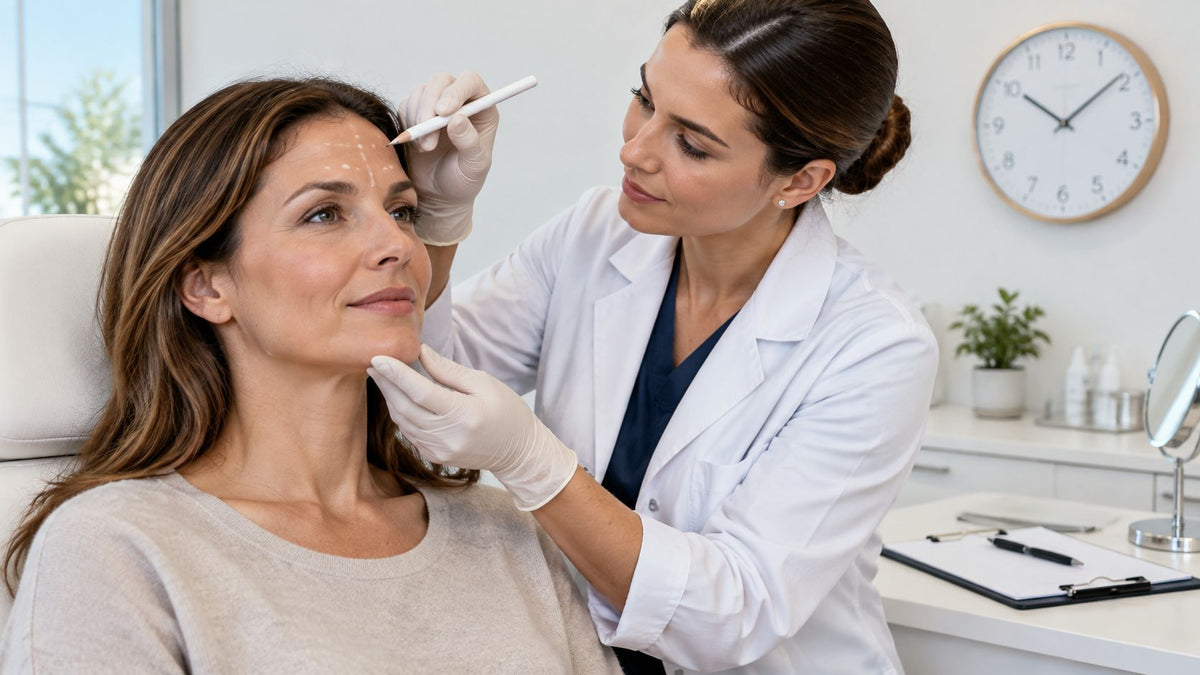
How Long Does Botox Appointment Take? a Visit Timeline
The injections themselves take about 10 minutes, a routine Botox visit for an established patient runs about 20 to 30 minutes, and a first visit or treatment of several facial regions needs 45 to 60 minutes. Those are planning ranges, not guaranteed appointment lengths.
The important distinction is procedure time versus time in the office. A clinician still needs to confirm that treatment is appropriate, assess how your face moves, agree on a plan, and explain what happens afterward. Booking enough time for those conversations makes the visit less rushed and gives you a clearer idea of what you're choosing.
Typical Botox Appointment Length by Visit Type
Choose your booking window by visit type, not by needle time alone. Cleveland Clinic describes the neuromodulator procedure as taking about 10 minutes, which is a useful benchmark once the treatment plan is established.
The American Society of Plastic Surgeons reports that botulinum-toxin injections usually take less than 15 minutes. Neither estimate means that every patient can arrive, complete a consultation, receive treatment, and leave within that injection-only window.
Typical Botox appointment length by visit type
The full-visit ranges below are scheduling benchmarks, not fixed procedure standards. Use them to choose an initial booking category, then confirm the actual slot with the practice.
| Visit type | Typical total time | What the time covers | Source basis |
|---|---|---|---|
| Injection portion only | About 10 minutes | Multiple small injections once the plan is set | Cleveland Clinic; ASPS reports under 15 minutes |
| Established patient, familiar areas | 20 to 30 minutes | Screening, consent, photos, cleansing, dosing, injections, aftercare | Scheduling benchmark |
| Straightforward follow-up | About 30 minutes | Brief review plus treatment of known areas | Scheduling benchmark |
| First visit or several facial regions | 45 to 60 minutes | Full consultation, history, consent, documentation, treatment and aftercare | UCLH consultation about 45 minutes, plus time per added injection site |
A returning patient may already have a documented treatment pattern and a clear sense of the result they prefer. That makes the conversation more focused, but it doesn't eliminate medical screening or reassessment. New medications, a change in health, or a different cosmetic goal can change the plan.
A first appointment involves more decisions. You may need to discuss whether the lines that concern you are suitable for a neuromodulator, how much movement you'd like to preserve, and whether the proposed outcome is realistic. That discussion is part of treatment, not an administrative delay.
Pick the row that matches your situation
Start by naming the areas you want assessed. Forehead lines, lines between the eyebrows, and lines beside the eyes are distinct concerns, even though you may think of them collectively as upper-face treatment.
Then identify whether you're returning for an established plan or starting a new one. A familiar patient requesting a different region may need a more substantial consultation than their usual appointment allows.
Booking rule: Tell the scheduler whether you're a new patient and list every area you want discussed. Don't assume a short injection appointment includes an unrestricted consultation.
Also check whether consultation and treatment are offered together. A consultation doesn't obligate you to proceed, and a clinician may recommend postponing injections or considering another approach. Choose your table row based on the work the visit needs to include, rather than the fastest possible treatment.
Stage-by-Stage Breakdown of a Botox Visit
These are typical estimates from clinic practice, not fixed figures. Some tasks overlap, and the total appointment windows aren't exact sums of independently timed stages.
| Stage | Estimated time | What happens |
|---|---|---|
| Check-in and identity screening | 3 to 5 minutes | Forms, ID, medication and allergy check |
| Consultation and goal review | 3 to 5 minutes for a follow-up; 20 to 30 minutes at a first visit | Goals, medical history, prior treatments and risks |
| Facial assessment and marking | About 5 minutes | Movement check, site selection and photos |
| Cleansing and dosing | 2 to 5 minutes | Skin prep and dose calculation for each site |
| Injections | About 10 minutes | Multiple small injections with a fine needle |
| Aftercare instructions | 2 to 5 minutes | Do's and don'ts, what to expect, follow-up timing |
| Total, established patient | About 20 to 30 minutes | Combined workflow for familiar areas |
| Total, first visit | 45 to 60 minutes | Combined workflow with a first-visit consultation |
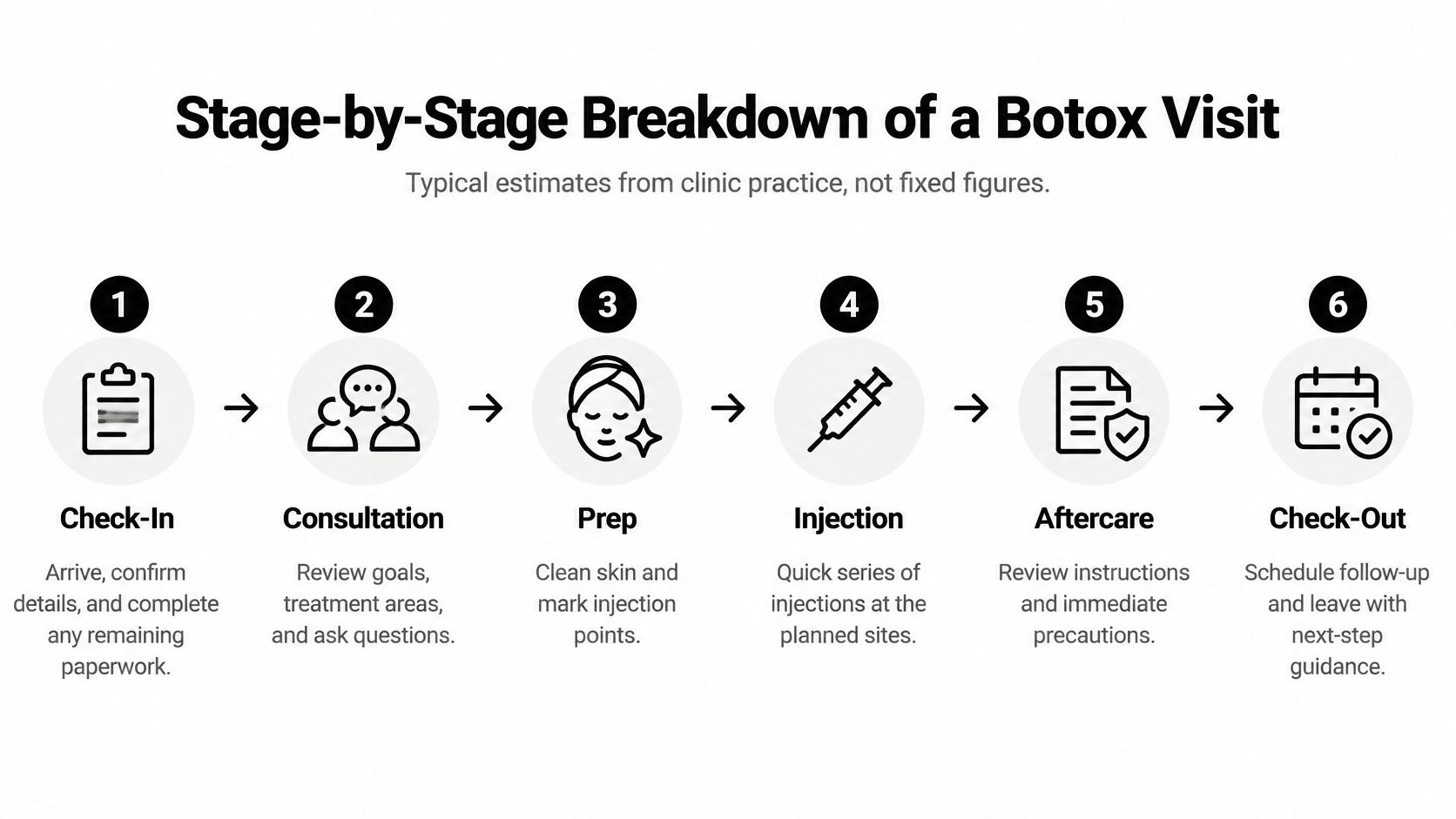
What happens before the injections
- Check-in and screening. Staff confirm your identity and review outstanding forms, allergies, and medications. Accurate information matters more than finishing quickly, so mention changes even if you've completed an online intake.
- Consultation and goal review. Explain what bothers you and what you'd like to retain, such as natural expression or some forehead movement. The clinician reviews your health history, previous injectable treatments, and relevant risks before deciding whether to proceed.
- Facial assessment and marking. You'll be asked to make expressions so the clinician can assess movement rather than relying only on how your face looks at rest. Site selection, photographs, and any markings help document the intended treatment.
- Cleansing and dose calculation. The clinician prepares the skin and determines the dose for each planned site. This isn't a matter of using the same pattern on every face, because anatomy, movement, and treatment goals need individual assessment.
The injection and departure
- Small, targeted injections. The clinician uses a fine needle at the planned sites, pausing when necessary for positioning or comfort. The FDA labeling for BOTOX Cosmetic describes a standard glabellar-line regimen of 20 Units across five sites, with 4 Units at each site, illustrating how a brief procedure can still involve carefully placed injections.
- Aftercare and check-out. You'll review immediate precautions, expected changes, and how to contact the practice if something concerns you. Before leaving, clarify whether a result review is recommended and when maintenance should next be considered.
You should leave with written aftercare instructions and a clear follow-up plan. If a review is appropriate, confirm the date or booking window rather than relying on a vague instruction to return later.
It's also reasonable to pause before treatment if you don't understand the proposed plan. The goal isn't to get through every stage as quickly as possible. It's to complete the necessary checks without making the appointment feel confusing or hurried.
Scheduling Repeat Visits at the Right Interval
Maintenance belongs on a different calendar from your immediate result check. Mayo Clinic states that repeat injections are generally needed to maintain the effect and should be spaced at least three months apart.
That isn't a requirement to receive treatment as soon as the minimum interval passes. Your clinician should consider how the previous treatment worked, how much movement has returned, and whether your goals have changed. A review appointment also doesn't automatically mean more injections.
Build a calendar around decisions
- Record the treatment date. Keep the date, treated areas, and any instructions together so you can give an accurate history at your next visit.
- Ask for the next window before leaving. Find out whether the practice recommends a separate result review, a maintenance appointment, or both.
- Set an advance reminder. Put a reminder ahead of the agreed maintenance window so you can arrange time away from work and avoid booking under pressure.
- Keep notes about the result. Write down what you liked, what felt different, and any concerns you want assessed.
A follow-up usually includes a discussion of how the previous treatment settled, examination of the treated areas, and a decision about the next plan. The clinician may retain the same approach, adjust it, or recommend waiting rather than repeating treatment immediately.
For a more detailed explanation of maintenance planning, see our guide to how often to get Botox. Use it to prepare questions, not to replace an individualized recommendation.
Separate a review from retreatment
A result review is a chance to assess the outcome after it has developed. Maintenance is a later decision about repeating treatment as the effect wears off. Mixing those appointments up can create the mistaken impression that every check-in requires another dose.
A calendar reminder is a prompt to reassess, not an instruction to inject.
The practical sequence is straightforward: complete the initial visit, attend a result check if recommended, and book maintenance within the clinician's agreed window. Reassess at every appointment, especially after a health change or a different response to the previous treatment. A shorter repeat visit should still include a fresh clinical decision.
Planning Your Schedule Around Results and Recovery
The time you spend waiting for the cosmetic effect may matter more than the time you spend in the treatment chair. Cleveland Clinic reports that desired effects commonly begin around day three or four, become fully visible within 10 to 14 days, and typically last about three to four months.
For an important event, that means allowing a two-week results window, rather than expecting a finished result when you leave the office. With a first treatment, discuss additional flexibility for visible bruising or an outcome that needs assessment.

Plan for gradual change
Immediately after treatment, your appearance doesn't tell you the final result. Avoid deciding that the treatment has failed, or that you need more, while the effect is still developing.
Say you're preparing for a wedding or a presentation with professional photographs. Schedule the consultation early enough to discuss expectations and decide whether treatment fits your plans, rather than trying a new procedure immediately before the occasion. The clinician may suggest a more conservative approach or advise leaving a larger margin.
Our Botox aftercare instructions can help you organize the practical side of the days after treatment. Your treating clinician's individualized instructions should take priority.
Distinguish expected effects from urgent symptoms
Expected local effects. Minor redness, soreness, mild swelling, or bruising can occur at injection sites. These effects don't necessarily prevent ordinary activities, but they may matter if you're planning close-up photographs or an appearance-sensitive commitment.
Concerns that need assessment. Contact the treating practice if a symptom is unexpected, worsening, or worrying you. Don't assume that an appointment described as having little downtime means every symptom should be ignored.
Urgent symptoms. Difficulty swallowing, changes in speech, or breathing problems require prompt medical attention. Breathing difficulty warrants emergency care, not a message left for a routine review.
Safety distinction: Waiting for the cosmetic result is appropriate. Waiting for serious symptoms to settle isn't.
Most scheduling mistakes come from treating departure from the clinic as the finish line. In practice, you need room for the result to develop and a clear route to help if something doesn't feel right. Arrange maintenance before you're scrambling around an event, while still respecting the treatment interval your clinician recommends.
How to Make Your Next Visit Faster and Smoother
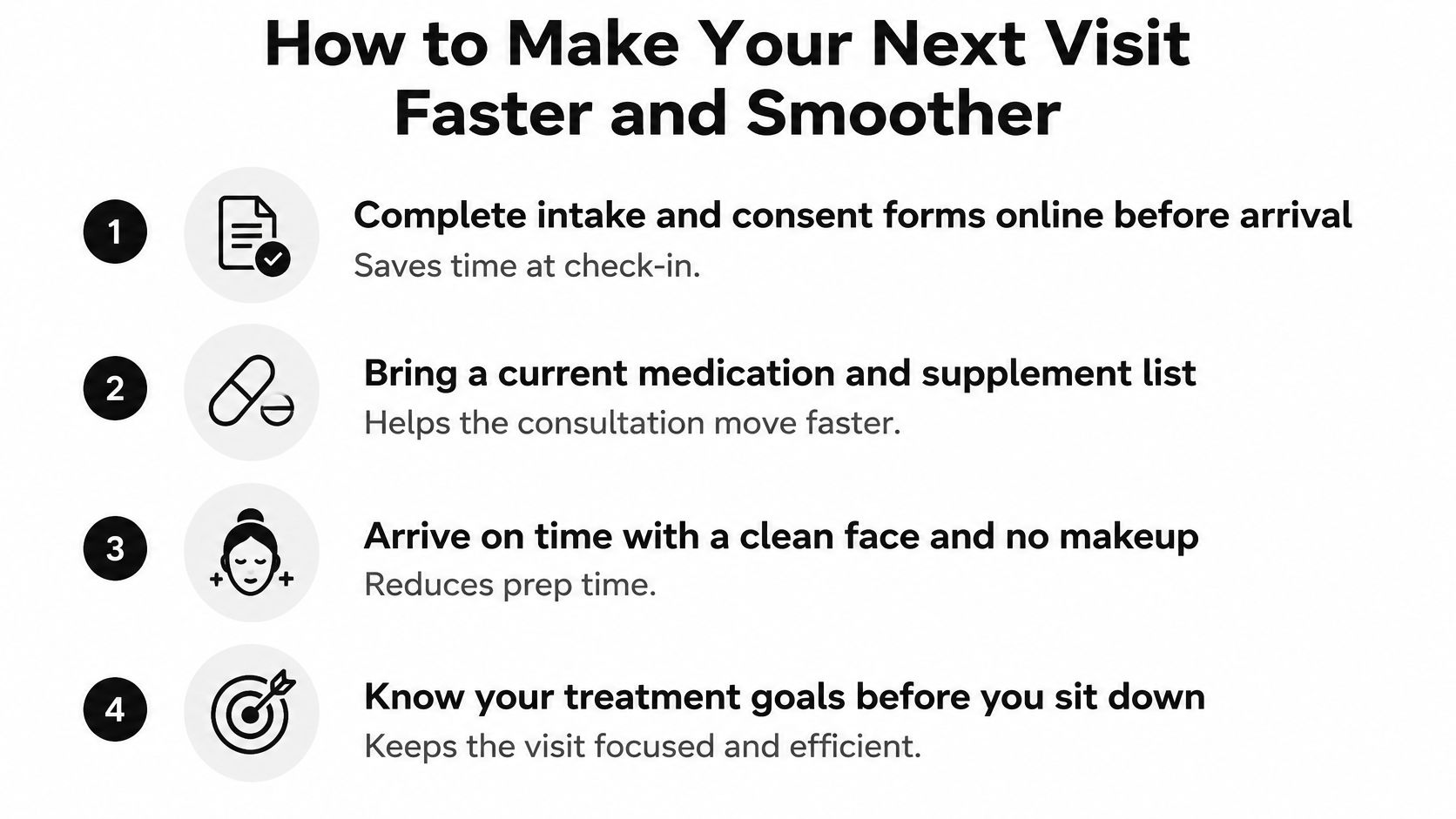
Preparation can shorten the administrative part of a visit, while the clinician still needs time for assessment and questions. A clear list of your goals and medications helps keep the conversation focused.
Remove avoidable delays
- Complete available forms before arrival. If the practice offers online intake forms, fill them out ahead of time. Read consent information in advance, and bring any questions to the appointment so you understand what you are agreeing to.
- Bring a medication and supplement list. Include prescriptions, nonprescription products, and recent changes. Don't stop a prescribed medication on your own to prepare for cosmetic treatment.
- Write down your priorities. Note the areas you want assessed and describe the result you hope to achieve. Follow the practice's directions about arriving with a clean face or without makeup.
- Leave breathing room in your schedule. Avoid booking the visit immediately before another commitment. A buffer gives you time to listen, ask questions, and make decisions without feeling rushed.
- Review immediate aftercare instructions. Know what activities to avoid after treatment and follow your clinician's guidance. Preparing for those instructions helps you plan the rest of your day.
Use this guide to preparing for a Botox appointment to organize what to bring and discuss. Preparation helps make the visit more focused; it should not replace the clinician's assessment.
Keep skincare separate from injectable treatment
An at-home LED mask belongs to a skincare routine, separate from injectable treatment. Use any device according to its manufacturer's directions, and ask your treating clinician when it is appropriate to resume use after injections, especially if the mask touches treated areas. A skincare device does not replace medical assessment.
What Changes Your Visit Length and What to Confirm Before Booking
Complexity, rather than injection speed, is what usually expands the appointment. University College London Hospitals states that its whole botulinum-toxin consultation takes about 45 minutes and may take longer when many injections are involved.
That is an example of a clinic's consultation schedule, not a universal duration for cosmetic Botox. It does demonstrate why an injection-only estimate is an unreliable guide when the visit requires substantial assessment.
The main reasons a visit gets longer
More treatment areas require more decisions. Assessing forehead movement isn't the same task as evaluating a lower-face concern. Each proposed region may require its own examination, discussion of limitations, site selection, and documentation.
A first visit starts without an established plan. The clinician needs to understand your history and preferences before choosing an approach. A returning patient can also need an extended appointment when requesting a different result or changing treatment areas.
Medical history can change the conversation. Medications, allergies, previous reactions, and relevant health conditions may need clarification. Bring the information rather than assuming something isn't important because the treatment is cosmetic.
Asymmetry or unusual goals need careful assessment. A difference between the sides of your face may be present before treatment. Documenting it and discussing what treatment can reasonably change helps prevent misunderstandings afterward.
Add-on services also need their own time. Don't assume that another injectable or skincare treatment can fit into a slot booked for a familiar Botox plan.
Compare a refresh with a new treatment plan
Consider a hypothetical returning patient booked for a 15-minute refresh of familiar areas. That slot only makes sense if the practice has explicitly confirmed what it includes and can complete the necessary review safely. It isn't a target patients should expect every clinic to meet.
Now consider a hypothetical 60-minute first appointment to discuss the forehead, eye area, and lower face alongside a full health-history review. Much of that visit may involve determining which concerns are appropriate to treat, rather than administering injections. The patient may choose to proceed with only part of the proposed plan.
These examples show why adding a fixed amount of injection time for each new region isn't a reliable scheduling formula. Ask the practice to estimate the total from your actual request instead of multiplying a procedure benchmark.
For general ideas about organizing documents and questions before a new medical visit, the Vein and Wound Institute's guidance to prepare for your first appointment is a useful administrative resource. It's not Botox-specific aftercare or injectable treatment advice.
Ask what the quoted appointment includes
Before booking, ask this directly:
Does the quoted duration include consultation, paperwork, facial assessment, and post-treatment instructions, or only the injections?
Then confirm the details that affect your own visit:
- New or returning patient. Say whether this is your first appointment with the practice, even if you've had Botox elsewhere.
- Areas to discuss. List your concerns before the scheduler selects the appointment type.
- Additional services. Mention anything else you'd like considered so the practice can allow appropriate time.
- Preparation requirements. Confirm what forms, records, medication details, and arrival instructions you need.
Our practice is run by a board-certified nurse practitioner, and we serve clients throughout Northern California. Pick the row from the opening table that best matches your situation, then confirm the time block before the day. The injection is quick, and the visit is what you plan.
BotoxBarb offers injectable services including Botox, Dysport, and Restylane, with individualized assessment to help you understand the treatment plan and appointment requirements. Visit BotoxBarb to explore your options and request a visit, noting whether you're a new patient and which areas you'd like assessed.