Article: How Many Days After Botox Do You See Results: Full Timeline
How Many Days After Botox Do You See Results: Full Timeline
Early Botox changes are often noticed within 3 to 7 days, the effect strengthens through the first week, and the final result is usually judged around day 14. But if you can still frown a few days after treatment, does that mean it hasn't worked?
Not necessarily. The first visible change and the right time to assess your result aren't the same milestone. Knowing the difference can prevent unnecessary worry, while knowing which symptoms deserve medical attention keeps reassurance from turning into inappropriate waiting.
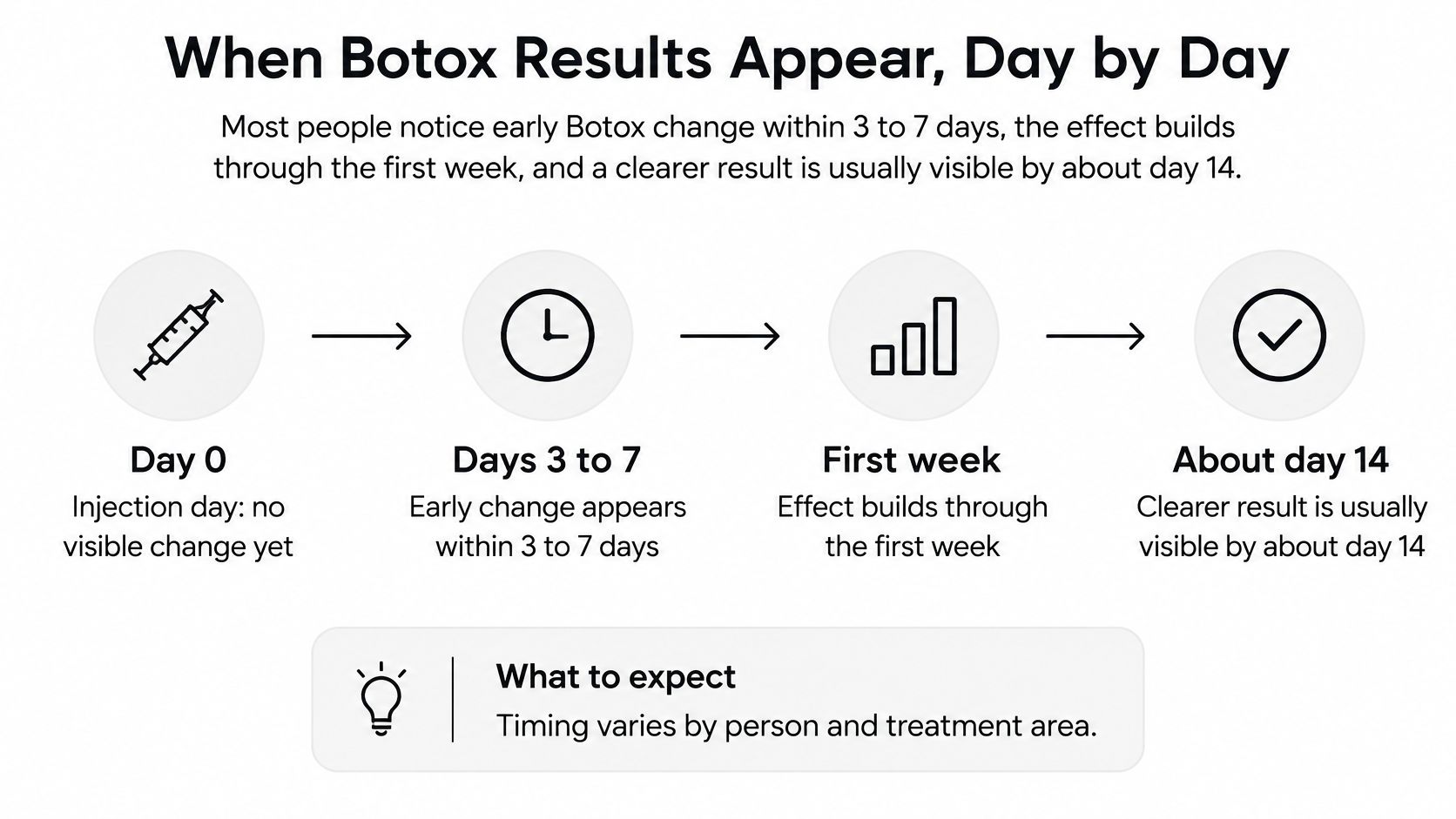
When Botox Results Appear, Day by Day
Botox temporarily reduces the nerve signals that tell a treated muscle to contract. It doesn't fill a wrinkle or immediately change the skin's structure, so the first thing you notice may be a softer expression rather than a completely smooth line.
The FDA prescribing information for Botox Cosmetic describes chemical denervation beginning 1–2 days after injection, with the effect increasing during the first week. Chemical denervation sounds alarming, but here it describes the intended temporary reduction in communication between the nerve and the targeted muscle.
Follow the milestones, not the mirror
The practical timeline below combines the early response described in FDA labeling with the cosmetic assessment windows in the NCBI clinical reference on botulinum toxin, which places maximum effect between 1 week and 1 month. The American Academy of Dermatology overview places noticeable results at 3–7 days and usual duration at 3–4 months.
| Timing | What You Notice | What Is Happening |
|---|---|---|
| Days 1–2 | Little or no visible change for many people | The toxin begins blocking nerve signals to the treated muscle |
| Days 2–3 | First softening; median onset about 2–3 days in aesthetic toxin studies | Chemical denervation strengthens |
| Days 3–7 | Smoother movement; expression lines begin relaxing | The effect builds through the first week |
| Days 7–14 | A clearer, often more even result | Most of the early cosmetic effect is in place |
| Around day 14 | A useful point to judge the result and spot asymmetry | The clinician assesses the developed cosmetic response |
| Around day 30 | Peak effect in some clinical measurements | Maximum wrinkle improvement in some studies |
| Months 3–4 | Gradual fading as muscle activity returns | Typical duration of benefit for glabellar lines |
These are milestones, not deadlines. A subtle response can be difficult to spot when you're checking your face repeatedly, particularly if you're expecting complete immobility.
For example, you might still lift your eyebrows, but the forehead creases may look less pronounced during that movement. That can represent a response even though your face hasn't become motionless.
Notice movement as well as lines
A crease visible while your face is resting isn't the same as a line that appears only when you frown. Reducing muscle activity can soften the movement-related component without erasing every existing crease.
The StatPearls clinical reference on cosmetic botulinum toxin describes efficacy developing thoroughly over approximately 2 weeks. That makes an early mirror check less useful than a consistent comparison after the response has developed.
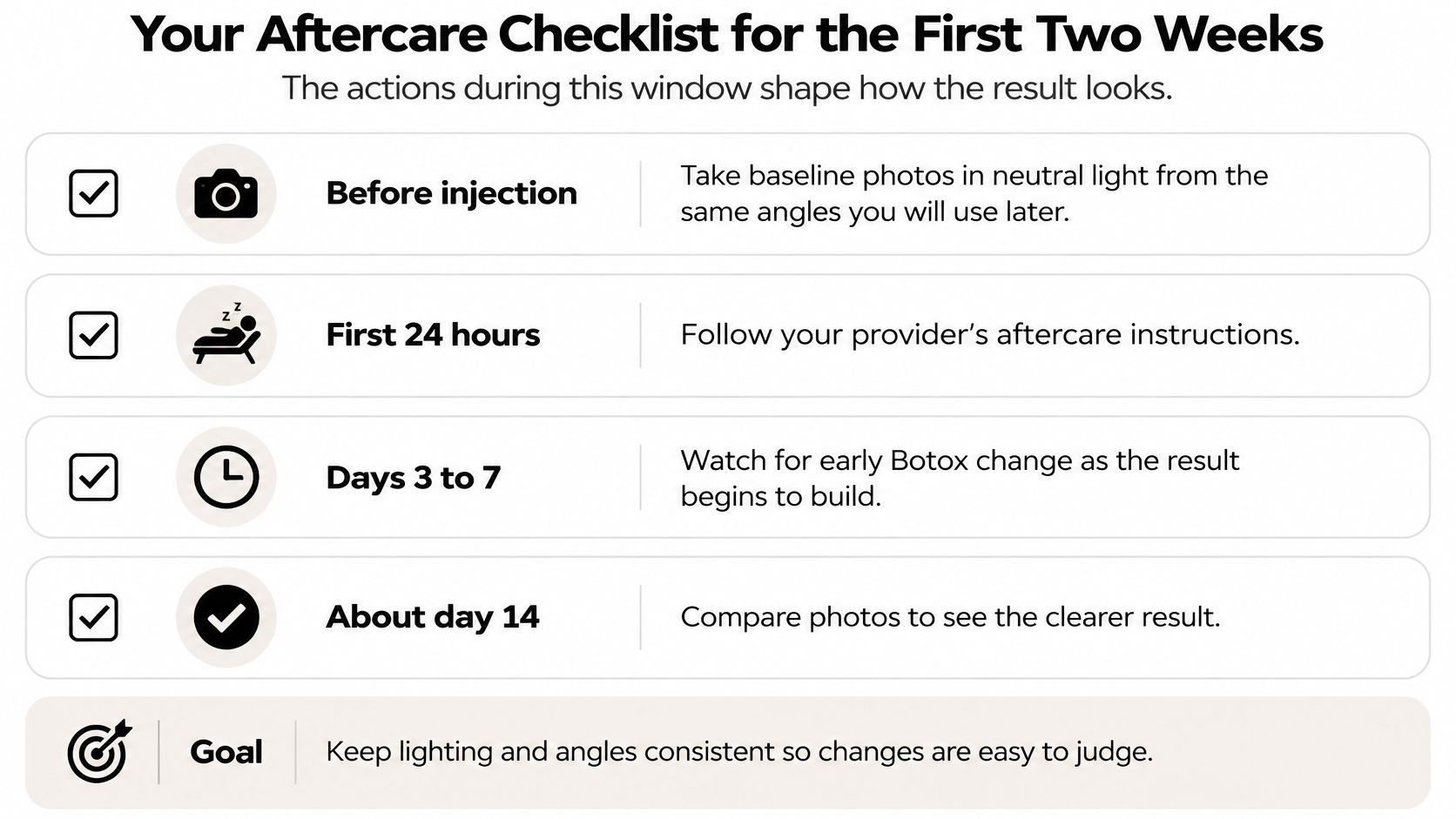
Photo habit: Photograph the treated area before injection, both at rest and during the relevant expression. Repeat those views around the assessment appointment using the same lighting, camera distance, and expression.
Photographs help you compare your result with your actual starting point, rather than with a memory or an unusually flattering angle.
Why Your Botox Timeline Differs From Someone Else's
Botox works more like a dimmer switch than an on-off light. The speed and degree of change depend on the muscle being treated, the formulation, and how the clinician delivers it.
Your friend's forehead isn't a reliable control group for your frown lines. Even within your own face, separate areas can respond differently because the muscles have different jobs, strengths, and movement patterns.
The factors that change the response
- Dose and treatment goal: The injector selects the dose after examining your anatomy and desired movement. More units aren't a reliable shortcut to faster onset, and a stronger effect isn't automatically a better cosmetic result.
- Muscle strength: A very active muscle may retain noticeable movement while the response develops. The relevant question is whether its activity is becoming appropriate for the treatment goal, not whether it matches someone else's face.
- Treated area: Forehead movement, frowning, and squinting involve different muscles. Compare each treated area with its own baseline rather than expecting every area to soften together.
- Injection placement: Placement influences which muscles relax and how balanced the result looks. Persistent imbalance requires an examination, not a guess about where additional product should go.
- Individual response: People differ in how they respond and how long the benefit lasts. A person who notices an early change won't necessarily have the longest-lasting result.
Metabolism often comes up in conversations about duration, but it isn't a useful home explanation for every slow start. You can't determine from the mirror whether the issue is normal progression, the dose, placement, or a mismatch between the treatment and your expectations.
Product identity matters
The FDA's updated Botox Cosmetic labeling supports a product-specific assessment rather than assuming every botulinum toxin treatment follows an identical schedule. Botox is a brand of onabotulinumtoxinA, not a general name for all injectable wrinkle treatments.
Ask for the exact product name and record it with the treated areas. That information makes a future consultation more useful, especially if you switch practices or compare a new treatment with a previous one.
Compare like with like: the same product, the same area, the same expression, and comparable photographs.
If one eyebrow appears more mobile than the other during early progression, document it without repeatedly forcing the expression. If the difference remains at the planned review, your clinician can assess whether it reflects baseline anatomy, uneven muscle response, or a treatment issue.
The practical goal is an individualized, balanced result, not winning a race to the earliest visible change.
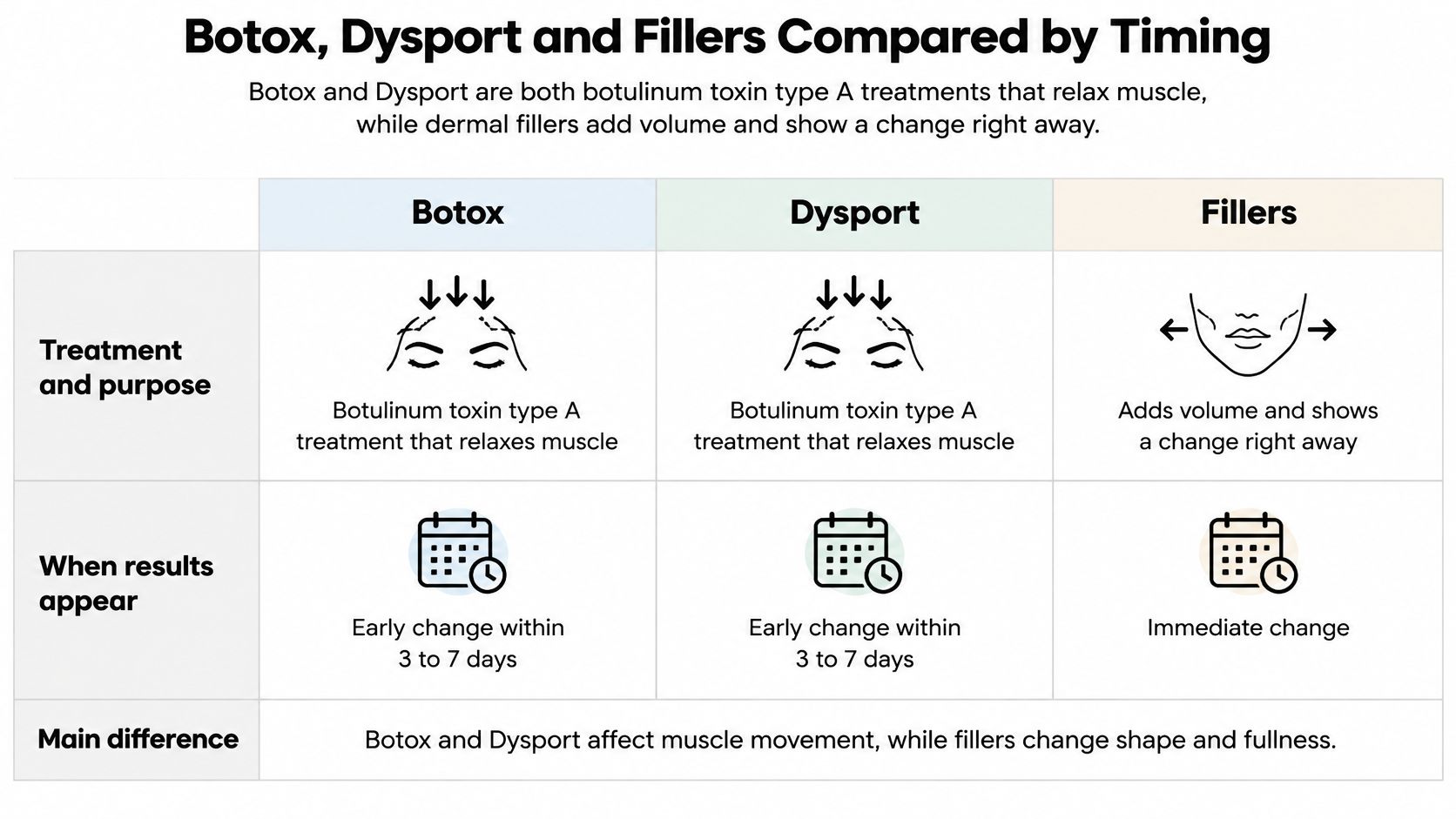
Botox, Dysport and Fillers Compared by Timing
Botox and Dysport relax targeted muscles; dermal fillers add volume. That distinction explains why a friend may see an immediate change after filler while you're still waiting for a toxin treatment to develop.
Botox contains onabotulinumtoxinA, while Dysport contains abobotulinumtoxinA. Both are botulinum toxin type A products, but their potency units aren't interchangeable, so an injector doesn't substitute them unit for unit.
Compare onset without promising a winner
A systematic review of aesthetic abobotulinumtoxinA treatment found a median onset of 2–3 days, with some studies recording effects within 24 hours. That's evidence that early change is possible, not a promise that every Dysport patient will see a next-day result.
For Botox, FDA clinical information describes biological effects beginning at 1–2 days, increasing during the first week, with glabellar-line improvement remaining superior to placebo for up to 120 days. These measurements describe different stages of response, so they shouldn't be treated as competing stopwatch results.
| Treatment | First Visible Change | Full Result | Typical Duration | Key Difference |
|---|---|---|---|---|
| Botox (onabotulinumtoxinA) | Early softening after biological activity begins | Assess once the cosmetic response has developed | Several months | Relaxes muscle; results build gradually |
| Dysport (abobotulinumtoxinA) | Median onset about 2–3 days in aesthetic studies | Assess after the early response has settled | Discuss the expected duration for your area and dose | Different potency units; not swapped unit for unit with Botox |
| Dermal fillers (hyaluronic acid) | Immediate volume change | Judge settled shape after swelling resolves | Determined by the filler product and treatment area | Adds volume; doesn't relax muscle |
For a more focused explanation of the Dysport response, our guide to how long Dysport takes to work separates early changes from the review decision.
Choose for the problem, not just the speed
Say your main concern is a crease that becomes prominent when you frown. A muscle-relaxing treatment may fit that concern better than adding volume, even though its result isn't immediate.
If your concern is lost fullness or contour, filler may be more relevant. An immediate volume change still shouldn't be mistaken for a fully settled result, because post-injection swelling can affect the appearance.
There isn't a universally fastest-and-best injectable. The clinician needs to match the treatment to the cause of the concern, your anatomy, and your goals. Don't choose a product solely because someone else noticed it sooner.
Your Aftercare Checklist for the First Two Weeks
Aftercare should make recovery and assessment straightforward, not turn the waiting period into a list of ways you might accidentally ruin your result. Follow your injector's written instructions, especially when they differ from general online advice.
Our Botox aftercare instructions provide a practical reference. Tell your injector about planned exercise, facial treatments, and any device you use directly against the treated skin.
Keep the routine simple
- Take baseline photographs. Use neutral lighting and capture your face both relaxed and making the expression being treated, so you have a meaningful comparison.
- Follow positioning instructions. If your injector gives you an upright period, follow that individual advice rather than applying a conflicting schedule from social media.
- Avoid rubbing or massaging the injection sites. Unnecessary pressure can irritate the area and is discouraged because of concern about affecting unintended muscles.
- Clarify exercise and heat restrictions. Ask when to resume strenuous workouts, saunas, hot tubs, and alcohol rather than assuming every practice uses the same protocol.
- Keep brief observation notes. Record meaningful changes, such as easier brow relaxation or reduced frown creasing, instead of repeatedly testing the muscles.
- Use sunscreen and postpone aggressive facial treatments. Confirm when facials, lasers, and pressure-based treatments can resume so you don't irritate recently treated skin.
- Leave dose decisions to the prescriber. Booking extra injections before an examination can complicate the assessment rather than solve the concern.
Prepare for the review
Bring your baseline photographs, comparison photographs, and short notes. Include the product name and describe whether your concern appears at rest, during movement, or both.
Consistency matters more than taking many pictures. Different lighting and camera angles can make an unchanged face look dramatically different, while a simple record helps your clinician identify a genuine treatment response.
Normal Slow Progress or a Problem to Report
Slow change in the first week often causes two mistakes. Some people request more product too soon. Others wait through a symptom that should be reported. Cleveland Clinic's Botox guidance notes that early changes often appear within the first week, while response varies with factors such as wrinkle severity and muscle strength, so the fuller result is best judged later in the timeline.
Patience applies to appearance. Safety applies to function. The two call for different responses.
Normal gradual progress
Movement can still be present while the treatment develops. That alone does not mean the dose was wrong.
Softening usually shows during expression first. A frown may crease less before the area looks different at rest. One side may also relax a little earlier than the other because muscles respond at slightly different rates.
A resting line can remain even when muscle activity has lessened. Keeping some expression may also be part of the plan discussed with the prescriber.
Arrange a clinician review
Use the roughly 14-day point as the time to judge the fuller effect. If the expected improvement has not developed by that review point, send clear photographs and arrange an examination.
Report persistent asymmetry with both a relaxed view and the expression that shows it. Report new eyelid or brow heaviness promptly, particularly when it is worsening rather than holding steady.
An adjustment is not automatic. The prescriber needs to review anatomy, placement, dose, and product before deciding what, if anything, should change.
At BotoxBarb, we are run by a board-certified nurse practitioner. An examination, rather than a self-selected repeat dose, is the appropriate basis for treatment decisions.
Seek urgent medical care
Seek emergency help immediately for breathing or swallowing difficulty.
Get urgent evaluation for double vision, generalized weakness, or symptoms spreading well beyond the treated area, especially with weakness or a change in function. Do not wait for a photo comparison when breathing, swallowing, vision, or strength is affected.
Our guide to recognizing Botox side effects explains the difference between common local reactions and symptoms that need prompt reporting. It does not replace urgent care. When doubt exists about a serious symptom, seek medical advice instead of booking another cosmetic treatment.
How Long Results Last and What to Do Next
For glabellar lines, the effect generally lasts 3–4 months, according to the FDA prescribing information for Botox Cosmetic, which also states that treatment more often than every 3 months has not been clinically evaluated. Plan maintenance around that judging point, not around the first day you notice movement returning.
The follow up assessment and the maintenance visit answer different questions. The assessment near day 14 checks whether the dose produced a balanced response. Maintenance later considers how that response is wearing off and when retreatment makes sense.
Rebook according to your response
Notice when your usual expressions begin returning, then discuss timing with your prescriber. Early movement in one area does not mean the full benefit has gone, and it does not automatically call for an immediate repeat treatment.
Keep a simple treatment record:
- Treatment details: Record the date, product, treated areas, and any dose information your clinician provides.
- Best-result photographs: Save comparable images that show the response you were happy with.
- Return of movement: Note which area starts moving more noticeably first.
- Treatment preferences: Write down whether you liked the amount of movement or wanted a different balance.
This record separates onset, satisfaction, and duration. You may have liked how quickly treatment started but want a softer or firmer result next time. Or you may have liked the result and need a schedule that fits your calendar.
Do not judge longevity only by whether you can force a strong expression in the mirror. How the area looks during ordinary conversation and at rest often matches your original goal more closely. Bring those observations to the maintenance discussion.
Support skin quality between appointments
Injectables relax selected muscles. Skin care supports surface texture, tone, and sun protection. The two work side by side, and one does not reproduce the action of the other.
A steady routine with gentle cleansing, moisturizer, and daily sunscreen helps maintain skin quality while Botox takes effect and while it gradually wears off. Consistency matters more than adding several new products at once.
LED facial masks are one type of home skin care device. They use light based treatment rather than muscle relaxation. A systematic review of light emitting diode phototherapy for skin aging in Aesthetic Plastic Surgery described home protocols lasting 3–21 minutes per session, performed 2–7 times weekly for 4–12 weeks, with reported improvements in concerns including wrinkles, texture, and elasticity.
Those study schedules are summaries of published protocols, not a prescription for every device. Follow the directions for the specific product you use, including eye safety guidance, and ask your clinician when it is appropriate to place a device over recently injected skin.
Honest limit: Skin care and light devices support an ongoing routine. They do not replace botulinum toxin, correct injection related asymmetry, or speed up Botox onset.
Make the next decision with a clear comparison
If you are still asking, “How many days after Botox do you see results,” because your own response seems incomplete, gather what you can document. Note the treated area, the expression, the change from baseline, and any symptoms. That record is more useful than comparing your face with an online before and after photograph.
A review is appropriate when the expected result has not developed by about day 14 or an imbalance remains. Seek medical attention sooner for concerning symptoms rather than waiting for the cosmetic result to settle.
At BotoxBarb, we offer Botox, Dysport, and Restylane by appointment, with individualized treatment decisions guided by a clinical assessment. If asymmetry or an incomplete result remains around day 14, book a review and bring your before-and-after photographs so we can evaluate the response and discuss appropriate next steps.