Layering Skin Care: Unlock Your Best AM & PM Routine
Staring at a bathroom counter crowded with bottles and jars can feel like you’re about to take a pop quiz. Which one goes first? Does it even matter? The answer is a resounding yes. Getting your skincare layering right isn't just some beauty guru rule—it’s the difference between wasting your money and getting the results you paid for.
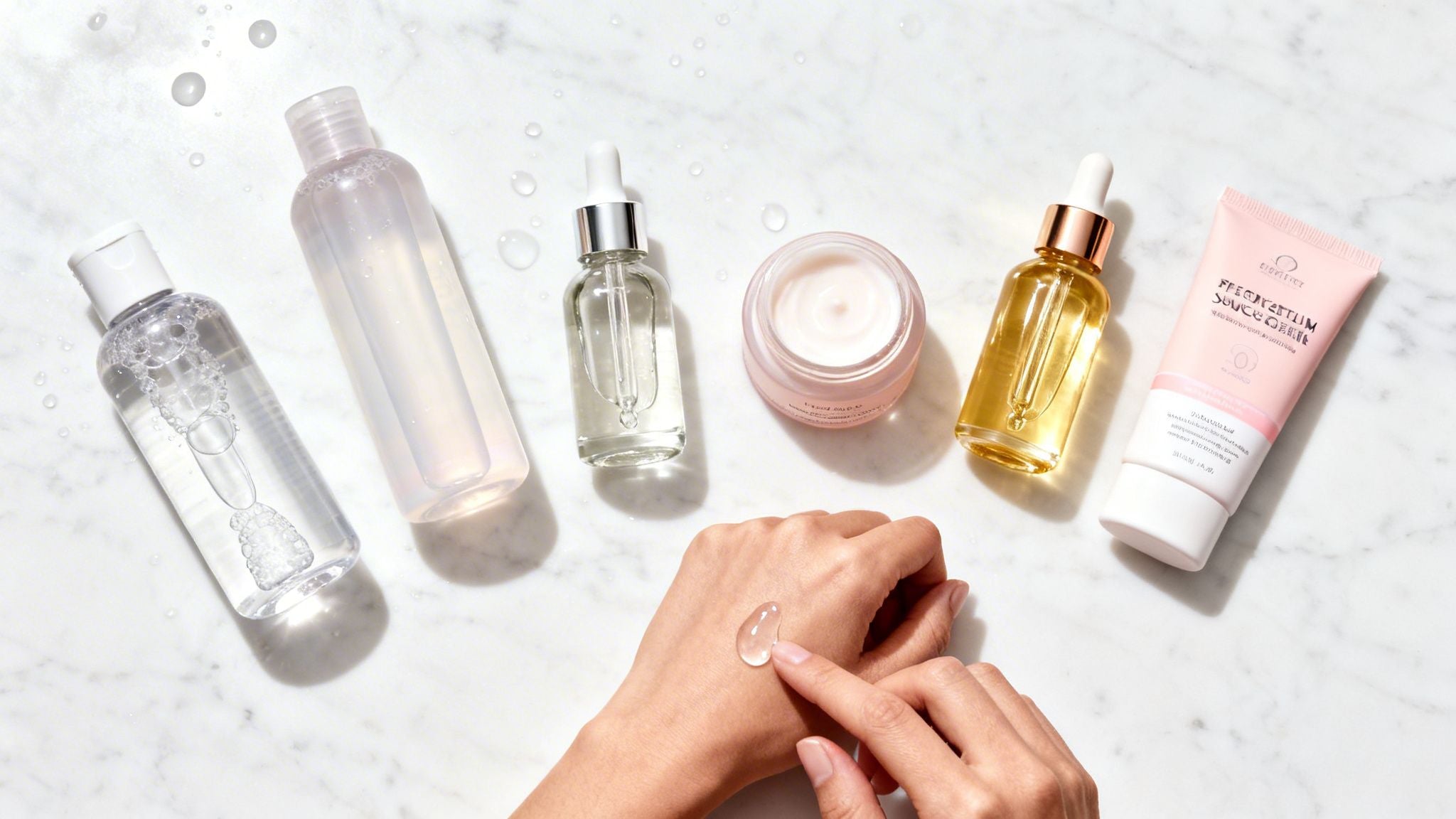
The secret is pretty simple: apply your products from the thinnest to thickest consistency.
The Foundation of Layering: Why Order Matters

Think of your skin's protective barrier as a very selective gatekeeper. It’s designed to keep things out, so you have to work with it, not against it.
When you start with lighter, water-based formulas like toners and serums, you’re giving those potent active ingredients a clear path to penetrate the skin. These are your workhorse products, targeting everything from fine lines to dark spots.
Following up with heavier creams and oils creates a seal. These thicker, more occlusive products lock in all the goodness from your serums and, just as importantly, prevent moisture from escaping. Applying them in the wrong order is like trying to water a plant by pouring water on top of a plastic sheet. It’s just not going to sink in.
Get the Most From Every Drop
Proper layering can dramatically boost how well your skin absorbs active ingredients. You’re ensuring your skin gets the full benefit of every drop by allowing thinner, water-based products to sink in before sealing them with heavier formulas.
To really nail the order, you need to understand the fundamental difference between face oil and serum. Knowing which is water-based and which is oil-based is the first step to unlocking your routine’s true potential.
From my clinical experience, getting the layering order right is the single most important step to unlocking the full potential of your products. It’s the difference between seeing mediocre results and achieving the radiant, healthy skin you’re investing in.
The Golden Rules of Layering
Beyond just "thinnest to thickest," a few other key principles will keep your routine on track.
- Water Before Oil: This is non-negotiable. Oil and water don't mix, and if you apply an oil-based product first, it creates a slick barrier that blocks any water-based formulas from getting through.
- Low pH Before High pH: If you’re using products with different pH levels, like an acidic Vitamin C serum and a more neutral moisturizer, apply the one with the lower pH first. This helps maintain its stability and effectiveness.
- Give It a Minute: Don't just slap one product on after another. Allowing each layer to absorb for about 30 to 60 seconds can prevent pilling (when products ball up on your skin) and gives each one time to start doing its job.
Your Morning Routine For All-Day Protection And Glow

Think of your morning routine as dressing your skin for the day. You wouldn't face a storm without a raincoat, so you shouldn't face environmental stressors like UV rays and pollution without a defensive shield. Proper layering skin care isn't about adding more steps; it’s about strategic protection that keeps your skin healthy and glowing from morning to night.
It all starts with a clean slate. A gentle cleanser washes away leftover products from your evening routine and any oil that built up overnight. This simple act preps your skin so the powerful actives you apply next can get to work without any barriers.
Build Your Daytime Shield
After cleansing comes your most important defensive player: a high-quality antioxidant serum. This is non-negotiable in my book. Antioxidants are your frontline defense against free radicals—those unstable molecules from sun exposure and city smog that break down collagen, leading to fine lines and dullness.
The gold standard here is a potent Vitamin C serum. It's a true multi-tasker that provides incredible antioxidant protection, brightens your overall complexion, and supports collagen synthesis for firmer skin. For a concentrated, medical-grade dose, our BARB N.P. Vitamin C Serum is formulated to fortify your skin’s defenses and deliver that sought-after glow.
Of course, there are other fantastic options trusted by skin professionals. Many of my colleagues and I often recommend the SkinCeuticals C E Ferulic serum, a product celebrated for its powerful, science-backed formula that dramatically boosts protection against environmental damage.
Next, you'll want to hydrate and protect the delicate eye area. A dedicated eye cream, gently tapped around the orbital bone with your ring finger, can help with puffiness and fine lines. Then, lock everything in with your moisturizer, applying it to your face and neck to seal in your serum and support your skin’s barrier.
AM Skincare Layering Order
To simplify the process, here is the exact order to follow for your morning routine. Think of it as a blueprint for building your skin’s daily armor, moving from the thinnest to the thickest textures.
| Step | Product Type | Primary Goal |
|---|---|---|
| 1 | Gentle Cleanser | Create a clean canvas for active ingredients. |
| 2 | Antioxidant Serum (Vitamin C) | Neutralize free radicals and brighten skin. |
| 3 | Eye Cream | Hydrate and protect the delicate eye area. |
| 4 | Moisturizer | Lock in hydration and support the skin barrier. |
| 5 | Broad-Spectrum Sunscreen | Protect against UV damage and prevent aging. |
Following these steps ensures each product can do its job effectively without being blocked by a heavier formula applied too soon.
The Non-Negotiable Final Layer
The final, and most critical, step in your morning layering skin care routine is sunscreen. A broad-spectrum SPF of 30 or higher is the security guard for all the hard work you just put in. It's an absolute must, every single day, rain or shine.
Consider this staggering fact: UV exposure is responsible for up to 80% of the visible signs of skin aging. Without sunscreen, even the best antioxidant serum is fighting a losing battle. It is, without a doubt, the single most effective anti-aging product you will ever use.
To see how these steps fit into a complete regimen, you can check out our full guide to a morning skincare routine for more detailed steps. Just remember to always make sunscreen the very last product you apply before your makeup.
Your Evening Routine For Overnight Repair And Rejuvenation
While you sleep, your skin gets to work. This is its dedicated time for repair, and your evening skincare routine is your chance to give it the high-performance tools it needs to regenerate. This is where you can deploy powerful treatments and deeply nourishing ingredients to tackle your biggest concerns and wake up to a healthier, visibly refreshed complexion.
It all starts with a non-negotiable step: the double cleanse. At night, a single wash just won't cut it. Your first, oil-based cleanse is for melting away the day—makeup, sunscreen, and pollution. Your second, water-based cleanse removes any lingering impurities, leaving you with a perfectly prepped canvas.
The Repair And Treat Phase
With your skin clean and patted dry, it's time for the heavy hitters. This is where your treatment serums come in—think potent formulas with active ingredients like retinoids, peptides, or alpha hydroxy acids (AHAs). These are the ingredients that do the real work overnight, accelerating cell turnover, stimulating collagen, and refining skin texture while you rest.
So, how do you choose your focus for the night? Simple. You listen to what your skin is telling you.

This little decision tree is my go-to for clients. Is your skin feeling parched and looking dull? Focus on repair and hydration. Are you dealing with breakouts or uneven texture? Shift into treat mode.
For instance, if anti-aging is your primary goal, a retinol serum is an absolute game-changer. But using it correctly is critical to avoid the irritation that makes so many people give up. We walk you through how to start safely in our guide to retinol serum side effects.
Supercharge Your Serums With LED Therapy
Want to get the absolute most from your serums? Add an at-home LED therapy session. Light-emitting diode (LED) masks use specific, clinically-proven wavelengths of light to penetrate the skin, boosting cellular activity and dramatically enhancing the effects of the products you just applied.
This is the perfect moment for the BARB N.P. Facial Mask. After applying your serums, you can slip on this comfortable, wireless mask and let it amplify your results while you relax, read, or move around freely.
This isn't about adding another complicated step. The BARB N.P. mask is about working smarter. It gives you three clinically-inspired light settings so you can customize your treatment every single night based on what your skin needs at that moment.
The mask's settings are targeted and effective:
- Red Light: My favorite for stimulating collagen, calming inflammation, and softening the appearance of fine lines and wrinkles.
- Blue Light: A must-have for breakout-prone skin. This wavelength targets and neutralizes acne-causing bacteria.
- Yellow Light: The perfect choice for calming redness, boosting circulation, and promoting lymphatic drainage to wake up less puffy and more radiant.
Using the mask for just 10-15 minutes after your serums helps drive those active ingredients deeper into the skin, making your entire routine more efficient. It’s a small time investment for a major return.
Finally, always—and I mean always—lock everything in with a nourishing moisturizer. This final step creates a protective barrier that prevents overnight water loss and seals in all the powerful ingredients you just applied, letting them work their magic undisturbed. This strategic approach to layering skin care is how you wake up to real, visible improvement.
Navigating Active Ingredients In Your Routine

This is where your routine graduates from basic maintenance to actively transforming your skin. When you start bringing in the heavy hitters—like retinoids and exfoliating acids—your layering skin care strategy becomes more complex, but the results are absolutely worth it.
Let's clear up the confusion, because I see it all the time in the clinic. Knowing which ingredients play well together and which ones need their own space is the key to unlocking their full potential without causing a mess of irritation.
Understanding ingredient synergy can give your routine a serious boost. For instance, a classic power trio I recommend is Vitamin C, Vitamin E, and Ferulic Acid. When layered together in the morning, they create an antioxidant powerhouse. The Vitamin E and Ferulic Acid actually stabilize the notoriously fussy Vitamin C, amplifying its protective benefits against daily environmental damage.
Building A Safe And Effective Routine
The number one rule I give my clients is to avoid overwhelming your skin. Certain combinations, if not handled with care, can lead to redness, sensitivity, and a compromised skin barrier.
A perfect example is layering a retinoid right after a strong AHA or BHA exfoliant in the same routine. Both are incredible ingredients, but using them together is a fast-track ticket to irritation.
Instead, a much smarter approach is to alternate them. Try using your exfoliating acid on one night and your retinoid on the next. This "skin cycling" method has become incredibly popular for a reason—it works. It gives your skin time to recover while still reaping the benefits of both ingredients. For an even more detailed breakdown, you can learn more about how to layer serums to maximize their impact safely.
Proper sequencing isn’t just a trend; it's a science-backed necessity. In my practice, I’ve seen that the right order can increase a product's efficacy by 40-80%. The thinnest-to-thickest rule is critical because applying an oil-based product first can block water-based actives by 30-40%. You're essentially wasting your best products if you get the order wrong.
To help you build a routine that delivers results without the drama, I’ve put together a quick guide on the most common active pairings I discuss with my clients.
Active Ingredient Pairing Guide
This quick-reference chart shows which active ingredients work beautifully together and which ones are better kept apart to avoid irritation.
| Ingredient 1 | Ingredient 2 | Pairing Recommendation |
|---|---|---|
| Vitamin C | Vitamin E & Ferulic Acid | Synergistic: Layer together in the AM for amplified antioxidant protection. |
| Retinoids | Hyaluronic Acid | Synergistic: Apply hyaluronic acid after your retinoid to hydrate and soothe. |
| Retinoids | Niacinamide | Synergistic: Niacinamide can help calm potential retinoid irritation. |
| Retinoids | AHA/BHA Acids | Use with Caution: Best used on alternate nights to avoid over-exfoliation. |
| Vitamin C | Retinoids | Use with Caution: Best to use Vitamin C in the AM and retinoids in the PM. |
By following these simple guidelines, you can build a powerful, safe routine that prevents sensitivity and ensures you get every bit of benefit from your chosen ingredients.
Common Layering Issues & How to Fix Them
You’ve done everything right—you’ve researched your ingredients, followed the thinnest-to-thickest rule, and then… it happens. Those annoying little balls of product start forming on your skin as you apply your moisturizer.
This is product pilling, and it’s one of the most common complaints I hear in the clinic. It’s frustrating, but don’t throw your products out just yet. Pilling is completely fixable.
Solving Product Pilling
Think of pilling as a tiny traffic jam on your face. It usually means you’re either applying products too quickly, using a little too much, or layering ingredients that just don't get along.
First, try the simplest fix: use less product. A pea-sized amount is often plenty. Then, give each layer a moment to sink in—about 60 seconds is usually enough. If the pilling stops, you've found your culprit.
If that doesn’t work, it's time to play detective with your ingredient lists. Products heavy in silicones (look for ingredients ending in "-cone," "-conol," or "-siloxane") are often the cause, especially when layered over each other.
Pro Tip from the Clinic: Instead of rubbing products in, gently pat or press them onto your skin. Rubbing creates friction that encourages pilling, while pressing helps the product absorb more effectively and keeps everything smooth.
Still struggling? It might be time for a reset. Pare your routine back to a simple cleanse, treat, and moisturize for a few days. Then, reintroduce your other products one by one until you find the one causing the issue.
Managing Redness and Breakouts
What if the problem isn’t pilling, but sudden redness, sensitivity, or breakouts? This is a clear signal from your skin that it’s feeling overwhelmed. It's often not a layering mistake, but a sign of too many active ingredients at once or a reaction to a specific new product.
When your skin is red and angry, the best thing you can do is pull back. Go on a "skin diet" for a few days: stick to a gentle cleanser, a soothing, basic moisturizer, and of course, your daily SPF.
This is also the perfect time to bring in some backup to actively calm things down. An at-home LED therapy session can be a game-changer for resetting irritated skin.
I designed the BARB N.P. Facial Mask for exactly these situations. It’s wireless and comfortable, so you can actually relax while you use it. The red light setting is my go-to for reducing inflammation and calming that angry redness, while the yellow light setting is fantastic for soothing sensitivity. Once your skin feels balanced again, you can slowly and carefully reintroduce your other products, ensuring your routine is truly working for you.
Common Questions About Layering Skin Care
Once you’ve got the basics down, a few common questions always pop up in my clinic. Let's tackle those practical details that can make or break your routine, because getting them right is what elevates good skincare to great skincare.
How Long Should I Wait Between Skincare Layers?
Forget the stopwatch. The real trick is to wait until a product is no longer tacky to the touch. This usually takes about 30 to 60 seconds and gives each formula a moment to properly settle into the skin before the next one goes on.
When you're working with powerful actives—like a medical-grade retinoid or an exfoliating acid—giving it an extra minute or two is a smart move. That brief pause allows the active ingredient to penetrate fully, which goes a long way in preventing irritation when you apply your next product.
Can I Layer Too Many Products?
Absolutely, and it happens more often than you'd think. I see clients all the time who are frustrated by a dozen-step routine that isn't delivering. Over-layering can actually work against you.
When you bombard your skin with too much, you can run into issues like:
- Pilling: Those little balls of product that roll up on your skin instead of absorbing.
- Reduced Absorption: Your skin has a saturation point. After a few layers, you're likely just wasting expensive serums.
- Irritation: Overwhelming your skin’s barrier is a fast track to redness, sensitivity, and breakouts.
A well-curated routine with a few high-performance products will always outperform a lengthy, complicated one. Focus on the essentials. You’ll get better results with a lower risk of overwhelming your skin.
Where Do Face Oils Fit Into A Layering Routine?
Face oils are your grand finale—almost always the very last step in your evening routine, applied right after your moisturizer. Oils are occlusive, meaning they create a beautiful seal over the skin.
This seal is incredible for locking in moisture and all the serums and creams you applied beforehand. But if you apply an oil too early, that same barrier will block your water-based products from ever reaching your skin, making them useless.
The only exception? Your morning routine. Sunscreen is the non-negotiable final step. No matter what, your broad-spectrum SPF is always the absolute last product you put on before any makeup.
To simplify your routine with effective, medical-grade products designed to work together, explore the curated collection at BotoxBarb. You can find powerful essentials to build your perfect regimen at https://barbnp.shop.