A Proven Skincare Routine for Redness to Calm Your Skin
A solid skincare routine for redness is all about three things: gentle cleansing, soothing hydration, and unwavering sun protection. The entire goal is to calm down inflammation and rebuild your skin's protective barrier with gentle giants like niacinamide and ceramides, all while steering clear of known triggers.
Why Your Skin Stays Red and What It’s Trying to Tell You
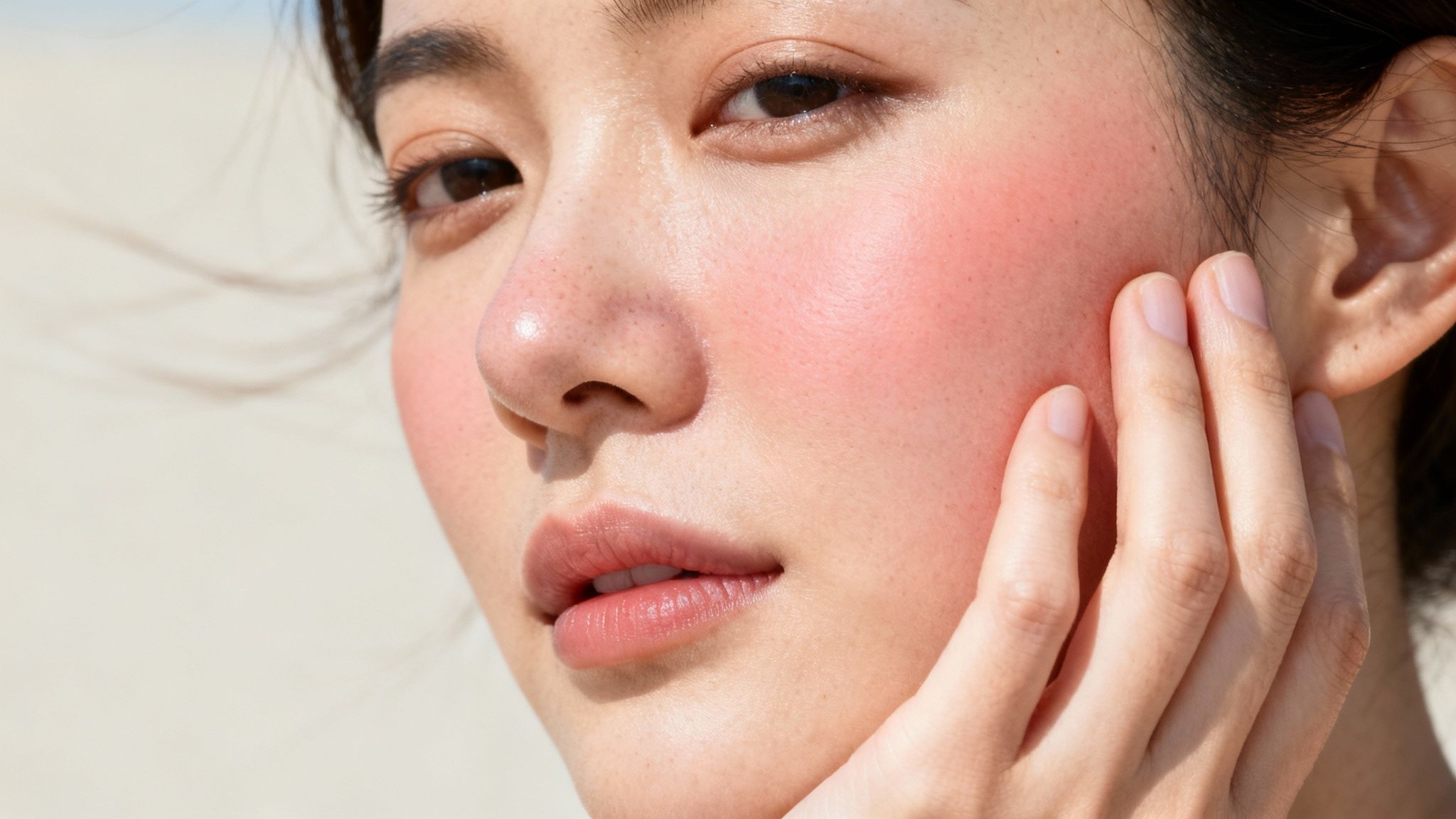
Before you start layering products, it’s incredibly important to figure out why your skin is sending out these red signals in the first place. Think of persistent redness as your skin’s check-engine light—it’s a clear message that something is out of balance, not just a surface-level annoyance.
More often than not, the primary culprit is a compromised skin barrier. This is your skin's frontline defense, and when it gets weakened, tiny cracks form. These cracks let moisture escape (hello, dehydration!) and irritants sneak in, sparking the inflammation you see as redness and sensitivity.
Identifying the Root Causes
Getting to the "why" behind your flush is the single most important step toward finding real, lasting relief. Redness isn't a one-size-fits-all problem; it comes from a whole host of sources that are unique to you. Pinpointing your personal triggers is the only way to build a routine that will actually make a difference.
Common sources of facial redness usually fall into a few categories:
- Underlying Conditions: Things like rosacea are a major contributor to that constant flush and the visible blood vessels that come with it.
- Environmental Factors: Sun exposure is a big one, but so are harsh winds and extreme temperatures. They can all set off an inflammatory response in sensitive skin.
- Lifestyle Triggers: Stress, what you eat (especially spicy foods and alcohol), and even super hot showers can cause temporary or prolonged flushing.
- Product Irritation: Using skincare loaded with harsh ingredients like fragrances, drying alcohols, or aggressive exfoliants can strip your skin and provoke a reaction.
The reality is, facial redness is incredibly common. It affects a staggering 16 million Americans alone, and women over 30 are three times more likely to experience it. This isn't just a local issue—up to 10% of the population in major markets like the US and Europe deals with this concern.
Your First Step Toward Calm Skin
Connecting the dots between your daily habits and the inflammation you see in the mirror is so empowering. It shifts you from just reacting to flare-ups to proactively managing your skin's health. Once you pinpoint what makes your skin unhappy, you can finally build a targeted and effective skincare routine for redness.
This foundational knowledge keeps you from wasting time and money on products that aren't right for your specific needs. Instead of chasing a temporary fix, you can focus on a strategy that provides genuine, long-term calm. To dive deeper, you can start by learning how to reduce redness on your face in our detailed guide.
Building Your Morning Routine to Protect and Soothe
Think of your morning skincare routine as your personal shield, prepping your skin to handle whatever the day throws at it. When you're managing redness, a smart morning plan is everything—it’s all about calming inflammation from the get-go and protecting that delicate skin barrier. The key isn't a 12-step routine; it's consistency with gentle, effective products.
It all starts with your first touchpoint: a gentle, pH-balanced cleanser. I see so many clients accidentally make their redness worse with harsh, stripping formulas that wreck their skin's natural defenses. You want to reach for a creamy or milky cleanser that washes away impurities without stealing essential moisture. Your skin should feel comfortable and calm, never tight.
The Art of Layering for Calmness
Once your skin is clean, we shift focus to layering products that soothe and strengthen. An alcohol-free calming toner is a great way to rehydrate the skin before you move on.
Next up, a targeted serum with niacinamide (Vitamin B3) is a game-changer for anyone dealing with redness. It’s a true multitasking powerhouse, known for its incredible ability to reduce inflammation, reinforce the skin barrier, and even improve overall skin texture. It's a non-negotiable in my book.
After your serum, it's time for a moisturizer. Look for formulas packed with ceramides and hyaluronic acid to lock in that much-needed hydration and support your barrier function.
A strong, healthy skin barrier is less permeable, meaning it's better at keeping moisture in and irritants out. This simple function is the foundation of any effective skincare routine for redness.
If your barrier needs a significant boost, I often recommend a specialized product like the BARB N.P. Epicutis Lipid Serum. Its formulation is specifically designed to replenish the lipids your skin is missing, making it fantastic for reducing reactivity and persistent flushing. For more ideas on gentle ingredients, this guide to natural skincare for sensitive skin offers some great insights into calming easily irritated complexions.
Your Most Critical Protective Step
Finally, we've arrived at the single most important step in your morning routine for redness: sunscreen. Sun exposure is one of the most common triggers I see for redness and rosacea flare-ups. UV radiation kicks up inflammation, completely undermining all the hard work you've put into calming your skin.
You absolutely need a mineral-based, broad-spectrum sunscreen with an SPF of 30 or higher. Mineral formulas, which use zinc oxide and titanium dioxide, are almost always better tolerated by sensitive skin than their chemical counterparts. They work by sitting on top of the skin to physically block UV rays, rather than causing a chemical reaction.
Think of it as your daily insurance policy against sun-induced flare-ups. You can dive deeper into finding the best sunscreen for sensitive skin in our comprehensive guide here.
Mastering Your Evening Routine for Repair and Recovery
While your morning routine is all about playing defense, your evening skincare routine for redness is where the real magic happens. This is your skin’s dedicated time for repair. As you sleep, your skin’s natural regeneration processes kick into high gear, making it the perfect window to calm inflammation and rebuild a compromised barrier.
It all starts with getting the day off your face—gently. A double-cleanse is non-negotiable here. The goal is to melt away makeup, sunscreen, and city grime without any harsh rubbing or stripping your skin. I always recommend starting with a soft balm or oil cleanser to dissolve everything, followed by a mild, creamy wash to leave your skin feeling clean, not tight.
Supercharging Your Skin's Recovery
Once you have a clean slate, it's time to bring in the targeted treatments designed for calming and repair. An evening serum is your workhorse. Look for something with azelaic acid, a true hero ingredient for dialing down redness, smoothing bumps, and offering a gentle exfoliation that won't trigger irritation like other acids can.
If you really want to level up your skin’s recovery, I often suggest adding an at-home LED therapy session a few times a week. It’s a completely non-invasive way to accelerate your progress and give your skin the support it needs to heal.
When your skin is in a constant state of inflammation, it needs more than just topical products. It needs dedicated time to heal. An evening routine focused on calming ingredients and restorative therapies provides the ideal setting for this crucial recovery work.
A fantastic, easy-to-use option is the Barb N.P. LED Facial Mask. What I love most about it is the freedom it gives you—it’s completely wireless, so you can read, relax, or walk around during your session. Its comfortable design sits gently on your face, making it easy to incorporate into your routine. It also features three distinct light settings for different treatments, and for redness, the yellow light is particularly amazing for promoting cellular repair and calming the skin down.
Locking In The Goodness
After your serums and any light therapy, the final and most critical step is sealing everything in with a rich, restorative moisturizer. Your night cream should be heavier than your daytime one. Its job is to create a protective blanket that prevents moisture loss overnight while delivering a steady dose of healing ingredients.
I always tell my clients to look for formulas loaded with ceramides—these are the natural lipids that make up over 50% of your skin's barrier. When you replenish them, you’re directly strengthening your skin's defenses and making it less reactive over time. A good ceramide cream ensures you wake up with skin that feels calmer, looks less red, and is far better equipped to handle the day ahead.
To make sure you're getting the most out of your products, it helps to understand when to use key ingredients.
Choosing Your Key Ingredients for Morning vs Evening
This quick-reference table will help you decide which ingredients work best in your AM routine versus your PM routine to tackle redness from all angles.
| Ingredient | Best for AM or PM? | Primary Benefit for Redness |
|---|---|---|
| Vitamin C | AM | Antioxidant shield, protects from environmental triggers. |
| Niacinamide | AM or PM | Calms inflammation, strengthens the skin barrier. |
| Azelaic Acid | PM | Reduces redness and bumps, gentle exfoliation. |
| Ceramides | PM | Rebuilds and repairs the skin barrier overnight. |
| SPF (Zinc Oxide) | AM Only | Essential protection from UV rays, a major redness trigger. |
Using the right ingredients at the right time is crucial. Your AM routine should focus on protection, while your PM routine is all about that deep, restorative repair work.
This simple, three-step morning routine is the perfect complement to your evening repair session.
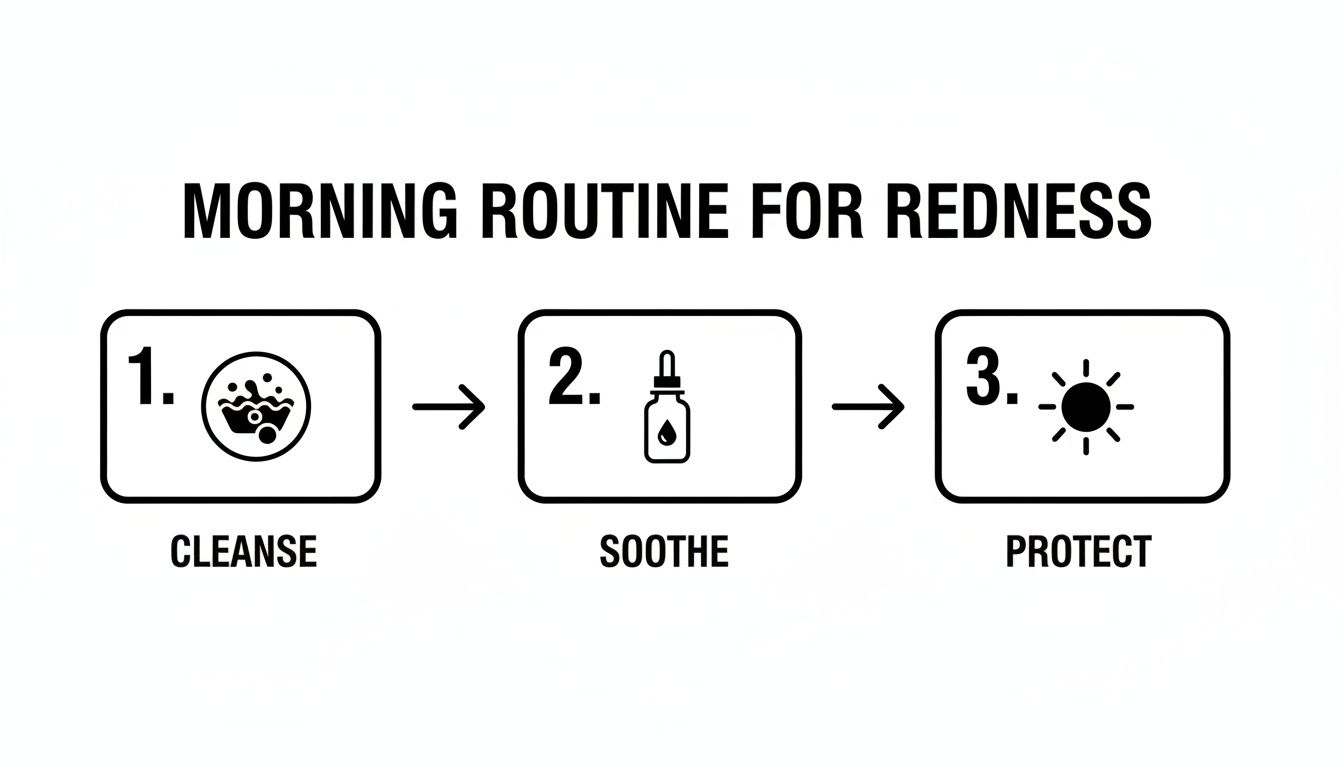
Think of it this way: the morning is for shielding your skin, and the evening is for healing it. By following the core principles of a gentle cleanse, soothing treatments, and non-negotiable sun protection, you create a 24-hour cycle of care that keeps flare-ups at bay.
The Best and Worst Ingredients for Redness-Prone Skin
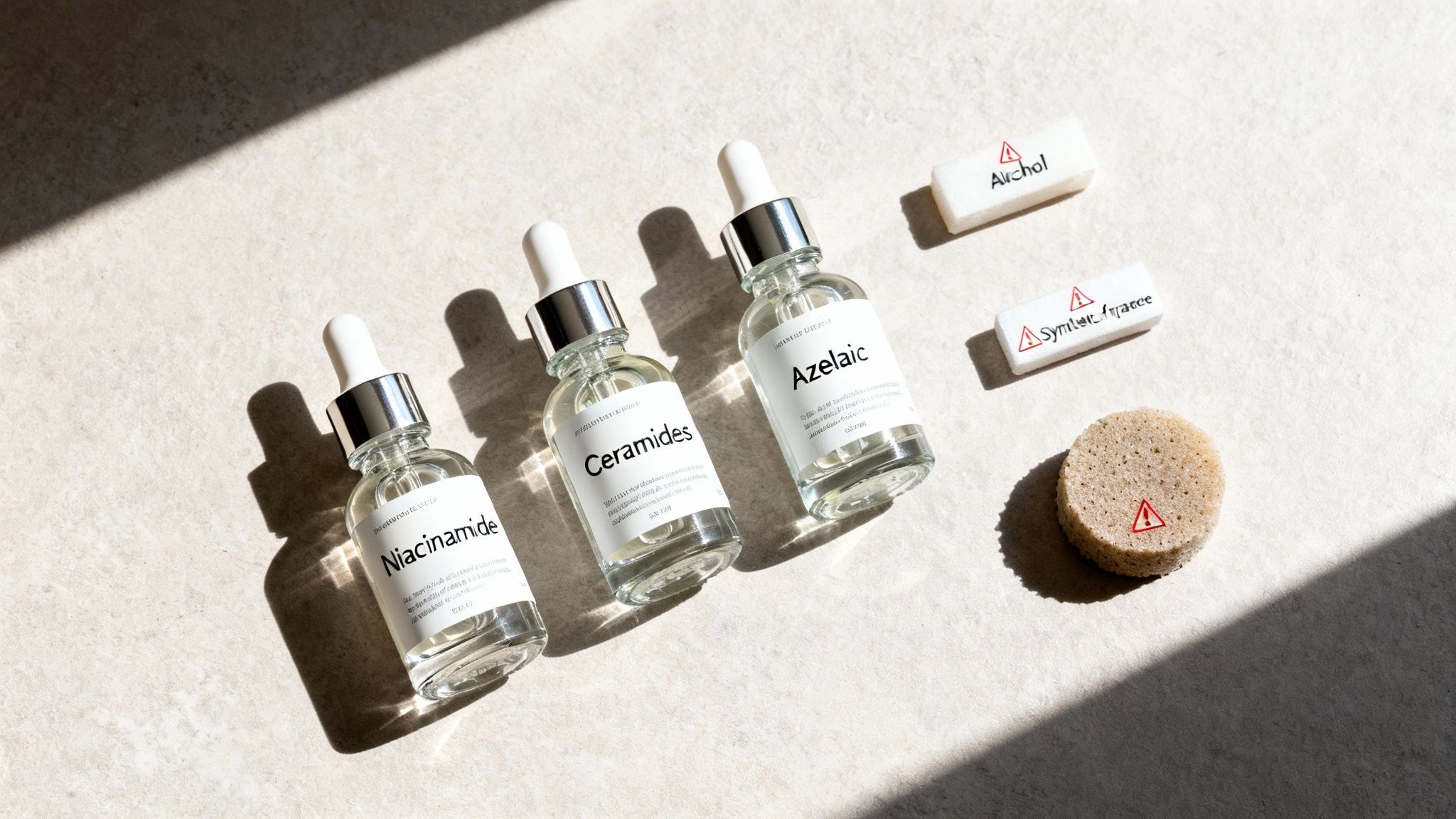
Walking down the skincare aisle when your skin is angry and reactive can feel like navigating a minefield. One wrong ingredient can send your complexion into a total tailspin, undoing weeks of careful work.
Let’s cut through the noise. This is your cheat sheet for reading labels with confidence, helping you build a skincare routine for redness that actually heals and calms your skin, rather than just irritating it further.
The secret is to focus on ingredients that do two things exceptionally well: soothe inflammation and rebuild your skin's protective barrier. When you prioritize these hero ingredients, you’re laying the foundation for skin that’s consistently calm and resilient.
Ingredients to Embrace
Think of these ingredients as your skin's personal support system. They work to fix the root causes of redness—like a weak barrier and chronic inflammation—instead of just putting a bandage on the symptoms.
Here are the top performers you should be looking for:
- Niacinamide (Vitamin B3): A true superstar for angry skin. It's clinically shown to strengthen the skin barrier, dial down inflammation, and improve texture, all without causing irritation.
- Ceramides: These are literally the mortar holding your skin cells together. Adding them back into your routine helps patch up the cracks in a compromised barrier, which locks moisture in and keeps irritants out.
- Azelaic Acid: This is a powerhouse for calming the specific redness and bumps that come with rosacea. It’s a gentle acid that reduces inflammation and has mild exfoliating properties, making it incredibly well-tolerated.
- Hyaluronic Acid: While it doesn't directly fight redness, its ability to pull moisture into the skin is crucial. Hydrated skin means a healthier, happier barrier function.
Diving deeper into understanding ingredients like peptides can also be a game-changer; these tiny protein fragments signal your skin to repair itself and produce more collagen. For more specific recommendations, our guide to the best rosacea skincare products offers a curated list of trusted formulas.
Ingredients to Avoid
Just as important as what you put on your skin is what you don’t. Some ingredients are notorious for stripping the skin's natural oils, triggering irritation, and making redness flare up with a vengeance.
Think of your skin like a delicate silk blouse. You wouldn't throw harsh bleach on it, right? The same goes for your skin barrier. The goal is always to nurture, not attack.
Keep an eye out for these common culprits on ingredient labels:
- Drying Alcohols (SD Alcohol, Denatured Alcohol): Often lurking in toners and acne spot treatments, these are extremely dehydrating and can completely wreck your skin barrier.
- Synthetic Fragrances: That little word "fragrance" or "parfum" on a label can hide a cocktail of hundreds of potential irritants. It's one of the most common triggers for flare-ups.
- Harsh Physical Scrubs: Abrasive scrubs with jagged particles (think crushed walnut shells) create micro-tears in the skin. This is an open invitation for inflammation.
- Essential Oils: While they sound natural and lovely, many essential oils—especially peppermint, citrus, and lavender—can be highly irritating for reactive skin.
The demand for gentle, effective skincare is exploding. The global market is projected to hit $192.8 billion by 2026, and moisturizers—a cornerstone of any redness-reducing routine—claim a massive 35% of that. With 5-10% of people worldwide dealing with chronic redness, this shift toward barrier-supportive products isn't just a trend; it's a necessity.
Beyond the Bottle: Lifestyle Habits and Pro-Level Support
A truly calm complexion isn't just about what you put on your skin—it's about how you live in it. Your daily routine is ground zero for redness flare-ups.
Think of it this way: your skincare is working hard to soothe and repair, but certain habits can unknowingly sabotage its efforts. Simple things, like the temperature of your shower, can make a huge difference. Steaming hot water feels great, but it strips your skin's protective oils and causes an immediate, angry flush. Always, always stick to lukewarm water.
Become Your Own Skin Detective
What makes one person's skin flare might be totally fine for someone else. The single most empowering thing you can do is learn your personal triggers. Start paying attention to when your redness spikes.
Does it happen right after:
- Certain Foods? Spicy dishes, red wine, and even hot coffee are notorious culprits that cause blood vessels to dilate and create that tell-tale flush.
- A Tough Workout? That post-spin glow can quickly turn into a lasting flush from increased blood flow and body heat.
- A Stressful Day? High cortisol levels from stress are directly linked to inflammation, and your skin is often the first place it shows up.
Keeping a simple journal for a few weeks can be a game-changer, revealing patterns you never would have connected. Once you know your triggers, you can make smart adjustments—maybe swapping that HIIT class for a lower-impact one or saving the spicy margarita for a special occasion.
When to Bring in the Experts
There comes a point when even the most diligent at-home routine and lifestyle tweaks aren't enough. That's not a failure—it's a sign that it's time to call in professional backup from an aesthetic provider like Barb N.P.
Professional treatments work on a deeper level than topicals can ever reach. Clinical-grade LED Light Therapy, for instance, uses specific wavelengths of light to calm inflammation at the cellular level. For more persistent issues, treatments like Platelet-Rich Plasma (PRP) can help rebuild your skin’s resilience from the inside out.
A great at-home routine is your foundation. Professional treatments are the reinforcements that target the root cause. Together, they create a level of calm that’s tough to achieve alone.
To bridge the gap between your daily products and in-office procedures, consider adding the Barb N.P. LED Facial Mask to your routine. It’s an amazing tool for giving your skin that extra professional-level support from home.
The mask is wireless and designed for total comfort, so you can easily pop it on while winding down. It features 3 lighting settings, with the yellow light being especially fantastic for reducing redness and promoting healing. It’s the perfect way to supercharge your results and maintain that post-facial calm.
Questions I Get All The Time About Calming Redness
Starting a new skincare routine for redness always comes with a few questions. Trust me, I hear them all the time. Knowing what to expect and how to handle the little bumps in the road is the difference between giving up and finally seeing calm, happy skin.
Let’s clear up a few of the most common ones.
The biggest question is always about timing: "How long until I actually see a difference?" While calming ingredients can give you a bit of that ahhh feeling right away, real change takes commitment. You might notice your skin feels less tight or reactive within a week or two, which is a great start.
But for the powerhouse ingredients like niacinamide or azelaic acid to visibly reduce that persistent redness and strengthen your skin barrier, you need to give it at least 4 to 8 weeks. My best tip? Take a picture in the same spot, with the same lighting, once a week. You'll be amazed at the subtle progress you might otherwise miss.
What About Advanced Steps Like Exfoliation?
Another thing I’m often asked is whether you can still exfoliate with red, sensitive skin. The answer is yes, but you have to be smart about it. Harsh, grainy scrubs and aggressive acids like glycolic are almost always a hard no for reactive skin—they just create more irritation.
Instead, look for ultra-gentle chemical exfoliants, like lactic acid or PHAs (polyhydroxy acids). Their molecules are larger, so they work on the surface without diving too deep and causing a meltdown. Start slowly—once a week is plenty—and always, always patch-test first. Listen to what your skin is telling you.
If your redness is stubborn, getting worse, or comes with stinging, burning, or little bumps, that's your cue to see a professional. An at-home routine is your foundation, but an aesthetic provider can properly diagnose the underlying issue and give you the next-level support you need.
Can I Add At-Home Devices to My Routine?
A lot of people are curious about adding at-home tech to the mix, asking, "Is it safe to use the Barb N.P. LED Facial Mask every day?" This mask was specifically designed for safe and regular at-home use. To tackle redness, I recommend using the yellow light setting for 10-15 minutes, about 3 to 5 times per week. That’s the sweet spot.
Because it's a completely non-invasive, UV-free treatment, it plays beautifully with your topical serums and creams. The best part is how easy it is to stick with—it’s wireless and designed for comfort, so you can pop it on while you’re winding down for the evening. Just follow the instructions and pay attention to how your skin responds to find the perfect frequency for you.
At BotoxBarb, we believe in a holistic approach to calm, healthy skin, combining effective at-home care with expert professional guidance. Explore our curated selection of medical-grade skincare and advanced at-home devices today at https://barbnp.shop.