Article: Alternatives to Nutrafol: What Really Works
Alternatives to Nutrafol: What Really Works
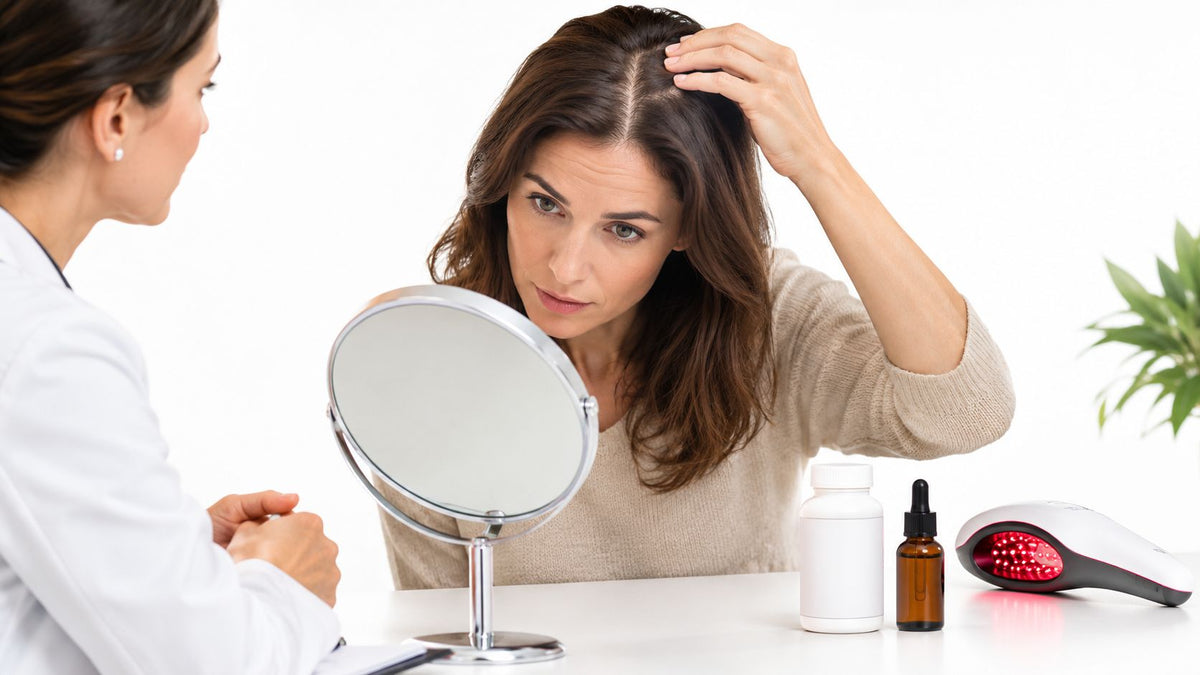
A client in her mid-thirties sits across from me, turning her phone toward the light so I can see the widening part in her photos. She's been taking Nutrafol for months, has spent hundreds of dollars, and still sees more scalp than she'd like. She's frustrated by the subscription, the daily pills, and the slow progress, but the worry underneath is more important: what if a supplement isn't treating the reason her hair is thinning?
Nutrafol may suit some people, but it isn't a diagnosis or a universal treatment. The best alternatives to Nutrafol depend on whether the change is pattern hair loss, temporary shedding, a deficiency, or a scalp or health condition. The comparison below is a starting point. It isn't a substitute for figuring out the cause.
| Situation | Options to discuss | Main trade-off |
|---|---|---|
| Gradual pattern thinning | Topical minoxidil; prescription options for appropriate patients | Treatment needs consistency, and suitability varies by diagnosis and sex |
| Sudden diffuse shedding | Identify triggers and check for an underlying cause before adding supplements | A new supplement may not address the trigger |
| Confirmed nutrient deficiency | Replace the nutrient under clinician guidance | Taking nutrients without a reason can add risk without solving the problem |
| Skin concerns alongside hair thinning | LED facial mask as a skincare adjunct | It doesn't treat hair loss |
Why People Start Searching for Nutrafol Alternatives
In a consultation, the first question often isn't which supplement to buy next. It's what the person expected Nutrafol to change, how long they've used it, and whether anyone has assessed the pattern of their hair loss. A widening part after months of supplements can feel like proof that nothing works, but it may instead mean the treatment doesn't match the cause.
The practical frustrations are real. A monthly subscription can become a recurring expense, a multi-pill routine can be hard to maintain, and mixed reviews make it difficult to know what's reasonable to expect. Hair changes slowly, so people may be paying for a product while trying to judge progress by memory, daily shedding, or a single bathroom mirror.
A useful question: What diagnosis is this product meant to address?
Nutrafol is a reasonable option for some people who want an oral supplement and understand its limits. But supplements can't be assumed to reverse genetic pattern loss, correct a thyroid problem, or treat an inflammatory scalp condition. If the underlying issue isn't identified, adding another formula can prolong the search without changing the treatment plan.
A cause-first comparison is more useful than a product ranking
I'd rather help someone identify the pattern, review health and medication history, and decide whether testing or a scalp examination is appropriate than compare supplement labels in isolation. The best next step might be a topical treatment, a prescription, targeted nutrient replacement, or no new product until a clinician has investigated the shedding.
This guide looks at treatments and supplements by the likely cause, while also distinguishing options that are clinically studied from those with more limited or variable evidence. It covers scalp treatments, oral options, and an LED device for a separate skincare concern. The aim is practical: to help you arrive at a clinical conversation with a clearer idea of what to ask, not to promise that one product will work for everyone.
The Causes of Hair Thinning You Need to Identify First
Hair thinning is a symptom, not one condition with one remedy. A clinician considers how the change began, where it's happening, what the scalp looks and feels like, and whether illness, childbirth, medication changes, or other health issues came first. The American Academy of Dermatology emphasizes diagnosis before treatment, which is why indiscriminate supplement use can waste money or delay appropriate care. For a closer look at one common pattern, see this guide to what causes female hair loss.
Pattern changes and sudden shedding point in different directions
Androgenetic alopecia, or pattern hair loss, often develops gradually. A widening part or thinning around the crown may be more noticeable in women, while a receding hairline or changes at the crown are familiar patterns in men. Family history can be a clue, although it doesn't establish the diagnosis by itself.
Telogen effluvium is a different pattern of shedding that can follow stress, childbirth, illness, or medication changes. A person may notice more diffuse shedding rather than a gradual change limited to the part or hairline. The timing of the trigger matters, so a clinician will ask what was happening in the months before the shedding began.
Deficiency, scalp disease, and health conditions need their own evaluation
Low levels of nutrients such as iron, zinc, vitamin D, or biotin may be relevant for some people, but supplementation makes sense when there's a reason to suspect a deficiency. Itching, flaking, tenderness, or visible inflammation can point toward a scalp condition that needs assessment rather than a hair supplement. Thyroid or hormonal factors may also be part of the picture, depending on symptoms and clinical history.
A practical self-check: did the change arrive suddenly or gradually, is it diffuse or concentrated, and did it follow childbirth, illness, stress, or a medication change? Note any scalp symptoms and family history. A board-certified dermatologist or experienced nurse practitioner can use those details to decide whether examination or testing is warranted. If you're comparing treatment paths, this resource on how to find effective hair loss therapy may help you prepare questions for that conversation.
Where Nutrafol Actually Fits in the Hair-Loss Toolkit
Nutrafol is an oral nutraceutical built around branded combinations of botanicals, vitamins, and other ingredients. Its appeal is understandable: it fits a wellness routine, doesn't require a scalp application, and offers a single product rather than asking someone to assemble separate ingredients. For a person who prefers an oral approach, that can feel manageable.
The limitation is that a supplement's potential usefulness depends on what is driving the hair change and what the formula contains. A systematic review of commercial hair supplements identified 14 studies involving 967 adults and found generally modest improvements in measures such as hair density, thickness, or shedding. But the studies varied in ingredients, dose, duration, design, and participants, so those findings don't show that one specific commercial formula works for every person or cause. The review of commercial nutraceuticals is useful context for evaluating the category without treating all products as equivalent.
Read the formula, not just the promise
Before buying any hair supplement, I'd want to know whether the ingredients and amounts are transparent, whether there's relevant evidence for the ingredients, and what kind of change the product can reasonably be expected to support. A formula can have an appealing ingredient list and still be a poor fit if the person has pattern hair loss that calls for a different approach.
Nutrafol may be a reasonable complement to a broader plan. It's less persuasive as a stand-alone answer when the cause is unknown, when shedding is sudden, or when a scalp or health condition needs attention. Supplements may have a place alongside other options, but they shouldn't postpone diagnosis or replace a treatment with stronger evidence for the specific condition.
A category comparison beats a brand-versus-brand debate
Once the cause is clearer, the useful comparison is between treatment types: topical or oral medication, prescription therapy, targeted nutrient replacement, or a supplement chosen with realistic expectations. In-office treatments such as platelet-rich plasma (PRP) are another option people ask about, but suitability and expected results need individual assessment. This overview of what research says about PRP offers background for a discussion with a qualified clinician.
Clinical Alternatives Worth Comparing to Nutrafol
For pattern hair loss, topical minoxidil is the most established non-supplement alternative. The American Academy of Dermatology identifies it as FDA-approved for both men and women. It can reduce shedding, stimulate growth, and strengthen existing hairs, but complete regrowth is unlikely. Visible improvement may take approximately 6–12 months, and continued use is generally needed to maintain benefits. In a Cochrane review of female-pattern hair loss, 157 of 593 participants receiving topical minoxidil reported moderate-to-marked regrowth, compared with 77 of 555 receiving placebo. The review found evidence for 2% and 5% formulations, while rating the overall evidence from moderate to low and noting methodological limitations. The AAD's overview of male-pattern hair-loss treatment provides practical context on treatment.
Oral minoxidil is a clinician-supervised route to discuss when topical use isn't suitable or manageable. A 2025 systematic review and meta-analysis covering 4 studies and 257 patients found no statistically significant difference in hair-density improvement between oral and topical minoxidil, with a pooled mean difference of 0.95 hairs and a 95% confidence interval from -24.98 to 26.87. Oral use requires medical screening because of possible cardiovascular and fluid-retention effects. Topical treatment can cause local irritation or unwanted facial hair. The comparison of oral and topical minoxidil discusses those route-specific considerations.
For men with androgenetic alopecia, prescription finasteride is another major option. The FDA approved Propecia, an oral finasteride product for male pattern hair loss, on December 19, 1997. In FDA-reviewed trials, finasteride produced a 107-hair advantage over placebo at 12 months within a 5.1-cm² target circle, and the advantage was 138 hairs after 2 years. Those results apply to men with vertex androgenetic alopecia, not every kind of shedding. Finasteride requires patient selection and discussion of sexual and reproductive considerations. Evidence in women is more limited; a Cochrane review found no greater benefit than placebo in the evaluated evidence. The FDA-reviewed finasteride label gives the trial details.
| Option | Best Fit For | Evidence Strength | Key Consideration |
|---|---|---|---|
| Topical minoxidil | Pattern hair loss in men and women | Established, studied option | Requires consistent use; local irritation can occur |
| Oral minoxidil | Selected patients who need an oral route | Clinical evidence; route choice needs assessment | Medical screening for systemic risks |
| Finasteride | Men with androgenetic alopecia | Strong benchmark data for the studied population | Prescription and clinician supervision; not a general supplement substitute |
| Dutasteride | Selected cases of pattern loss | Used off-label for hair loss | Discuss risks and suitability with a prescriber |
| Low-level laser therapy | People seeking a device-based adjunct | Evidence varies by device and protocol | Don't treat it as a substitute for diagnosis |
| PRP | Selected patients considering an in-office option | Discuss the evidence and candidacy with a clinician | Protocol, cost, and response can vary |
| Spironolactone | Some women with pattern loss and relevant hormonal factors | Clinician-selected prescription option | Requires individualized medical review |
Low-level laser therapy and in-office PRP may be discussed as add-ons, not automatic replacements for a diagnosis-specific primary treatment. Spironolactone may be considered for some women with pattern loss when hormonal factors are relevant; its use also calls for clinician oversight. For a closer look at the procedure, see this overview of PRP for hair restoration and BotoxBarb's guide to PRP treatment for hair loss.
Supplement Alternatives That Sit Next to Nutrafol
If you want to stay with an oral approach, there are other formulations to compare, but don't assume a different label means a better match. Saw palmetto is used by some people interested in androgen-related thinning, including men who decline finasteride. Pumpkin-seed oil, tocotrienols, and omega-3/6 combinations have shown positive placebo-controlled signals in some studies, but that doesn't establish any ingredient as a universal substitute for Nutrafol.
A 2025 review reported statistically significant improvement in terminal-hair density from dietary supplements in women, while the apparent benefit in men didn't reach statistical significance, partly because male studies had smaller samples. It also suggested stronger nutraceutical evidence in peri- and postmenopausal women than in men. Those findings are about the evidence base, not a guarantee that a particular formula will work for an individual. The AAD's guidance on female-pattern hair loss also notes that evidence for supplements such as biotin and folic acid is mixed, with most studies showing no effect on hair growth or thickness.
Target the gap, not the marketing category
A single-ingredient supplement may make more sense than a complex blend when testing or clinical history points to a particular nutrient issue. Iron, zinc, vitamin D, and biotin shouldn't be treated as automatic hair-growth ingredients. Biotin is most relevant when there's a documented deficiency, and a clinician can help determine whether testing is appropriate before starting supplementation.
Marine collagen and hydrolyzed proteins may appeal to people whose dietary intake is low, but they don't replace assessment for pattern loss, scalp inflammation, medication effects, or other causes. Compounded or dermatologist-formulated blends also deserve scrutiny: ask what each ingredient is intended to do, whether the amount is disclosed, and what evidence supports it.
For a broader look at how to think about these products, review this guide to supplements for hair growth. My safety rule is simple: supplements can help address a gap, but they don't diagnose the reason for shedding. Bloodwork and a clinical history should guide whether nutrients belong in the plan at all.
The BARB N.P. Facial Mask as a Skin and Confidence Adjunct
Hair thinning can affect how someone feels about their appearance, and it's common to want support for more than one concern at a time. If dullness, blemish-prone skin, or visible aging is also on your mind, a facial LED mask is a separate skincare option to consider. It isn't a hair-growth treatment, and it shouldn't take the place of assessing the cause of thinning.
The BARB N.P. Facial Mask is a recommended at-home LED device. Its wireless design can make it easier to use without managing a cord, and the contoured fit is intended to feel comfortable during a routine. It has three lighting settings intended for different treatment goals. Check the device's current specifications and use instructions to confirm the settings and how they're intended to be used.

What LED evidence can and can't tell you
At-home LED studies have used red light in the 620–750 nm range and near-infrared light in the 780–2,000 nm range, with treatment schedules and exposure varying across devices and studies. A randomized comparison summarized in a review reported improvements in skin elasticity, wrinkles and sagging, and pore and skin density with a face-fitting 630-nanometer mask. A separate randomized trial found no significant between-group difference in overall wrinkle scores, although active-treatment groups had reductions in some wrinkle measurements compared with sham treatment. The LED mask trial protocol and the review of facial LED therapy show why results depend on the device and protocol.
Use a mask as an adjunct for skincare, not as a shortcut for hair treatment. Follow the manufacturer's instructions, use it consistently, and keep expectations realistic. For hair loss, the priority remains identifying the cause and choosing a treatment that matches it.
Matching the Right Alternative to Your Situation
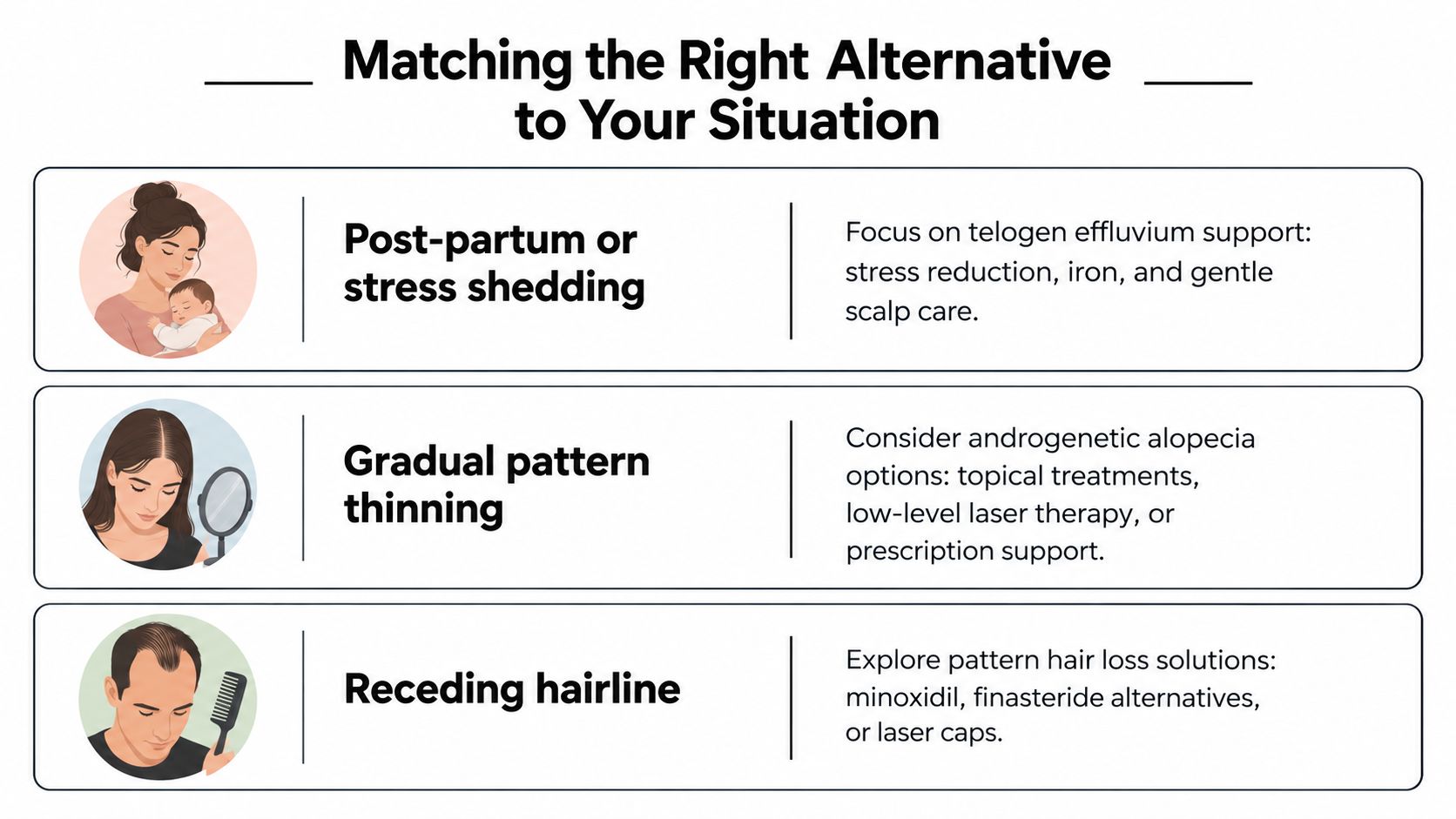
For recent post-partum or stress-related shedding, ask whether the timing and pattern fit telogen effluvium, and discuss whether iron, vitamin D, thyroid, or other checks are appropriate. Don't start iron or a multi-ingredient formula just because shedding began. If regrowth stalls or the pattern changes, a clinician can reassess and discuss whether topical minoxidil is appropriate.
For gradual part-line widening during peri- or postmenopause, get a diagnosis before treating it as a nutrient problem. Topical minoxidil is an established option to discuss; a clinician may also consider spironolactone or oral minoxidil when appropriate. A supplement can be complementary, but it shouldn't be the entire plan by default.
For men with gradual crown thinning or a receding hairline, ask about finasteride and minoxidil, including whether prescription treatment is suitable. Supplements or saw palmetto may be considered as adjuncts, but they shouldn't be presented as equivalent to prescription care. If hair loss is sudden or patchy, or the scalp is itchy or inflamed, seek a dermatology assessment rather than trying another supplement.

A practical plan: Book a clinician consultation, get a diagnosis and any appropriate testing, then choose one primary treatment. Add no more than one supplement and one device at a time, and track standardized photographs for at least 6 months before judging the change.
BotoxBarb offers appointment booking for aesthetic and wellness services, including LED light therapy and PRP, alongside a curated online boutique with skincare and haircare options. If you're weighing alternatives to Nutrafol, visit BotoxBarb to explore the boutique and arrange a consultation about a plan that fits your needs.