
Article: Azelaic Acid Benefits for Skin Explained
Azelaic Acid Benefits for Skin Explained
Used at 15% to 20% in a gel or cream, azelaic acid improves inflammatory acne, rosacea redness and excess pigment over roughly 8 to 16 weeks, and each concern has its own fair check-in date. Acne shows change first at 8 to 12 weeks, rosacea and post-acne marks around 12, melasma closer to 16 to 24.
The size of the acne effect is what makes that patience reasonable. In a double-blind randomized trial of 60 patients with mild-to-moderate acne, azelaic acid gel cut total lesion counts by 60.6% against 19.9% with vehicle, and acne-severity index scores dropped 65.2% against 21.3%, a treatment effect about 3.06 times that of placebo (trial record on PubMed). Nothing in that number suggests a fast fix. It suggests a dependable one.
Most disappointing azelaic acid stories share the same shape: a low-strength cosmetic serum, applied twice, judged on day nine. The clinical evidence sits with 15% gel and 20% cream, tested in trials that ran for months, and the gap between those products and a brightening serum is not marketing. It's dose, and dose sets the timeline.
The evidence table further down pairs each concern with the strength studied, the result to expect, and the week you should judge it. Choose your row before you buy anything.
Why One Acid Handles Breakouts Redness and Marks
Azelaic acid is a dicarboxylic acid that dermatology has leaned on for decades, and its promise is narrow and useful: one topical that quiets inflammatory acne, calms rosacea flushing, and fades the marks a flare leaves behind.
That range comes from three actions running at once. It normalizes the way follicle cells shed, it reduces microbial activity associated with Cutibacterium acnes, and it moderates the inflammatory signals that turn a clogged pore into a red papule. The same molecule also slows tyrosinase, the enzyme melanocytes use to manufacture pigment. Acne, redness and dark marks aren't three unrelated problems. They're three stages of one flare, which is why a single ingredient can touch all of them.
Strength matters more than the label on the box. The formulations with real trial evidence are 15% gel and 20% cream. A 10% cosmetic serum is not a gentler version of the same experiment, it's a different product with a different evidence base, and judging it against clinical results will leave you disappointed for the wrong reason.
The limits are worth stating plainly. Azelaic acid doesn't erase a spot overnight, it doesn't replace sunscreen, and it doesn't cure melasma, which relapses with light, heat and hormones. It also isn't the fastest route to clearing severe nodular acne.
If you're weighing a topical against in-clinic options for tone and redness, the Atlanta medspa skin rejuvenation guide from Georgia Plastic & Reconstructive Surgery lays out how lasers, peels and topical programs compare for pigment and texture. Whichever route you choose, the supporting routine decides how well your skin tolerates the active, and a guide to rosacea skincare products built around barrier repair is a better partner than a cabinet full of exfoliants.
Azelaic Acid Benefits by Concern and Trial Evidence
| Skin concern | Studied form | Result to expect | Check-in |
|---|---|---|---|
| Inflammatory and comedonal acne | 15-20% gel or cream | Total lesions down 60.6% vs 19.9% with vehicle in a 60-person trial; comedones down about 70% vs 14% across four studies (2023 systematic review) | 8-12 weeks |
| Rosacea redness | 15% gel | Inflammatory lesions fell 12.9 vs 10.7 with 0.75% metronidazole gel; 56% vs 42% gained at least one point on a four-point erythema scale over 15 weeks, with a number needed to treat of 7. A 2023 review of 20 rosacea studies found improvement in erythema severity and lesion counts by 12 weeks | 12-15 weeks |
| Post-acne marks | 15% gel | Post-inflammatory erythema and hyperpigmentation both improved with consistent twice-daily use in trial settings | 12 weeks |
| Melasma or facial pigment | 20% cream twice daily | Median lesion size down 71% vs 78% with hydroquinone in 52 adults at 24 weeks (randomized trial in phototypes IV to VI) | 16-24 weeks |
| Clogged, rough texture | 20% cream | Comedone improvement comparable to a standard topical retinoid over extended use, with fewer local tolerability problems | About 6 months |
Pick one row and treat it for twelve weeks. People who start azelaic acid for acne, melasma and texture at the same time, twice daily from day one, usually end up with a raw barrier and no reliable read on which concern improved. One target, one strength, one timeline. That is the dose-and-timeline decision this table is built around.
Reading the acne and rosacea rows
The acne row carries the best support. A randomized trial of 60 people with mild-to-moderate acne vulgaris found 20% azelaic acid gel produced significant reductions in total lesion counts and improved acne-severity scores after 12 weeks, with minimal adverse effects (trial summary). Judge this one on lesion counts and photographs at week 8 to 12, not on how your skin feels in week one.
Practical rule: Photograph your face in the same light, from the same angle, every two weeks. Azelaic acid changes slowly enough that memory will miscount your lesions.
Rosacea deserves a careful read of the comparator. That 15-week study measured 15% gel against 0.75% metronidazole gel, an established prescription topical rather than a placebo, so an edge here carries more weight than the percentages suggest. The number needed to treat of 7 means the benefit is real but modest: many people improve, and a meaningful minority gain their extra point of redness control from it. Give it 12 to 15 weeks, and keep the rest of the routine boring while you do.
Reading the pigment and texture rows
The melasma row is where expectations go wrong most often. Hydroquinone still reduced lesion size further, and it usually works faster. What azelaic acid offers instead is a pigment option you can use long term, proven in a trial population that included many people with Fitzpatrick phototypes IV to VI, the group most often warned away from aggressive lighteners. Additional randomized data in deeper phototypes points the same direction, with the 20% cream lightening pigment more than vehicle on both clinician grading and precise measurement.
The texture row is the sleeper. Over extended use, 20% cream performed comparably to a standard topical retinoid for comedonal acne while causing fewer local tolerability problems, which makes it a reasonable first move for someone whose skin never adjusted to a retinoid. Tolerability is what keeps a routine running for six months, and a routine that survives six months beats a stronger product abandoned in week three.
Products under 15% shouldn't be described as equivalent to any of this, and a lower percentage can't be assumed to follow the same timeline. Twelve weeks is a fair test of a studied strength. Three days isn't a test of anything.
How Azelaic Acid Calms Follicles and Pigment
A pore behaves like a narrow hallway. Cells lining the follicle shed constantly, and when they shed too stickily, they pile up in that hallway until it blocks, which is a comedone. Azelaic acid's anti-keratinizing action normalizes that shedding, so the hallway stays open. That's why it works on blackheads and on the inflamed papules that follow a blockage.
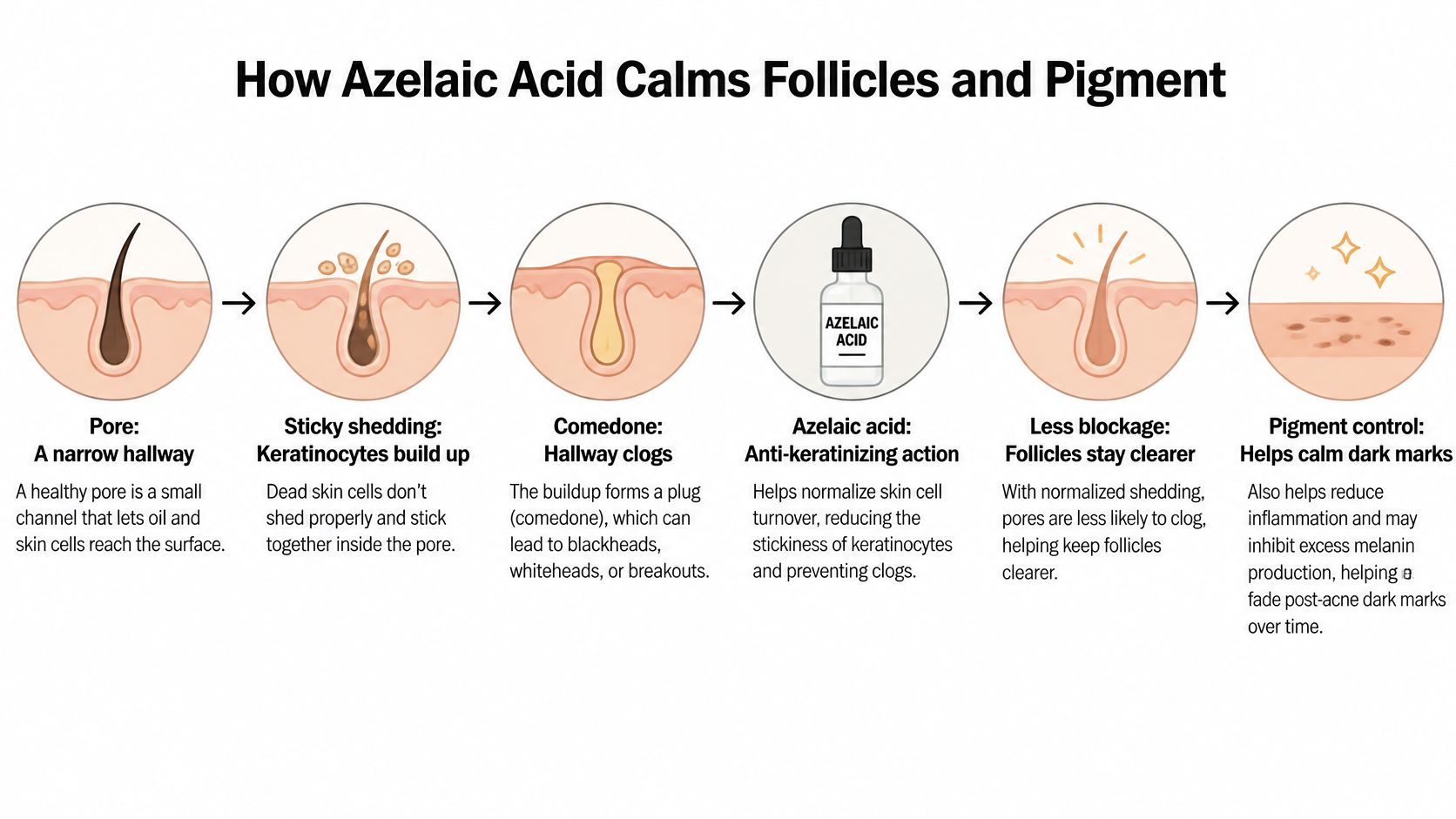
The same picture explains the redness. Blocked follicles feed Cutibacterium acnes, bacteria that provoke the immune response you see as a red bump. Azelaic acid reduces that microbial activity and dampens the inflammatory signaling, so a papule has less fuel and settles faster (review of azelaic acid mechanisms and use).
Why pigment needs a different fix
Pigment is a switch, not a blockage. Tyrosinase is the enzyme melanocytes use to manufacture melanin, and after a breakout or sun exposure, hyperactive cells leave that switch jammed on. Azelaic acid selectively inhibits tyrosinase and interferes with melanin production in those overactive cells while generally sparing normally pigmented skin. That's regulation, not bleaching. Your whole face doesn't lighten two shades; the stubborn patch fades toward the skin around it.
The part most people skip: ultraviolet light keeps flipping the switch back on. Azelaic acid isn't photosensitizing, but that doesn't make it a sunscreen, and pigment work collapses without daily broad-spectrum coverage.
Dermatology reviews describe 15% gel and 20% cream as generally well tolerated, without photodynamic reactions or meaningful systemic toxicity in typical use. For stubborn patches that aren't responding to a topical alone, medically supervised care for brown patches from ProMD Health is a sensible next step, because persistent pigment sometimes needs a prescription-strength plan rather than another serum.
The practical translation is unglamorous: fewer new clogs, quieter redness, gradual fading of old marks. There's no peel-day reveal with this ingredient, which is exactly why it's safe to keep using.
Melasma Marks Pregnancy and Darker Skin
A post-acne mark is a footprint: inflammation and melanin left behind where a lesion healed, fading as cell turnover does its work. Melasma is weather. It's a recurring pattern driven by hormones, ultraviolet light and heat, and it can fade and return for years. Treating the two as one condition is why so many shoppers buy the wrong product and quit at week six.
The evidence lands later than most marketing implies. A 16-week study of 15% gel improved acne severity and post-inflammatory hyperpigmentation in patients with skin of color, and melasma results take longer still to judge (review of azelaic acid across acne, rosacea and melasma). Azelaic acid reduces excess pigmentation and inflammation. It is not a sunscreen substitute, and it is not a permanent cure for melasma.
The pregnancy question deserves a real answer
Clinicians often consider topical azelaic acid a suitable option during pregnancy, which is why it gets recommended so often. That is not the same as a blanket yes. If your skin is irritated, if you're stacking multiple actives, or if you're using a compounded product with other ingredients, the decision belongs with your clinician.
"Pregnancy-compatible" describes an ingredient in isolation. It doesn't describe your barrier, your other products, or your particular risk tolerance.
| Situation | Fit | Reason |
|---|---|---|
| Mild-to-moderate acne plus marks | Strong fit | Addresses active lesions and leftover discoloration |
| Facial rosacea redness | Strong fit | Erythema and lesion data over 12-15 weeks |
| Melasma | Useful adjunct | Needs 16-24 weeks plus daily sunscreen and can relapse |
| Sensitive or broken barrier | Slow start or pause | Early burning can trigger more pigment |
| Pregnancy | Clinician decision | Suitability depends on your skin, not a blanket yes |
| Already using strong retinoids or acids | Do not stack blindly | Combined irritation raises the risk |
Darker phototypes belong in the evidence, not in a caution paragraph. Sustained use improved both lesion size and pigment intensity in adults with deeper skin tones, and that matters because inflammation from over-treatment is itself a pigment trigger. On deeper skin, irritation isn't just uncomfortable. It can deepen the mark you were trying to fade.
Melasma needs a routine built for maintenance rather than one heroic active, and this melasma skincare routine covers the sunscreen, antioxidant and reapplication habits that decide whether the pigment you faded stays faded. Fading is the easy half. Keeping it faded is the work.
How to Work Azelaic Acid into a Routine
Azelaic acid is a dose-and-timeline decision. Pick the percentage, pick the pace, then give it weeks before you judge whether it's working.
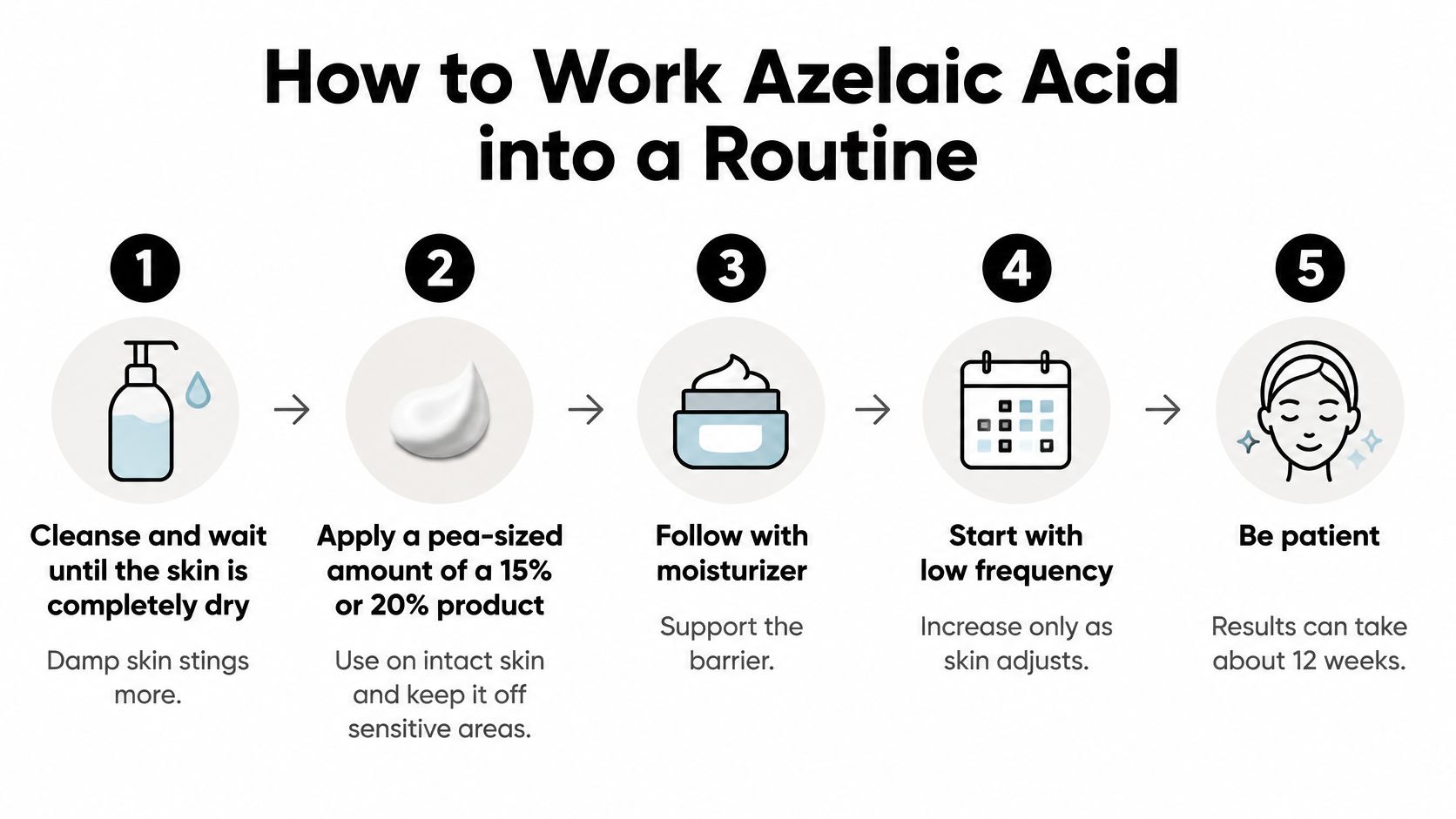
- Cleanse, then wait until your skin is completely dry. Damp skin stings more, and the sting teaches people to quit a product that would have worked.
- Use a pea-sized amount of a 15% or 20% product on intact skin, keeping it off eyelids, the corners of the nose and any broken or freshly exfoliated areas.
- Apply every other night for the first two weeks. Turn the frequency dial before you touch quantity.
- Follow with a bland moisturizer. Ceramides or glycerin, no fragrance, no extra acids. Support the barrier while it adapts.
- Move to nightly once stinging settles within minutes and there's no ongoing scaling or redness.
- Consider twice daily only after a month of calm skin. Twice-daily use has trial support, but that schedule isn't right for every barrier.
- Apply broad-spectrum sunscreen every morning and reapply when you're outdoors, because pigment improvement depends on it.
On reactive or deeper skin, hold each step an extra week before climbing. A slower ramp costs you days. An irritated barrier costs you months.
Which sensations pass and which mean stop
Burning, stinging, itching, scaling and brief redness are most common in the first weeks, and they don't prove the product is working. They're expected adaptation (review of tolerability and dosing). What should stop you is different: persistent irritation that lasts into the next day, marked dermatitis, swelling, or depigmented patches. Rare reactions including contact dermatitis and facial edema need clinical assessment rather than a moisturizer.
On skin of color, that pause matters more, because inflammation can intensify post-inflammatory hyperpigmentation. A reaction you push through on fair skin becomes a mark you create on deeper skin.
Controlled trials of azelaic acid for acne-related redness and hyperpigmentation used steady twice-daily application over weeks and reported only mild reactions, but no study protocol settles the pace for every skin type. Start where your barrier is, not where a trial ended.
My recommendation: if you're using a prescription retinoid, alternate nights rather than layering both. The combined irritation buys you nothing and costs you weeks.
When you're building the rest of a post-procedure or post-flare routine, these post-treatment skincare recommendations explained by Luxe Aesthetic Surgery & Medical Spa are a useful frame for sequencing gentle products around an active.
Pair the Routine with a Home LED Mask
Decide the acid first. Choose a studied 15% or 20% azelaic acid when the goal is mild-to-moderate acne, rosacea redness or acne marks, and you can stay with it for about 12 weeks. Delay the start while your barrier is raw. Light doesn't rescue a routine that's already burning.
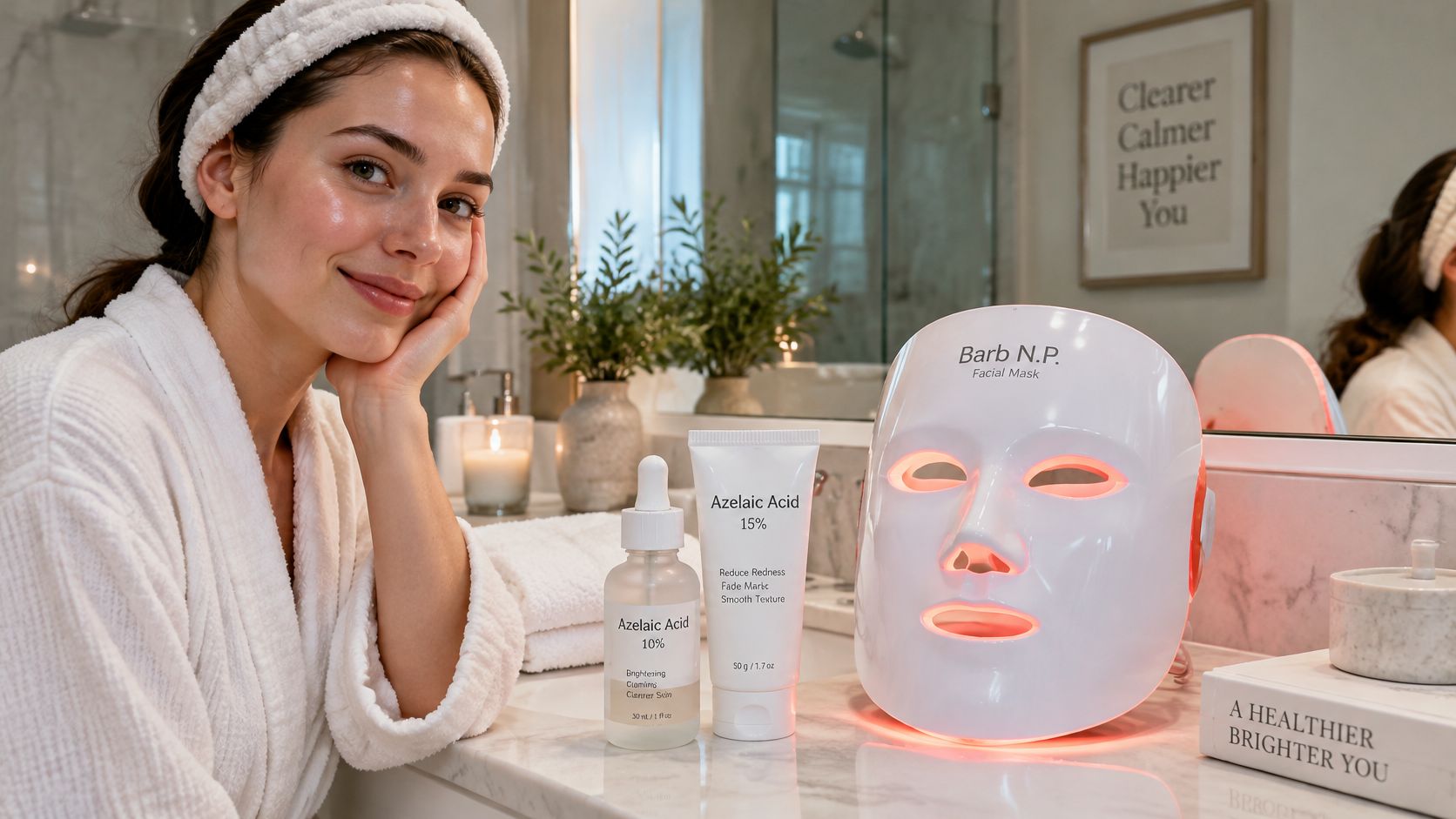
Once the acid plan is set, an LED mask is an optional companion that sits beside it, never a replacement for the acid or the sunscreen. Published device studies use specific doses: blue LED at 414 nm, used every other day for eight weeks, produced a 52% reduction in acne-lesion count in one randomized trial, while a split-face study using red LED at 635-670 nm for 15 minutes twice daily over eight weeks found 66% fewer inflammatory and 59% fewer non-inflammatory lesions (systematic review of LED therapy). The same reviewers suggested blue power density of 6-40 mW/cm² or red power of 8-100 mW/cm² for up to 20 minutes, which may not match every consumer device, so follow your device's instructions and protect your eyes as directed.
The Barb N.P. LED face mask offers a gentle, painless at-home routine with three lighting settings for different treatment approaches. Blue light targets acne-causing bacteria, which suits blemish-prone skin. Red light penetrates to help stimulate collagen production, reduce the look of inflammation and support skin healing. Purple blends the benefits of red and blue wavelengths to help reduce the look of dark circles, brighten the skin and support anti-aging effects. For more on matching wavelength to goal, this guide to the benefits of LED light therapy is a good primer.
If you want the dose, the timeline and the light setting matched to your own skin rather than to a generic routine, booking a consultation with Barb N.P. through BotoxBarb gets you a product recommendation built around your skin type and goals. The shop carries the Barb N.P. LED face mask alongside medical-grade skincare, including the cleansers, antioxidant serums and daily sunscreens that hold a pigment result in place. Start with your primary concern, give it twelve weeks, and let the mask support the plan instead of replacing it.

