Article: What's in Lip Fillers? Ingredients, Safety and Longevity

What's in Lip Fillers? Ingredients, Safety and Longevity
If your lip filler contains hyaluronic acid, do you know what else is in the syringe? The ingredient that adds fullness is only part of the answer. Cross-linkers, water, buffering salts, and sometimes a local anesthetic help determine how the finished product behaves and what your clinician needs to know before treatment.
Understanding what's in lip fillers doesn't require a chemistry background. It starts with separating the ingredient that creates volume from the ingredients that help the gel last, remain stable, or make injection more comfortable.
Lip Filler Ingredients at a Glance
Most modern lip fillers are hydrated hyaluronic acid gels, not plain water and not permanent implants. The table below separates the main volumizing material from a cross-linker, an anesthetic, and other filler materials you might encounter while comparing treatments.
Lip filler ingredients compared
| Ingredient | What it is | Job in the syringe | Typical duration | Reversible |
|---|---|---|---|---|
| Hyaluronic acid (HA) | Sugar-like polysaccharide found in skin and cartilage | Holds water to add volume and smooth lines | Approximately 6-12 months, the FDA's general HA range | Yes, with hyaluronidase when clinically indicated |
| BDDE cross-linker | Chemical agent that links HA strands | Slows breakdown to extend persistence | Tied to the HA gel | Not separately; clinicians treat the HA gel |
| Calcium hydroxylapatite (CaHA) | Mineral resembling a component of bone | Structural support in deeper tissue | Governed by the product and treatment area, not a lip-gel timeline | No, not with hyaluronidase |
| Poly-L-lactic acid (PLLA) | Synthetic biostimulator | Prompts the body to make its own collagen | Governed by the collagen response and treatment course | No, not with hyaluronidase |
| Lidocaine | Local anesthetic of the amide type | Numbs injection discomfort | Hours, rather than the lifetime of the filler | Not applicable |
This is a lookup table, not a ranking. CaHA and PLLA belong in the comparison because patients encounter them under the broad term dermal filler, not because they're interchangeable options for the lips. Lidocaine isn't a volumizer at all.
Read beyond the main ingredient
A label that says hyaluronic acid identifies the base material, but it doesn't describe the whole formulation. Two products can share that ingredient while differing in their cross-linking, physical properties, and anesthetic content.
Before your appointment, find the ingredient names on the package insert and consent form. If you can identify only HA, the next questions are whether it's cross-linked and whether the syringe contains a numbing medicine. Those answers matter more than a reassuring description such as a hydrating gel.
Hyaluronic Acid, the Gel Behind Most Lip Fillers
What does “hyaluronic acid” on a label tell you about a lip filler? It identifies the gel's base material, but not the full formula or how it will behave in tissue.
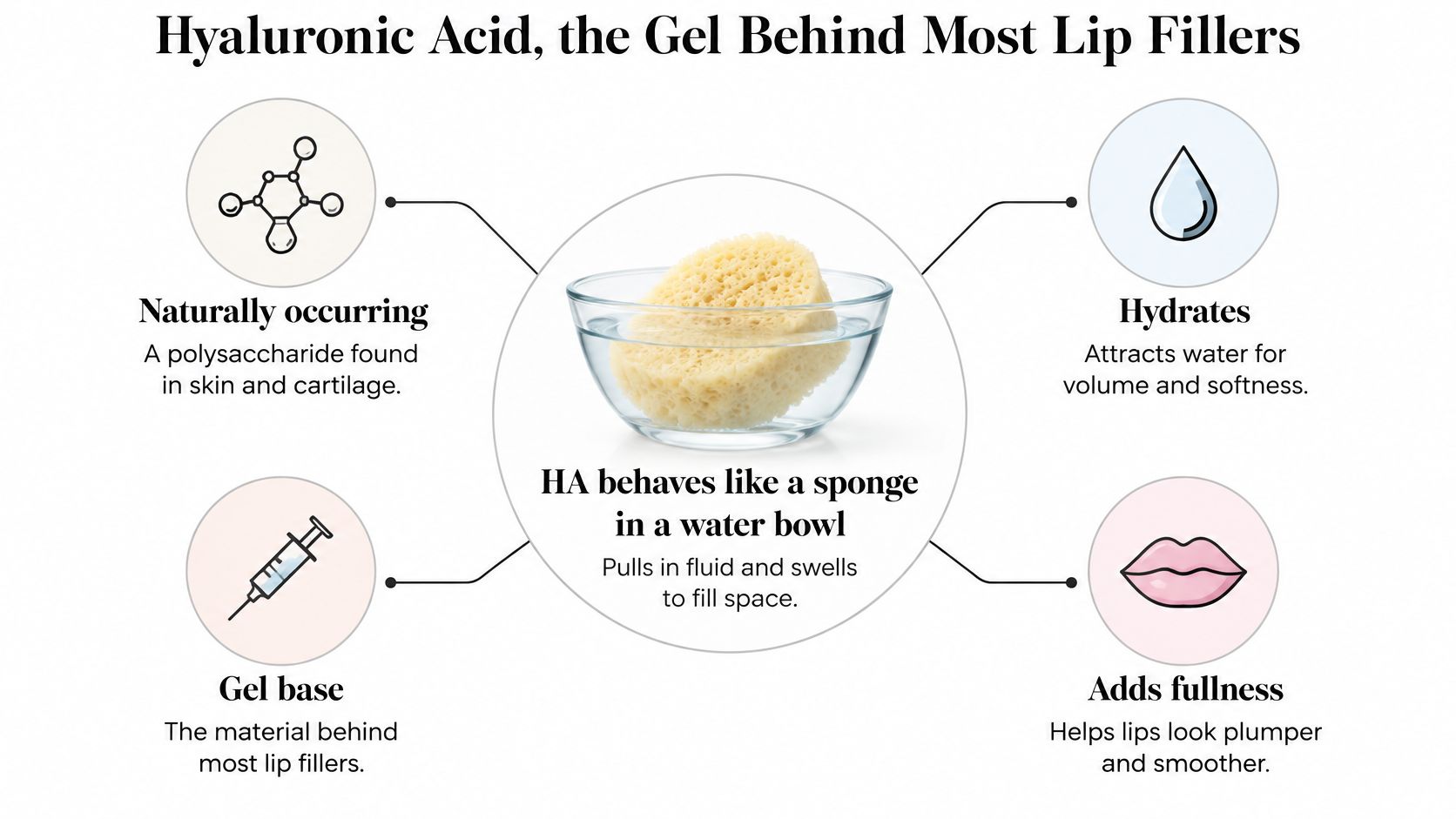
HA is a polysaccharide, a type of sugar found naturally in tissues including skin and cartilage. It attracts water, a little like a sponge, which helps the gel add volume. Your body already contains HA, but that doesn't make an injectable product risk-free. The finished gel, its placement, and your medical history still matter.
From raw material to injectable gel
Manufacturers may produce HA through bacterial fermentation or obtain it from avian material, such as rooster combs. They process it into a hydrated gel, and the details vary by product. The words “hyaluronic acid” alone don't reveal its origin.
The finished syringe may also contain buffering agents, salts, and other excipients. An excipient supports the formulation rather than providing its main volumizing effect. These ingredients are part of the medical product, not evidence that the syringe contains only diluted HA.
Applying HA to skin is different from injecting a manufactured gel into tissue. An explanation of using hyaluronic acid in daily routines concerns topical skincare; a serum isn't a substitute for filler.
Why composition matters
If you want a little more fullness, the clinician selects and places a gel to create that effect. HA can provide volume as soon as it is injected, although early swelling can make the initial result look different from the settled one.
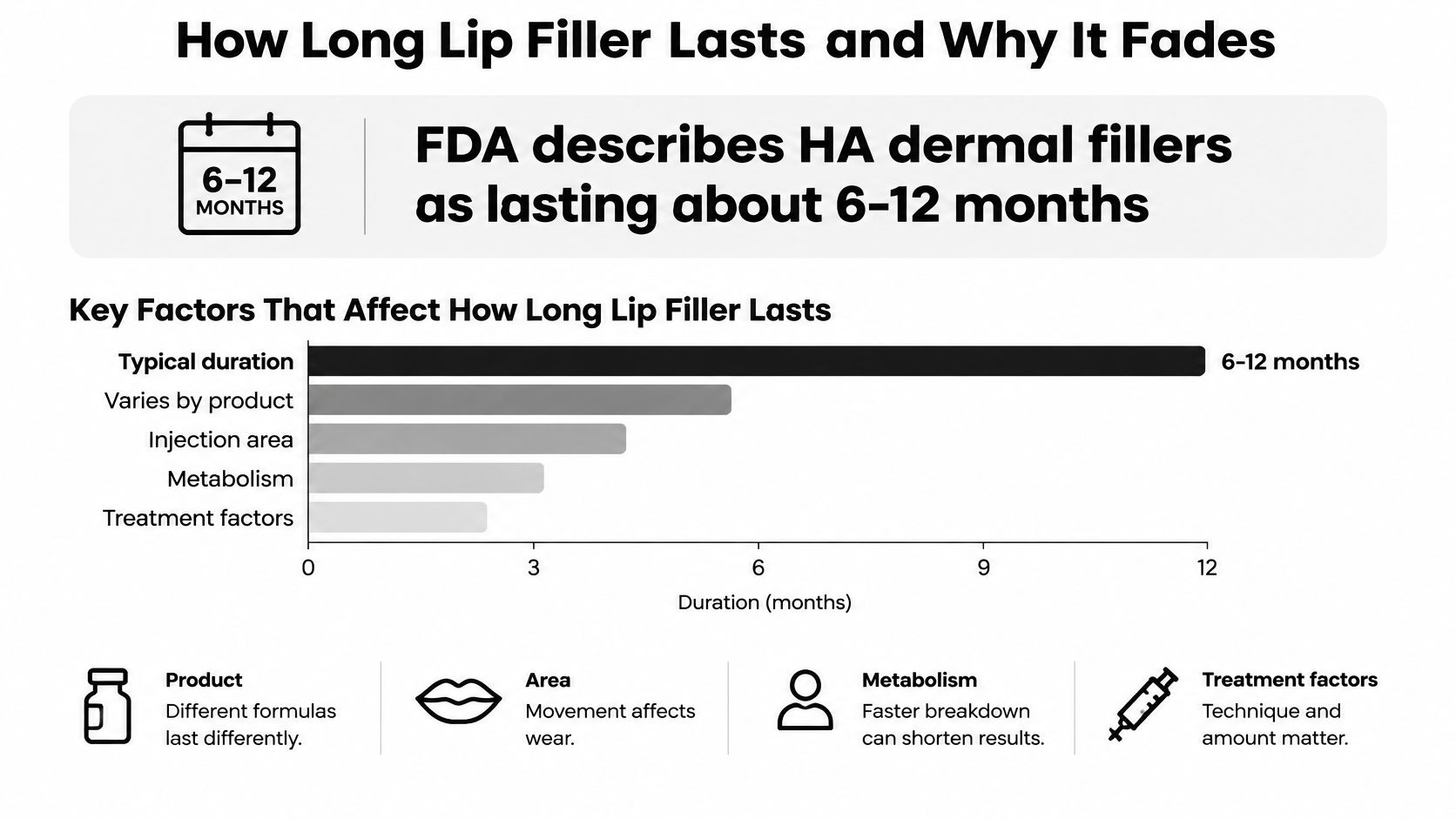
In the United States, dermal fillers are regulated as medical devices. The FDA's dermal filler guidance describes typical HA effects as lasting approximately 6-12 months and limits authorized lip-filler uses to adults 22 or older for specified indications.
The basic distinction: HA adds volume when placed, then your body gradually absorbs the gel. Maintaining the effect may require further treatment.
A product label is a starting point, not the whole ingredient list. Check the product information to understand what is in the syringe and how its formulation contributes to the result.
Cross-Linkers and Numbing Agents Inside the Syringe
A filler described as just HA may contain a chemically modified HA network and a medication for comfort. The base ingredient doesn't tell you the complete recipe. That's why the exact product name matters more than the broad category.
BDDE, short for 1,4-butanediol diglycidyl ether, is a chemical cross-linking agent. Think of it as creating connections between HA strands so the gel resists breakdown longer than it otherwise would. Cross-linking also changes physical properties, so longevity and feel aren't separate from the chemistry.
A real product example
The FDA product information for Revanesse Lips+ identifies BDDE-cross-linked HA and states that patients with prior hypersensitivity to amide local anesthetics, such as lidocaine, shouldn't receive the product. This is a practical example of why an ingredient review must include both the gel and anesthetic-related precautions.
Cross-linked gels can feel firmer, but you can't judge a product's suitability from the presence of BDDE alone. The finished formulation matters. A clinician should explain why that particular gel suits your lip anatomy and goals rather than treating more cross-linking as automatically better.
Some dermal fillers are combination products, containing an added drug constituent such as lidocaine or mepivacaine. That means numbing medicine may be built into the syringe, separate from any cream or other anesthetic used before injection. Built-in anesthetic improves comfort; it doesn't remove the need to assess allergies or procedural risk.
Check the ingredients against your history
Use these checks when reading the insert:
- Cross-linker: Look for BDDE or another description of how the HA is modified.
- Anesthetic: Identify whether the formulation contains lidocaine, mepivacaine, or another drug constituent.
- Previous reactions: Tell the clinician about known amide-anesthetic hypersensitivity and describe what happened, rather than saying you dislike dental numbing.
If you're unsure whether a past reaction was an allergy, don't decide on your own that the ingredient is safe or unsafe. Bring the medication name and any available medical documentation for clinical review.
A useful product description names the gel and its relevant additives. Hyaluronic acid alone isn't a complete answer.
Request the full product name and manufacturer before treatment so you can read the correct package insert, not information for another product in the same brand family.
Why CaHA and PLLA Are Not Lip Gels
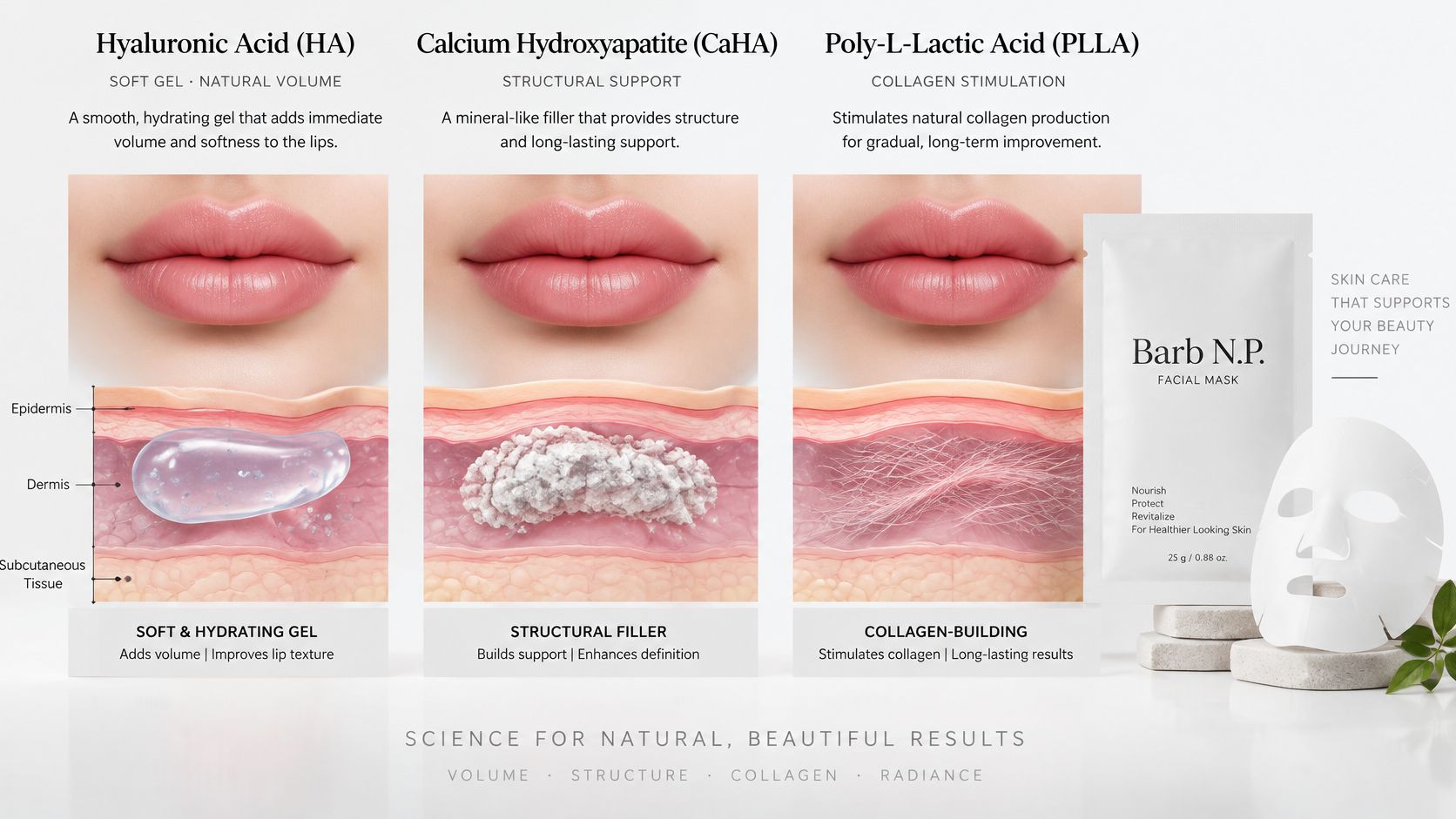
Not every dermal filler works like a soft HA gel. Calcium hydroxylapatite and poly-L-lactic acid have different mechanisms, which changes both the treatment goal and the options available if the result needs correction.
A simple comparison helps: HA is like filling a balloon with water now. CaHA is closer to adding scaffolding, while PLLA resembles planting seeds that lead to a response over time. These are analogies for how they work, not descriptions of literal structures inside your face.
Different materials, different purposes
CaHA is a mineral resembling a major component of bone. Its use as a structural filler in deeper areas doesn't make it an equivalent substitute for a soft, lip-specific gel. The material must match the tissue and intended treatment.
PLLA works primarily as a collagen biostimulator. Rather than behaving as an immediate HA-like volumizer, it prompts the body to produce collagen. A treatment designed around that response requires different expectations from one intended to add lip fullness directly.
The FDA's dermal filler safety guidance distinguishes filler materials and emphasizes that their risks include accidental injection into blood vessels, potentially causing tissue necrosis, visual impairment or blindness, or stroke. Material selection therefore isn't merely a preference about texture.
Reversal isn't the same across categories
Hyaluronidase can treat HA filler when clinically indicated, but it doesn't dissolve CaHA or PLLA in the same way. An unwanted result from those materials can't be approached as though it were an HA gel that can be dissolved.
- For lip treatment: A soft, movement-heavy area needs a product chosen for that anatomy.
- For a non-HA recommendation: Request a clear explanation of suitability, authorized use, alternatives, and complication management.
- For broader comparison: Review the distinctions among types of dermal fillers without assuming that every facial filler belongs in the lips.
The practical lesson isn't to memorize every mechanism. It's to know which material will be injected and what can, and can't, be done afterward.
How Long Lip Filler Lasts and Why It Fades
Lip fullness improvement after HA lip filler
| Time point | Share with improvement | Count |
|---|---|---|
| 6 months | 77% | 129 of 168 |
| 12 months | 60% | 101 of 169 |
In one FDA-reviewed HA lip-filler study, 77% of participants, 129 of 168, had at least a one-point improvement in lip fullness at six months, while 60%, 101 of 169, retained that improvement at twelve months. These are results for a particular study, not a forecast for every product or patient.
The meaningful pattern is gradual fading, not an on-off switch. Participants could retain a measurable improvement without looking exactly as they did immediately after treatment. Likewise, a result becoming less noticeable doesn't prove that every bit of material has disappeared.
Use duration as a planning window
The product, injection area, metabolism, and treatment factors can affect persistence. The amount placed and the intended correction also influence how you interpret the result: subtle border refinement and a noticeable increase in fullness aren't identical goals.
Discuss lifestyle questions with your clinician, but be cautious about simple promises that a particular habit will make filler last longer. An ingredient list can't predict your personal breakdown rate, and a brand name alone can't guarantee a maintenance schedule.
- Record the starting point: Keep consistent photographs so comparisons aren't distorted by lighting or expression.
- Review before adding more: Have the remaining effect assessed rather than treating the calendar as an automatic instruction to reinject.
- Discuss your goal: Maintaining a subtle change may call for a different decision than recreating the initial fullness.
A broader explanation of how long filler lasts can help you compare treatment areas without assuming they share the same timeline.
Planning advice: Arrange a review around month six, rather than committing in advance to a top-up.
That review is a decision point, not a deadline. If you're happy with the remaining result, additional treatment may not be necessary.
Safety Risks Linked to What Is Injected
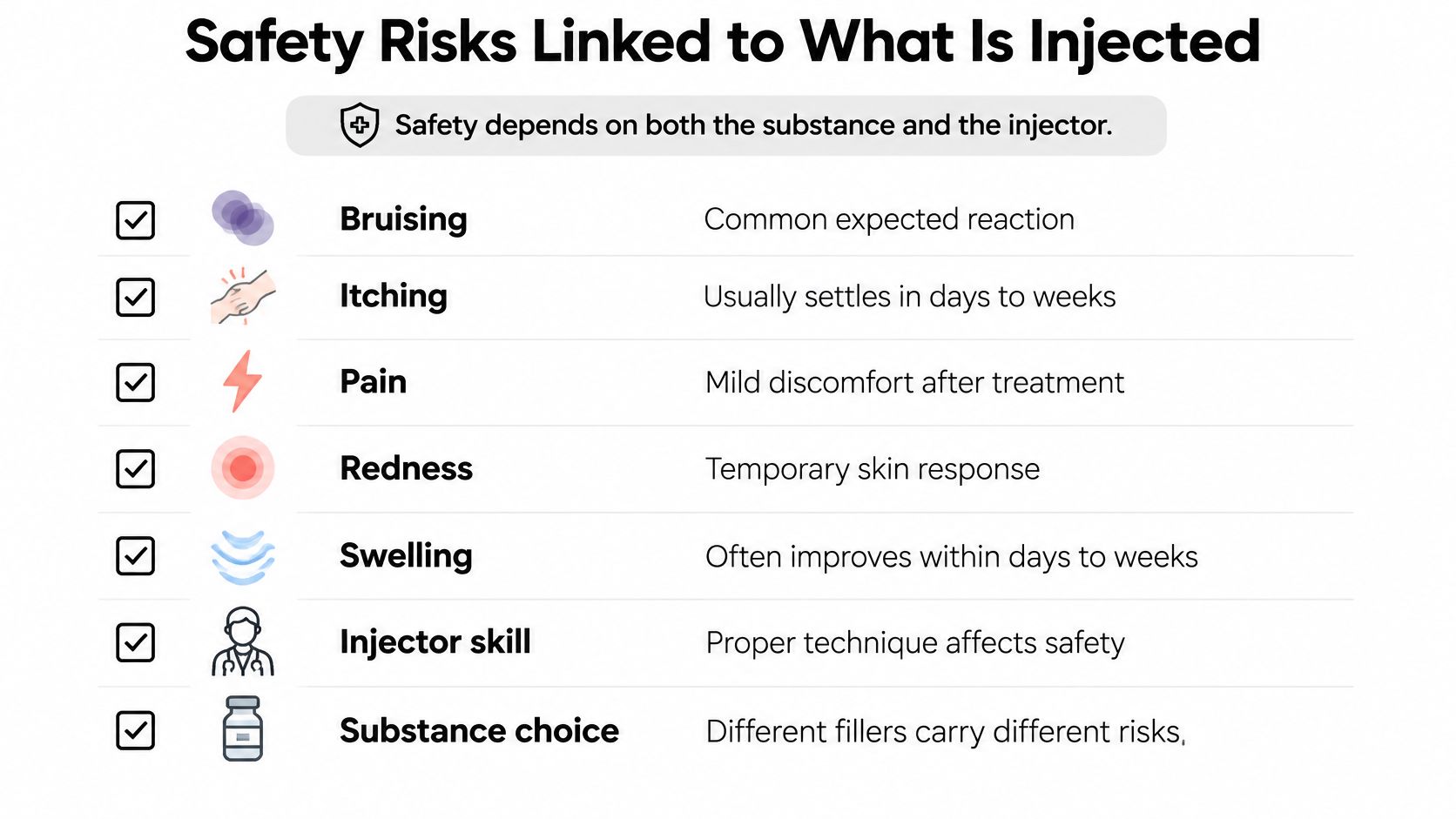
Safety depends on both the substance and the injector. Bruising, itching, pain, redness, and swelling are expected short-term reactions, with many settling within days to weeks. Their presence doesn't automatically mean something has gone wrong, but the pattern and severity matter.
Less common complications include severe allergic reactions, migration, leakage or rupture, infection-related problems, and permanent hard nodules. A familiar ingredient name doesn't eliminate these possibilities. Neither does the fact that the material is temporary.
Know when not to wait
Accidental injection into a blood vessel can obstruct blood flow and cause serious injury before the body has time to absorb the filler. That's why waiting for a temporary product to wear off isn't an appropriate response to concerning symptoms.
Seek urgent assessment for:
- Severe or unusual pain: Especially pain that increases or seems disproportionate to the treatment.
- Pale or dusky skin: Blanching, grayish patches, or an unexpected dark color change near the treated area.
- Any visual change: Treat blurred vision, loss of vision, or other sudden visual symptoms as an emergency.
- Spreading swelling: Particularly when it progresses rapidly or comes with other concerning symptoms.
- Fever: Especially with increasing redness, warmth, or pain that could indicate infection.
For visual symptoms or a severe rapidly progressing reaction, seek emergency medical care immediately. Don't wait for a routine follow-up or a reply to a photograph. Contact the treating clinician as well, but don't let that delay emergency assessment.
Match reassurance with preparation
The FDA safety evidence described for HA lip fullness included 22 studies involving 3,965 people; average participant age across studies ranged from 40 to 55, and most participants were women. That describes the population studied, not a promise that every individual will respond similarly or that someone outside that profile is protected from complications.
Use authorized products administered by qualified, licensed healthcare professionals. Avoid consumer-sold injectables and needle-free filler devices. A product's ingredient list can't compensate for uncertain sourcing or an unsafe delivery method.
Before treatment, obtain product-specific informed consent explaining expected reactions, serious risks, alternatives, and what to do if symptoms develop. Keep the product name with your treatment information so another healthcare professional can identify the material if you need care elsewhere.
The goal isn't to make every bruise alarming. It's to distinguish a manageable aftereffect from a symptom that needs prompt medical attention.
Confirm the Product and Provider Before You Book
Use a short verification routine before paying for treatment. Bring written questions so the conversation doesn't stop at a brand name or a promise of natural results.
Your booking checklist
- Get the exact product name and manufacturer. Read the package insert for cross-linking, anesthetic content, and amide-allergy precautions. A brand family isn't enough to identify the formulation.
- Confirm the intended use. Check that the specific product is FDA-authorized for lip augmentation in adults and that you meet its eligibility requirements.
- Identify the injector. Confirm that a licensed healthcare professional will perform the procedure. Know who will manage concerns afterward.
- Request written, product-specific consent. Compare it with the insert and resolve any mismatch before treatment, not after the syringe is opened.
- Agree on follow-up and reversal planning. Request a written review plan, including a review around month six, and an explanation of how the actual material would be managed if correction became necessary.
If you're considering lip filler near you, run the same checks with our team at BotoxBarb. Ask us to identify the product and explain the material; don't rely on verbal reassurance alone.
Book only when the product name, material, and reversal plan are clear. If any is missing, postpone and ask again.
BotoxBarb offers injectable services including Restylane and Revanesse, as well as Hylenex/hyaluronidase, so bring your ingredient and reversal questions to your consultation. Visit BotoxBarb to explore appointment options and request a product-specific discussion before deciding on lip filler.