
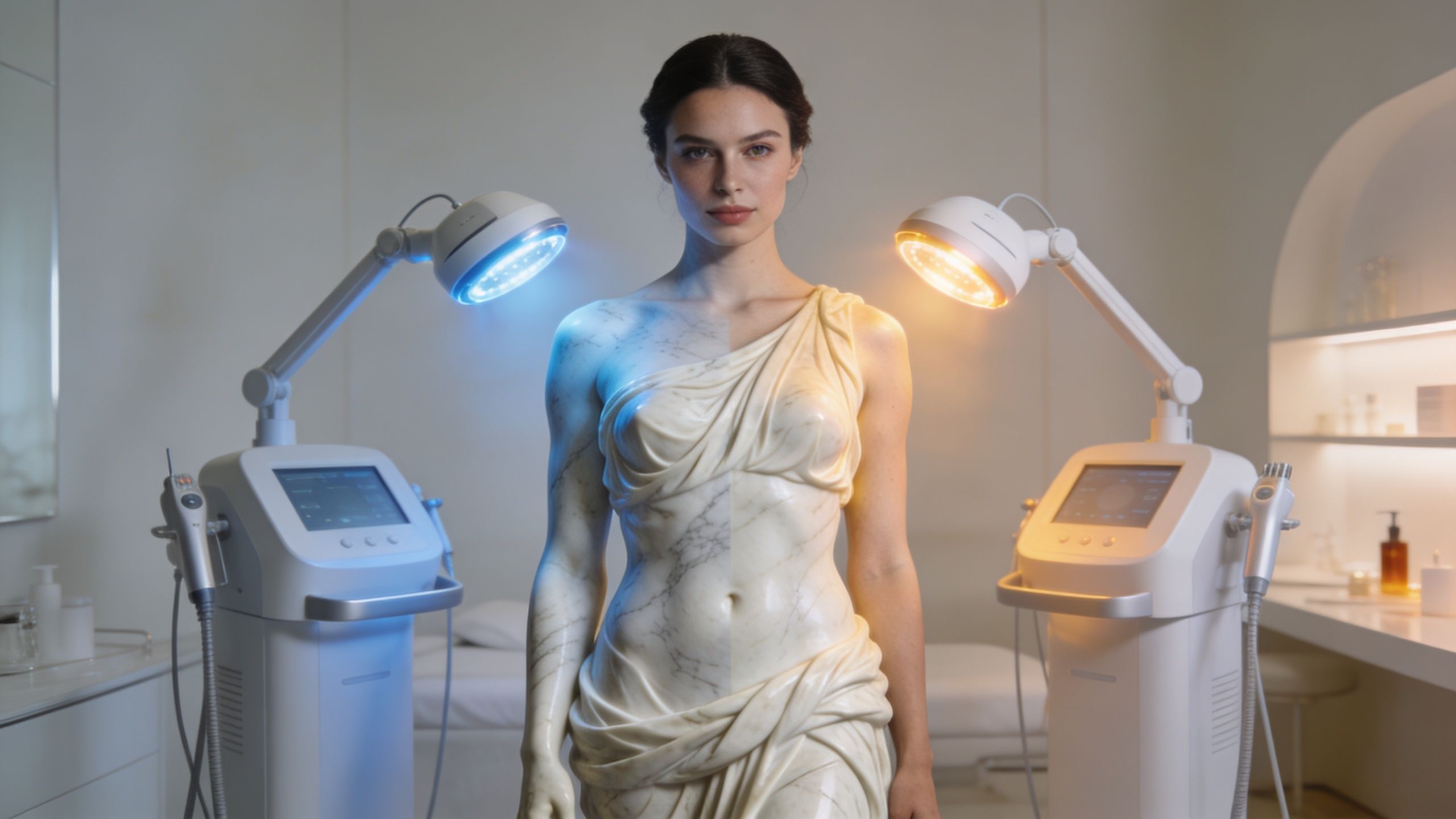
Benefits of Body Sculpting: A 2026 Guide
You can eat well, work out consistently, and still have one area that won’t cooperate. For a lot of people, it’s the lower abdomen, flanks, inner thighs, or the fullness that changes how clothes sit even when the scale hasn’t moved much.
That’s where body sculpting becomes useful. Not as a shortcut. Not as a substitute for weight loss. It’s a contouring tool for people who’ve already done a lot of the right things and want more precision than diet and exercise can always deliver.
As a Nurse Practitioner, I think the most helpful way to discuss the benefits of body sculpting is directly. Some treatments reduce stubborn fat. Some add muscle definition. Some help skin look firmer. Some can support posture and comfort. None of them replace lifestyle habits, and none of them work well when expectations are unrealistic.
Beyond Diet and Exercise The Promise of Body Sculpting
One of the most common frustrations I hear is simple: “I’m doing the work, so why is this one area still there?” That question usually comes from someone who’s already exercising, trying to eat well, and wants their body shape to match the effort they’re putting in.

Body sculpting is useful in that setting because it targets localized concerns. It isn’t designed to make a person broadly smaller overnight. It’s designed to refine areas that often resist otherwise good habits.
What body sculpting does well
Benefits of body sculpting show up when the goal is specific. Think of it as fine-tuning rather than rebuilding.
- Targeted contouring: It can address pockets of fat that remain after weight has stabilized.
- Low disruption: Many non-invasive options let people return to normal routines right away.
- Gradual change: Results usually look more natural because the body changes over time, not all at once.
Body sculpting works best when your habits are already reasonably solid. It sharpens results. It doesn’t create them from nothing.
What it doesn’t do
Body sculpting is not the right tool for major weight loss, and it won’t fix every concern in a single session. If someone wants dramatic volume removal or has significant loose skin, a non-invasive device may not be enough.
For patients who want to support their results with better nutrition structure, practical tools can help. A resource like AI-powered meal planning for 2025 can make consistency easier, especially when you’re trying to maintain a stable routine instead of bouncing between extremes.
Understanding The Two Paths To A Contoured Body
Body contouring usually follows one of two paths. One is surgical. The other is non-surgical. I explain it to patients this way: one path chisels, the other gradually melts and reshapes.

Surgical contouring
Surgical options are for people who want larger, faster changes and are willing to accept more downtime, more recovery, and the realities of an invasive procedure. This category includes procedures such as liposuction and skin-removal surgeries.
The upside is obvious. Surgical work can produce dramatic reshaping. The trade-off is equally obvious. Recovery is longer, the process is more involved, and the risk profile is different.
Non-surgical sculpting
Non-invasive body sculpting aims for selective improvement without surgery. These treatments are usually better for people who are close to their goal and want refinement, not overhaul.
That shift toward less invasive care is one reason non-surgical treatments have grown so quickly. Non-invasive body sculpting drove the body contouring market to USD 1.50 billion in 2023, with a 6% annual increase in procedures, outpacing surgical alternatives like liposuction, according to this body contouring market overview.
If your long-term goal includes more muscle definition through training, I also like practical education that sets realistic expectations. A straightforward ultimate guide for beginner bodybuilding can help patients understand what exercise can do on its own and where aesthetic treatments may complement that work.
A practical comparison
| Approach | Best for | Main advantage | Main trade-off |
|---|---|---|---|
| Surgical contouring | Larger reshaping needs | More immediate and dramatic change | More downtime and invasiveness |
| Non-surgical sculpting | Localized fat or mild contour goals | Minimal interruption to daily life | More gradual and typically subtler results |
For readers exploring options beyond surgery, BotoxBarb also has a helpful overview of non-invasive cosmetic procedures that fits into this same decision-making process.
Practical rule: Choose the least invasive option that can realistically meet your goal. If a device can’t get you there, it’s better to say that upfront than to oversell it.
Key Benefits Beyond Simple Fat Reduction
A lot of marketing around body sculpting focuses only on shrinking an area. That’s incomplete. Some of the most meaningful benefits of body sculpting have less to do with the tape measure and more to do with how the body feels and functions.

Better posture and core support
When a treatment includes muscle stimulation, the outcome can go beyond appearance. Some technologies use HIFEM to create intense muscle contractions that the body can’t reproduce easily through casual exercise alone.
Cleveland Clinic notes that building core strength with HIFEM, equivalent to 20,000 sit-ups per session, can improve posture and spinal alignment, with some studies reporting 28% lower chronic pain incidence in treated groups, as described in their body contouring overview.
That matters. If you’ve ever had lower back tightness, a weak core, or the feeling that your posture collapses by the end of the day, you already know appearance and function are connected.
Skin quality matters too
Patients often ask about the area after fat reduction. Will the skin look smooth? Will it look tighter? That’s the right question.
Some body sculpting technologies use heat-based energy that can support collagen activity and improve firmness. The visual result isn’t just “less fat.” It can also be a cleaner silhouette, better skin texture, and an area that looks more balanced rather than deflated.
Confidence is a real outcome
I don’t treat confidence as a superficial benefit. When clothes fit better, when an abdomen looks firmer, or when a person feels less self-conscious in fitted clothing, daily life changes. People move differently. They stand taller. They stop hiding under oversized layers.
Here’s where I think patients should be realistic:
- Fat reduction helps shape: It won’t solve body image concerns rooted in perfectionism.
- Muscle-focused treatments can improve support: They don’t replace strength training or physical therapy when those are needed.
- Skin tightening can improve finish: It won’t recreate the effect of surgery in someone with significant laxity.
The best cosmetic result is one that also makes you feel more comfortable in your body.
Why this matters in real life
With my orthopedic background, I pay attention to how body changes affect movement. Contouring around the abdomen or flanks can change how someone experiences clothing pressure, mobility, and body awareness. Muscle-building devices may also support a stronger midsection, which can be a meaningful secondary benefit for the right patient.
That broader view is important. The benefits of body sculpting are not just visual when the treatment plan matches the person.
A Closer Look at Popular Body Sculpting Treatments
A good treatment plan starts with matching the tool to the goal. In practice, I look at three things first: where the fullness sits, how the skin behaves, and whether the patient would benefit more from fat reduction, muscle stimulation, or a smaller-area option.

CoolSculpting and cryolipolysis
CoolSculpting uses cryolipolysis to cool targeted fat cells so the body can clear them over time. The benefit is precision. This approach fits patients who are close to their usual weight and want to reduce a defined area such as the lower abdomen, flanks, bra line, or under the chin.
As noted earlier in the article, published cryolipolysis research reports high patient satisfaction and measurable reduction in treated areas without meaningful overall weight loss. That distinction matters. The scale may not change much, but clothing fit and body proportions often do.
From a practical standpoint, patients usually feel strong cold and suction at the start, followed by numbness. The trade-off is time. Changes develop gradually over several weeks as the body processes the treated fat.
I also set expectations around skin quality. If an area has mild laxity, contouring may look cleaner after fat reduction. If the skin is loose to begin with, removing volume can reveal that looseness more clearly. In those cases, I often pair body sculpting with a skin-focused plan rather than treating fat as the whole problem.
EMSCULPT NEO
EMSCULPT NEO addresses a different concern. It combines radiofrequency heat with high-intensity electromagnetic stimulation to target fat and contract muscle at the same time.
That makes it useful for patients who want more than a smaller measurement. In the right person, improving muscle tone through the abdomen or glutes can support posture, create a firmer look, and make the midsection feel more engaged during daily movement. With my orthopedic background, I pay attention to that functional side. Better core engagement will not replace exercise instruction, physical therapy, or treatment for back pain, but it can complement a broader wellness plan.
The limitation is just as important to explain. EMSCULPT NEO does not replace strength training, and results hold better when patients keep up with movement, protein intake, hydration, and weight stability.
Comparing what each treatment does best
| Treatment | Primary target | What patients usually like about it | Main limitation |
|---|---|---|---|
| CoolSculpting | Localized fat | Targeted contouring in stubborn areas | It does not build muscle or address significant loose skin |
| EMSCULPT NEO | Fat and muscle | More definition and a firmer feel in select areas | It does not replace exercise, rehab, or weight loss care |
Some concerns call for a more focused approach than either of these body devices. Submental fullness is a good example. For the right candidate, deoxycholic acid injection for double chin may make more sense than treating a larger area with a device.
The best choice depends on what you want to improve and what your tissues can realistically do. Stubborn fat responds differently than weak muscle tone, and both behave differently when skin quality is poor. That is why a thoughtful plan often includes contouring, skin support, and maintenance habits together rather than treating body sculpting like a one-time cosmetic fix.
Determining If Body Sculpting Is Right For You
You eat reasonably well, stay active, and still have one area that does not match the rest of your progress. That is often the point where body sculpting starts to make sense. In practice, the best candidates are not chasing a total body reset. They want targeted change, and they understand that the result depends on tissue quality, daily habits, and a realistic plan.
I screen for fit the same way I would for any elective treatment. I look at what is bothering you, what your skin and underlying tissue can do, and whether treatment will support your broader wellness goals. Sometimes contouring helps clothing fit better and makes exercise progress more visible. In some patients, reducing fullness around the abdomen or flanks also improves comfort with movement, posture awareness, and joint loading during exercise. That functional piece gets overlooked.
Signs you may be a good candidate
Body sculpting is usually a reasonable option if several of these are true:
- Your weight has been steady for a while. A stable baseline makes results easier to judge and easier to maintain.
- You have a defined concern. Lower abdomen, flanks, inner thighs, under the chin, or another specific area tends to respond better than a vague goal to “tone everything.”
- You are patient with gradual change. These treatments refine shape over time.
- You already have workable routines. Consistent sleep, hydration, protein intake, and movement matter more than people expect.
- You are open to combining treatments when needed. Fat reduction, muscle definition, and skin tightening are different problems and may need different tools.
Skin quality deserves special attention here. If laxity is a bigger issue than fullness, a contouring device alone can leave you underwhelmed. In that situation, it helps to review options for tightening loose skin after body contouring before choosing a treatment plan.
Situations where I usually advise caution
Body sculpting can still be a poor fit, even when someone is motivated.
- You are hoping it will replace weight loss care. These treatments shape an area. They do not treat the root causes of weight gain.
- Your weight is fluctuating. Repeated gains and losses make the final contour less predictable.
- Loose skin is the main concern. If the skin does not retract well, the result may look softer than expected.
- You are in a high-stress stretch with poor recovery habits. Sleep disruption, inconsistent eating, and low activity can work against the outcome.
- You want dramatic change from one session. Nonsurgical body sculpting works best for refinement, not a surgical-level transformation.
I also encourage patients to be honest about maintenance before they book. If appetite control has been the main barrier, practical nutrition changes often matter just as much as the procedure. A simple starting point is building meals around satiating foods to feel full, since rebound snacking can make any contour result harder to preserve.
Questions that lead to a better decision
A good consultation should answer a few plain questions.
- What is the main issue: fat, weak muscle tone, skin laxity, or a mix?
- Will changing this area help only appearance, or also comfort, confidence, and movement?
- Are you prepared for a modest, polished improvement rather than a complete body overhaul?
- Do you have a plan to keep your weight and routines reasonably stable afterward?
That last point matters. As noted in the clinical review mentioned earlier, body sculpting tends to satisfy the right patient when expectations are specific and body weight stays fairly steady. The people happiest with treatment usually see it as one part of a larger plan that includes strength work, skin support, and consistent daily habits.
A good consultation should narrow the right treatment, or tell you to wait. Both are useful outcomes.
Protecting Your Investment Maximizing And Maintaining Results
Body sculpting isn’t the finish line. It’s the part that makes healthy habits more visible. If those habits fall apart afterward, the remaining fat cells can still enlarge, and skin quality can still decline over time.
What maintenance actually looks like
Maintenance is rarely dramatic. It’s usually the boring, effective stuff done consistently.
- Nutrition with satiety in mind: If you’re trying to avoid rebound eating, practical guidance on satiating foods to feel full can help you build meals that are easier to stick with.
- Strength and movement: Muscle tone supports contour, posture, and long-term body composition.
- Weight stability: The most predictable way to preserve a sculpted result is to avoid major fluctuations.
- Skin support: The finish of a result depends partly on the skin, not just the fat underneath.
Why skin maintenance deserves more attention
This is the part many practices skip. A person may be happy with fat reduction, then notice that skin quality becomes the next issue they care about. That’s why a more integrated plan makes sense.
Emerging 2025 to 2026 trends suggest hybrid protocols that pair body contouring with treatments like LED light therapy can improve skin elasticity retention by up to 40% at 18 months, according to this discussion of nonsurgical body contouring maintenance. The exact protocol still needs to be individualized, but the broader point is valuable: maintenance matters.
For patients also focused on skin quality, one at-home option is the Barb N.P. Facial Mask. It fits naturally into a maintenance routine because it’s wireless, designed for comfortable wear on the face, and includes 3 lighting settings for different treatments. I see it less as a replacement for in-office care and more as a practical support tool for people who want to keep collagen-focused skin habits consistent between visits.
A smarter long-term plan
| Focus area | Why it matters after sculpting |
|---|---|
| Stable eating patterns | Helps limit regain in untreated or remaining fat cells |
| Muscle support | Improves shape and functional support |
| Skin-focused care | Helps preserve firmness and overall polish |
If loose skin is part of the concern, a more targeted plan may also include treatments specifically intended to improve firmness. BotoxBarb has a useful resource on how to tighten loose skin, which is often the next conversation after fat reduction succeeds.
Maintenance is where a good result becomes a lasting result.
Begin Your Personalized Transformation with BotoxBarb
The benefits of body sculpting are real when the treatment matches the problem. It can refine stubborn areas, improve shape, support better definition, and in some cases contribute to posture and comfort. What it doesn’t do is replace weight management, strength work, or realistic expectations.
That’s why personalized planning matters. One patient needs fat reduction. Another needs muscle support. Another is really dealing with skin laxity and would be better served by a different approach entirely. The right answer depends on anatomy, goals, lifestyle, and how much change you want.
I always tell patients the same thing. A strong treatment plan should feel clear, not confusing. You should understand what the treatment can do, what it can’t do, and how you’ll maintain the result afterward.
If you’re curious about body sculpting, the next step is a consultation built around your specific goals. That conversation can clarify whether a non-invasive treatment makes sense, whether another option would be more effective, and how to tie your results into a broader wellness and skin plan so the outcome looks balanced and lasts.
If you're ready to discuss a customized aesthetic and wellness plan, explore treatment options and products through BotoxBarb.


