Article: Best Retinol for Sensitive Skin: A Clinician's Guide
Best Retinol for Sensitive Skin: A Clinician's Guide
You bought a retinol because you wanted smoother texture, softer fine lines, or a more even-looking complexion. Instead, your cheeks turned hot, your nose started peeling, and every moisturizer suddenly stung. After enduring that cycle for days, abandoning the bottle can feel like the only sensible choice.
I see this pattern often in aesthetic practice. A client with easily flushed skin tries a high-strength retinol, peels for two weeks, and decides the entire vitamin A category is off-limits. Usually, the problem isn't that sensitive skin can't use a retinoid. The problem is that retinoid type, concentration, delivery vehicle, and application schedule were treated as separate from the skin's baseline reactivity.
The best retinol for sensitive skin isn't necessarily the weakest product on the shelf. It's the formula you can monitor, adjust, and continue using without keeping your barrier in a constant state of distress.
The Burning Question Most Sensitive Skin Readers Bring to the Chair
Should I give retinol another chance, or is my skin too sensitive?
That's the question I hear after someone has already tried to push through burning and peeling. The client usually describes the same sequence: a strong product applied enthusiastically, followed by tightness, visible flaking, redness, and a few weeks of avoiding makeup or active skincare altogether. They may have assumed that irritation was proof the product was working.
It isn't.
Some adjustment can occur when skin begins using a retinoid, but painful burning, persistent redness, swelling, broken skin, or a worsening rash aren't milestones to tolerate. They're signals to stop and reassess the product, the vehicle, the frequency, and the condition of the barrier.
Sensitive skin also isn't one fixed category. One person flushes easily but has a strong barrier. Another is temporarily sensitized after exfoliating too often. A third has rosacea-prone skin, eczema tendencies, or a history of contact reactions. Those situations may look similar in the mirror, but they don't call for the same retinoid strategy.
Chairside rule: I'm less interested in whether a label says “sensitive skin” than in how the skin behaves before, during, and after application.
A useful plan answers four practical questions. Which retinoid is being used? How much active is delivered to the skin? What ingredients slow or soften that delivery? And how long does the reaction last after application?
By the end of this guide, you'll have a clearer way to choose between retinol, retinaldehyde, encapsulated systems, and retinoid-adjacent alternatives. You'll also know when mild adaptation may be manageable and when continuing is likely to make the situation worse.
How Retinoids Actually Behave on Reactive Skin
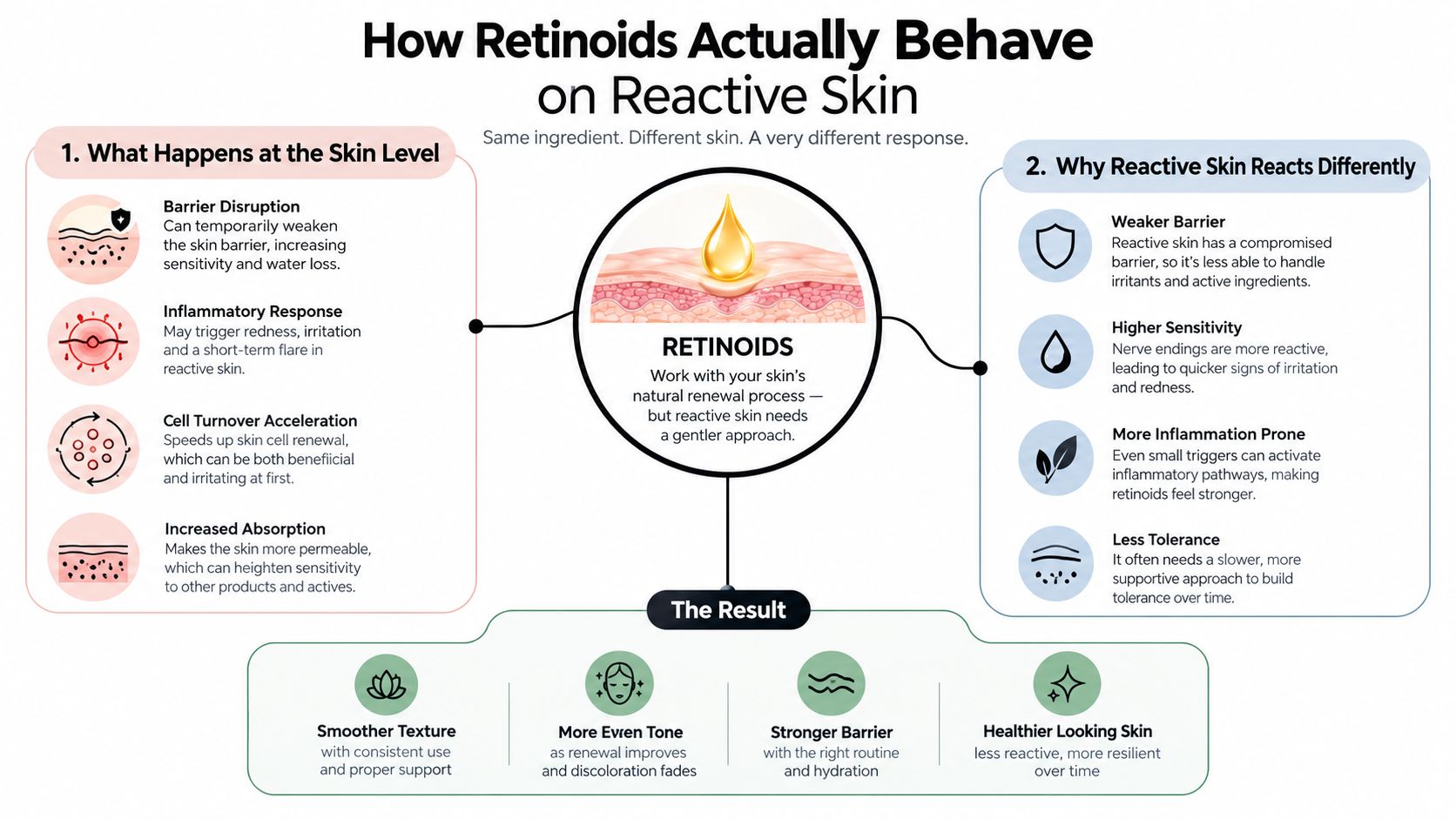
Think of the skin barrier as a construction site with a strict work schedule. Retinoids increase the pace of renewal, so older surface cells move out more quickly and newer cells arrive sooner. That faster schedule can support smoother texture and a more refined appearance, but a reactive barrier may experience the acceleration as disruption.
Retinoids don't “scrub” the surface. They influence how skin cells develop and communicate. In a 2003 mechanistic study, retinol-induced irritation was linked mainly to the inflammatory cytokines MCP-1 and IL-8, with dose-dependent irritation indices reported for retinol concentrations of 0.1%, 1%, and 2%. The reported irritation indices ranged from 0.74 to 0.49, showing why a higher-strength formula can produce substantial irritation even though retinol remains widely used in anti-aging skincare. Read the mechanistic retinol irritation study on PubMed
That inflammatory signaling helps explain why a product can sting even when your skin looked calm before application. The sensation isn't always a sign of an allergy. It may reflect a barrier that's allowing more active penetration than it can comfortably manage.
Retinoid type changes the workload
Cosmetic retinoids don't all sit at the same point in the conversion pathway. Retinyl esters are generally further from active retinoic acid and tend to offer a softer entry point. Retinol requires conversion in the skin before it can act. Retinaldehyde, also called retinal, sits one conversion step closer to retinoic acid, which is one reason it can feel more active.
Prescription tretinoin is already retinoic acid, while adapalene is a prescription-strength retinoid-like medication with its own pharmacology. These products shouldn't be treated as interchangeable with an over-the-counter retinol serum.
The practical point is simple. Conversion efficiency matters, but it isn't the only variable. A well-designed, gradually releasing formula may be easier to tolerate than a lower-looking percentage delivered abruptly through a drying base.
Your baseline matters
A systematic review identified sensitive skin as the most reliable predictor of irritation, and found that lower concentrations were generally better tolerated than higher ones in the reviewed retinoid comparisons. Review the evidence on topical retinoid tolerability
That's why I assess the skin before discussing a product. If cleanser, water, or a basic moisturizer already causes stinging, the first priority is barrier recovery. Retinoids work best when the skin has enough stability to adapt.
The Three Levers That Decide Tolerability
A percentage on the front of a box tells you only part of the story. I evaluate three levers together: retinoid type, concentration, and vehicle.
The first lever is the molecule. Retinyl esters generally offer a gentler starting point, retinol occupies the familiar middle ground, and retinaldehyde can provide a more direct route toward active retinoid signaling. None is automatically right or wrong for reactive skin. The formula has to match the person's reactivity and goals.
The second lever is concentration. Higher exposure can produce stronger effects, but it can also raise the irritation burden. In a clinical study of 173 Korean participants, researchers increased retinol exposure over three weeks, using 2500 IU in week one, 3300 IU in week two, and 5000 IU in week three. The sensitive-skin group reported irritation more often than the non-sensitive-skin group. See the Korean retinol tolerability study
The third lever is the vehicle, meaning the base and delivery system carrying the retinoid. Encapsulation, silicone particles, microsponge systems, emulsions, ceramides, physiologic lipids, panthenol, and carefully selected soothing ingredients can change how quickly and evenly the active reaches the skin.
What the formulation data tells us
A review reported that a 0.2% retinol silicone-particle formulation had a cumulative irritation score of 296.0±37.6, compared with 383.0±29.55 for a 2% retinol microsponge formulation. The comparison doesn't mean every silicone system will outperform every microsponge system. It shows that delivery technology can materially alter irritation burden, even when the label percentage isn't the only difference. Read the review of retinol delivery and irritation
| Lever | Low-Irritation Option | Higher-Irritation Option | Why It Matters |
|---|---|---|---|
| Retinoid type | Retinyl ester or well-formulated low-dose retinol | More rapidly acting retinoid used too aggressively | Conversion and activity influence how much adaptation the skin needs |
| Concentration | Lower exposure with gradual escalation | High concentration introduced frequently | More active exposure can increase dryness, erythema, and discomfort |
| Vehicle and delivery | Encapsulation, lipid-rich emulsion, barrier-supportive base | Fast-release, drying, alcohol-heavy vehicle | Release speed and barrier support can change the skin's inflammatory response |
I don't use a rigid “three-to-five-times gentler” rule because the evidence doesn't support applying one universal multiplier across products. The reliable heuristic is more useful: vehicle choice can matter as much as concentration.
If your barrier is already fragile, choosing a product with ceramides or physiologic lipids may be more meaningful than choosing the lowest number without checking the rest of the ingredient list. For additional barrier guidance, use this practical resource on repairing a damaged skin barrier.
Retinol Retinaldehyde and the Gentler Alternatives Worth Knowing
Sensitive-skin shoppers often stand in front of a display comparing retinol, retinaldehyde, bakuchiol, and newer retinoid-like blends. The label can make them look like interchangeable routes to the same result. They aren't.
Retinol
Retinol is the most familiar over-the-counter retinoid in this group. It can support smoother texture and a more even-looking complexion, but irritation remains a real trade-off. In a 2023 retinol-containing topical treatment study, about 30% of participants reported some skin irritation, although most continued after modifying use. The same study found significant increases in erythema, dryness or scaling, and itching during the first 4 to 8 weeks compared with baseline. Review the clinical retinol treatment data
A lower-dose retinol in an encapsulated, lipid-supportive moisturizer is often more sensible for a beginner than a bare high-strength serum.
Retinaldehyde
Retinaldehyde sits closer to retinoic acid than retinol, so it can feel more active and may suit someone seeking visible change without moving immediately to prescription therapy. That proximity doesn't make it automatically harsher. A 2026 comparative evaluation reported that stabilized 0.1% retinaldehyde was generally well tolerated with minimal adverse effects. Review the comparative retinaldehyde evaluation
For reactive skin, I'm interested in the complete system: stabilization, airless packaging, release behavior, and barrier ingredients. A 0.1% retinaldehyde product in a supportive cream or serum may be a better choice than a stronger, unbuffered retinol.
Bakuchiol
Bakuchiol is a genuine retinol alternative for people who can't tolerate retinoids, not merely a softer version of retinol. It's especially relevant for someone who experiences repeated irritation despite careful use. Anyone who is pregnant, trying to conceive, or breastfeeding should discuss skincare actives with a healthcare professional, and bakuchiol may be considered as an alternative only after individualized guidance.
It doesn't have identical pharmacology or the same depth of clinical evidence as prescription retinoids. I position it as a realistic option for supporting the appearance of texture and firmness when retinoids aren't a good fit.
Retinoid-adjacent blends
Retinoid-like peptides, bakuchiol-retinol hybrids, and granactive retinoid formulas can appeal to patients who want a gradual introduction. Their evidence depth and formulation quality vary, so I look for transparent labeling and barrier-supportive ingredients rather than relying on the novelty of the name.
For readers comparing non-retinoid options, this guide to a retinol alternative for irritation-prone skin offers useful context.
| Active | Typical Strength Range | Irritation Ceiling | Evidence in Sensitive Skin | Best Use Case |
|---|---|---|---|---|
| Retinol | Low to moderate cosmetic strengths | Moderate, especially with rapid escalation | Stronger history, but irritation is common | Someone who wants a familiar retinoid in a buffered formula |
| Retinaldehyde | Stabilized low-dose formulas, including 0.1% | Variable, often dependent on vehicle | Emerging comparative tolerability evidence | A patient seeking more activity with careful formulation selection |
| Bakuchiol | Product-specific cosmetic strengths | Generally lower than retinoid strategies, though reactions remain possible | Useful as an alternative, not an identical substitute | Someone who cannot tolerate retinoids or needs a non-retinoid conversation |
| Retinoid-like blends | Product-specific | Depends heavily on the blend and base | Variable | A cautious beginner prioritizing gradual exposure |
A Clinicians Safe Introduction Protocol for Sensitive Skin
I give sensitive-skin patients a schedule they can follow, not a slogan. The first step is assessing whether the skin is currently calm enough to begin. If water, cleanser, or moisturizer stings, repair the barrier first rather than adding a retinoid.
The first week
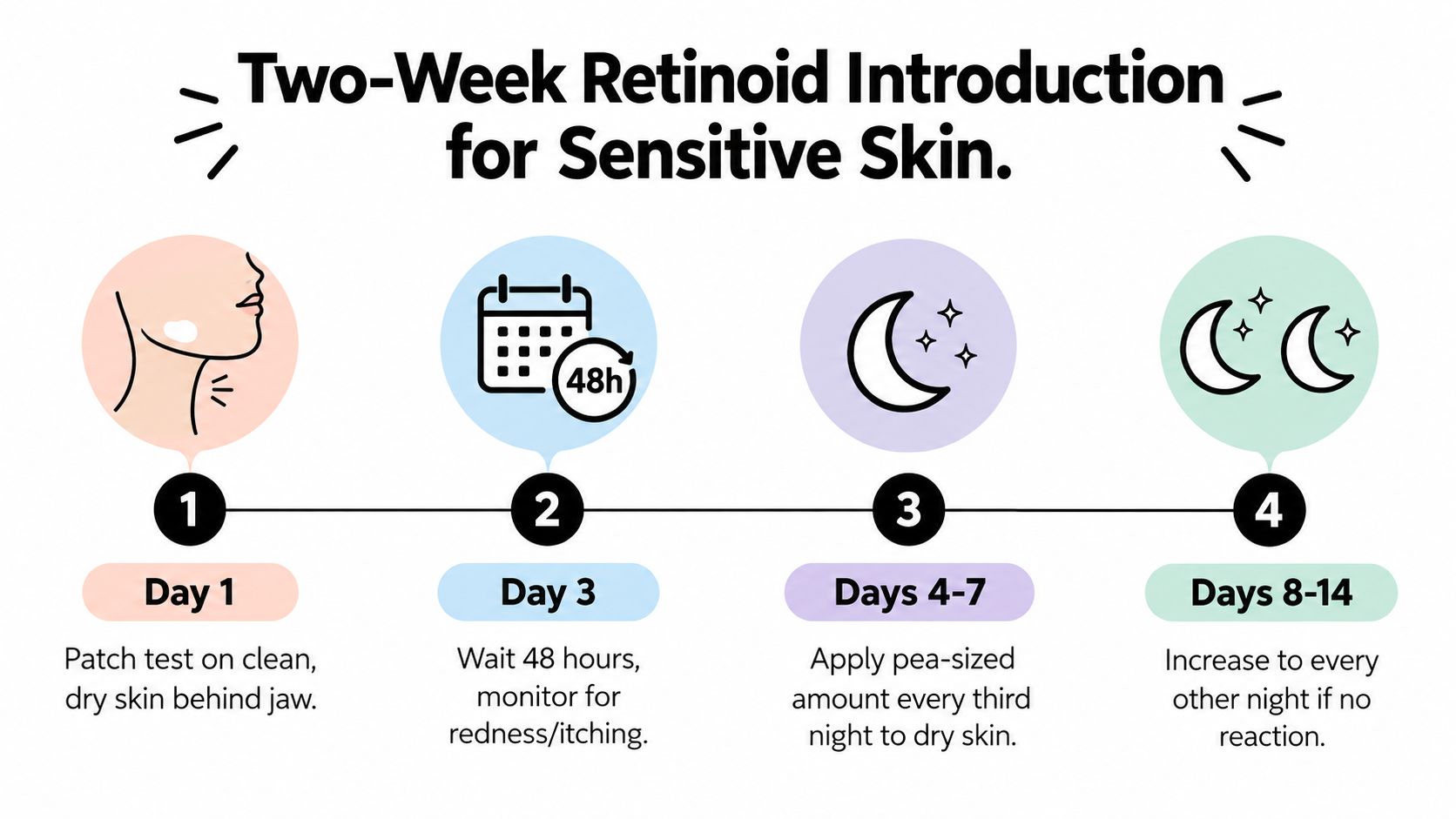
On day one, apply a small amount behind the jaw on clean, dry skin. Wait 48 hours and watch for redness, itching, swelling, or persistent stinging. A patch test can't predict every facial reaction, but it gives you an early safety checkpoint.
If the test area stays comfortable, apply a pea-sized amount to the entire face every third night during week one. Use clean, completely dry skin. Layer a plain ceramide moisturizer over damp skin after cleansing, allow the surface to become comfortable and dry, then apply the retinoid. Keep the rest of the routine deliberately quiet.
Humectants can help draw water into the upper layers, while occlusives reduce water loss. Ceramides and other barrier lipids support the structure that retinoids can temporarily challenge.
Skip the dose after exfoliation, significant sun exposure, windburn, or any day when the skin feels hot and reactive. Don't use an exfoliating acid, scrub, or another retinoid on the same night.
The second week
During week two, use the sandwich method if your skin remained comfortable: moisturizer, retinoid, then moisturizer. Increase to every other night only if there's no flaking or stinging.
Red or infrared LED light therapy may be a useful soothing adjunct, but I don't present it as a guaranteed way to accelerate adaptation or as a proven method for directly calming the MCP-1 and IL-8 cascade in every home routine. Use a correctly operated device according to its instructions. LED therapy is generally considered low-risk when used correctly, and reported device classes use wavelengths outside harmful UVA and UVB ranges. Review dermatology coverage of LED light therapy safety
Monitoring rule: If redness lingers beyond 30 minutes after application, halt progress. Don't increase frequency until the skin has returned to baseline.
For related scheduling questions, this guide on using retinol before or after vitamin C can help you separate potentially irritating actives by time of day.
Retinization or Real Irritation How to Tell the Difference
Mild retinization is a temporary adjustment, not a requirement to endure damage. I define the manageable version as light, uniform flaking and tightness that lasts roughly 5 to 14 days, without broken skin, true persistent redness, swelling, or significant pain.
Three checks make the distinction clearer.
Duration: If symptoms steadily resolve, you may be seeing adaptation. If they persist beyond two weeks or worsen with each application, reduce frequency or stop.
Severity: A brief, mild tingle is different from burning. Burning, swelling, oozing, open areas, or a severe rash warrants discontinuation and professional assessment.
Pattern: A predictable, mild response after application may reflect retinization. Random flares, sharply defined patches, or reactions that resemble rosacea, eczema, or contact dermatitis need a different level of caution.
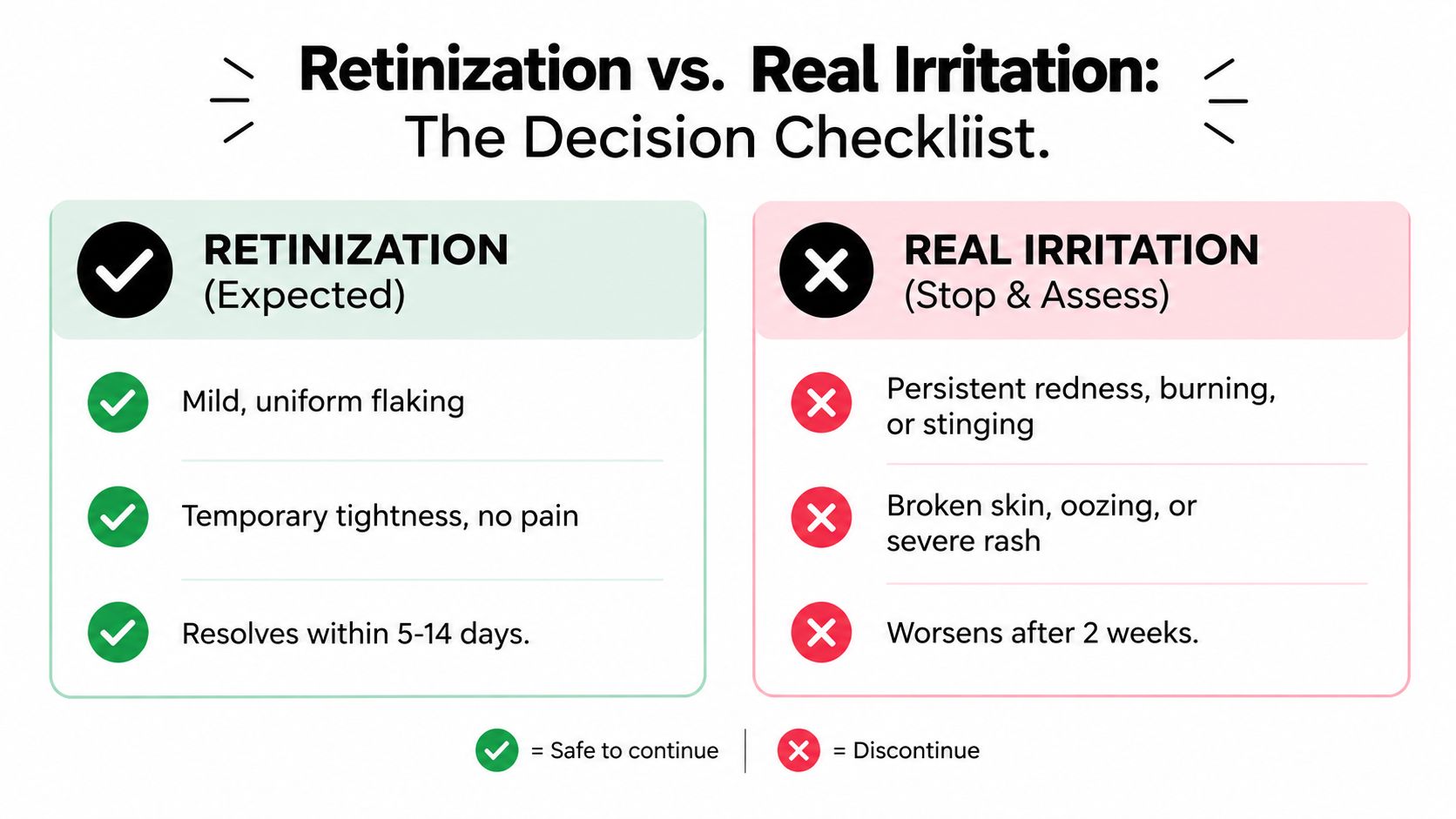
Use the reaction as a decision tool
| What you notice | What I'd do |
|---|---|
| Mild tightness or uniform flaking | Add moisturizer and hold the current frequency |
| Stinging that lasts or increases | Stop increasing frequency and add buffering |
| Persistent redness or burning | Discontinue and simplify the routine |
| Broken skin, swelling, oozing, or severe rash | Stop the product and seek professional guidance |
| Flare resembling rosacea or eczema | Don't push through, arrange a clinical assessment |
Keep a simple note after each application: product, amount, location, time of reaction, duration, and what the skin looked like the next morning. That record turns “my skin hates retinol” into useful clinical information.
More discussion of possible reactions is available in this guide to retinol serum side effects.
Recommended Product Archetypes From the Barb N.P Perspective
I recommend shopping by product architecture rather than celebrity ingredients. Three archetypes cover most sensitive-skin conversations.
The first is a low-percent retinaldehyde serum in an airless pump, supported by squalane, ceramides, or another lipid-rich base. This suits reactive skin that wants a more active retinoid, provided the patient starts at a low frequency and the formula avoids an aggressive delivery system.
The second is an encapsulated retinol moisturizer around 0.025% to 0.05%, paired with barrier-supportive ingredients such as niacinamide and panthenol. This is the most approachable structure for a beginner who wants retinol integrated into a moisturizer rather than delivered as a concentrated serum.
The third is a bakuchiol-synbiotic hybrid serum for someone who repeatedly fails retinoid trials despite careful use. It can provide a collagen-supportive skincare step without forcing the patient to keep provoking the same reaction.
Read the label beyond the percentage
Look at where the retinoid appears in the INCI list. If it sits around the middle, the formula may be using a lower concentration, although ingredient-list placement doesn't provide an exact percentage. I also prefer formulas without denatured alcohol high in the list or heavy fragrance, especially for skin that flushes or stings.
Barrier lipids, squalane, panthenol, and a well-built emulsion are more meaningful to me than a dramatic percentage claim. A product can be marketed as gentle and still be poorly matched to a compromised barrier.
| Archetype | Retinoid Type and Range | Barrier-Supporting Actives | Best For |
|---|---|---|---|
| Low-dose retinaldehyde serum | Stabilized retinaldehyde, including 0.1% formulas | Squalane, ceramides, calming emollients | Reactive skin seeking visible activity |
| Encapsulated retinol moisturizer | Encapsulated retinol around 0.025% to 0.05% | Niacinamide, panthenol, ceramides | First-time users rebuilding tolerance |
| Bakuchiol-synbiotic hybrid | Bakuchiol with retinoid-adjacent support | Prebiotic or soothing ingredients, moisturizers | People unable to tolerate any retinoid |
A product such as the Barb N.P. Facial Mask may also fit into a calming routine as an LED device option. Its stated practical features include wireless use, a comfortable face fit, and three lighting settings for different treatments. Use any LED device correctly and follow its instructions, particularly if you have a photosensitive condition or use photosensitizing medication.
Anyone with diagnosed rosacea, perioral dermatitis, active eczema, or recently post-procedure skin should consult a clinician before self-prescribing a retinoid. That consultation can prevent weeks of treating a reaction that needed a different diagnosis.
Long Game Thinking for Sensitive Skin and Retinoids
The best retinol for sensitive skin is the formula you can use consistently over the long term, not the strongest product you can survive briefly. A gentle retinaldehyde used twice weekly may serve you better than a stronger retinol that leaves you peeling, uncomfortable, and unable to maintain the routine.
Keep a skin diary with the product name, application nights, visible redness, stinging, flaking, and next-morning comfort. That makes seasonal adjustments easier. You may prefer a lighter vehicle during warm weather and a richer barrier-supportive base during dry winter conditions.
Persistent stinging beyond four weeks is information, not stubbornness. It may mean the concentration is too high, the vehicle is too irritating, the frequency is too ambitious, or the underlying condition needs assessment.
Calm skin is the priority. Monitor, adjust, and let consistency do the work instead of treating irritation as proof of effectiveness.
BotoxBarb offers personalized aesthetic services, LED light therapy, and a curated online selection of medical-grade skincare that can support a sensitive-skin retinoid routine. Visit BotoxBarb to explore skincare options and book professional guidance before restarting retinol after a significant reaction.