
Article: Botox Dysport Conversion Guide with Charts and Examples
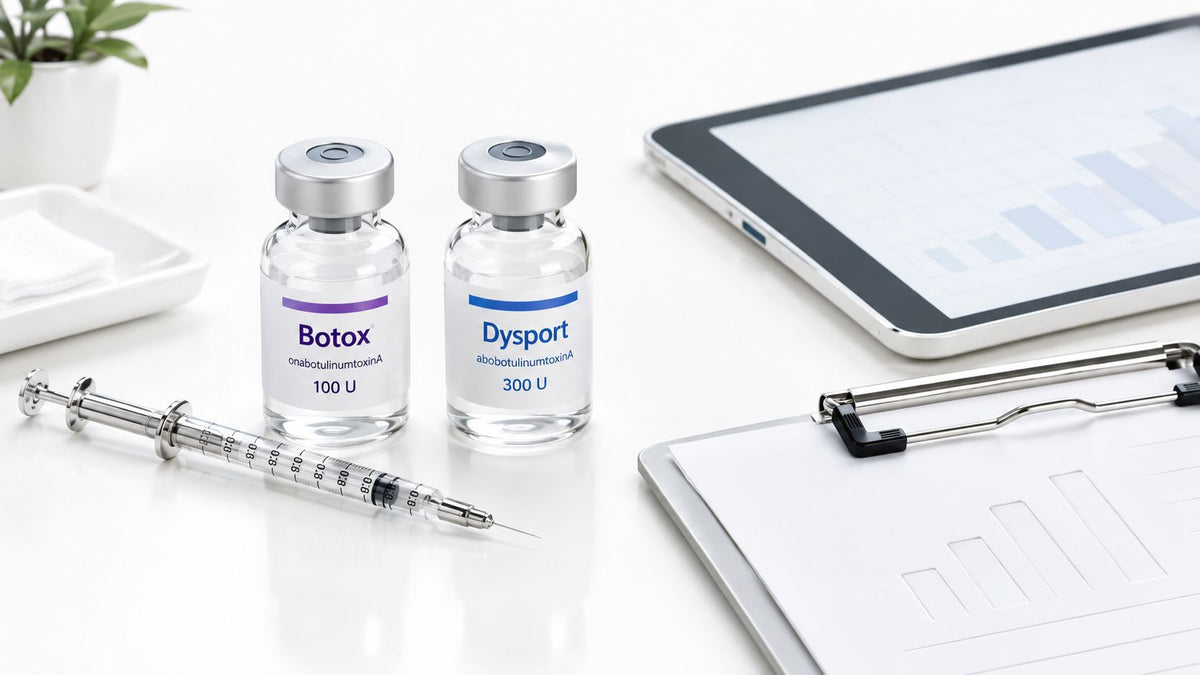
Botox Dysport Conversion Guide with Charts and Examples
A widely used clinical convention is 2.5 to 3 units of Dysport per 1 unit of Botox, so 20 units of Botox roughly align with 50 to 60 units of Dysport for glabellar lines. These products are not FDA-interchangeable, however, and the appropriate dose must be individualized by product, treatment area, muscle anatomy, and injector judgment.
You may be comparing an old treatment record with a new consultation, checking whether a quoted Dysport dose sounds comparable to your Botox history, or documenting a product switch in a clinical chart. The unit numbers can look dramatically different even when the intended clinical effect is similar. That difference reflects product-specific potency measurements, not automatically a stronger or weaker treatment.
Introduction to Botox Dysport Conversion for Clinicians and Patients
The phrase botox dysport conversion sounds like a simple multiplication problem. In practice, it's a clinical translation tool. A clinician may begin with a Botox treatment plan and estimate a Dysport range, while a patient may need help understanding why a previous Botox dose doesn't match a proposed Dysport number one to one.
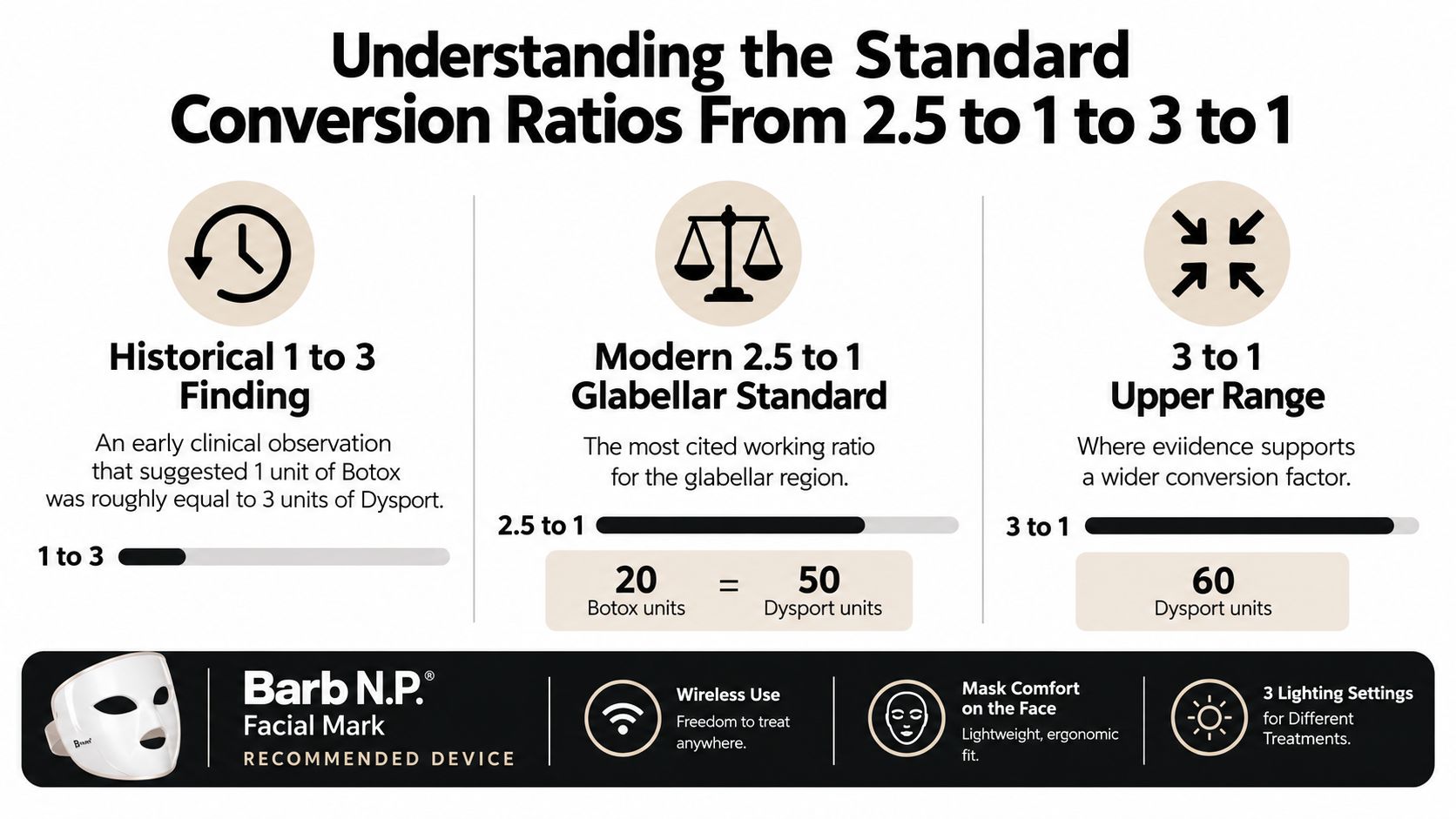
The most commonly used working range is 2.5:1 to 3:1 Dysport to Botox. Historically, comparative clinical research from the 1990s and 2000s repeatedly observed that 1 unit of Botox was roughly equivalent to 3 units of Dysport in clinical activity, even though the products weren't formally interchangeable. The early evidence helped establish the familiar rule of thumb, but it didn't create a universal mathematical law. PubMed's comparative pharmacokinetic record describes the clinical activity of 1 unit of Botox as roughly equivalent to 3 units of Dysport.
Practical rule: Use conversion math to support clinical reasoning, not to replace an examination.
This distinction matters for both safety and expectations. A patient's corrugator strength, frontalis activity, eyelid position, facial proportions, treatment history, and desired movement all influence the final plan. An injector should also document the exact formulation, target muscle, indication, dilution and chosen ratio rather than recording only a bare unit count.
How to use this guide
The next sections move from the underlying reason units differ to the commonly cited ratios, a quick-reference table, worked calculations, safety considerations, and complementary LED care. Readers looking for a fast estimate can use the table and calculator logic. Readers preparing for treatment should use the information to ask better questions, then defer the final prescription and injection plan to a qualified clinician.
Patients can also review what neuromodulators are before a consultation. The most useful question isn't “Which product has fewer units?” It's “Which product, dose and placement fit this treatment area and my goals?”
Why Botox and Dysport Units Are Not Interchangeable
Botox and Dysport both belong to the botulinum toxin type A category, but their labeled units come from different products and assay systems. A unit is therefore a product-specific biological measure, not a universal weight or volume that can be transferred directly between brands.
The FDA labeling makes this especially clear. The BOTOX label states that potency units are specific to the preparation and assay method and cannot be compared with or converted into units of another botulinum toxin product. The same principle applies to DYSPORT labeling. The FDA BOTOX prescribing information is the regulatory reason a 2.5:1 or 3:1 estimate must be described as a clinical convention, not an FDA-defined equivalence.
Why the ratio changes across settings
Comparative studies don't all measure the same outcome. One may assess visible muscle activity, another wrinkle improvement, and another symptom control in a movement disorder. Injection technique, muscle size, anatomy, treatment indication and follow-up timing can also affect the apparent conversion factor.
That's why a safe protocol names three things before applying math:
- Product: onabotulinumtoxinA or abobotulinumtoxinA, rather than “tox” or “units” alone.
- Indication: for example, glabellar lines or cervical dystonia.
- Target: the specific muscle group and treatment map.
A review of botulinum toxin conversion research found that reported ratios varied widely, while newer evidence more often supported a range around 2.5:1 to 3:1 in relevant settings. The clinical review on botulinum toxin conversion also emphasizes that labeled units aren't bioequivalent across products.
The practical consequence is reassuring when explained correctly. A higher Dysport number doesn't automatically mean a patient is receiving an excessive dose. It means Dysport's unit scale is different. The concern arises when someone treats the numbers as interchangeable, applies a blanket ratio to every facial zone, or increases the multiplier without reassessing anatomy and response.
For a patient-friendly comparison of the products' characteristics and treatment considerations, BotoxBarb also provides a discussion of Dysport versus Botox.
Understanding the Standard Conversion Ratios From 2.5 to 1 to 3 to 1
A clinician reviewing a prior Botox chart may need to estimate the corresponding Dysport amount. The arithmetic is straightforward, but the ratio is a clinical convention, not a universal exchange rate. Aesthetic protocols commonly work within 2.5:1 to 3:1, with the selected factor tied to the treatment area, anatomy, and documented experience.
For glabellar lines, a frequently cited comparison pairs 20 units of Botox with 50 units of Dysport, producing the familiar 2.5:1 ratio. This clinical dosing summary presents that pairing as a practical reference for the same region. The calculation is:
20 Botox units × 2.5 = 50 Dysport units
Comparing the commonly used factors
At 2.5:1, multiply the documented Botox amount by 2.5. This factor can provide a clear starting point for reviewing an aesthetic treatment map, as long as the original indication and anatomy are known.
At 3:1, multiply the same Botox amount by 3. Using the glabellar example, 20 Botox units would calculate to 60 Dysport units. A practice may use this convention for a defined muscle group or patient population, but the larger Dysport number does not by itself indicate a stronger or better treatment.
At 4:1, the calculation moves outside the commonly used aesthetic range and requires particular restraint. A review of conversion ratios in movement disorders supports a practical range of 1:2.5 to 1:3.0, while reporting that higher ratios may increase adverse effects in some settings. The review of conversion ratios in movement disorders provides context for why a blanket multiplier is inappropriate.
The ratio should therefore be recorded with its indication and purpose. For example: “Estimated Dysport amount based on a 2.5:1 aesthetic convention for the documented treatment area.” That note separates mathematical conversion from the clinical decision about whether the calculated amount is suitable. It also makes later review easier if the patient's response, muscle activity, or treatment plan changes.
A ratio belongs to the treatment context, not only to the product names. Aesthetic conventions should not be transferred automatically to movement-disorder care, where dosing evidence and safety considerations require separate evaluation.
Master Reference Table for Botox Dysport Conversion by Treatment Area
The table below is a calculation aid, not a dosing protocol. It shows how a known Botox amount translates mathematically at 2.5:1 and 3:1, but it doesn't establish that every patient should receive those Botox amounts or that the resulting Dysport range is appropriate for every face.
| Treatment Area | Botox Units | Dysport at 2.5 to 1 | Dysport at 3 to 1 |
|---|---|---|---|
| Glabellar lines | 20 | 50 | 60 |
| Forehead lines | 20 | 50 | 60 |
| Crow's feet | 20 | 50 | 60 |
The table uses the same illustrative Botox input so the ratio is easy to see. It does not imply that glabellar lines, forehead lines and crow's feet require the same starting Botox dose. Those areas have different muscles, different nearby structures and different tolerance for diffusion. The injector must establish the area-specific Botox dose first, then apply the selected conversion convention.
Reading the table safely
Start with the actual product and indication in the chart. If the record says 20 units of Botox for glabellar lines, the mathematical Dysport range is 50 to 60 units. If the same 20 units were used for another region, the arithmetic is unchanged, but the clinical interpretation may not be.
Next, identify the ratio used by the practice. A chart note should state something like: “Estimated Dysport dose based on 2.5:1 clinical convention for the documented treatment area.” That wording makes the calculation reproducible and prevents a future clinician from assuming the products were considered interchangeable.
Vial size also affects inventory and waste planning, but it doesn't define biological equivalence. One clinical study reported typical supply sizes of 100-unit Botox vials and 500-unit Dysport vials, and cited an average cervical dystonia dose of 200 units of Botox or 500 units of Dysport. The clinical study describing vial sizes and cervical dystonia dosing shows how a 2.5:1 convention may be operationalized in practice, while the official labels still prohibit direct unit conversion.
Documentation insight: Record the product name beside every dose. “50 units” without the product is incomplete clinical information.
Worked Example Calculations You Can Apply in Practice
A patient arrives with a previous Botox treatment record, but the clinic plans to use Dysport. The calculation provides a reference range, not a direct unit-for-unit substitution. Begin with the Botox dose documented for that indication, apply the selected convention, then individualize the final Dysport dose after examination.
Example one with glabellar lines
A documented plan uses 20 Botox units for the glabellar region.
- Multiply 20 by 2.5. The result is 50 Dysport units.
- Multiply 20 by 3. The result is 60 Dysport units.
- Record 50 to 60 Dysport units as the calculated range, rather than calling either figure an interchangeable equivalent.
A clear note could state: “Prior Botox plan, 20 units for glabellar lines. Dysport estimate, 50 to 60 units using a 2.5:1 to 3:1 clinical convention. Final dose individualized after assessment.” The published 20 Botox to 50 Dysport comparison supports the lower reference point, while the upper estimate follows the commonly used 3:1 convention. The practical conversion review examines this range and the safety considerations associated with each factor.
Example two with a forehead plan
For a reference plan of 16 Botox units:
- 16 multiplied by 2.5 equals 40 Dysport units.
- 16 multiplied by 3 equals 48 Dysport units.
The mathematical range is 40 to 48 Dysport units. Before choosing a final dose, assess frontalis activity, brow support and the patient's desired expression. Forehead treatment calls for careful placement because softening lines should not unnecessarily alter brow position or useful movement.
Example three with lateral canthal lines
For a 12-unit Botox reference dose around the lateral canthal area:
- 12 multiplied by 2.5 equals 30 Dysport units.
- 12 multiplied by 3 equals 36 Dysport units.
The estimate is 30 to 36 Dysport units. Around the eyes, arithmetic cannot account for injection depth, placement precision or the effect of unwanted spread. A measured plan and reassessment matter more than automatically selecting the top of the range.
Reverse calculation
To estimate a Botox reference from a Dysport record, divide the Dysport dose by the chosen ratio. 50 Dysport units divided by 2.5 equals 20 Botox units. Dividing 50 by 3 produces approximately 16.7 Botox units. Treat that result as a historical estimate, not as permission to repeat a prior dose without examining the patient.
Dosing Cautions and Safety Factors That Change the Ratio
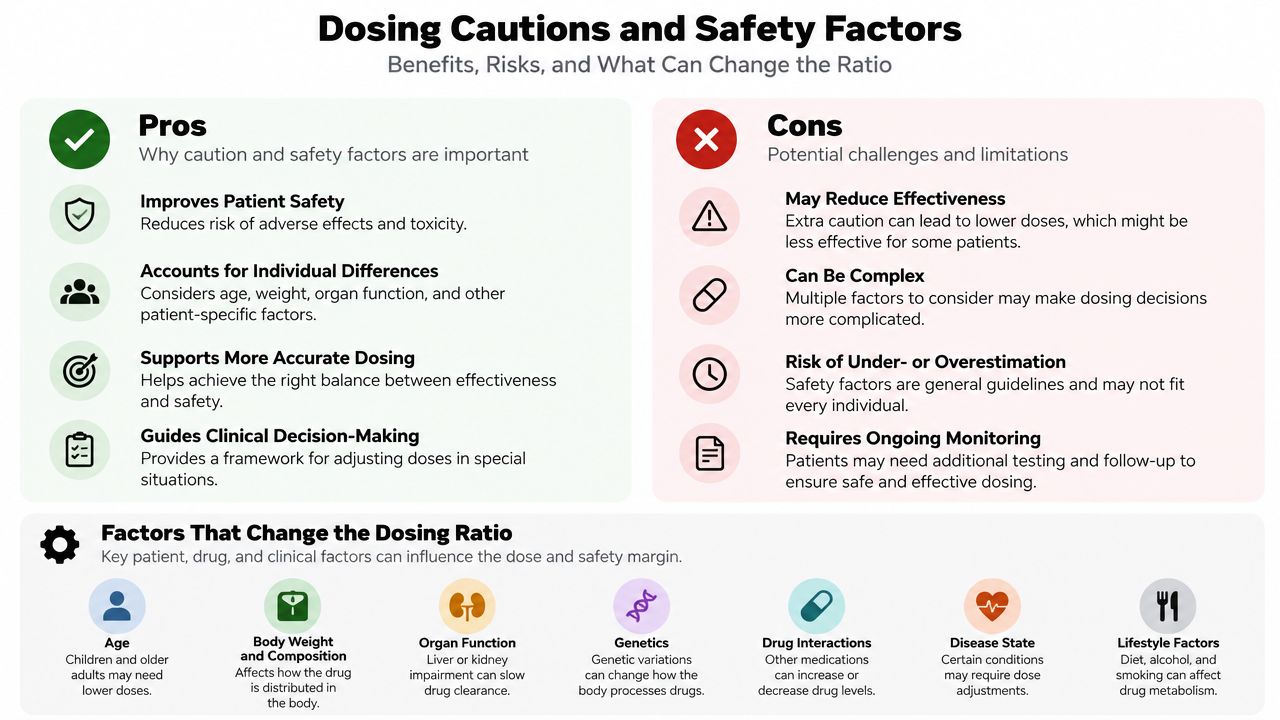
A conversion table may give a neat answer, while the patient in front of you still requires a different plan. The treated muscle, nearby anatomy, prior response and injection accuracy all affect the final dose. A ratio is a clinical convention, not an interchangeable rule. Its meaning can change with the indication.
Why conservative planning matters
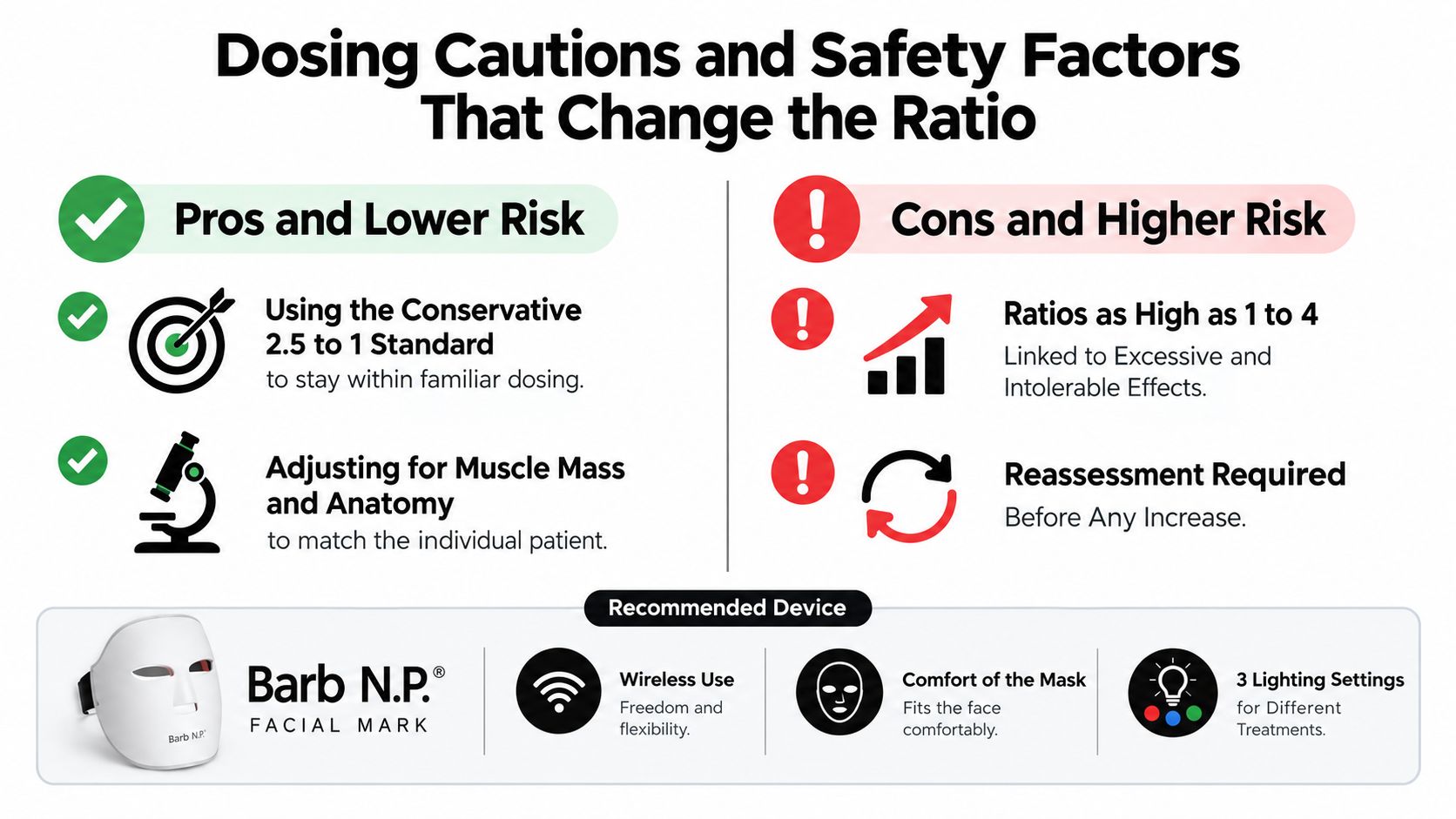
1:2.5 is a practical reference point, not a universal prescription. It can offer a cautious starting framework when the treatment area, indication and injection map support it. In some settings, moving toward 1:3 may maintain a similar clinical effect, while also carrying a possible increase in adverse effects. The clinical analysis of 1:2.5 and 1:3.0 helps clarify why multiplying by more units does not automatically produce a better result.
Before increasing a dose, reassess the patient, especially after changing products. Review the prior onset, degree and duration of benefit, unwanted weakness and asymmetry. Examine present muscle activity rather than relying only on a remembered unit count.
Factors that influence judgment
- Muscle strength: A strong muscle may need a different plan from a weaker muscle, even when the visible lines look alike.
- Anatomy: Brow position, eyelid support, muscle borders and neighboring structures determine how much room there is for dosing and placement error.
- Indication: A facial aesthetic protocol should not be transferred directly to cervical dystonia or another therapeutic use.
- Placement: Location, depth and distribution influence spread and outcome alongside the total unit count.
- Treatment history: Previous response provides context, but a current examination remains necessary.
The appropriate ratio can also depend on the condition being treated. A randomized crossover study in cervical dystonia compared 1:3 and 1:4 and concluded that the suitable factor in that setting was less than 3:1. The published crossover study supports indication-specific caution, rather than a universal escalation strategy.
Safety principle: A ratio change should trigger a new assessment and clear documentation. Do not increase the Dysport number simply because someone expects the Botox number to be multiplied.
Patients need individualized counseling about onset, spread and possible adverse effects, without promises about an identical experience. New weakness, asymmetry or another unexpected symptom should be reported promptly to the treating clinician.
Supporting Skin Recovery and Results With LED Light Therapy
Neuromodulators address muscle movement. They don't replace a skincare routine for texture, tone, barrier support or environmental protection. A broader aesthetic plan can pair appropriate injectable treatment with gentle skincare and complementary light therapy, as long as the clinician confirms that the timing and device use fit the patient's post-treatment instructions.
Independent evidence for LED facial masks remains limited, but wavelength-specific research supports potential benefits in selected skin concerns. One randomized controlled trial of blue and red light for acne reported that a 4-week regimen was well tolerated and improved inflammatory acne lesions compared with placebo, although the retrieved record doesn't verify the product-specific features of every consumer mask.
The Barb N.P. Facial Mask
The Barb N.P. Facial Mask can be considered as an at-home LED option because it's described with three practical features: wireless use, a comfortable mask fit on the face, and three lighting settings for different treatment goals. Those features may make it easier to follow a consistent routine, but they shouldn't be presented as proof of a particular medical outcome for every user.
Use LED therapy as a supportive skin-health step, not as a substitute for a qualified injection plan. Follow the device directions, protect sensitive skin as advised, and ask your clinician when to resume any device after an injectable appointment. Patients who want to understand the broader role of LED skincare can review LED light therapy for skin.
LED therapy may also be discussed beyond facial skincare. For readers exploring light-based approaches for the scalp, scalp light therapy for hair growth offers a separate resource focused on that treatment area. The face and scalp have different goals, so the same device or routine shouldn't be assumed to apply interchangeably.
Building a calm routine
A simple routine supports consistency:
- Cleanse gently: Avoid introducing unnecessary irritation around treatment days.
- Follow clinician guidance: Timing matters after injections, especially if the skin is tender or reactive.
- Use medical-grade basics: Sun protection and a suitable moisturizer remain foundational.
- Track response: Note irritation, dryness or sensitivity so the routine can be adjusted.
The best complement to injectable care is not the most complicated routine. It's one that matches the patient's skin, treatment plan and ability to follow it comfortably.
Quick Reference Calculator and Clinical Checklist for Safe Use
Use the following logic as a point-of-care reminder, not as an independent prescribing tool.
Calculator formulas
Botox to Dysport
Dysport estimate = Botox reference dose × selected ratio
Use the two common working factors:
- 2.5:1: Botox dose multiplied by 2.5.
- 3:1: Botox dose multiplied by 3.
For a 20-unit Botox reference, the resulting Dysport estimates are 50 and 60 units, respectively. The calculation is only meaningful when the original Botox dose, treatment area and indication are documented.
Dysport to Botox
Botox estimate = Dysport reference dose ÷ selected ratio
A reverse calculation helps interpret an old record, but it shouldn't be used to recreate treatment automatically. The clinician must confirm the product, indication, muscle activity and current goals.
Clinical checklist
Before treatment, verify:
- Product: Is the planned formulation clearly named as Botox or Dysport?
- Indication: Is the treatment area and clinical purpose documented?
- Ratio: Is the selected factor recorded as a clinical convention rather than an FDA equivalence?
- Dose: Are the product-specific units and total dose written separately?
- Anatomy: Has muscle strength, brow position and nearby sensitive anatomy been assessed?
- History: Has the patient's prior response, duration and adverse effects been reviewed?
- Consent: Has the patient understood that unit numbers aren't interchangeable?
- Follow-up: Is there a plan to reassess before any increase or product change?
Keep the table available for arithmetic, and return to the safety discussion whenever the treatment area is complex or the proposed ratio changes. Patients should bring prior treatment records when possible, including the product name and units, because “I had 20 units” isn't enough information by itself.
BotoxBarb offers consultations and aesthetic services that include Botox, Dysport, dermal fillers, LED light therapy and skincare guidance, allowing treatment planning to connect product selection with broader skin and wellness goals. Visit BotoxBarb to review available services and products, then bring your conversion questions to a qualified clinician before treatment.

