Best Cheek Filler Guide to Lift Volume and Longevity
You notice it first in photos. Your midface looks flatter, the shadow beneath the eyes seems stronger, or your cheekbones no longer frame your face the way they once did. A quick search for the best cheek filler brings up firm gels, flexible gels, collagen stimulators, longevity claims, and product rankings that make the decision look simpler than it is.
In practice, there isn't one universal winner. The right choice depends on whether your face needs projection, support, soft volume, dynamic movement, or gradual collagen stimulation, along with how comfortable you are with maintenance and whether you want an option that can be adjusted. This guide uses the same decision points I use in consultation, including anatomy, product behavior, safety, recovery, and long-term fit.
| Goal | Product direction | Why it may fit | Main trade-off |
|---|---|---|---|
| Immediate, precise cheek volume | Hyaluronic acid filler | Adds structure and hydration right away | Requires eventual maintenance |
| Defined zygomatic projection | Firmer, cohesive HA | Holds shape and supports lift | May feel or look less soft if poorly selected or placed |
| Natural movement while smiling | Flexible HA | Integrates more naturally in a mobile midface | May offer less rigid structural support |
| Gradual, diffuse volume improvement | Biostimulatory filler | Encourages collagen development over time | Results aren't immediate and correction is more complex |
| First treatment with a preference for reversibility | HA filler | Can be treated with hyaluronidase when clinically appropriate | Reversibility doesn't eliminate procedural risk |
Why Finding the Best Cheek Filler Feels Confusing
A patient may arrive with a very specific complaint, such as under-eye shadowing or deeper lines beside the nose, while the underlying issue is reduced cheek support. Another person may have no obvious age-related hollowing at all. They may want more cheekbone definition in photographs. Both can ask for the best cheek filler, but they aren't asking for the same treatment.
The confusion starts when product names replace assessment. A firm gel may be useful for a flatter lateral cheek, while a more flexible formulation may make more sense across a mobile anterior cheek. Someone who wants a subtle refresh and someone seeking visible contour shouldn't receive the same plan just because both mention cheek volume.
Best means best fit
The cheeks aren't one flat injection zone. The medial cheek, anterior cheek, lateral cheek, and zygomatic arch each create different visual effects. Placement can influence whether the result reads as lift, projection, fullness, or puffiness, and the same syringe can behave differently depending on depth, tissue quality, facial movement, and the amount already present.
Longevity also deserves a more honest conversation. Midface HA fillers may last roughly 8 to 12 months in many clinical series, while selected products and techniques have shown benefits persisting to 18 to 24 months, according to a recent review of cheek-filler durability and the limits of the current evidence base (review of midface HA filler longevity). The longest-lasting option isn't automatically the best option if it creates more maintenance anxiety, swelling concerns, or difficulty correcting an overfilled result.
My consultation rule: choose the product and placement that solve the specific structural problem without asking the face to carry more volume than it needs.
At BotoxBarb, a consultation should clarify your baseline anatomy, desired degree of change, previous filler history, skin quality, and tolerance for downtime. Bring photos that show what bothers you, but also be open to a plan that treats the cheek as part of the whole midface rather than chasing every shadow directly.
How Cheek Fillers Work and What They Can Do
Cheek filler works by placing a material in a carefully selected tissue plane to change the way light, shadow, and facial contours interact. The injector isn't filling a hollow. They're deciding where support is missing and whether the desired result calls for vertical lift, forward projection, lateral width, or softer transition.
Age-related volume loss can affect the fat compartments and supporting structures of the midface. A patient may see a flatter cheekbone, a hollow beneath the lower eyelid, or a heavier transition toward the nasolabial area. Restoring cheek support can improve the overall balance of the face, but it won't correct every concern and shouldn't be used as a substitute for a full facial assessment.
The main filler categories
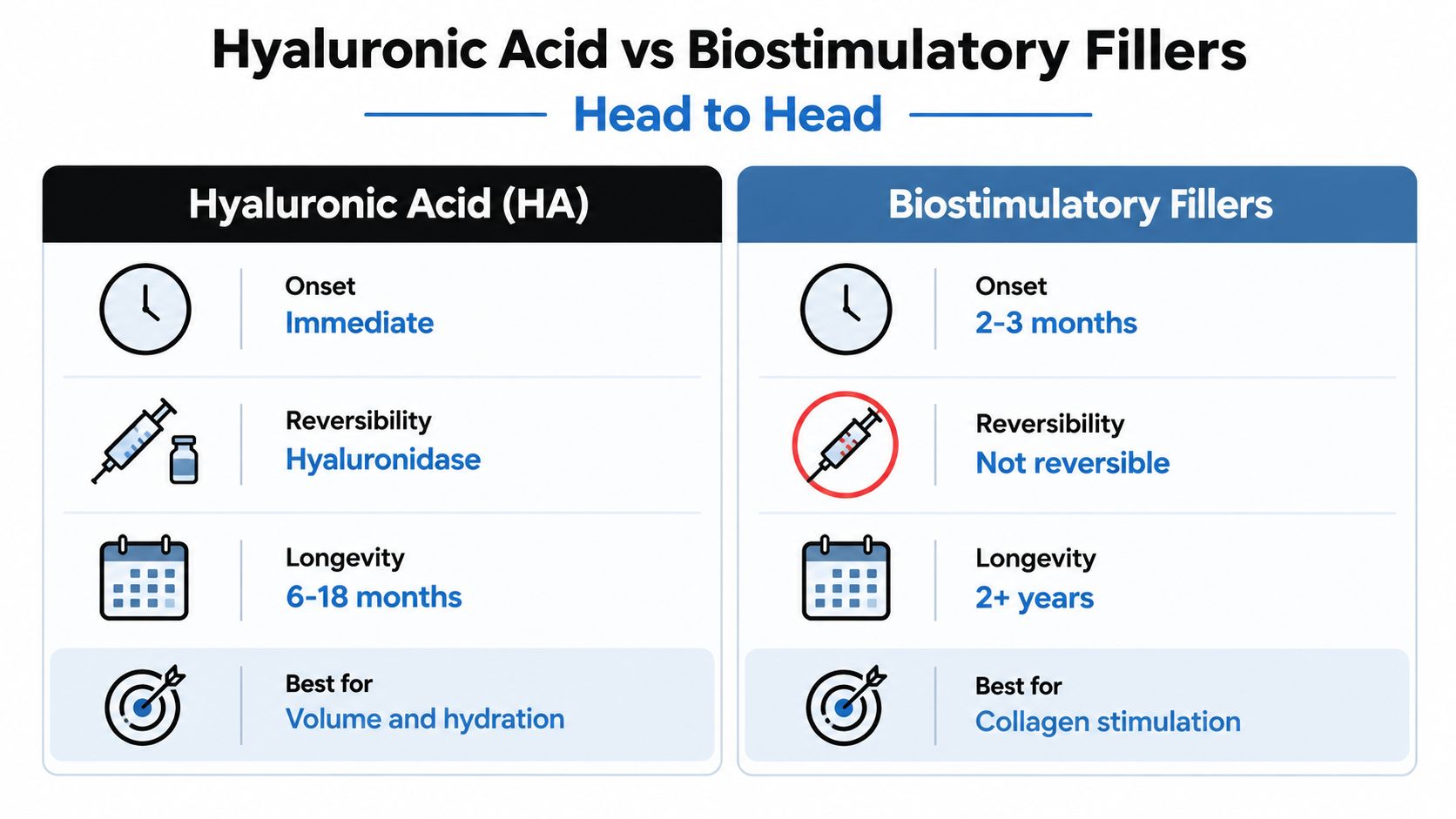
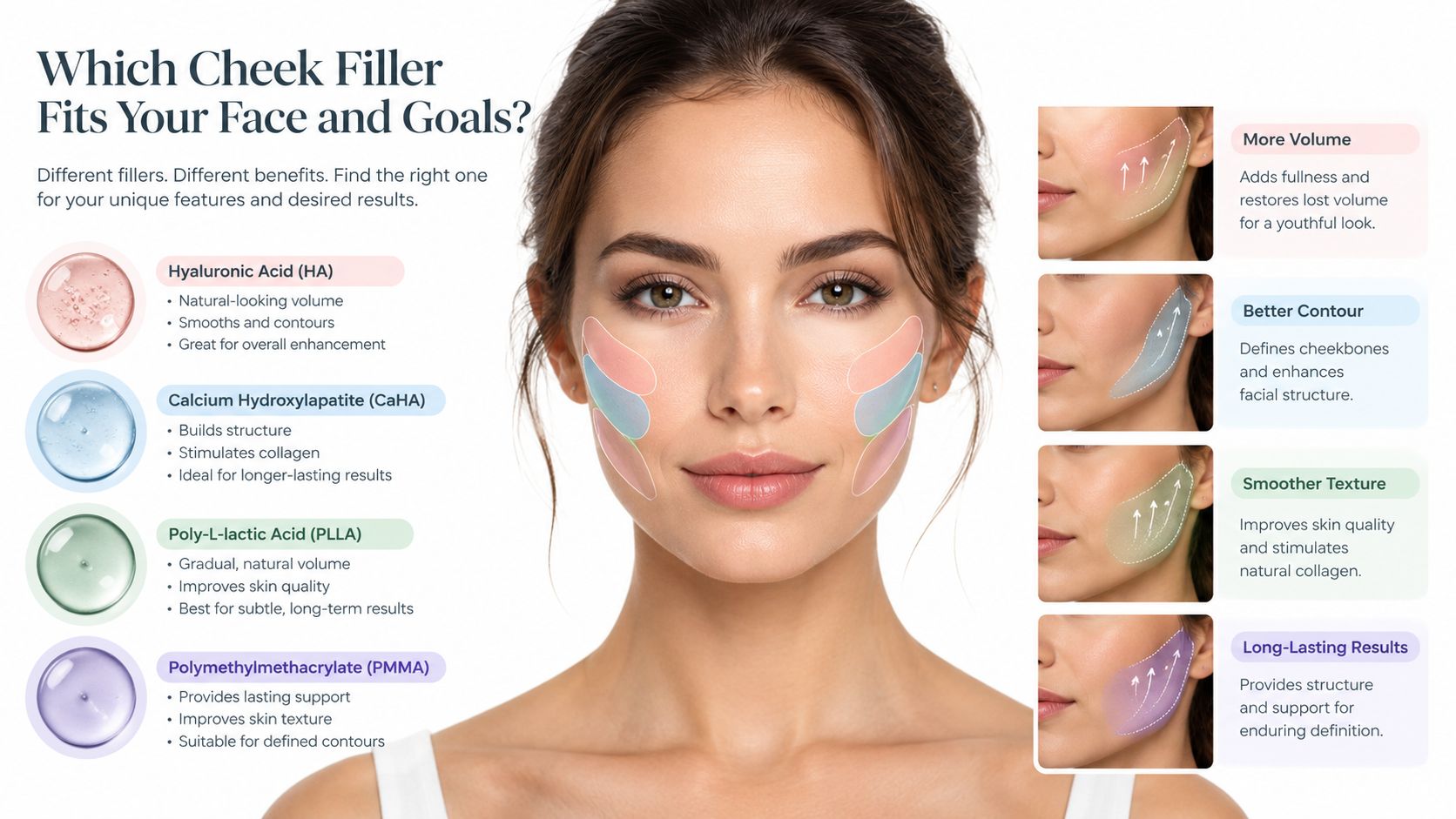
Hyaluronic acid, or HA, fillers add immediate volume and attract water, which can create both structure and hydration. Their main practical advantage is control. The injector can select a product with a specific balance of firmness, cohesivity, and flexibility, then adjust the plan at a later visit. When clinically appropriate, HA can also be treated with hyaluronidase, an enzyme used to dissolve HA filler.
Biostimulatory fillers work differently. Materials such as poly-L-lactic acid encourage the body to build collagen gradually rather than delivering the complete visual result at the appointment. They can suit diffuse volume loss and patients who prefer a progressive change, but they aren't the simplest choice for someone seeking precise, immediate cheekbone projection or easy reversal.
What lift actually means
Lift capacity describes how well a gel can support tissue and create a visible change from a given placement. In a 2025 split-face study, two rheologically different HA cheek fillers produced similar midface lifting through 12 months. Cheek-region lift measured at at least 2.07 mL for one product and at least 2.08 mL for the other, with no significant difference in lifting-capacity ratios over time (2025 split-face cheek-filler study).
That finding matters because a product doesn't need to win a ranking to work well. The more flexible formulation showed more distributed integration and better support for dynamic expression, which is especially relevant when the cheek changes shape during smiling. Product selection and injection technique remain inseparable. A useful plain-language overview of the mechanism is available in this explanation of how dermal fillers work.
Hyaluronic Acid Versus Biostimulatory Fillers Head to Head
A patient asking for the “best” cheek filler may want one of several different outcomes: sharper cheekbone definition today, softer support across a hollow midface, or gradual improvement with fewer visible changes at first. HA and biostimulatory fillers serve those goals differently. HA is a preformed gel, so the injector can control placement, projection, and contour immediately. A biostimulatory filler prompts a tissue response, meaning improvement develops over time and varies with the patient's biology.
| Criterion | Hyaluronic Acid Filler | Biostimulatory Filler |
|---|---|---|
| Onset | Immediate structural change, followed by settling | Progressive improvement as collagen develops |
| Reversibility | HA can be treated with hyaluronidase when appropriate | Generally isn't reversed with an enzyme |
| Best use | Precise projection, targeted volume, and contour | Diffuse support and gradual collagen-focused improvement |
| Movement | Product choice can range from firm to flexible | Depends on material, technique, and tissue response |
| Maintenance | Retreatment when the visible result fades | May involve a staged treatment plan and later maintenance |
| Main concern | Swelling, asymmetry, or overcorrection | Delayed result and more difficult correction if placement is problematic |
A 2024 systematic review and network meta-analysis found no significant differences in Global Aesthetic Improvement Scale scores at 1, 3, and 6 months among the compared HA cheek-volume fillers. Safety outcomes varied, with one filler showing significantly lower adverse-event risk than several comparators, including risk ratios as low as 0.22 to 0.36 (systematic review of HA cheek-volume fillers). The practical point is straightforward: a similar short-term appearance score does not make every product equally suitable for every cheek or patient.
The practical trade-off: durability is valuable, but so are reversibility, predictable integration, and a manageable recovery.
For defined cheekbone projection now, HA may be the more sensible starting point, particularly when the patient values the option to adjust treatment with hyaluronidase when clinically appropriate. A flexible HA formulation can also suit the dynamic midface, where the cheek changes during smiling. A biostimulatory approach may fit broader volume loss or a patient who accepts a staged plan and a slower, less immediately controllable result. Product choice should follow the cheek subregion, tissue quality, expression pattern, safety considerations, and lifestyle, not a longest-lasting claim.
Readers who prefer a structured comparison can use the same fit-and-context approach described in this guide on GEO for SaaS teams. In an injectable consultation, that means weighing anatomy, prior reactions, product behavior, reversibility, and technique together. BotoxBarb's biostimulator injection guide provides further background on why biostimulatory treatments follow a different timeline from HA.
Product Traits That Change Your Result
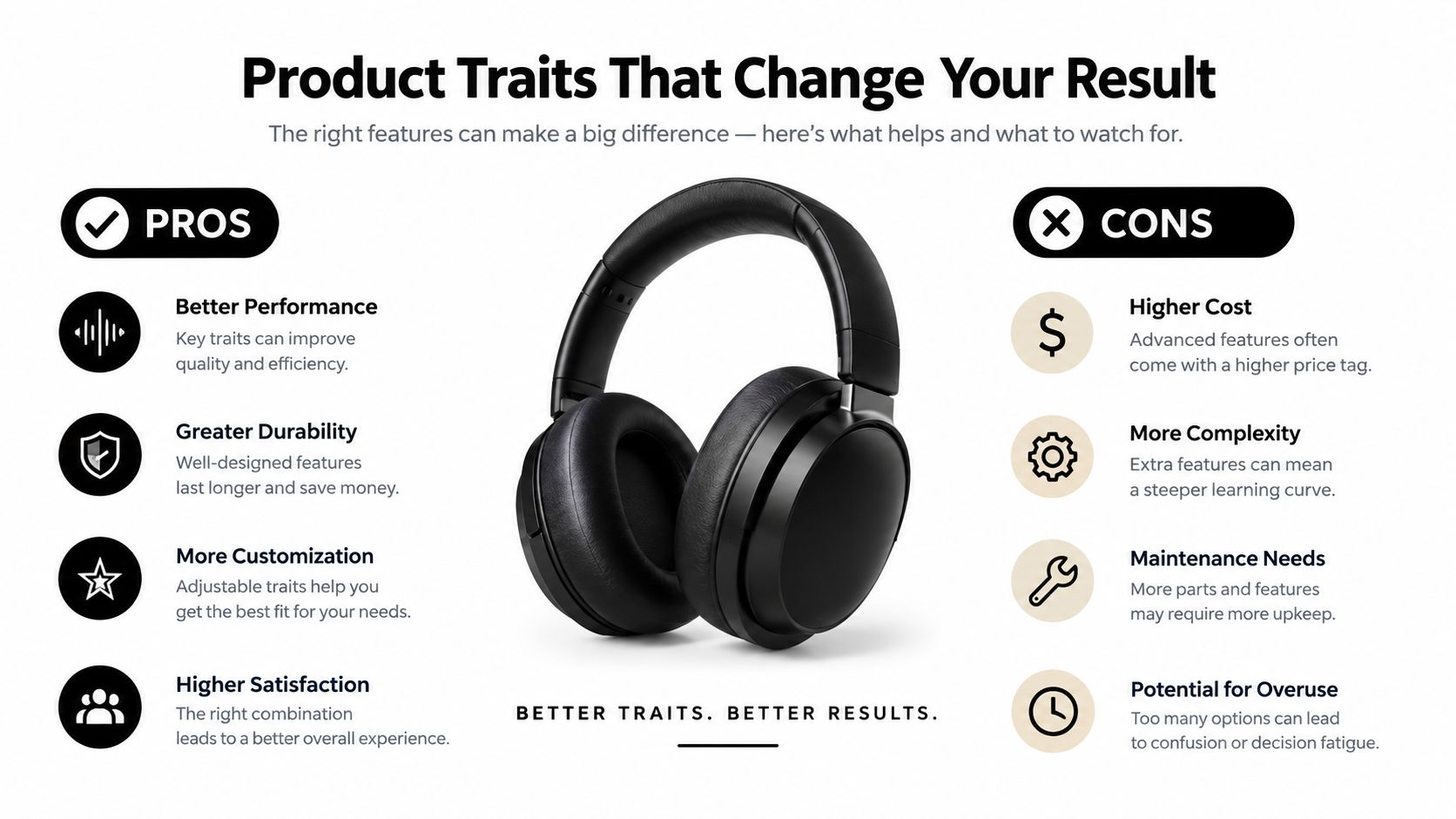
A cheek filler's brand name tells only part of the story. In the treatment chair, the gel's physical behavior often determines whether the result looks structured, soft, or overly apparent. Four terms help describe that behavior: rheology, G Prime, cohesivity, and flexibility. They explain how a product responds to pressure, spreads through tissue, maintains shape, and moves with facial expression.
Rheology and spread
Rheology describes gel behavior under force. A formulation that spreads in a controlled way can soften a broader transition, while one that is too fluid for the intended tissue plane may travel beyond the area the injector planned to treat. A thicker gel is not automatically the better option. Resistance to movement can support projection, yet may feel or look less forgiving in a cheek that changes noticeably during smiling.
G Prime refers to a gel's resistance to deformation. Higher G Prime products generally provide more structural support and projection. They may also feel firmer or create a sharper contour when the volume, depth, or placement does not match the patient's anatomy.
Cohesivity and flexibility
Cohesivity describes how well the gel stays together after placement. A cohesive filler can preserve a defined shape, which may suit the lateral cheek or zygomatic arch. Strong shape retention can reduce diffuse integration, so the same property that supports definition may be less suitable where a soft transition is the goal.
Flexibility matters in the anterior cheek and other mobile areas. Smiling, speaking, and chewing change the tissue throughout the day. The split-face evidence cited earlier supports assessing integration and movement separately from lift capacity. A gel can provide structural support while behaving differently during expression (split-face evidence on flexible cheek filler).
Safety belongs in product selection
Comparable aesthetic improvement does not mean identical safety performance. A network meta-analysis found differences in adverse-event risk among the HA products it compared, even when short-term improvement was similar (HA filler efficacy and safety comparison). Product selection should therefore include the available safety evidence, the treatment plane, the cheek subregion, and the injector's familiarity with that formulation.
The lateral cheek may benefit from controlled support and shape retention. The anterior cheek often calls for a product that integrates comfortably with movement. Neither choice can compensate for poor anatomy assessment, superficial placement, excessive volume, or inadequate knowledge of vascular anatomy. The best cheek filler is the one whose behavior fits the tissue, expression pattern, desired contour, and ability to manage complications.
Which Cheek Filler Fits Your Face and Goals
A useful consultation starts with the result you want to see in the mirror, then works backward to the product family and injection plan. These scenarios can help you organize that conversation, but they can't replace an in-person assessment of your tissue, proportions, and medical history.
You want a quiet refresh
If early volume loss has made the midface look tired but you don't want a visible contour change, a conservative HA plan may be appropriate. A flexible or moderately supportive gel placed in selected areas can restore transition without making the cheek look round. The key question is whether you need actual projection or only a small amount of structural support.
You want stronger cheekbone definition
A flatter lateral cheek or less visible zygomatic arch may call for a firmer, cohesive HA chosen for projection. The injector may focus on deep structural placement rather than spreading product broadly through the anterior cheek. This approach can create a cleaner contour, but it requires restraint. More structure isn't always more attractive, particularly on a narrow face or in thin skin.
You want soft support in a mobile midface
If your priority is natural movement when you smile, a flexible HA may be preferable to the firmest available gel. The 2025 split-face findings support the idea that similar lift can coexist with different integration and expression behavior (clinical comparison of flexible and firm HA fillers). Your injector should still evaluate whether the product offers enough support for the specific subregion being treated.
You have diffuse volume loss
A biostimulatory approach may suit someone who wants gradual, broader improvement rather than a sharply defined cheekbone. This requires patience and a willingness to accept that the result won't be fully visible immediately. Patients who need a precise correction, have limited tolerance for uncertainty, or want straightforward reversal may prefer HA instead.
You're new to filler and want an adjustment option
For a first treatment, HA often offers psychological as well as technical control. You can begin conservatively, allow swelling to settle, and reassess the result before adding more. If the outcome requires correction, HA's potential reversibility is a meaningful consideration, although it doesn't make the treatment risk-free.
Longevity Pricing Risks and Recovery Expectations
Longevity should be discussed as a range, not a promise. In a two-year comparative split-face study, the two monophasic HA fillers retained 81% and 66% of the four-week volume increase at two years, while the two biphasic fillers retained more than 50% of the four-week result (two-year comparative HA cheek-filler study). Those figures provide a durability benchmark, but individual metabolism, facial movement, tissue quality, product selection, and treatment technique still influence what you see in the mirror.
A separate multicenter study reported that 89.3% of subjects were rated much or very much improved at week 3, 90.9% at month 3, and 76.4% at month 6. At six months, 65.8% of the week-three correction remained, while three-dimensional analysis found 67.7% of volume maintained and 92.1% of subjects satisfied or very satisfied (multicenter HA cheek-enhancement study). These results show why follow-up timing matters. Early swelling and later product persistence answer different questions.
What pricing should include
Clinics may quote by syringe, treatment area, or an overall plan. The final cost depends on the product selected, the amount needed, whether treatment is staged, and whether a follow-up or refinement is included. Be cautious about choosing based on the lowest per-syringe price when the plan, injector experience, and emergency support aren't clear.
Ask for:
- Product identity: Confirm the exact filler and whether it suits the intended cheek subregion.
- Treatment scope: Clarify how many syringes are proposed and whether the plan may be staged.
- Follow-up policy: Understand when the provider evaluates swelling, asymmetry, or the need for refinement.
- Correction planning: Ask how the clinic manages complications and whether HA reversal is available when appropriate.
Recovery and technique
A cheek filler appointment may involve either needles or cannulas. In an evaluator-blind randomized study of VYC-20L for cheek augmentation, 60 adults with moderate-to-severe midface volume deficit received treatment with cannulas or needles. Mean MFVDS change at month 1 was -1.8 with cannulas and -1.9 with needles, with a paired difference of 0.1; the study reported minimal procedural pain, no serious adverse events, and concluded the product was safe and effective with either approach (VYC-20L cannula and needle study).
Expect temporary swelling, tenderness, and possible bruising. Don't judge the final contour while swelling is active, and follow your injector's specific instructions about pressure, exercise, heat, alcohol, medications, and when to contact the clinic. For a broader explanation of duration and maintenance planning, see BotoxBarb's guide to how long filler lasts.
Between appointments, skin-quality support can complement an established recovery routine. The Barb N.P. Facial Mask is a wireless LED device designed for comfortable wear across the face, with three lighting settings intended for different treatment goals. It isn't a substitute for medical aftercare, but it can fit into a calm, consistent skincare routine once your provider says home light therapy is appropriate.
Our Recommendation and Your Next Steps at BotoxBarb
My recommendation is situational, not a single product winner. A flexible HA filler makes the most sense when natural movement and a soft anterior-cheek transition matter most. A firmer, cohesive HA may be the better tool for defined lateral projection or zygomatic support, provided the injector controls depth and volume carefully.
A biostimulatory filler deserves consideration when the goal is gradual collagen support across a broader area and the patient accepts a delayed result with less straightforward correction. It isn't my first choice for someone who wants a precise cheekbone change immediately or feels anxious about not being able to reverse the material with hyaluronidase.
Prepare for a productive consultation
Bring a short list of priorities rather than a product demand. Useful questions include:
- Result: Do I want lift, projection, softness, or broader volume improvement?
- Movement: How will this formulation behave when I smile?
- Safety: What adverse effects are associated with the proposed product and technique?
- Maintenance: What might reassessment and future treatment look like?
- Reversibility: If HA is used, what correction options are available if needed?
- Proportion: Will treating the cheek alone support the balance of my full face?
Bring a list of medications, allergies, previous filler treatments, and photos that show your concern in neutral expression and while smiling. A provider should explain why a particular product fits your anatomy, not present a brand as the answer.
BotoxBarb offers dermal filler services for restoring volume and enhancing facial contours, along with skincare and light-therapy products through its online boutique. The Barb N.P. Facial Mask can be found at barbnp.shop, where patients can also explore medical-grade skincare options. For practices and patients interested in smoother administrative coordination around healthcare services, a Medical virtual assistant can be a useful operational resource, but clinical product selection and injection decisions belong with a qualified injector.
Review your result after swelling has settled, not in the first mirror check. The most convincing cheek filler usually looks like better support, clearer light, and a more rested expression rather than an obvious addition.
Book a personalized cheek-filler consultation with BotoxBarb to assess your midface anatomy, compare flexible HA, firmer HA, and biostimulatory options, and build a maintenance plan that fits your goals. Visit BotoxBarb to explore appointment options, dermal fillers, medical-grade skincare, and the Barb N.P. LED Facial Mask.