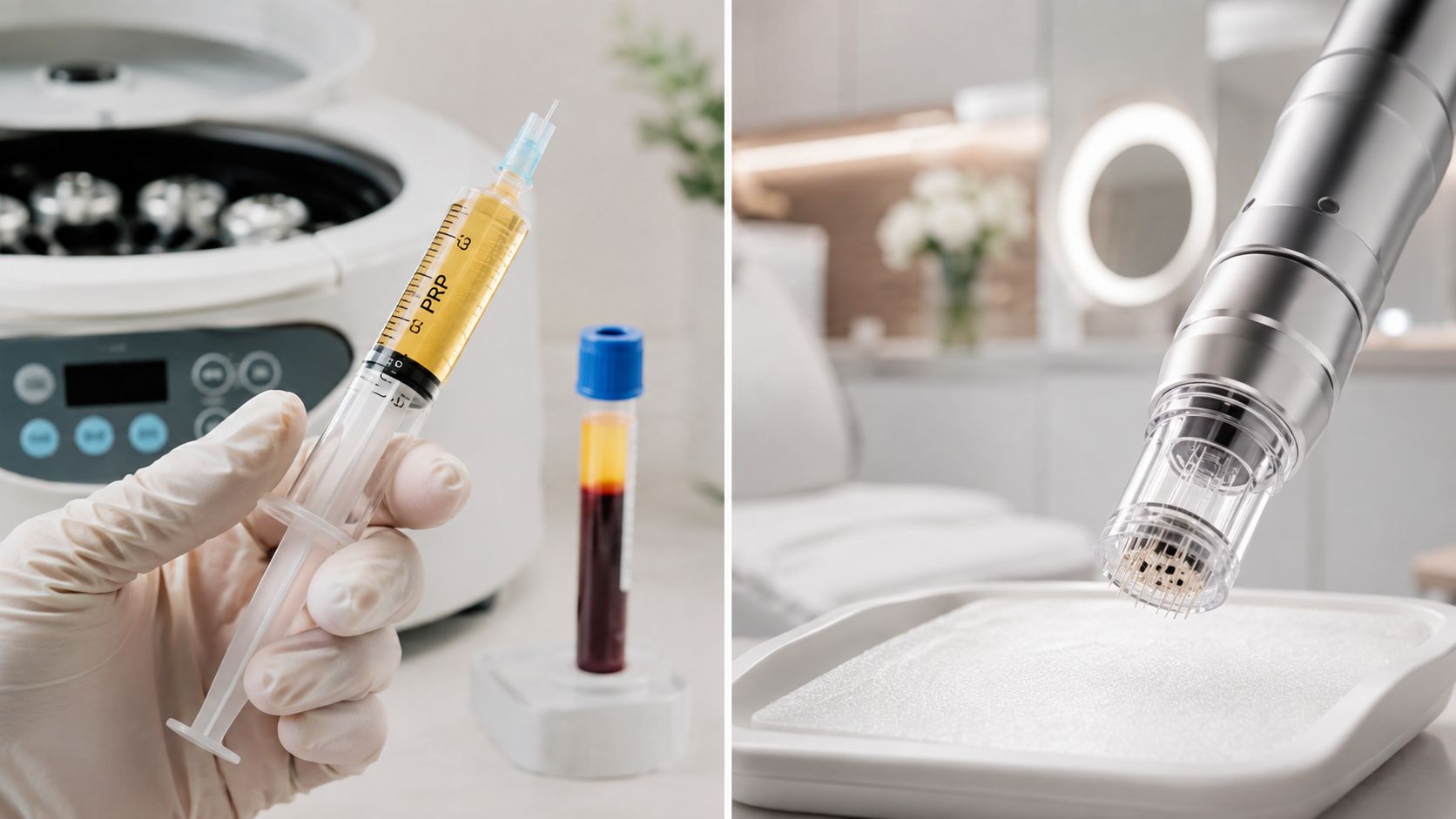
Biostimulator Injections: How Collagen Boosters Really Work
You're in your 40s, you've tried hyaluronic acid filler and neurotoxins, and you like the improvement, but you don't want a face that looks repeatedly topped up. What you really want is better skin quality, softer crepiness, and a gradual restoration that still looks like you.
That's where biostimulator injections enter the conversation. They aren't fillers that last longer. They're treatments designed to encourage your own tissue to remodel, which means less instant gratification, more planning, and a result that develops over weeks to months.
Why Biostimulator Injections Are Not Just Another Filler
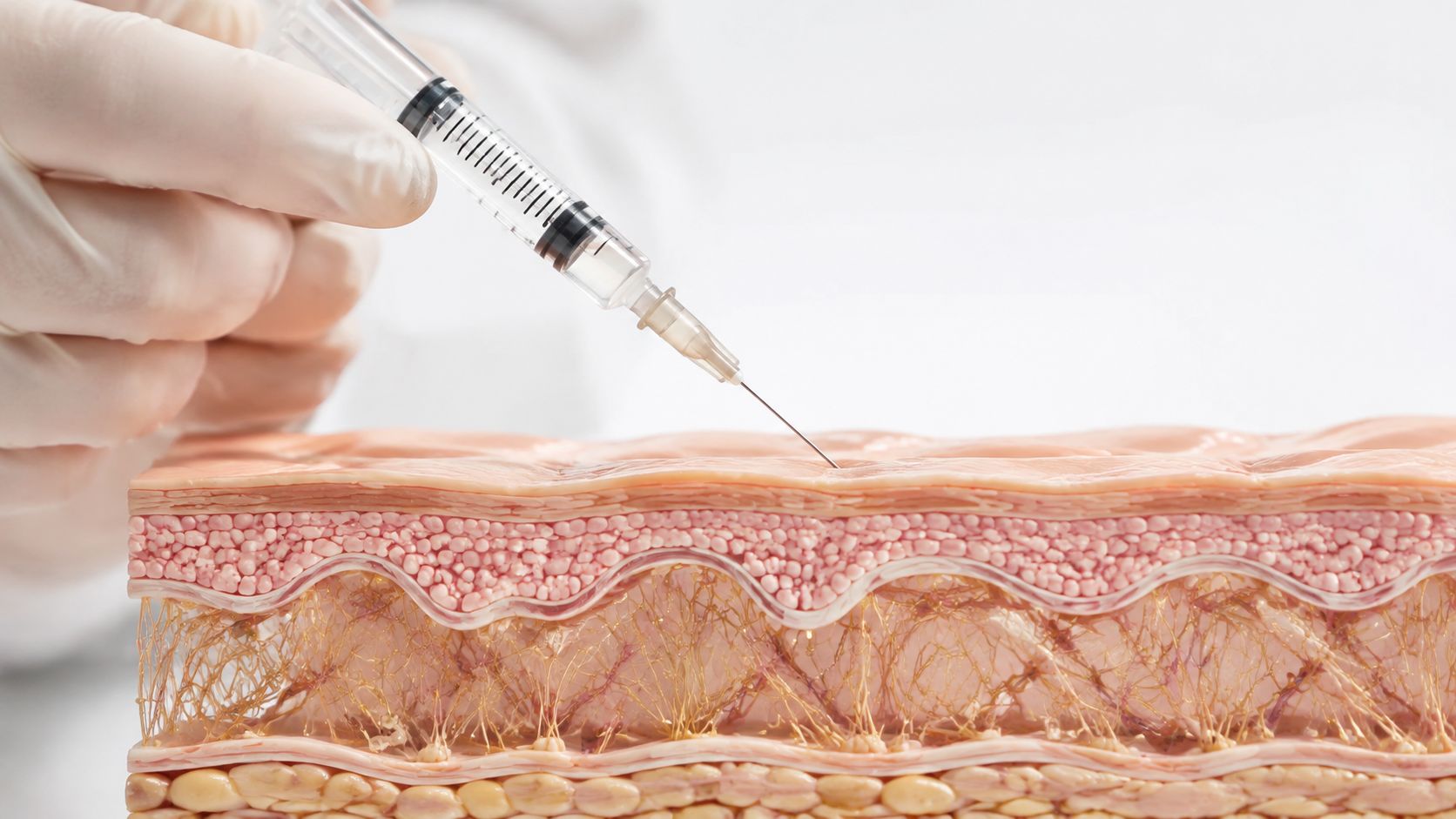
A traditional hyaluronic acid filler places a gel into tissue to create immediate volume, soften a fold, or sharpen a contour. A biostimulator takes a different route. Instead of relying mainly on a deposited gel, it uses a biocompatible material to encourage collagen-related tissue remodeling.
That distinction changes the consultation. A patient asking for an immediate correction before an event may be better served by a carefully selected HA filler. Someone concerned about diffuse volume loss, crepey texture, or gradual facial deflation may be a stronger candidate for a collagen-stimulating approach.

The result is biological, not instant
The first change after treatment can be misleading. Some patients see temporary fullness from the injected product, fluid, or mild swelling. That early appearance isn't the final collagen result. The meaningful change develops gradually as fibroblasts respond and new structural tissue forms.
Human clinical literature has reported biopsy-confirmed collagen stimulation after three PLLA sessions spaced four weeks apart, supporting the idea that PLLA works through remodeling rather than simple immediate filling (human review of PLLA collagen stimulation).
Practical rule: If you need your final result immediately, biostimulator injections probably aren't the right single treatment.
What patients usually notice
The best outcomes tend to be understated. Skin may look denser, less tired, and more supported rather than dramatically inflated. Cheeks can regain some softness, temples may appear less hollow, and the lower face may look less deflated as tissue quality improves.
The trade-off is that you can't judge the treatment too early. A patient who evaluates PLLA after a few days is evaluating swelling and temporary volume, not the actual regenerative response. That's why treatment planning matters more than chasing a dramatic first-day photograph.
How Biostimulators Actually Trigger Collagen
Biostimulators work differently from HA fillers. Instead of filling a gap with a shaped cushion, their particles provide a temporary scaffold or stimulus that prompts surrounding tissue to remodel through a controlled healing response. Fibroblasts become active, and new collagen is deposited over time.
The central process is neocollagenesis, the formation of new collagen. With PLLA, biodegradable particles gradually encourage tissue remodeling. CaHA can provide some immediate structural support while its particles also stimulate a longer-term tissue response.
The remodeling sequence
The clinical process develops in stages:
- Placement: A trained injector places the product in an appropriate tissue plane and treatment zone.
- Cellular response: The body recognizes the particles and activates a controlled local response.
- Fibroblast activity: Fibroblasts contribute to producing new extracellular-matrix components.
- Gradual refinement: Tissue density and support change progressively instead of appearing all at once.
- Product resorption: The original material may diminish while collagen-related remodeling continues to influence the result.
The injector is not depositing a fixed volume and leaving it unchanged. Plane, distribution pattern, dilution, and treatment depth all affect how evenly the product integrates and how the tissue responds.
That technique also explains why two patients can receive the same product yet experience different results. Anatomy, tissue quality, product placement, and the amount of correction sought all influence the remodeling process.
For patients exploring regenerative skincare ingredients more broadly, this guide to growth factors for skin offers useful context. Topical growth factors and injectable biostimulators still reach tissue through different delivery routes, so they should not be treated as interchangeable.
You are not buying a permanent substance that sits unchanged in the face. You are asking your tissue to participate in a gradual remodeling process.
Because the response develops slowly, treatment plans may involve more than one session. The schedule depends on the product, anatomy, skin quality, and desired correction. Patience is part of the treatment, and early swelling or fullness should not be mistaken for the finished collagen result.
PLLA vs CaHA and How They Differ in Practice
A patient seeking a softer, globally refreshed appearance may suit poly-L-lactic acid, or PLLA. Someone wanting more defined structure or contour may be better matched with calcium hydroxylapatite, or CaHA. Sculptra is the familiar PLLA example, while RADIESSE is the established CaHA option.
PLLA is selected for diffuse collagen stimulation and gradual facial balancing. CaHA can provide more immediate structural support while also encouraging collagen remodeling. That difference affects both the first impression and the treatment plan. PLLA usually requires patience, whereas CaHA can offer visible shape sooner, with its own requirements for product choice, dilution, depth, and placement.
PLLA vs CaHA at a Glance
| Attribute | PLLA, for example Sculptra | CaHA, for example RADIESSE |
|---|---|---|
| Primary role | Gradual collagen stimulation and broader tissue remodeling | Structural support with biostimulatory activity |
| Early appearance | Subtle and progressive, with temporary post-treatment fullness possible | Often more immediately visible because the product can provide structure |
| Typical planning style | Commonly planned as a series of visits | Often planned around a focused treatment, with maintenance assessed later |
| Durability benchmark | Effects lasting up to 25 months in a 2026 systematic review | Effects lasting 12 to 18 months in the same review (systematic review of PLLA and CaHA durability) |
| Best fit | Global rejuvenation, diffuse deflation, and skin-quality goals | Sculpting, lifting, selected contour work, and skin-quality support |
| Key caution | Nodules and delayed inflammatory reactions require careful technique and follow-up | Product selection, dilution, depth, and anatomy still determine safety and appearance |
| FDA-approved example | PLLA received FDA approval in August 2004 for HIV-associated facial lipoatrophy (clinical history of biostimulators) | RADIESSE received FDA approval in December 2006 for moderate-to-severe facial wrinkles and folds and HIV-associated facial volume loss |
RADIESSE and RADIESSE (+) are FDA-approved for adults 22 and older to smooth moderate-to-severe facial wrinkles and folds, including nasolabial folds. The product is also indicated for restoring volume in the backs of the hands. Diluted RADIESSE at a 1:2 ratio with 0.9% saline can be used for décolleté wrinkles (RADIESSE official indications).
The practical question is not only which product lasts longer. It is whether the patient needs broad, gradual tissue restoration or more immediate shape and support. Product choice also depends on anatomy, skin quality, the treatment area, and tolerance for staged change. A focused discussion of wrinkle correction and filler selection appears in this guide to the best fillers for wrinkles.
What a Real Treatment Timeline Looks Like
Plan biostimulator injections around the calendar, not around one appointment. A typical PLLA course may include two to three sessions spaced four to six weeks apart, followed by observation while collagen remodeling develops.
The first visit establishes the treatment foundation. A second may build on the initial distribution, while a third can address remaining correction when appropriate. Visit count depends on anatomy, baseline volume, treatment goals, and response. A responsible injector should assess those factors before recommending a fixed course.

A realistic PLLA calendar
- Consultation: Review medical history, medications, skin condition, facial movement, volume changes, and treatment goals.
- Session one: Place the product according to the planned anatomy and injection technique.
- Four to six weeks later: Perform the next session if staged correction is appropriate.
- Another four to six weeks later: Consider an optional additional session based on the response.
- Eight or more weeks after the final session: Assess the collagen-related change more clearly, while refinement may continue.
Subtle improvement may appear around week eight. More meaningful change is often assessed around month three to six. These are planning benchmarks, not promises. Collagen response varies between patients, and swelling or early product distribution can make the first results difficult to judge.
CaHA follows a different rhythm
CaHA often suits a more focused plan, sometimes using a single session with earlier visible change. Maintenance may be reviewed around six to twelve months, depending on the product, treatment location, metabolism, and clinical result.
PLLA may provide a longer-lasting result than CaHA, but longevity is only one part of the decision. A slower treatment can frustrate someone seeking immediate correction. It may also be less suitable when precise reversibility or a narrowly defined contour matters. CaHA can offer earlier structure and support, while PLLA generally asks the patient to accept staged treatment and delayed remodeling.
Schedule treatment well before major events. Allow time for swelling, follow-up, and the gradual result to develop. Biostimulators work best with spacing and reassessment, not last-minute rushing.
Who Is a Good Candidate and Who Should Wait
The strongest candidate usually wants better structure and skin quality, not an instant transformation. This may include someone from their late 30s through their 60s with mild to moderate volume loss, early laxity, crepey texture, or a face that no longer responds as satisfyingly to isolated HA filler or neurotoxin treatments.
Biostimulator injections can suit patients who feel they've reached a plateau with traditional fillers. They're particularly useful when the concern is diffuse deflation rather than one sharply defined line. The result should look integrated, not like a new object has been placed under the skin.
A candidacy check
A consultation should explore:
- The actual goal: Global rejuvenation and improved tissue quality are different objectives from creating a sharp lip, tear-trough, or chin contour.
- The timing: Patients expecting instant results should wait until they understand the delayed process.
- Medical history: Pregnancy, breastfeeding, active infection at the treatment site, and certain autoimmune conditions may make treatment inappropriate or require deferral.
- Follow-up ability: Patients need to be available for assessment and willing to report delayed changes rather than ignoring them.
- Treatment zone: Common areas include the cheeks, temples, jawline, neck, hands, and décolleté.
The face also deserves an anatomical assessment rather than a product-led sales pitch. A hollow temple, a flat cheek, and lax neck skin may all be described as “volume loss,” but they don't require identical injection plans.
Patients with active inflammation or infection should address that problem first. Anyone with a complex immune history should receive individualized medical clearance and a careful risk discussion. Biostimulators aren't a substitute for diagnosing an underlying skin or systemic condition.
The best candidate understands that subtlety is a feature. If your priority is a predictable, immediate and potentially adjustable contour change, an HA filler discussion may be more appropriate than starting with a collagen-stimulating product.
Side Effects, Nodules and the Rescue Plan Most Articles Skip
Most patients ask about swelling and bruising. Those are reasonable concerns, but the more important discussion is what happens if a delayed lump or inflammatory reaction develops after the appointment.
For PLLA, nodule formation is the most notable adverse event in the recent literature. Across included studies, reported rates ranged from 4.7% to 28.6%, and a Brazilian case series found complications were more common on the face and typically appeared about one month after treatment (review of PLLA complications and management).

Expected reactions versus warning signs
Mild tenderness, swelling, redness, or bruising around injection sites can occur after treatment. These symptoms should trend in the right direction. A firm or visible lump that appears later, becomes increasingly tender, or is associated with redness and warmth deserves a call to the treating clinic.
The timing matters. A patient may feel fine immediately after treatment and still develop a delayed inflammatory response later. That's why follow-up instructions shouldn't end when the initial swelling settles.
Why the usual filler eraser doesn't work
Hyaluronidase breaks down hyaluronic acid. It doesn't dissolve PLLA or CaHA, so it isn't a rescue treatment for these products. Management depends on the diagnosis and may include observation, targeted massage when appropriate, intralesional steroid treatment, other clinician-directed medication, or, in rare cases, surgical management.
If a delayed lump appears, don't try to dissolve it at home and don't assume it's ordinary swelling. Contact the injector promptly and provide the treatment date, product, location, and symptom changes.
The rescue plan begins with evaluation. The injector needs to distinguish a noninflamed palpable deposit from infection, a delayed inflammatory nodule, vascular compromise, or another complication. Each problem requires a different response.
Injection depth, product preparation, dilution discipline, distribution, anatomy, and aftercare all influence risk. A provider who can explain what happens if a nodule develops is demonstrating better clinical preparation than one who only promises a smooth recovery. For broader context on warning signs and filler reactions, see this guide to dermal filler side effects.
Cost Ranges and How to Pick the Right Provider
Pricing depends on region, product, treatment area, and whether your plan involves one appointment or a series. In U.S. metropolitan markets, PLLA sessions commonly range from roughly $700 to $1,500 or more, while CaHA sessions commonly range from $600 to $1,200 or more. These are practical market ranges, not a promise of what a particular clinic will charge.
A single-visit comparison can make PLLA look less expensive than it is if the full course requires multiple sessions. Ask the provider to outline the expected number of visits, product amount, follow-up process, and any likely additional treatment. The clinic should also explain how it evaluates and manages complications, rather than presenting the procedure as a simple purchase.
Provider questions that matter
Choose a qualified medical professional who can show:
- Relevant credentials: Confirm licensure and experience with injectable anatomy.
- Product-specific training: Ask how often the provider performs PLLA and CaHA treatments, and how the techniques differ.
- Authentic results: Request before-and-after photographs of actual patients treated by that clinician.
- Preparation standards: Ask how the product is reconstituted, diluted, labeled, stored, and administered.
- A complication protocol: The clinic should explain who you contact after hours and how delayed nodules or inflammatory reactions are assessed.
- Conservative planning: A responsible provider may recommend staged treatment, a different product, or no treatment when the risk-benefit balance is unfavorable.
The quality of the consultation matters as much as the quoted fee. A careful plan accounts for gradual collagen remodeling, realistic timing, and the possibility that the first approach may need adjustment. Be cautious if a provider promises an immediate, permanent result or cannot describe what happens when the result is uneven.
At-home LED can support a broader skin-quality routine, but it does not replace the injection or resolve a nodule. The Barb N.P. Facial Mask is a wireless LED device designed for repeated facial use, with red, red plus infrared, and blue lighting settings for different skincare goals. Use it only as a complement to professional care and follow your provider's instructions about timing around treatment.

Other FDA-cleared LED options include the TheraFace Mask, which uses 648 lights for red, red plus infrared, and blue light alongside vibration therapy (TheraFace Mask details), and MitoGLOW, which uses four wavelengths, 465 nm blue, 590 nm amber, 630 nm red, and 830 nm near-infrared, delivered through 1,064 LED chips across 266 LED packages (MitoGLOW product specifications). Choose according to comfort, intended use, device clearance, and whether you can follow the routine consistently.
Frequently Asked Questions About Biostimulator Injections
How much downtime should I expect?
Most patients plan for 24 to 72 hours of mild swelling or bruising, although the response varies by product, injection area, technique, and individual healing. Schedule treatment with enough buffer that you aren't forced to conceal or evaluate the result immediately.
Can I combine biostimulators with Botox, Dysport, or HA filler?
They can sometimes be combined in one treatment plan, either during the same appointment or in staged visits. The decision depends on anatomy, treatment zones, skin condition, product choice, and the injector's assessment. Botox and Dysport address muscle activity, HA filler provides immediate structure, and biostimulators focus on gradual remodeling, so combining them should serve a clear goal rather than add treatments indiscriminately.
What does a delayed lump feel like?
It may feel like a firm, localized area under the skin, with or without visible swelling. If it appears weeks after treatment, becomes painful, red, warm, or larger, contact your injector promptly. Don't massage aggressively or seek hyaluronidase without a diagnosis.
How many sessions should I budget for?
Many PLLA plans involve two to three sessions, while CaHA may fit a more focused single-session approach. Your final plan should be based on the product, treatment area, degree of volume loss, and how your tissue responds, not on a fixed package sold before examination.
BotoxBarb offers professional aesthetic services that include biostimulator treatments such as Sculptra and RADIESSE, along with complementary LED light therapy and skincare options. Visit BotoxBarb to review available services and book a consultation focused on your anatomy, timeline, goals, and a clear plan for follow-up if your response isn't straightforward.