Chemical Peel or Microneedling First? a Pro's Guide for 2026
You're probably here because your skin doesn't fit neatly into one box. Maybe you have acne marks that are half pigment and half texture. Maybe your pores look larger than they used to, but you also have sun damage on the cheeks. Or maybe you've searched “chemical peel or microneedling first” and found a pile of vague answers that don't help you decide what to book.
In practice, this question matters. The order changes how efficiently you treat pigment, texture, recovery time, and risk. A peel and microneedling are not interchangeable. They solve different problems, and the smartest plan starts with your dominant concern, not with whatever treatment is trending.
The Big Question Which Treatment Comes First
Clients ask this every week, and the answer is rarely “always peel” or “always microneedling.” The right first step depends on what is bothering you most right now. If your eye goes straight to discoloration, scattered post-acne marks, dull tone, or sun damage, your starting point is often different from someone whose main complaint is pitted acne scarring or crepey texture.
That's where people get stuck. They compare treatments as if they're competing for the same job. They're not. One works more on the skin's surface. The other is more about collagen remodeling and structural change. If you choose the wrong first move, you can still improve, but you usually won't improve as efficiently.
Here's the practical framework I use in consultation:
- Start with your primary goal: pigment and tone, or texture and collagen.
- Check your tolerance for downtime: some clients can hide for a few days, others can't.
- Factor in pigment risk: especially if you've had dark marks linger after acne, waxing, or irritation.
- Build the second treatment later: the first treatment opens the door, it shouldn't try to do everything at once.
The best plan isn't the most aggressive one. It's the one your skin can heal from predictably.
If you want a useful answer to chemical peel or microneedling first, think less about which treatment is “better” and more about which treatment should lead your sequence.
Understanding the Fundamentals Chemical Peels and Microneedling
A lot of confusion disappears once you understand what each treatment is doing.
How a chemical peel works
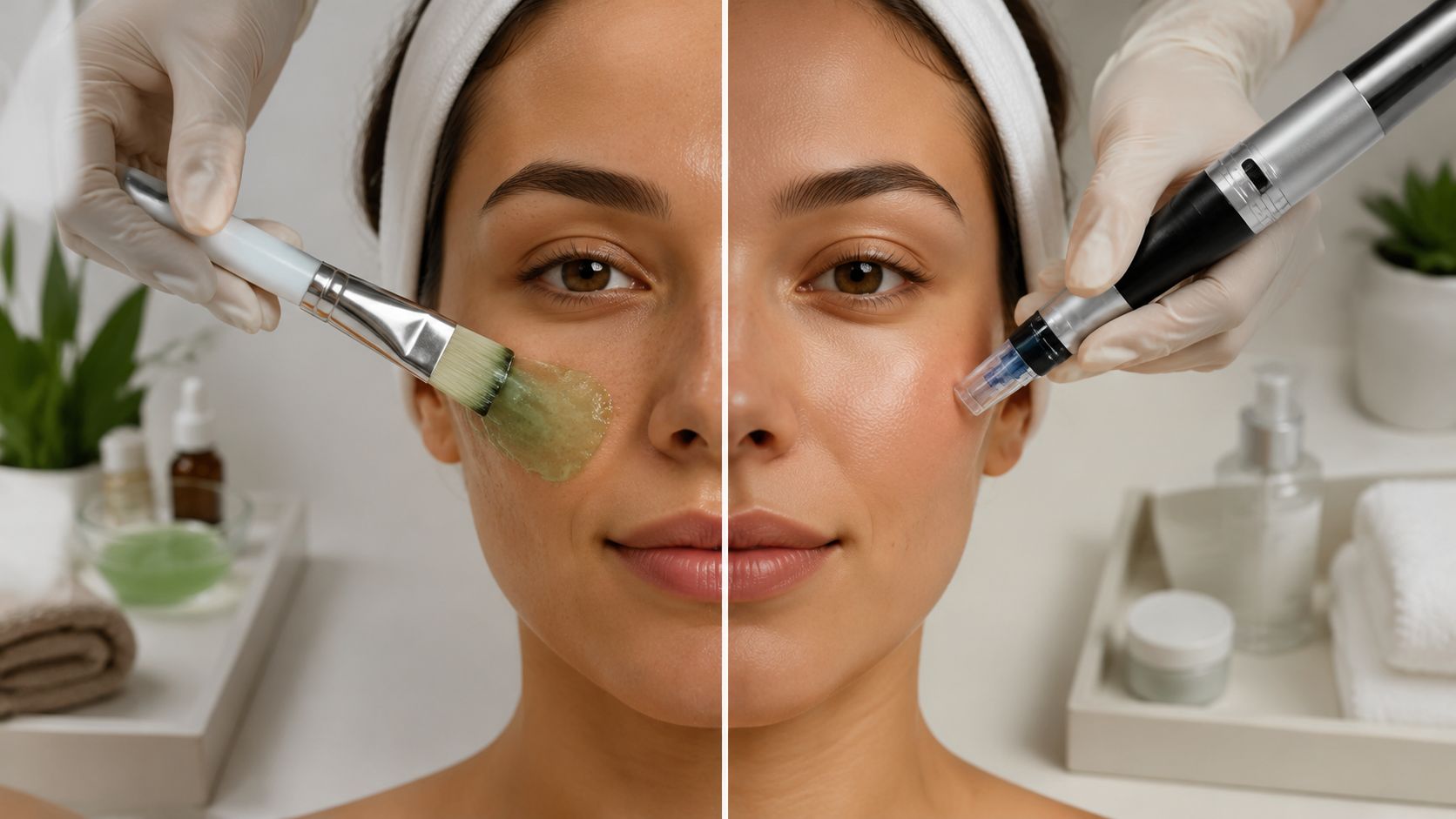
A chemical peel uses a controlled acid solution to loosen and remove damaged surface cells. That's why peels are often a strong fit for concerns you can see at the epidermal level, like uneven tone, residual acne marks, dullness, and roughness. The formula and strength matter. A superficial peel behaves very differently from a more intensive peel.
A peel is not just “making skin shed.” In the right patient, it helps reset surface turnover and refine visible tone. If you're trying to understand exfoliation more clearly, BotoxBarb's guide to chemical exfoliation and how it works is a helpful primer.
For acne-prone skin, peel choice matters too. If you're comparing acids and trying to sort out which ingredients make sense before booking a treatment, Neutralyze insights for acne offer a useful ingredient-level perspective.
How microneedling works
Microneedling works on a different principle. Instead of dissolving surface buildup, it creates controlled microchannels in the skin. That mechanical stimulation triggers a repair response, and the skin responds by building new collagen and elastin over time.
That's why microneedling is often chosen when the issue is less about color and more about structure. Think acne scars, enlarged pores, early laxity, and textural irregularity. The change usually isn't instant because collagen remodeling takes time.
Why they aren't the same treatment
The biggest mistake I see is treating these procedures like they're interchangeable “skin rejuvenation” options. They overlap a little, but their main strengths are different.
Use this simple lens:
- Choose peels when the skin looks discolored, dull, blotchy, or congested
- Choose microneedling when the skin looks indented, uneven, or less firm
- Use both over time when your skin has both surface and structural concerns
That sequencing mindset is what produces cleaner, safer treatment plans.
A Side by Side Comparison of Key Differences
When clients compare these treatments, they usually want four answers fast. What does it help most? How much downtime will I have? How many sessions am I likely signing up for? And what's the price range likely to look like?
This chart gives you the practical version.
| Feature | Chemical Peel | Microneedling |
|---|---|---|
| Main mechanism | Controlled chemical exfoliation of surface skin | Controlled micro-injury to stimulate collagen |
| Usually strongest for | Uneven tone, brown spots, post-acne marks, sun damage, superficial texture | Acne scars, pores, wrinkles, firmness, textural aging |
| Recovery pattern | Peeling, dryness, redness depending on depth | Redness, warmth, mild swelling, dry rough feel |
| Speed of visible change | Often faster for brightness and tone | Slower, because collagen remodeling builds over time |
| Who often starts here | Clients focused on pigment and glow | Clients focused on texture and structural change |
| Budget range in market examples | Wider range depending on peel depth | Mid-to-higher procedural range depending on setting |

Downtime and scheduling realities
According to a clinical overview from a U.S. dermatology market example, light chemical peels typically require about 1 to 2 days of downtime, medium peels about 1 week, and microneedling commonly causes 2 to 4 days of redness. The same overview notes that visible collagen-related improvement from microneedling often unfolds over 6 to 12 weeks, and many protocols use 3 to 6 sessions spaced 4 to 8 weeks apart for scar or wrinkle improvement. It also reports market pricing examples of roughly $200 to $6,000 for chemical peels and about $550 to $2,000 for microneedling in a major city such as New York, which helps explain why downtime tolerance and budget shape treatment choice so heavily in real practice (clinical overview of peel and microneedling downtime and cost).
Those numbers matter because expectations matter. If you need a quick brightening treatment before an event, a superficial peel may fit the calendar better. If you're investing in scar revision, microneedling usually asks for more patience.
What clients often feel, not just what they read
A peel can feel “faster” because the skin often looks brighter earlier. Microneedling can feel “deeper” because the best changes show up as the skin remodels itself. Neither impression is wrong.
If you want a more detailed patient-facing overview of how microneedling fits into a skin plan, this guide to microneedling and skin rejuvenation breaks that process down clearly.
If your top priority is visible tone correction, peels usually give you a cleaner first win. If your top priority is scar remodeling, microneedling usually earns its place first.
What doesn't work well
What fails most often is not the treatment itself. It's poor matching.
- Starting with microneedling for obvious pigment-only concerns: you may improve, but not as directly.
- Starting with a stronger peel for a patient with textural scarring as the main complaint: brightness improves, but the deeper issue stays.
- Trying to force one treatment to solve every concern: that usually leads to overtreatment or disappointment.
A good plan separates what needs surface correction from what needs collagen work.
Your Goal Oriented Guide Which Treatment to Start With
The decision becomes clear when you consider this: Start with the treatment that addresses your primary complaint, not the one that addresses your secondary complaint.
Start with a chemical peel if pigment is your main issue
If your skin concern is mostly brown spots, blotchy tone, post-acne marks, or visible sun damage, a peel usually makes more sense as the first move. Independent dermatology guidance notes that chemical peels often have an advantage for brown spots, blotchy tone, sun damage, and post-acne marks, while microneedling is stronger when collagen stimulation is the priority for scars, pores, and early textural aging. The same guidance also warns that microneedling can cause temporary hyperpigmentation, particularly in darker skin tones if needle settings are overly aggressive, which is exactly why sequencing matters so much in pigment-prone patients (dermatology guidance on pigment versus texture priorities).
In plain language, if your skin mostly needs color correction, start with the treatment built for color correction.
A peel-first approach often makes sense for:
- Sun-related discoloration
- Residual red-brown acne marks after breakouts calm down
- General dullness with uneven tone
- Clients who want a smoother, brighter look before a specific event
Start with microneedling if texture is the issue you can feel and see
If you run your fingers over your cheeks and feel unevenness, or if acne scars catch the light from the side, that's a different category. Texture, pore irregularity, and shallow depressed scars usually respond better when you start with collagen stimulation.
This is the client I steer toward microneedling first:
- The skin has visible pitting or uneven contour.
- The client says “my skin looks rough even under makeup.”
- Pore size and fine etched lines matter more than discoloration.
- They understand results build gradually.
Practical rule: If the problem is mostly in the skin's shape, not its color, start with the treatment that remodels shape.
Special caution for darker skin tones and pigment history
Cookie-cutter advice falls apart, especially if you have melanin-rich skin, melasma history, or a pattern of getting dark marks after inflammation. The question isn't just “Which treatment works?” It's “Which treatment works with the lowest chance of triggering more pigment?”
That doesn't mean microneedling is off the table. It means settings, depth, skin prep, and treatment timing matter more. In many pigment-prone clients, I'd rather begin conservatively, establish how the skin heals, and avoid aggressive first passes.
If you have both pigment and texture
Most real patients do.
In that case, I break the tie with one question: What bothers you more in daylight? If your answer is “the spots,” start with the peel pathway. If your answer is “the scarring” or “my skin looks uneven,” start with microneedling.
A simple way to think about it:
- Pigment dominates. Peel first
- Texture dominates. Microneedling first
- Equal mix, but you're pigment-prone. Usually peel first, cautiously
- Equal mix, but scarring is more severe. Usually microneedling first, then refine with peels
Trying to solve both with one rushed appointment is where people get into trouble.
Building Your Combined Treatment Plan for Maximum Results
Once your first phase is chosen correctly, the smartest long-term plan usually uses both treatments in sequence. Such a plan allows for more complete outcomes, especially for acne-scarred or mixed-concern skin.

Why combination plans make sense
A peel can clean up tone and surface roughness. Microneedling can work on the dermal remodeling side. Those are complementary jobs, not duplicate jobs.
A 2025 systematic review of eight randomized controlled trials and one non-randomized trial, published 2011 to 2023, found that combining microneedling with a chemical peel produced clinically meaningful improvement in all nine studies of atrophic acne scars. In pooled responder data, 40 to 50% of combination recipients achieved at least 75% improvement, compared with ≤13% for microneedling or peeling alone. For at least 50% improvement, the combination reached 80 to 97% versus 19 to 43% for microneedling alone and 5 to 31% for peels alone. The meta-analysis also reported significantly better odds for combination therapy than microneedling monotherapy (OR 5.72; 95% CI 2.82 to 11.61; p = 0.006) and than peel monotherapy (OR 8.94; 95% CI 4.72 to 16.95; p < 0.00001) (systematic review on combining microneedling with chemical peels for acne scars).
That's strong support for sequencing rather than arguing over one winner.
What a practical sequence looks like
In clinic, I think of treatment in phases.
Phase one is your lead treatment. That's peel-first for pigment or microneedling-first for texture.
Phase two is refinement. Once the skin has shown it can heal well, add the other modality carefully.
A typical real-world approach often looks like this:
- First block: commit to the treatment matched to your main problem
- Healing window: let the skin settle fully before switching modalities
- Second block: bring in the complementary treatment
- Maintenance: use either peels or microneedling periodically based on what tends to recur first for you
What works and what doesn't
What works is deliberate spacing and restraint.
What doesn't work is stacking irritation because you're impatient. Many clients can handle both treatments over time. Far fewer benefit from trying to compress everything into a too-aggressive schedule.
Good sequencing doesn't just improve results. It improves the odds that your skin stays calm enough to keep progressing.
The clients who do best are usually the ones who treat this as a plan, not a one-off fix.
Enhancing and Maintaining Your Results at Home
In-office treatment starts the change. Home care protects it. If you neglect barrier support, hydration, and sun protection after a peel or microneedling series, you make the skin work harder than it should.

The basics that matter most
Keep the routine boring right after treatment. That's a good thing.
- Use a gentle cleanser: avoid scrubs, cleansing brushes, and active exfoliants while the skin is healing.
- Prioritize hydration: a simple hydrating serum and barrier-supportive moisturizer help reduce that tight, irritated feeling.
- Wear daily sun protection: if you don't protect fresh skin from UV exposure, pigment problems can come right back.
If you're recovering from microneedling and want a practical reference for timing and product choices, this guide on how to care for skin after microneedling is worth saving.
Where LED therapy fits
LED light therapy is one of the few at-home tools I like as an add-on between professional treatments because it supports recovery without adding exfoliation or friction. The Barb N.P. Facial Mask is one option if you want a device for home use. It's wireless, designed to sit comfortably on the face, and includes three lighting settings: red light for post-treatment support and collagen-focused care, blue light for acne-prone skin, and amber light for calming sensitivity.
That kind of support is useful when you're trying to stay consistent without overdoing your routine.
Don't forget internal support
Skin healing also depends on what's happening beyond the surface. If you're trying to strengthen recovery habits, this guide to essential skin repair vitamins is a reasonable place to review the nutritional side of skin repair.
Home care shouldn't compete with your in-office plan. It should make healing smoother and results easier to maintain.
Frequently Asked Questions
How long should I wait between a chemical peel and microneedling?
Wait until the skin is fully healed, calm, and no longer reactive. In practice, that usually means your provider should see that redness, flaking, tenderness, and barrier disruption have settled before the next modality starts. If you switch too fast, you increase irritation and pigment risk.
Can I do these treatments around Botox or filler appointments?
Yes, but the timing should be intentional. I don't like clients booking procedures in a random order and hoping they won't interfere. If injectables are part of your plan, ask your provider to map the schedule so your skin treatment doesn't disrupt placement, healing, or post-procedure instructions.
Is an at-home peel kit or dermaroller a good substitute?
Usually no. The problem isn't just strength. It's control. At-home devices and peel kits make it easy to treat too aggressively, treat unevenly, or use the wrong product for your skin history. That's especially risky if you're acne-prone, sensitive, or pigment-prone.
Which treatment is better if I have both acne marks and acne scars?
Separate the marks from the scars. Marks are pigment or post-inflammatory discoloration. Scars are textural changes. If the color bothers you more, start with the peel pathway. If the indentations bother you more, start with microneedling.
Can darker skin tones still do both treatments?
Yes, but treatment selection has to be more careful. Depth, formula, healing history, and pigment behavior matter more than trends. Conservative protocols are often the smarter choice.
What's the biggest mistake people make?
They chase intensity instead of fit. More aggressive doesn't automatically mean more effective. Matching the treatment to the skin problem is what gets cleaner results.
If you want a treatment plan that matches your skin's actual priorities, not a generic menu, explore BotoxBarb for professional services and curated skin support. The right sequence can save time, reduce irritation, and move you toward results that look smoother, brighter, and more natural.