Does Botox Raise Eyebrows? What the Science Actually Shows
Yes, Botox can raise the eyebrows, with clinical studies measuring changes from about 0.6 mm to 3.06 mm, depending on the injection pattern and anatomy. The lift comes from relaxing the muscles that pull the brows downward, not from injecting the muscle that lifts them.
So why do some people see a subtle, attractive arch while others develop a heavy forehead or an uneven “Spock brow”? The answer isn't whether Botox works. It depends on which muscles are treated, how much product is used, where the injections sit, and how strongly your frontalis muscle is already working.
The frontalis is the only muscle that raises the eyebrows. The corrugator supercilii, procerus, and portions of the orbicularis oculi pull the brows down or inward. A carefully planned Botox brow lift weakens selected depressors and preserves enough frontalis activity to let the brow move upward. Treat the frontalis too aggressively, and the same product can make the brows look lower.
Yes, Botox Can Lift the Brows but Not the Way Most People Think
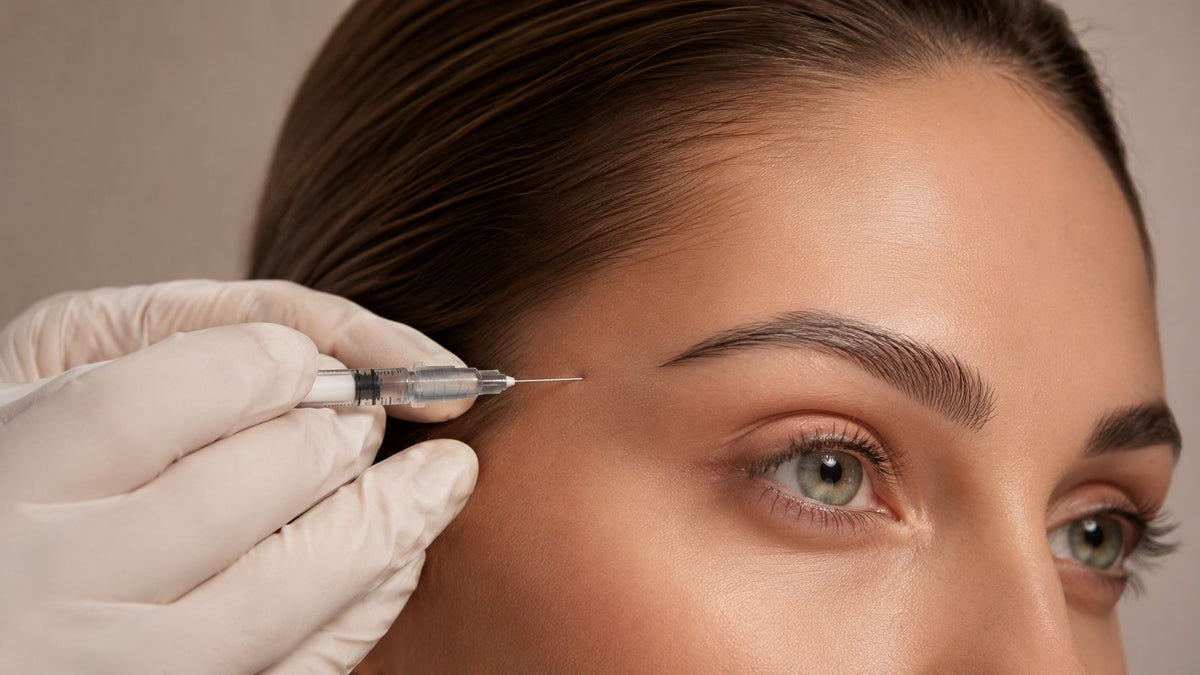
A Botox brow lift is an indirect lift. The injector isn't lifting the eyebrow by strengthening the frontalis or mechanically repositioning the skin. Instead, botulinum toxin reduces the downward pull from selected brow depressors, allowing the remaining frontalis activity to influence brow position more strongly. Clinical evidence supports this mechanism, although the effect is generally modest and highly technique-dependent. A 2000 PubMed study recorded statistically significant elevation after treating brow depressor muscles, with the largest mean changes reaching 1.86 mm on the right central brow and 3.06 mm on the left central brow in the relaxed position. The original clinical study established the basic principle behind the chemical brow lift.
The anatomy is a tug-of-war
Think of the brow as a rope pulled by opposing hands. The frontalis pulls upward. The corrugator supercilii draws the medial brow downward and inward, the procerus contributes to downward movement around the glabella, and the orbicularis oculi can depress the lateral brow. When Botox relaxes some of those downward-pulling muscles, the upward force from the frontalis becomes less opposed.
That doesn't mean every depressor should be treated. The brow's shape depends on the balance between these muscles, the position of the orbital rim, the amount of upper-eyelid skin, and the patient's habitual facial expression. A lateral injection pattern may create more tail elevation, while a different distribution can alter the central or medial brow.

Practical rule: A brow lift requires preserving the frontalis while selectively reducing the muscles that pull the brow down.
Injecting the frontalis isn't automatically wrong. Forehead-line treatment may require it, but excessive or poorly positioned frontalis weakening can remove the muscle's ability to support the brows. That risk is why a brow-lift consultation should distinguish between smoothing forehead lines and changing brow position. Patients who want to understand the broader treatment process can review these Botox treatment details, while BotoxBarb's guide to where to inject Botox for an eyebrow lift offers a more focused discussion of injection planning.
How Dose and Injection Pattern Change the Lift
The question “does Botox raise eyebrows?” becomes more useful when you add a second question: which part of the brow should move, and how much depressor activity should be reduced?
A randomized trial published in 2007 treated the glabella at seven sites using 10, 20, 30, or 40 units of botulinum toxin type A. The 20-unit, 30-unit, and 40-unit groups showed immediate lateral eyebrow elevation, followed by central and medial elevation that peaked at 12 weeks. The 10-unit group showed mild brow ptosis and the weakest response. The randomized dose study demonstrates that dose affects not only strength but also the direction and timing of brow movement.
A separate randomized controlled trial found brow elevation ranging from 0.6 to 2.1 mm and reported 97% patient satisfaction after selected depressor treatment. That trial also showed that adding medial depressor injections changed the lift pattern rather than increasing lift everywhere.
| Injection Site | Typical Dose (U) | Primary Effect on Brow |
|---|---|---|
| Lateral corrugator tail | Low, precisely selected dose | Reduces lateral downward pull and can emphasize the arch |
| Procerus region | Low, anatomy-dependent dose | Relaxes central glabellar depression |
| Lateral orbicularis oculi | Low, superficial targeted dose | Can encourage lateral brow elevation |
| Frontalis | Conservative, pattern-dependent dose | Smooths forehead movement, but excessive treatment can reduce brow support |
The table describes treatment logic, not a prescription. Units aren't interchangeable across products, and a safe plan must account for the individual muscle pattern. Underdosing may fail to change the brow. Overtreating the wrong muscle may flatten the arch, lower the brow, or create asymmetry.
The same number of units can produce different results in different faces because muscle strength, brow shape, and injection depth change the balance.
For a deeper discussion of treatment planning, BotoxBarb's article on how many units of Botox are appropriate for an eyebrow lift is a useful companion. The most responsible plan starts with the desired brow shape, not a fixed unit count.
The Brow-Lift Technique Versus the Full-Frontal Pattern
A brow-lift pattern and a full-frontal pattern solve different aesthetic problems. The first aims to preserve upward support while relaxing selected depressors. The second focuses more broadly on horizontal forehead lines and can reduce frontalis movement across the forehead.
The distinction matters because the frontalis is the only brow elevator. The FDA labeling pattern discussed in a clinical review specifies 4 units per site at 5 sites, for a total of 20 units, when treating the frontalis in the labeled forehead pattern. The labeling discussion highlights why frontalis placement deserves special care. Weakening this muscle can smooth lines, but it can also reduce the support that some patients use to keep their brows and upper eyelids open.
Two strategies, two visual outcomes
A lateral-sparing brow-lift technique generally keeps the central frontalis active and focuses on selected depressors. Depending on the patient's anatomy, an injector may target the lateral corrugator tail, procerus, or superolateral orbicularis oculi with carefully chosen amounts. The visual goal is often a subtle opening of the eye area or a more defined lateral arch.
A full-frontal pattern spreads treatment through the forehead to reduce horizontal movement. It may be appropriate when forehead lines are the main concern, but it can be a poor match for someone whose brows already depend on strong frontalis recruitment. The patient may leave with smoother skin but less brow support.

An advanced plan may combine both approaches, treating forehead lines conservatively while preserving enough central frontalis activity to avoid a heavy appearance. The injector must also account for asymmetry. One brow may sit lower, one side may recruit the frontalis more strongly, or one lateral orbicularis oculi may dominate the expression.
A smooth forehead isn't automatically a lifted brow. The injection pattern must match the patient's primary goal.
Who Is a Good Candidate for a Botox Brow Lift
The best candidate usually has mild or moderate brow descent with useful frontalis strength. The brow may sit low at rest, the lateral hooding may feel heavy, or the patient may notice that the outer brow looks less defined than before. In these cases, reducing selected activity in the corrugators or lateral orbicularis oculi may improve the balance.
A good consultation looks at the face both at rest and in motion. I want to see how high the brows sit naturally, how much the frontalis activates when the patient opens the eyes, and whether the upper eyelids are being lifted by forehead effort.
A practical screening checklist
- Brow position: Compare right and left brow height at rest, including the central and lateral portions.
- Frontalis recruitment: Ask the patient to raise the brows and observe whether the forehead is compensating for hooded lids.
- Lid-to-brow distance: A short distance may leave little room for additional frontalis weakening.
- Skin and eyelid tissue: Significant dermatochalasis or true eyelid ptosis won't be corrected by relaxing depressors.
- Medical history: Review neuromuscular disease, medications, pregnancy, prior eyelid or brow surgery, and relevant eye symptoms.
Patients with very high-set brows may not want additional elevation. Someone with substantial excess upper-eyelid skin, levator aponeurosis dehiscence, or a heavily over-recruited frontalis may need a different treatment conversation. Blood thinners can also affect bruising considerations, and neuromuscular conditions require particular medical caution.

A Botox brow lift is most predictable when the problem is muscle imbalance, not substantial tissue laxity. Realistic expectations matter. The goal is a refined, modest change, not the repositioning that surgery can provide.
Realistic Results, Onset, and How Long a Botox Brow Lift Lasts
Published studies show that brow movement can vary substantially by technique. One systematic review covering 585 patients found reproducible brow shaping, but the reported elevation range varied widely, with the highest lateral-brow changes ranging from 0.4 to 4.8 mm across studies. The systematic review also reported only five eyelid ptosis cases overall, reinforcing that the treatment can be studied and measured while still carrying technique-related risks.
Another clinical report found selected depressor injections produced average temporal elevation of 1.02 mm at the midpupil and 4.83 mm at the lateral canthus. The clinical report illustrates why a patient may see more change at the tail than near the center. Brow shape matters as much as overall height.
What the timeline feels like
Botulinum toxin doesn't create an instant mechanical lift. Relaxation develops progressively, and the brow position changes as the treated muscles lose activity. Some patients notice a subtle difference within several days, but the final balance should be assessed after the product has had time to settle.
The randomized 2007 trial found that some central and medial changes peaked at 12 weeks, while other measured outcomes are reported over shorter observation periods. That variation is another reason not to judge a brow-lift result immediately.
Most don't schedule a first treatment immediately before a major event and expect to evaluate the final shape on the same day. Build in time for assessment, communication with the provider, and any small adjustment that may be appropriate.
Risks and Side Effects Including Brow and Eyelid Ptosis
The most concerning aesthetic complications are brow ptosis, eyelid ptosis, and an over-elevated lateral brow. Each can result from an imbalance in muscle treatment rather than from Botox “failing.”
Brow ptosis can occur when the lower frontalis is weakened in a patient who already relies heavily on that muscle to support the brows or open the eyes. Eyelid ptosis involves unwanted effect near the muscles that raise the upper eyelid. Injection depth, location, anatomy, and product spread all matter.
What the provider is trying to prevent
- Brow ptosis: The forehead or brow looks heavier after too much frontalis weakening.
- Eyelid ptosis: The upper eyelid becomes lower after product affects the levator region.
- Spock brow: The lateral brow rises more than the center because frontalis activity remains unbalanced.
- Asymmetry: The two sides respond differently because facial muscles and baseline brow positions aren't identical.
- Bruising or headache: Temporary local reactions can follow injections.
- Diplopia: Rare visual symptoms require prompt communication with the treating clinician.
The systematic review cited earlier recorded only five eyelid ptosis cases among 585 patients across the included studies, but that finding shouldn't be interpreted as a guarantee of zero risk. A qualified injector should explain warning signs and have a plan for follow-up.

Patients should receive individualized aftercare instructions and avoid rubbing or pressing the treated area. For a broader overview of possible reactions and treatment considerations, BotoxBarb's guide to Botox side effects provides relevant background. Seek medical advice promptly for significant eyelid drooping, visual changes, swallowing or breathing difficulty, or symptoms that feel unexpected.
Alternatives to Botox for Raising the Eyebrows
Botox is most useful when downward muscle activity contributes to the low brow position. It won't remove substantial excess skin, correct advanced tissue laxity, or reposition a descended brow in the way surgery can.
Hyaluronic acid filler may help when volume loss at the temple or lateral brow makes the area look hollow or unsupported. Filler adds structure and contour, but it isn't a muscle treatment and carries its own risks, including vascular occlusion. It also may not be appropriate in a tight or anatomically crowded area.
Thread lifts create a mechanical effect rather than a chemical one. They can produce a more immediate change, but results and symmetry depend heavily on placement, tissue characteristics, and the body's response. Migration, puckering, and asymmetry are possible trade-offs.
Surgical brow lift or upper-eyelid surgery offers the most substantial correction for marked drooping or excess skin. The trade-off is a longer recovery, incisions, surgical risk, and a more lasting change that isn't as easily reversed as a temporary injectable treatment.
| Option | Best suited to | Main trade-off |
|---|---|---|
| Botox | Muscle-driven brow heaviness and subtle contour change | Temporary and modest |
| Hyaluronic acid filler | Selected volume loss or contour deficiency | Vascular and placement-related risks |
| Thread lift | Patients seeking mechanical elevation without traditional surgery | Variable lift, possible asymmetry or puckering |
| Surgery | Significant drooping, excess skin, or structural descent | Recovery and permanent anatomical change |
Good skin care, daily sun protection, and collagen-supporting treatments may improve skin quality, but they can't reproduce the effect of selectively relaxing a depressor muscle. A facial plastic surgeon's discussion of brow lift options in Murrells Inlet, South Carolina can help patients compare nonsurgical and surgical approaches when skin laxity is a major part of the concern.
Smart Questions to Ask Your Provider and a Pairing Tip
A strong consultation should sound specific. Ask which muscle is creating the heaviness, whether the goal is relaxation or actual elevation, and how the proposed pattern will affect your brow shape.
Useful questions include:
- Treatment map: Which injection points are planned, and which muscles do they target?
- Dose logic: What unit range is being considered, and how will the provider adjust it for your anatomy?
- Movement forecast: Should the center, arch, or tail rise, and what result would indicate too much frontalis weakening?
- Safety plan: How does the provider reduce the risk of brow ptosis, eyelid ptosis, asymmetry, or a Spock brow?
- Follow-up: When will the result be reviewed, and how are unwanted effects managed?
Bring up prior facial surgery, eyelid problems, dry eye, medications, pregnancy, and any neuromuscular diagnosis. Baseline photographs taken at rest and while raising the eyebrows can reveal whether the treatment is changing height, smoothing expression, or reducing the movement that was supporting the brow.
For at-home skin support, the Barb N.P. Facial Mask is one product option to discuss as a complementary routine. Its wireless design is intended to make use convenient, the mask is designed for comfortable wear across the face, and it offers three lighting settings for different treatment routines. LED light isn't a substitute for Botox, filler, or surgery, and it shouldn't be presented as a proven brow-lifting treatment. Follow the device instructions and ask your provider when it makes sense to resume any device use after injections.
Choose the treatment according to the cause of brow heaviness, then choose the product and pattern according to the anatomy.
BotoxBarb offers personalized Botox, Dysport, filler, LED light therapy, and skincare guidance for patients who want a carefully planned approach to brow balance and upper-face rejuvenation. Visit BotoxBarb to explore treatment appointments, the Barb N.P. Facial Mask, and medical-grade products that can complement a clinician-guided plan.