Article: Hair Loss Prevention Supplements That Actually Work
Hair Loss Prevention Supplements That Actually Work
You notice more hair in the brush, more strands around the shower drain, or a part that looks wider in photographs. The instinct is understandable: search for the best hair loss prevention supplements and start taking whatever promises thicker growth. But the right first question isn't “Which bottle should I buy?” It's “What is causing my hair to thin?”
Supplements can help when they correct a documented nutritional problem, and some multi-ingredient formulas may modestly support pattern thinning. They can't reverse every type of hair loss, and they shouldn't delay an evaluation for thyroid disease, autoimmune conditions, hormonal changes, or scalp inflammation. The most useful approach matches the ingredient to the root cause.
Why Your Hair Is Thinning in the First Place
A 34-year-old patient staring at the drain after every shower may describe the problem as “hair loss,” but that phrase doesn't identify the diagnosis. I start with the timeline. Did shedding begin suddenly after illness, significant stress, rapid weight change, or childbirth? Did the change happen gradually over years? Is the loss diffuse, concentrated at the crown, visible as a widening part, or appearing in smooth patches?
Those details separate several conditions that need different responses. Androgenetic alopecia usually develops gradually and follows a recognizable pattern influenced by genetics and hormones. Telogen effluvium can cause diffuse shedding after a physical or emotional stressor, illness, nutritional shortfall, or hormonal shift. Postpartum shedding often reflects a temporary change in the hair cycle, while alopecia areata can produce distinct patches and requires medical assessment.
Styling matters, too. Tight ponytails, extensions, repeated chemical processing, and heat can create traction or shaft damage. Hair may look thinner because it breaks, not because the follicle has stopped producing hair. Thyroid disorders, iron deficiency, autoimmune disease, medications, and scalp inflammation can also create similar-looking symptoms.
Start with the clinical clues
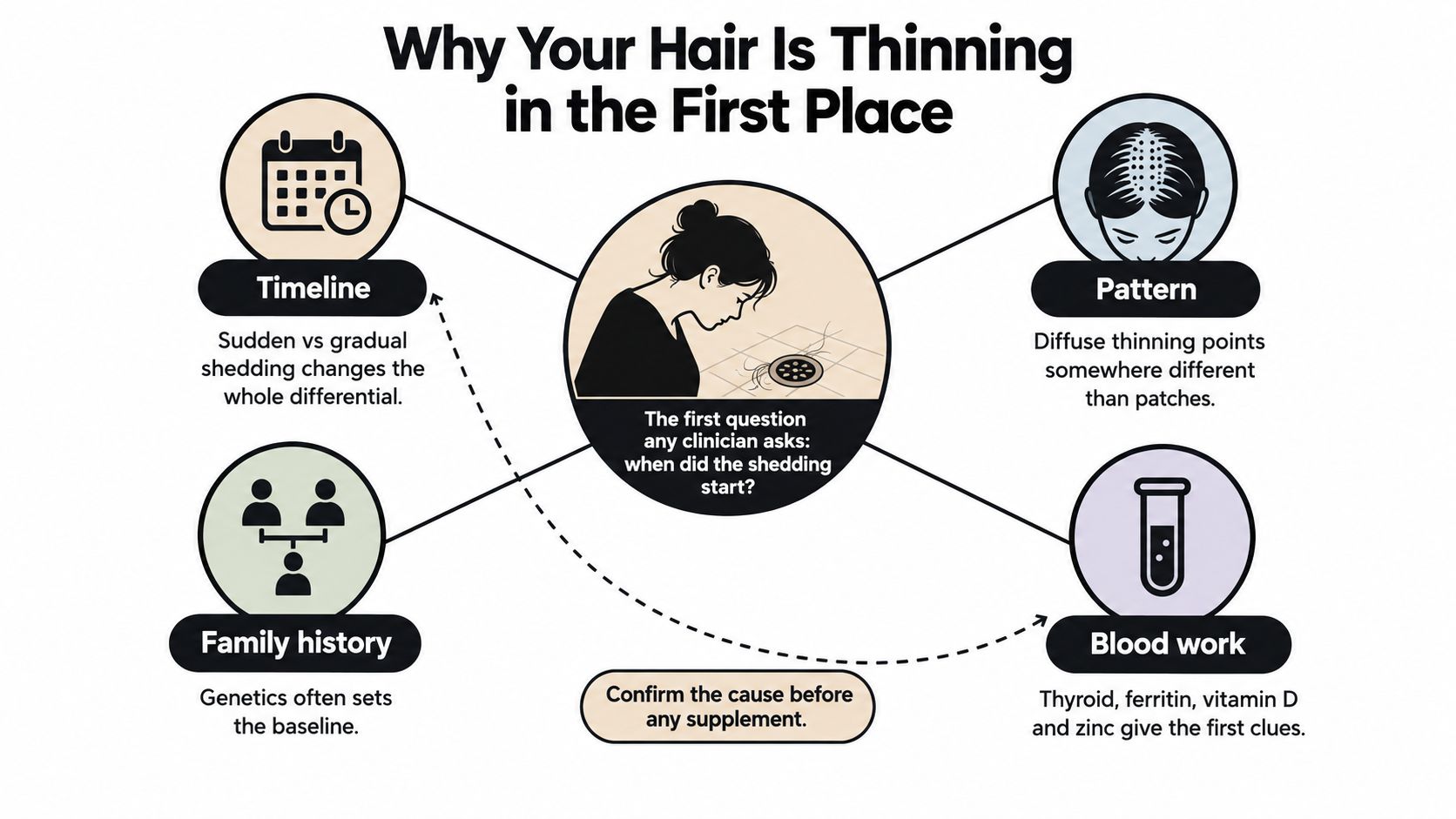
Before choosing a supplement, document:
- Timeline: Sudden shedding suggests a different work-up than gradual thinning.
- Pattern: Diffuse loss, temple recession, crown thinning, and patchy loss don't point to the same cause.
- Family history: Relatives with patterned thinning can raise suspicion for androgenetic alopecia.
- Symptoms: Itching, scaling, pain, redness, or scarring deserve a scalp examination.
- Blood work: Ferritin, thyroid testing, vitamin D, zinc, and a complete blood count may provide useful clues when the history supports testing.
The causes of female hair loss deserve particular attention because hormonal changes, nutritional problems, pattern loss, and medical conditions can overlap. A supplement may be appropriate, but it should be one part of a diagnosis-led plan.
Clinical rule: Hair thinning is a symptom, not a diagnosis. The supplement that helps one person may do nothing for another, and an inappropriate supplement can distract from the condition that needs treatment.
The Core Mechanisms Behind Hair Loss
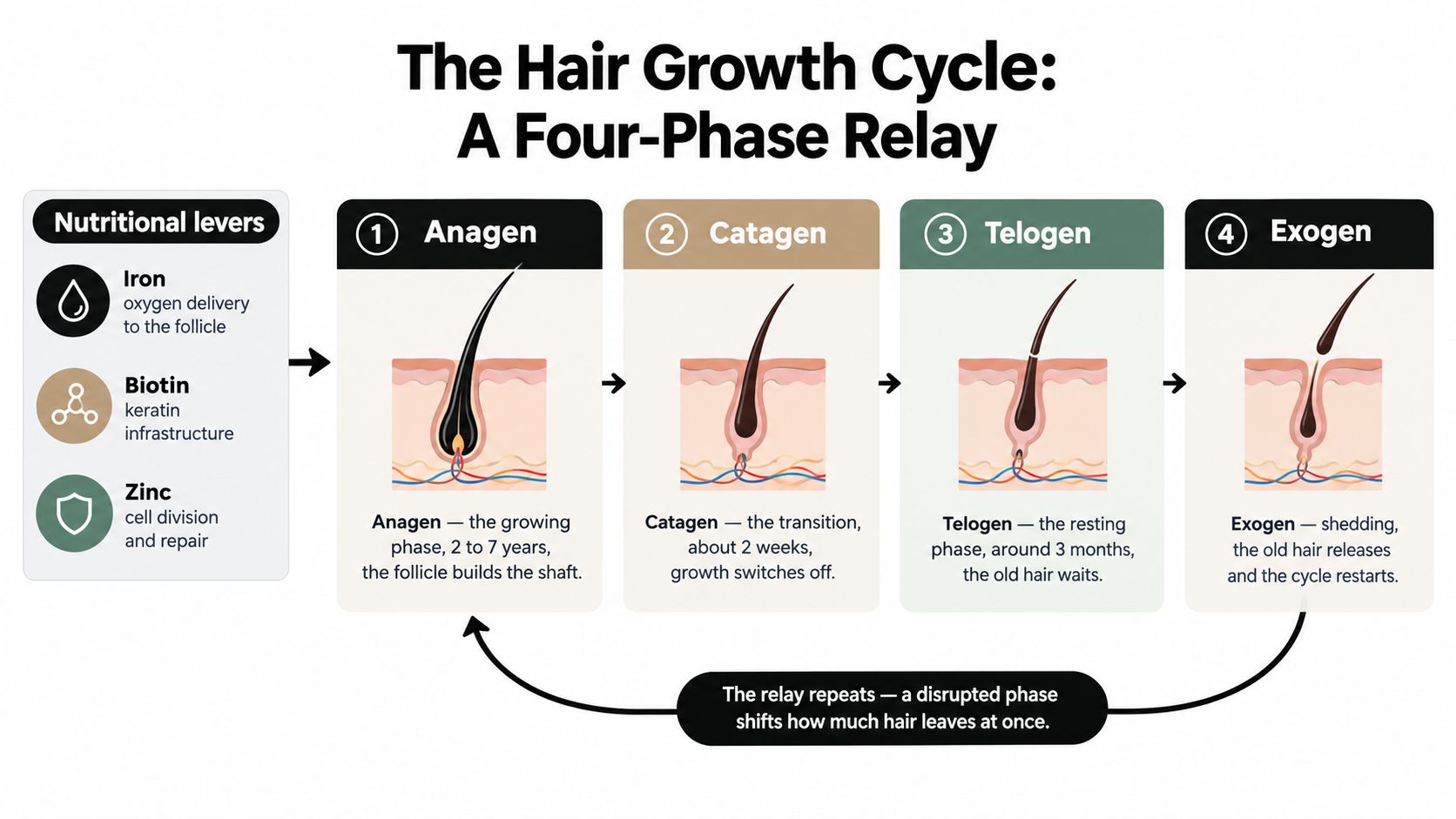
Each follicle moves through a repeating relay. During anagen, the follicle actively builds a hair shaft. Catagen is the transition phase, when growth switches off. In telogen, the follicle rests, and in exogen, the old strand releases. A disruption in this relay can make shedding more noticeable or shorten the time a follicle produces a thick strand.
Many people assume thinning always means excessive shedding. In pattern loss, the more important change may be follicular miniaturization. Androgen-sensitive follicles gradually produce finer, shorter hairs, especially around the part, crown, or temples. Dihydrotestosterone, commonly called DHT, is one hormonal factor clinicians consider when the distribution suggests androgenetic alopecia. A clinician may discuss appropriate DHT blood test options as part of a broader evaluation, although a lab result alone doesn't diagnose the cause.
Match the mechanism to the visible pattern
- Widening part or crown thinning: This can fit androgenetic alopecia, particularly when the change is gradual and there is a family pattern.
- Diffuse shedding: This can follow illness, stress, hormonal change, inadequate nutrition, or a medication change.
- Receding temples: This may reflect androgen sensitivity, traction, or styling-related breakage.
- Patchy loss: Smooth patches, eyebrow changes, or nail changes warrant evaluation for autoimmune causes.
- Short broken hairs: Breakage points toward mechanical or chemical damage rather than a problem that a supplement can correct.
Low iron, vitamin D, or zinc status may interfere with the follicle's ability to support active growth, particularly when laboratory testing confirms a deficit. Inflammation can also disturb the scalp environment and hair cycle. These mechanisms overlap, but they aren't interchangeable.
That distinction explains why broad “hair vitamins” disappoint some users. A multi-ingredient formula may provide nutritional support, yet it won't address every hormonal, autoimmune, inflammatory, or mechanical trigger.
Evidence-Based Ingredients Worth Knowing
The strongest practical distinction is between an ingredient that corrects a deficiency and an ingredient marketed for general pattern loss. The first has a clearer rationale when testing confirms low levels. The second often has more modest and variable evidence.
Biotin is the clearest example of overmarketing. Biotin can help when a true deficiency exists, but deficiency is uncommon, and evidence doesn't show meaningful hair-growth benefit in healthy people with normal levels. A review found no high-quality evidence demonstrating benefit for healthy individuals, while the NIH Office of Dietary Supplements review of biotin describes the available support as limited and warns that supplementation can interfere with laboratory testing.
Iron deserves testing rather than guesswork. Low iron stores can contribute to diffuse shedding, especially when blood loss, restrictive eating, or malabsorption is present. Iron is not a general-purpose hair thickener, and unnecessary supplementation can create a medical problem.
Zinc and vitamin D are most defensible when laboratory work identifies low levels or when the clinical history creates a strong reason to test. A 2024 systematic review linked imbalances involving vitamin D, zinc, iron, selenium, and B vitamins with androgenetic alopecia risk, while emphasizing that targeted correction is more rational than indiscriminate high-dose supplementation (review of micronutrients and alopecia).
Selenium requires restraint. Both deficiency and excess can be associated with hair problems, so adding selenium to an already complex formula isn't automatically beneficial.
Saw palmetto is used in some pattern-loss formulas because it may influence 5-alpha-reductase activity. Small studies suggest a possible modest benefit, but it doesn't have the same level of established evidence as medical treatments for androgenetic alopecia, and product standardization varies.
Multi-ingredient nutraceuticals have the most substantial supplement research. A systematic review in JAMA Dermatology assessed 30 studies, including 17 randomized clinical trials, 11 non-randomized clinical studies, and 2 case series, and identified potential benefit from products and ingredients including Nutrafol, Viviscal, Nourkrin, Pantogar, zinc, tocotrienol, pumpkin seed oil, and omega-3/6 combinations with antioxidants. Adverse effects were uncommon and generally mild across the therapies evaluated, but the authors still described the evidence as limited and mixed (systematic review of nutritional interventions for hair loss).
| Ingredient | Evidence strength | Best for |
|---|---|---|
| Biotin | Weak outside documented deficiency | Confirmed deficiency or unusual medical indications |
| Iron | Useful when low, inappropriate when replete | Documented low iron stores with an appropriate clinical cause |
| Zinc | Conditional and dose-sensitive | Confirmed deficiency or selected cases with low zinc |
| Vitamin D | Inconsistent unless low | Correcting documented vitamin D deficiency |
| Selenium | Limited and narrow therapeutic rationale | Confirmed deficiency under clinical guidance |
| Saw palmetto | Early, modest, variable | Possible adjunct for pattern loss after medical review |
| Nutrafol-style blends | Moderate but still limited | Adjunctive support for selected multifactorial or pattern thinning |
Consumers comparing formulas may also find practical ingredient discussions in these Maximum Health Products supplement insights, but the label still matters more than the marketing category. Check the individual ingredients, amounts, contraindications, and whether the formula duplicates another supplement.
Single Nutrients Versus Multi-Ingredient Formulas
A single nutrient is usually the cleaner choice when testing identifies a specific shortfall. If ferritin is low, iron has a defined job. If vitamin D is low, vitamin D can address that finding. A broad blend may add unnecessary ingredients, increase the chance of interactions, and make it difficult to know what helped.
Multi-ingredient formulas make more sense when thinning is multifactorial or when a clinician is using an adjunctive strategy for androgenetic alopecia or telogen effluvium. Nutrafol, Viviscal, and Pantogar are examples of commercial products that combine several ingredients rather than relying on one vitamin.
Clinical trial evidence suggests that these products can produce modest improvements over several months, not overnight transformation. In a Nutrafol trial cited by an NIH-hosted review, terminal hair count increased 6.8% at 90 days and 10.4% at 180 days, compared with 0.07% and 3.5% in the placebo group. In the same study, 80% of Nutrafol participants reported significant improvement in hair growth versus 46.2% in the placebo group (NIH-hosted review of Nutrafol trial data).
| Product type | Best for | Key trial finding | Average monthly cost |
|---|---|---|---|
| Targeted single nutrient | Confirmed deficiency | Corrects the identified nutritional gap | Varies by ingredient and brand |
| Multi-ingredient formula | Multifactorial or pattern thinning | May provide modest support over multi-month use | Usually higher than a single nutrient |
| Botanical blend | People seeking an adjunctive option | Evidence varies by extraction, dose, and formula | Varies widely |
| Prescription treatment | Confirmed medical or hormonal cause | Uses a diagnosis-specific mechanism | Determined by treatment and clinician |
There is no reliable rule that a more expensive blend works better. A focused supplement can be more rational than a complex formula when the diagnosis is clear. Conversely, a single biotin product isn't a substitute for a broader plan when the person has pattern thinning.
Read this comparison of biotin versus collagen for hair with the same question in mind: does the ingredient address the suspected cause, or does it just sound familiar?
Dosing Safety and Who Should Be Cautious
Dose should follow the diagnosis, the product label, laboratory results, and the patient's medications. The ranges often printed in hair-loss content aren't universal prescriptions, and higher doses don't create faster follicle recovery.
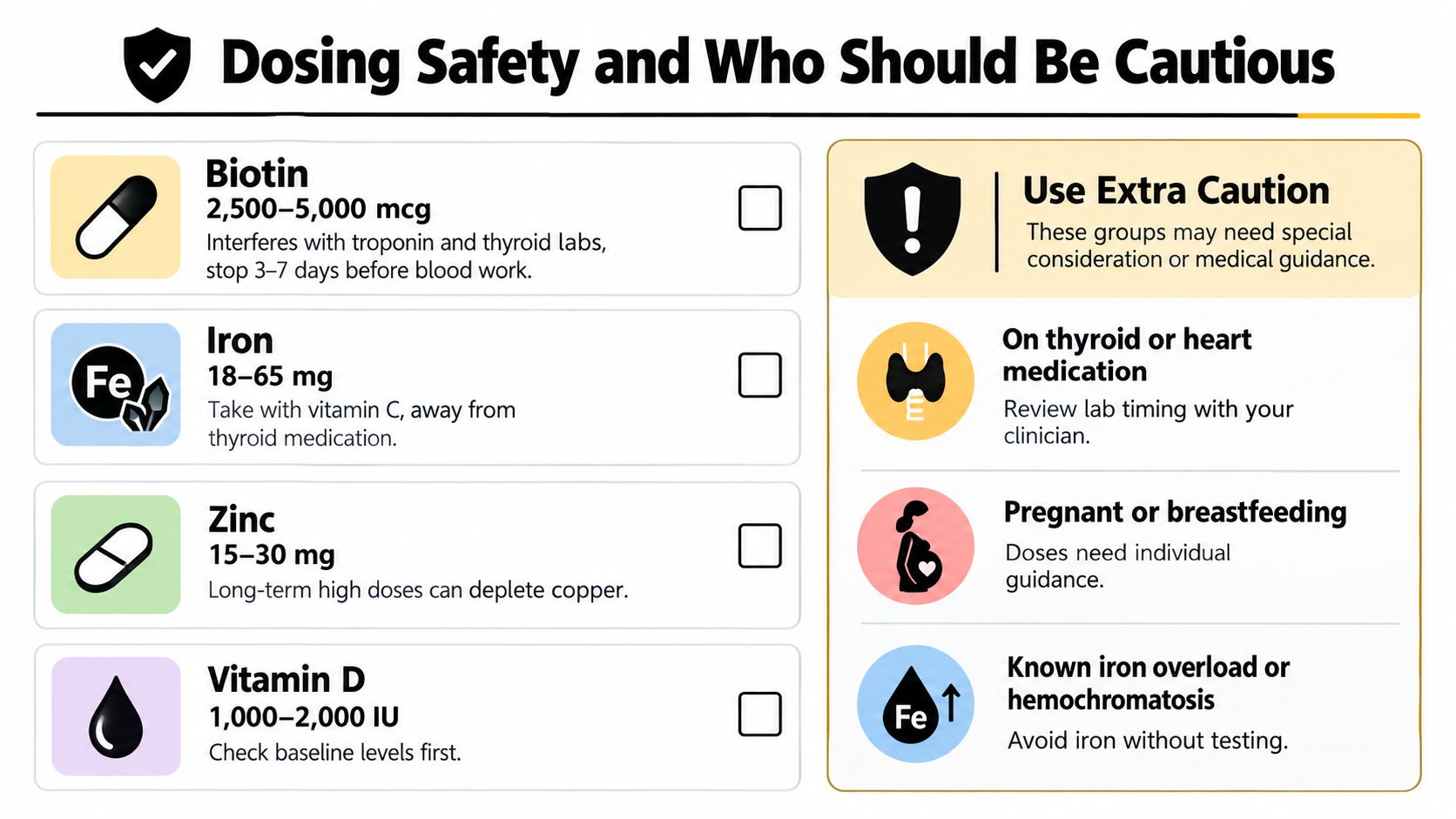
Biotin deserves special caution because it can distort thyroid tests and troponin results. Tell the ordering clinician that you're taking it and ask when to stop before blood work. Iron should generally follow confirmed deficiency and a plan to identify why iron is low. Unnecessary iron can accumulate, particularly in people with iron-overload conditions.
Zinc can cause problems when taken excessively or for too long, including copper depletion. Vitamin D should be guided by baseline testing and medical history rather than stacked across several products. Saw palmetto requires a medication review and isn't appropriate for everyone, particularly during pregnancy or when hormonal medications are involved.
Use a safety screen before starting
- Review medications: Thyroid medication, anticoagulants, hormonal therapy, and other prescriptions may affect the choice or timing of supplementation.
- Check pregnancy status: Pregnancy and breastfeeding change the safety profile of botanical and high-dose products.
- Test before treating: Sudden shedding, scalp inflammation, suspected thyroid disease, and suspected autoimmune loss deserve blood work or examination.
- Avoid duplicate ingredients: A multivitamin plus a hair formula can unintentionally create excessive intake.
- Stop before testing when advised: Biotin is especially important because it can make certain results look falsely abnormal.
Don't self-prescribe iron if you have known hemochromatosis or another iron-overload disorder. Don't use a high-dose zinc product indefinitely without discussing copper balance. Selenium also shouldn't be added casually because excess may contribute to hair shedding rather than prevent it.
The safest product is one with transparent labeling and a clear reason for every active ingredient. If you can't explain why you're taking an ingredient, pause and ask a clinician.
How Supplements Fit Into a Full Hair Plan
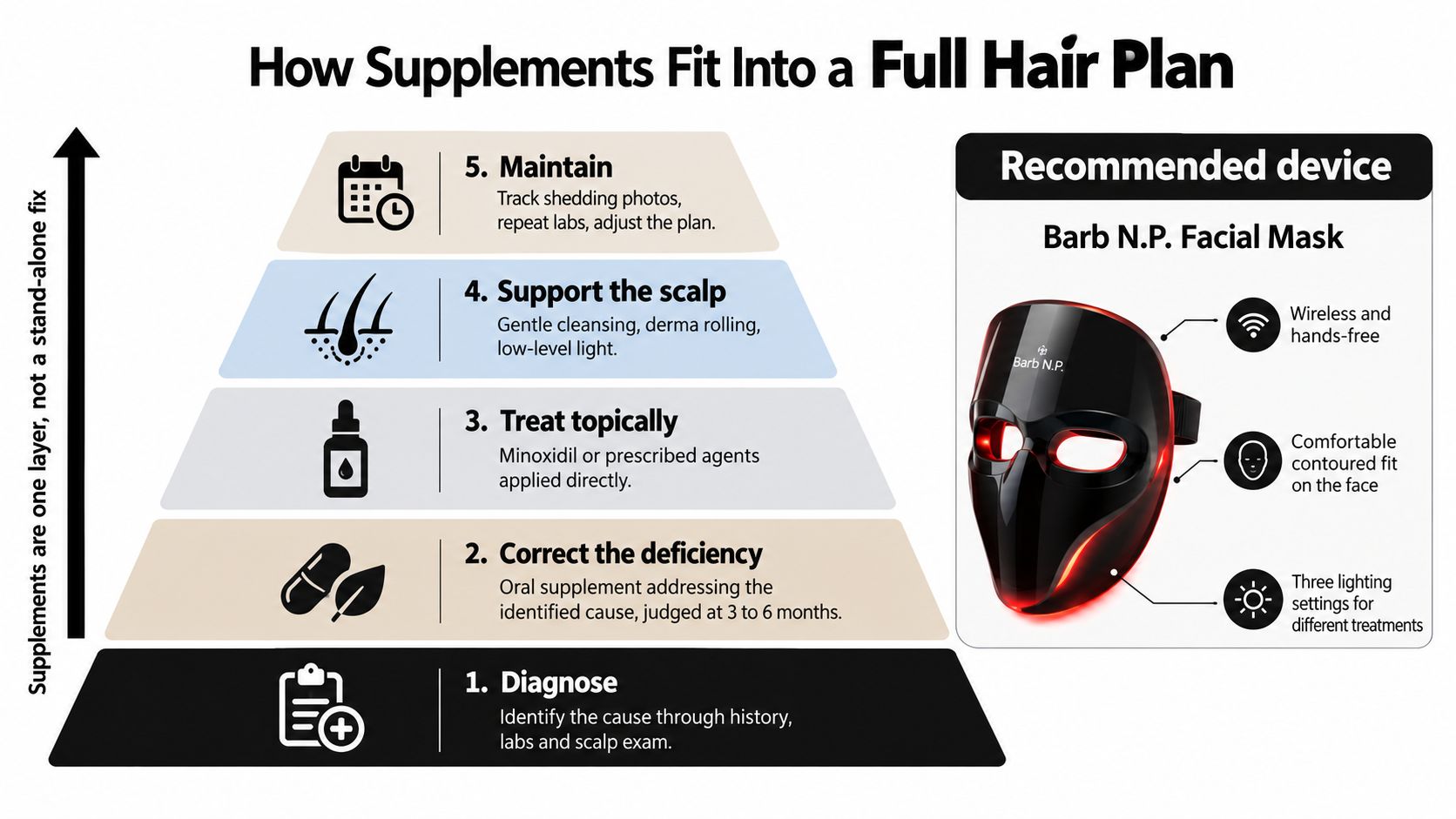
A supplement belongs inside a treatment sequence, not at the top of it. First identify the cause. Then correct a documented deficiency, treat the follicle directly when appropriate, support the scalp, and track the response over time.
For genetic thinning, topical 5% minoxidil may be considered, while low-dose oral minoxidil requires prescribing and monitoring. If androgenetic alopecia is confirmed, a clinician may discuss anti-androgen options such as spironolactone, finasteride, or dutasteride, with attention to sex, pregnancy potential, medications, and other risks. PRP and microneedling may also have a role in selected patients.
Give each treatment one job
- Nutrition: Corrects a documented gap and supports normal follicle function.
- Topical treatment: Delivers an active therapy directly to the scalp.
- Prescription treatment: Addresses hormonal or inflammatory mechanisms when diagnosed.
- In-office care: Provides options such as PRP or microneedling for appropriate candidates.
- Scalp support: Uses gentle cleansing, reduced traction, and selected light-based devices.
Low-level light therapy can be a supportive at-home tool. LED devices are generally considered safe, although people with light sensitivity should avoid them or obtain medical guidance. The Mayo Clinic overview of LED face masks discusses safety considerations and light-based skin treatment. A Barb N.P. Facial Mask is wireless, hands-free, designed for a comfortable contoured fit on the face, and offers three lighting settings for different treatments. It supports a broader skin and wellness routine, but it shouldn't be presented as a replacement for a hair-loss diagnosis or scalp-directed therapy.
For additional context on science-backed supplement options, compare the formula with the rest of the plan rather than judging it alone. You can also learn more about PRP treatment for hair loss when discussing in-office options with a qualified provider.
Common Myths and Misleading Marketing
Myth one, biotin works for everyone. It doesn't. Biotin has a rational role when deficiency exists, but healthy people with adequate levels shouldn't expect a dramatic change from adding more. High doses can also interfere with medical tests.
Myth two, a higher price means a stronger formula. Price may reflect branding, formulation, packaging, or distribution. It doesn't prove that the product is better suited to your diagnosis. A targeted nutrient can be more appropriate than an expensive blend when testing identifies a specific deficiency.
Myth three, collagen gummies reverse genetic thinning. Collagen may be marketed for hair, skin, and nails, but evidence for reversing androgenetic alopecia remains inconclusive. A gummy also doesn't address DHT sensitivity, autoimmune inflammation, traction, or thyroid disease.
Myth four, supplements replace medical treatment. They don't replace an examination, laboratory work, minoxidil, prescription therapy, or treatment for an underlying illness. A person with patchy loss or scalp inflammation needs a clinical assessment, not a longer supplement stack.
Watch for proprietary blends that hide individual amounts, dramatic before-and-after photos with different lighting or styling, and promises to stop shedding in an implausibly short time. Peer-reviewed supplement trials generally evaluate outcomes over multiple months and report modest average changes, not guaranteed regrowth.
Marketing filter: Ask what the product contains, at what dose, for which diagnosis, and based on which human evidence. If the label can't answer those questions, the bottle shouldn't answer your hair-loss concern.
Your Next Steps for Healthier Hair
Start with information rather than a purchase. A clinician may consider ferritin, thyroid-stimulating hormone, vitamin D, zinc, and a complete blood count based on your symptoms, medical history, diet, menstrual history, medications, and pattern of loss. Testing is especially important before taking iron or high-dose single nutrients.
Next, identify the visible pattern. Diffuse shedding after a trigger differs from a widening part, receding temples, or smooth patches. Take clear photographs of the part line, crown, and temple corners under consistent lighting so you can compare changes rather than relying on memory.
Choose one transparent, appropriately dosed product if supplementation is justified. Give the plan enough time to evaluate, since visible hair changes usually take at least three to six months, as reflected in the multi-month Nutrafol trial data cited by the NIH-hosted review. Avoid changing several products at once, because you won't know which ingredient caused a benefit or a side effect.
Use supplementation alongside appropriate adjuncts, such as topical minoxidil, prescribed treatment, PRP, microneedling, or a suitable light-based device. Ask your dermatologist or nurse practitioner:
- What is the most likely cause of my pattern?
- Which laboratory tests do I need?
- Is a deficiency documented, or am I supplementing empirically?
- Could this product interact with my medications?
- What result should we measure, and when should we reassess?
Photograph your hair monthly, keep a record of shedding and symptoms, and stop treating marketing claims as a diagnosis.
BotoxBarb offers medical-grade haircare products, hair-growth supplements, LED light therapy, and PRP appointments that can support a diagnosis-led hair plan. Visit BotoxBarb to explore the available options and arrange personalized guidance before committing to a supplement routine.