Article: Filler Cost Per Syringe: A Practical 2026 Pricing Guide
Filler Cost Per Syringe: A Practical 2026 Pricing Guide
In major U.S. markets, filler cost per syringe averages roughly $684 to $715, while consumer-facing prices often range from $500 to $1,500 per syringe. The number on the menu is only the starting point, because the final bill depends on the product, injector, location, and amount used.
You may be sitting at home comparing treatment menus, feeling confident about the price until you realize that “per syringe” doesn't necessarily mean “per treatment.” A syringe is a unit of product, not a promise that one unit will address every concern you have.
That distinction matters. A subtle lip enhancement may use less product than a cheek or jawline plan, while a full-face approach may involve multiple syringes and staged appointments. My goal as a practitioner is to make the math understandable before you commit, so you can weigh clinical judgment, product choice, recovery, and long-term maintenance rather than chasing the lowest advertised number.
Why a Per-Syringe Number Can Mislead You
A patient once came to a consultation with the national average written in her notes. She had researched the $684 to $715 average and expected her quote to be close. When the estimate was higher, she assumed the practice was overcharging.
Her plan included a premium hyaluronic acid product, an experienced injector, and more than one syringe. The quote also covered assessment time and supplies, which were not obvious in the advertised figure. Her concern made sense. The original number was not necessarily wrong. It answered the cost of one unit, while she needed the expected cost of her treatment plan.
The menu price is a starting point
A per-syringe fee may include the filler, injector time, technique, clinical assessment, and practice overhead. Geography and product selection can change the quote substantially. A national benchmark can help you spot a quote that seems unusually high or low, but it cannot account for your anatomy, goals, or the amount your injector recommends.
Regional pricing makes that clear. One U.S. pricing guide listed averages of $865 in California, $810 in New York, $805 in New Jersey, and $845 in the District of Columbia, compared with $618 in Mississippi, $617 in Arkansas, and $627 in Alabama. It also reported treatment totals of $2,300 in Los Angeles and $1,528 in New York City for filler-related treatments. Those figures show why the patient-facing bill can vary by location, not just by product. The state and city filler pricing guide from CareCredit provides that regional comparison.
Practical rule: Ask for the estimated total, including the product, number of syringes, consultation, and any planned follow-up, rather than asking only for the price of one syringe.
A realistic budget should also account for maintenance. An initial appointment may not represent what you spend over time, especially if your plan involves staged treatment or periodic adjustments. If you are considering aftercare, the BARB N.P. LED Facial Mask can be discussed as an optional post-filler care upgrade, separate from the syringe cost and your injector's medical instructions. The useful figure is the cost of an appropriate plan performed conservatively, not just the lowest menu price.
What a Syringe of Filler Actually Is
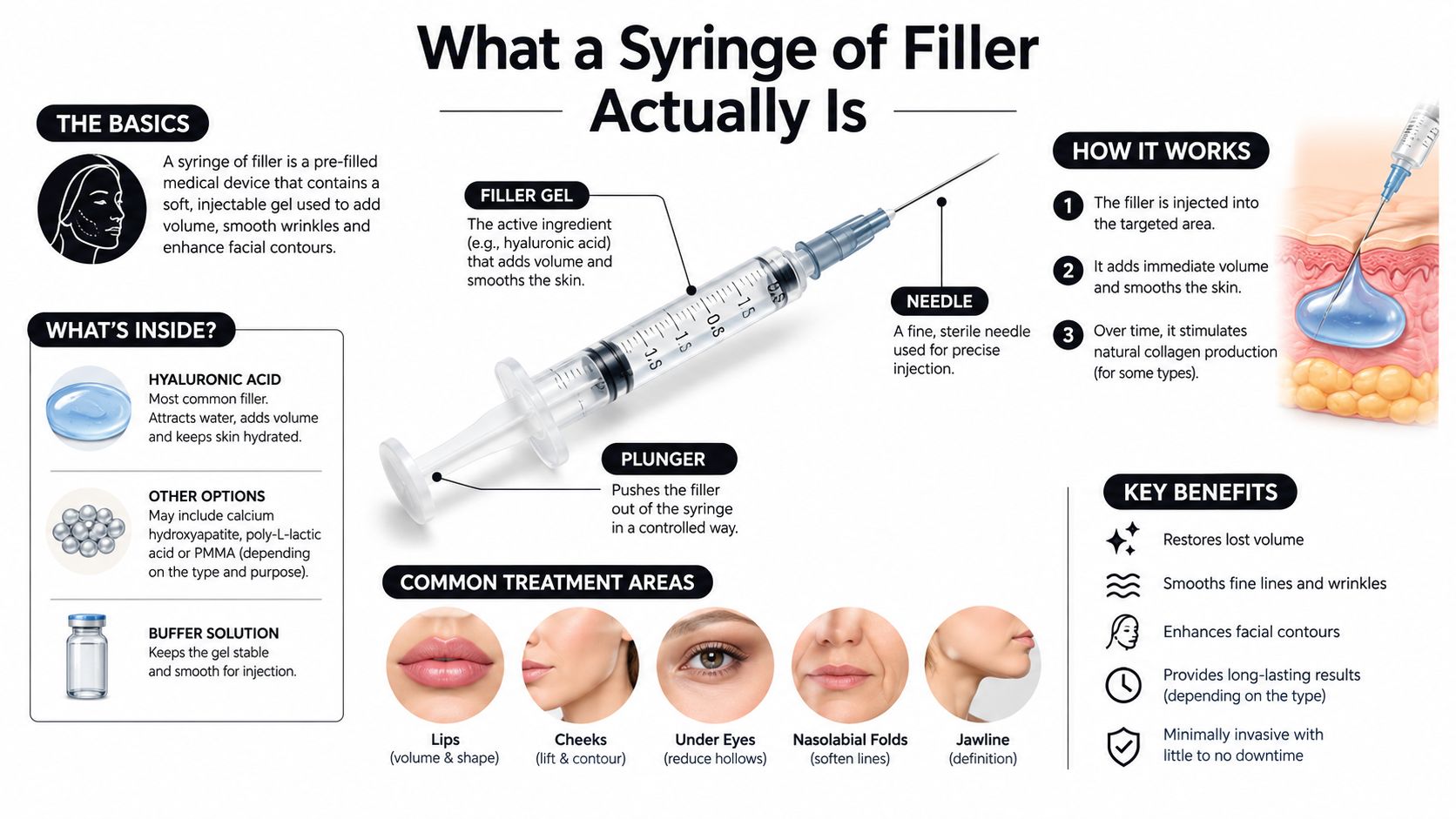
A syringe is the standard billing unit in aesthetic medicine. For many dermal fillers, it contains approximately 1 mL, or 1 cc, of gel. Clinics use this unit because it allows the provider to document the product selected and the volume placed, rather than assigning one vague price to an area that can require very different amounts for different faces. RealSelf's dermal filler cost guide explains the typical 1 mL syringe size and why patients may need more than one.
That doesn't mean every filler behaves the same way. The gel's thickness, flexibility, cohesiveness, and intended tissue depth all affect how it's selected.
The main filler families
Hyaluronic acid, or HA, fillers include families such as Juvéderm, Restylane, and RHA. HA is widely used for lips, cheeks, folds, chin, and other areas because it can integrate with tissue and, when clinically appropriate, can be treated with an enzyme if reversal is needed. HA products dominate conversations about filler cost per syringe because they're commonly sold and discussed using that unit.
Calcium hydroxylapatite, represented by Radiesse, provides structure and can also stimulate collagen production. It isn't interchangeable with a soft lip filler.
Poly-L-lactic acid, commonly associated with Sculptra, works as a collagen-stimulating treatment rather than an immediate gel volumizer. Practices generally discuss it by vial and treatment plan.
Polymethyl methacrylate, used in Bellafill, is a longer-lasting option that requires especially careful patient selection and technique. It isn't comparable to a standard HA syringe just because both are injectable.
You can learn more about composition and clinical categories in this overview of what dermal fillers are made of.
Why one syringe rarely tells the whole story
One syringe may be appropriate for a focused touch-up, but it may not be enough to create balanced change across both cheeks, the chin, or several areas. A provider should explain whether the plan is conservative and staged or designed to address several concerns in one visit.
The most useful consultation language is specific: which product, how much volume, where it will go, and what the total cost will be. Without those details, a per-syringe price is only a shopping reference.
The Four Biggest Drivers of Filler Cost Per Syringe
Four variables account for most of the difference between one quote and another: brand, filler type, injector expertise, and geographic market. These variables overlap, so comparing two prices only makes sense when the product and treatment plan are reasonably similar.
Brand and product line
A soft lip product and a firm cheek product may come from the same manufacturer but serve completely different purposes. Structural products designed for projection or lift may sit at the higher end of a practice's menu. A thinner formulation may be selected for movement and subtlety rather than maximum volume.
Product choice should follow anatomy, not the promotional price. A lower-cost filler that isn't suited to the treatment plane can create a poor result and may require correction.
Filler type and intended performance
HA, Radiesse, Sculptra, and Bellafill don't have the same composition or treatment objective. Comparing one HA syringe with one vial of a collagen stimulator as though they're identical units creates confusion. The clinically appropriate product may cost more at the appointment while offering a better fit for the area.
Injector expertise
You're paying for more than the box. An experienced aesthetic NP, dermatologist, or plastic surgeon brings facial assessment, injection technique, vascular anatomy knowledge, and a plan for managing complications. That judgment is particularly important in areas where millimeters can affect symmetry, contour, and safety.
Geographic market
Practice rent, staffing, demand, and local economics all influence pricing. The state-by-state data cited earlier shows that the same broad category of treatment can carry very different averages in different parts of the country.
| Price Driver | Lower End Example | Higher End Example | Typical Impact Per Syringe |
|---|---|---|---|
| Brand and product line | Standard HA formulation | Premium structural HA formulation | Can shift the quote within the practice's menu |
| Filler type | Focused HA treatment | Biostimulator or structural product | Changes both the unit used and the treatment plan |
| Injector expertise | Lower-overhead practice | Advanced, highly experienced injector | Higher fees may reflect assessment and complication readiness |
| Geographic market | Lower-cost regional market | Major metropolitan market | Can change the patient-facing price by hundreds of dollars |
The published consumer ranges reinforce that spread. A major-market guide places HA filler around $684 to $715 per syringe, with broader prices commonly reaching $500 to $1,500 depending on product, provider, and location. This HA filler pricing guide gives that benchmark and explains why the range is wider than a single national average.
Comparing Popular Filler Brands and Their Price Ranges
Brand names help you understand what you're being offered, but they don't tell you the final price by themselves. Juvéderm, Restylane, and RHA each include several formulations with different textures and intended uses. Radiesse and Sculptra belong in a separate comparison because practices may price them by vial or treatment plan rather than by a conventional HA syringe.
The available consumer pricing data demonstrates how much product-specific pricing can vary. One guide reported Juvéderm at $529 to $1,155 per syringe, Belotero at $445 to $966, and Radiesse at $563 to $1,225. Those ranges are broad enough that a brand name alone can't produce a reliable quote. The published filler brand pricing comparison provides those product ranges.
Match the product to the treatment goal
Juvéderm options such as Voluma, Ultra Plus, and Volite aren't identical. Voluma is associated with structural volume, Ultra Plus may be selected for lips or folds depending on the clinical assessment, and Volite is used for skin-quality goals in markets where it's available. This overview of Juvéderm filler types can help you understand why “Juvéderm” is not a complete product description.
Restylane products such as Lyft, Contour, Refyne, and Defyne also differ in firmness and flexibility. RHA products are selected for their movement and tissue behavior in appropriate areas. Revanesse, Belotero, and Teoxane may be available depending on local practice preference and regulatory status, but their price should be confirmed directly with the injector.
| Brand / Product | Typical Use Area | Approx. Price Per Syringe |
|---|---|---|
| Juvéderm family | Lips, folds, cheeks, chin, or skin quality depending on formulation | $529 to $1,155 in the cited consumer range |
| Belotero | Fine lines and selected delicate areas | $445 to $966 in the cited consumer range |
| Radiesse | Structure and collagen stimulation | $563 to $1,225 in the cited consumer range |
| Restylane portfolio | Lips, cheeks, folds, and contouring depending on formulation | Clinic-specific quote required |
| RHA Collection | Dynamic areas and selected facial support | Clinic-specific quote required |
| Sculptra | Collagen-stimulating treatment | Usually discussed by vial and plan, not a standard syringe quote |
| Revanesse or Teoxane | Product-specific facial indications | Clinic-specific quote required |
Thinner HA products used for lips may be priced differently from firmer products intended to support cheeks or jawline. A newer or less familiar product may also require additional injector training, which can affect the practice fee. The right comparison is always same area, same product, similar provider experience, and the same number of syringes.
How Multiple Syringes Change the Real Treatment Price
The most common budgeting mistake is multiplying a menu price by the wrong treatment assumption. A syringe contains a limited volume, and many treatment areas are bilateral or structurally broad. Cheeks, chin, and jawline work can require more product than a small lip touch-up, while an injector may intentionally stage treatment rather than place everything in one visit.
A two-syringe plan at a quoted $684 per syringe would total $1,368 before any additional fees, while the same number of syringes at $715 each would total $1,430. Those are arithmetic examples based on the published benchmark, not a promise about what any practice will charge. This filler cost explanation emphasizes why the final bill rises quickly when a plan needs two or more syringes.
Ask what the quote includes
Practices may structure multi-syringe treatment in different ways. Some discount additional syringes used during the same visit. Others offer package pricing, seasonal promotions, or event-day pricing. Those offers can be useful, but only if the product is authentic, the injector is qualified, and the treatment plan remains clinically appropriate.
Look for line items such as:
- Consultation fees: Ask whether the consultation is applied toward treatment.
- Numbing: Confirm whether topical anesthetic is included or charged separately.
- Cannula and clinical supplies: These may be bundled or itemized.
- Follow-up care: Ask whether a post-treatment assessment is part of the fee.
- Correction or additional product: Clarify what happens if the initial plan needs refinement.
A single-syringe touch-up is financially different from a corrective plan involving several appointments. Your provider should explain the expected number of syringes, whether treatment will be staged, and what could change the estimate.
For a broader treatment-planning perspective, review this discussion of liquid facelift cost. The important question at checkout isn't “How much is filler?” It's “What exactly am I paying for today, and what might I reasonably plan for next?”
Insurance, HSA, FSA, and Financing for Filler
Elective cosmetic filler is generally a personal expense rather than a covered medical benefit. Health insurance usually doesn't pay for treatment performed solely to change appearance, although reconstructive circumstances can be evaluated differently. Post-trauma correction and facial lipoatrophy related to certain medical conditions are examples where documentation and policy language may matter.
HSA and FSA eligibility also depends on medical purpose and current plan rules. A cosmetic treatment normally won't qualify just because it takes place in a medical office. If filler is being considered for a documented condition, ask your benefits administrator and keep the diagnosis, provider documentation, receipts, and treatment description. This guide to tax-free HSA spending offers useful general context, but your plan administrator remains the authority for your account.
Financing deserves careful reading
Some practices work with third-party financing providers such as CareCredit or Alphaeon Credit. Others offer an in-house payment plan. These options can divide a large invoice, but approval requirements, interest, promotional periods, fees, and late-payment consequences vary.
Ask these questions before accepting financing:
- What is the total repayment amount?
- When does interest begin?
- What happens if the promotional balance isn't cleared on time?
- Are there account, processing, or cancellation fees?
- Does the plan cover only today's treatment or future visits too?
A payment that fits comfortably into one month's budget can still become expensive over time. For elective filler, financing should support a plan you can already afford, not make an unaffordable treatment appear manageable. A transparent package price may be preferable to borrowing, and postponing treatment is always a valid option.
Building a Realistic Annual Filler Budget
A first filler appointment may establish your result, while a later review determines whether refinement makes sense. Future visits may address gradual changes in the treated area. Timing varies with the product, treatment area, anatomy, and how your result develops, so an annual plan should leave room for reassessment rather than assume a fixed schedule.
Use this budgeting formula:
Annual filler budget = planned syringes × price per syringe + consultation or treatment fees + skincare and recovery expenses.
Base the calculation on your written quote. Earlier sections covered the broad price differences between products, practices, and locations. For your own estimate, replace those general ranges with the amount your injector gives you, then calculate the cost of the volume you may realistically use across the year. Treatment totals depend on the area and product as well as the unit price, a point also reflected in This dermal filler cost reference.
Budget for recovery and skin support
Reserve money for the care your injector recommends, such as gentle skincare and sun protection. You may also choose an at-home LED device as part of your regular routine. It does not replace an experienced injector or prompt medical assessment when symptoms are concerning.
The BARB N.P. LED Facial Mask is listed at $300 and described as wireless, comfortable on the face, and fitted with three lighting settings for anti-inflammatory, rejuvenation, and circulation-boosting uses. The BARB N.P. LED Facial Mask product page contains those product details and the current listed price. I would place it in the optional post-filler care budget, not count on it to extend filler longevity.
| Budget Tier | Annual Syringes | Est. Syringe Cost | Touch-Ups | Skincare + LED | Total Yearly Estimate |
|---|---|---|---|---|---|
| Focused maintenance | Your injector's planned amount | Use the written local quote | Include only if clinically advised | Add products you will use consistently | Calculate confirmed line items |
| Moderate maintenance | More than one syringe may be needed | Multiply the quote by planned volume | Set aside money for a separate review | Include recovery skincare and optional LED | Add each confirmed expense |
| Premium multi-area plan | Several syringes may be discussed | Use the product-specific quote | Ask whether staging changes the total | Include the device only if it suits your routine | Request an itemized annual estimate |
Keep a separate reserve for follow-up care instead of spending the full budget on product at the first visit. Packages can lower the apparent per-syringe price, but buying more product than your treatment plan calls for can waste money. A responsible maintenance budget pays for clinically appropriate treatment, reassessment, and care you will use.
Putting It All Together and Your Next Step
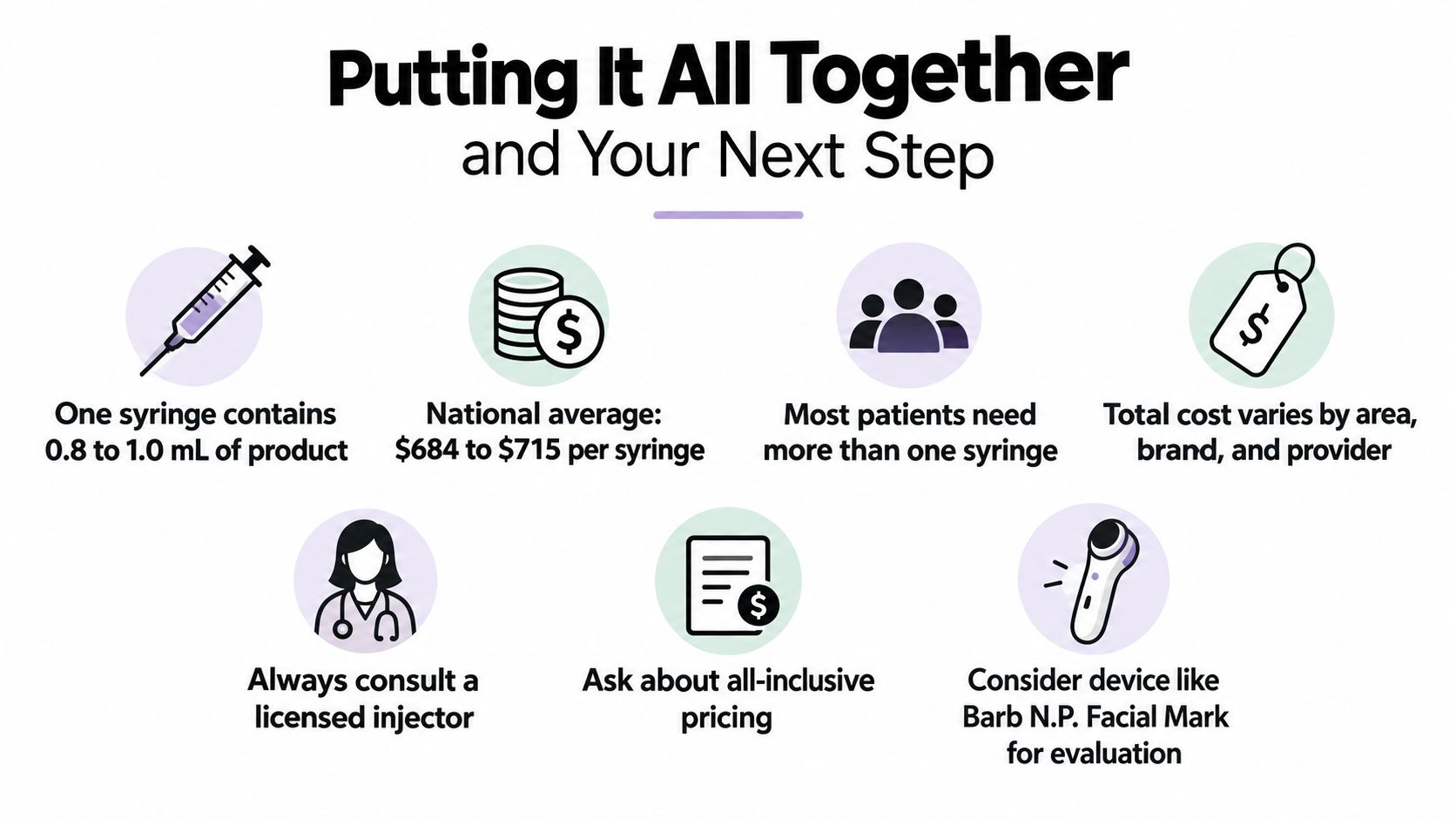
One syringe is a measured unit of filler, commonly about 1 mL, while the national benchmark in major U.S. markets sits near $684 to $715 per syringe and broader consumer pricing often spans $500 to $1,500. Most patients shouldn't assume one syringe will address every concern. The final plan reflects the brand, filler type, injector expertise, geographic market, and number of syringes selected.
Insurance rarely pays for elective cosmetic filler. HSA or FSA use may depend on documented medical necessity and plan rules, while financing can spread payments but may add interest or fees. A realistic budget also accounts for follow-up care, skincare, and optional recovery tools such as the BARB N.P. LED Facial Mask.
Use this consultation checklist
- Confirm the product name and approval status. Ask which formulation is being recommended and why it fits the area.
- Ask how many syringes are needed. Clarify whether the plan is conservative, staged, or multi-area.
- Request an itemized quote. Include product, injector fee, supplies, numbing, follow-up, and any package terms.
- Plan the review and touch-up schedule. Don't assume you need more product before your result has settled.
- Reserve money for recovery and skincare. Include only products you understand and intend to use, including an LED device if it suits your routine.
Internet averages can orient you, but they can't account for your facial structure, treatment goals, medical history, or the injector's recommendation. A consultation is the right place to receive a personalized quote and decide whether the expected result justifies the full maintenance cost.
BotoxBarb offers in-clinic Botox, Dysport, dermal fillers, LED light therapy, and personalized aesthetic guidance, along with medical-grade skincare and wellness products. Visit BotoxBarb to explore appointment options and plan your filler treatment with a clearer view of the product, budget, and aftercare involved.