
Article: How Many Units of Dysport for Forehead Lines
How Many Units of Dysport for Forehead Lines
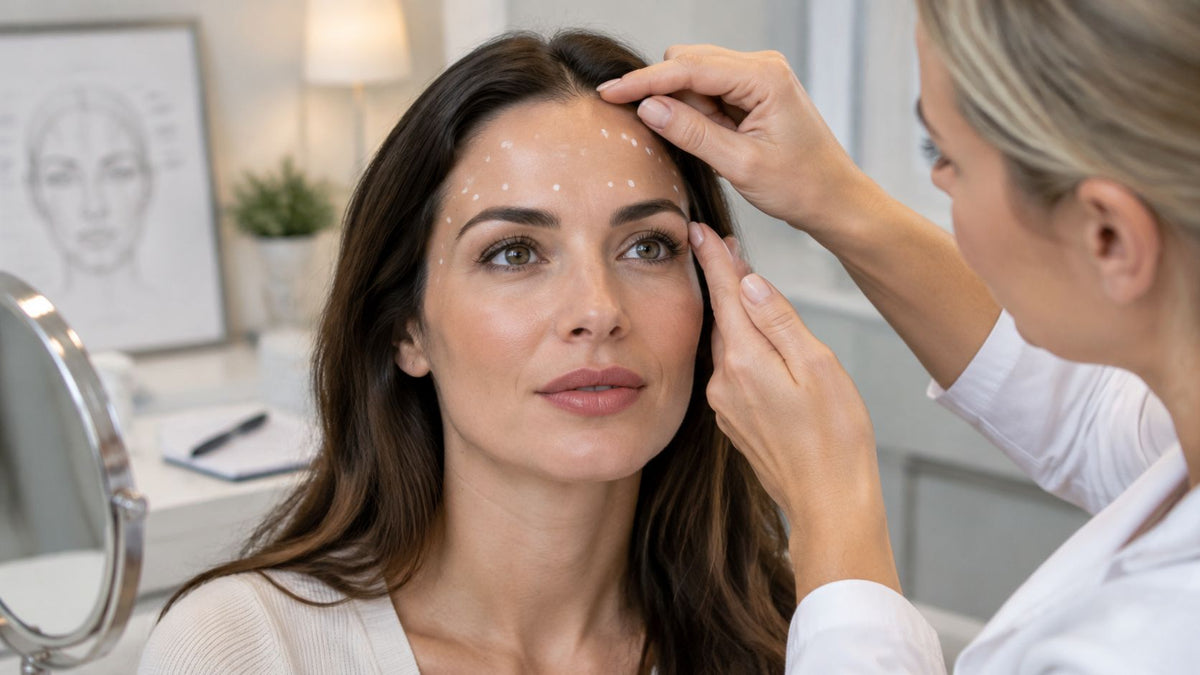
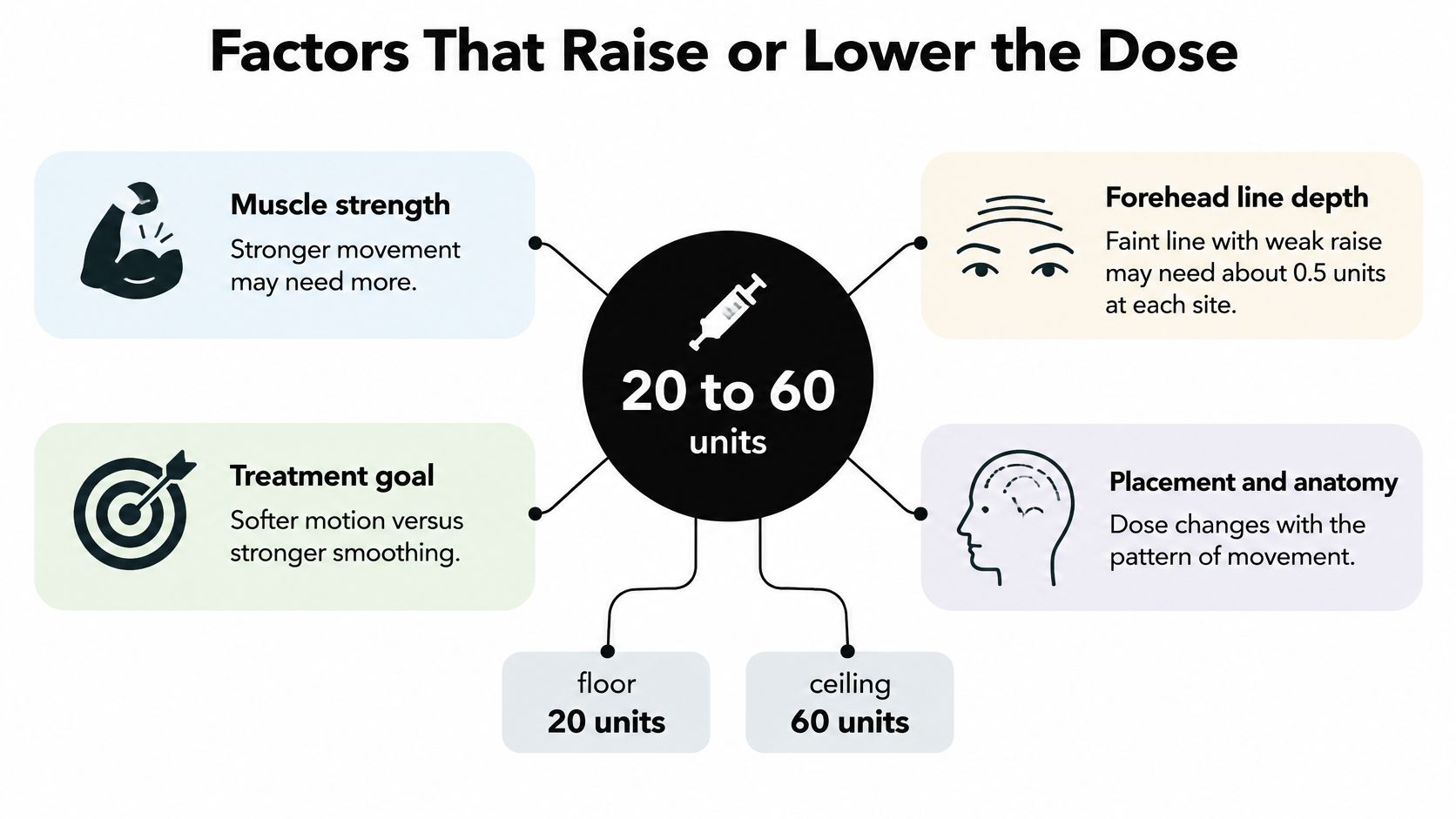
Forehead plans commonly fall around 20 to 60 Dysport units, while the FDA-labeled 50-unit regimen is for glabellar lines between the eyebrows, not the horizontal forehead. Your actual forehead dose needs an in-person assessment, because smoothing the lines also means deciding how much brow lift to preserve.
You may be comparing a clinic quote with a friend's treatment or a number from a comment thread. The useful question isn't just whether your total looks higher or lower. It's whether the quote covers the same muscles, uses actual Dysport units, and accounts for what your forehead is doing to hold your brows up.
Dysport Units for Forehead Lines
Two similar-looking foreheads can fall within the same 20 to 60 Dysport-unit planning band and still need different totals. The number is a reference range, not an individual prescription. In the United States, forehead treatment is off-label; the FDA prescribing information specifies 50 units across five equal 10-unit injections for glabellar lines between the brows, not a standard forehead dose.
A number found online may describe the frown lines, the forehead alone, or both areas together. Check which muscles and product units a quote covers before comparing totals.
Dysport planning ranges for forehead and nearby lines
| Situation | Typical Dysport units | How it is placed | What shifts the number |
|---|---|---|---|
| Horizontal forehead lines | 20 to 60 units as a planning band, not an FDA-established forehead dose | Several sites selected after examining movement | Frontalis strength, forehead height, brow position |
| Glabellar 11 lines, FDA reference | 50 units total | Five equal injections into the corrugator and procerus muscles | This is a glabellar reference, not a forehead prescription |
| Low or heavy brows | Often toward the lower end of the planning band, or treatment deferred | Placement selected to preserve brow lift | How much support the forehead muscle provides |
| Forehead working harder after glabella treatment | A separate, individualized forehead plan | Assess both areas and document their doses separately | Whether the forehead is compensating for reduced glabellar movement |
| Touch-up while prior toxin remains | An assessed add-on, not an automatic repeat of the full dose | Recheck movement before deciding on more treatment | How much movement remains |
Clinical guidance also describes approximately 0.5, 1, or 2 units per site according to contraction strength, with placement at least 2 cm from the orbital rim. These figures are individualized references, not a fixed forehead protocol. The FDA label describes the labeled glabellar regimen, not a standardized forehead map.
Don't combine total-dose and per-site figures into a do-it-yourself injection plan. The figures alone don't specify the dilution, number of sites, or distribution appropriate for an individual forehead. Ask the injector to show the marked sites, explain the product-specific amount at each one, and show how those amounts add up to the written total.
Why similar-looking foreheads get different totals
Suppose two people have horizontal lines that look equally deep in a photograph. One raises the brows strongly and has comfortable lift at rest. The other keeps the forehead slightly contracted because relaxing it makes the upper lids feel heavy. Similar lines can call for different treatment priorities.
The first person may have more room to reduce movement. For the second, preserving useful lift may matter more than softening every line. A broad forehead doesn't automatically call for a higher dose, and a narrow one doesn't guarantee a lower-risk plan. The movement pattern, not surface area alone, shapes the map.
The desired result matters as well. Softening lines during conversation is a different goal from reducing nearly all visible forehead movement. If a crease remains when the forehead is relaxed, adding toxin to chase it may weaken useful movement without giving the skin the finish you want.
Practical rule: A forehead quote should state what movement the injector plans to preserve, as well as what they intend to relax.
Read the quote before comparing the number
Use this sequence to understand a proposed treatment:
- Count the injection sites. Ask how the total is divided and why the points match your movement. Site count alone doesn't explain the amount at each site.
- Separate the treatment areas. Confirm whether the glabella is included. A combined upper-face quote isn't directly comparable with a forehead-only quote.
- Ask about placement. Ask where the marks sit relative to the orbital rim and how the plan accounts for brow support.
Check whether the quote is for an initial treatment or an adjustment while an earlier treatment remains active. Those situations call for different decisions, even if the invoice uses the same treatment-area name.
Skin nutrition and wellness habits can support general skin care, but they don't determine an injectable dose. A friend's total can start a conversation; it can't replace assessing forehead movement and resting brow position.
Factors That Raise or Lower the Dose
Muscle strength comes before line depth. An injector needs to see your brows rise and relax, not just inspect the deepest crease under bright lighting.
A person with faint lines may still recruit the forehead strongly. Another person may have visible lines at rest but very little remaining movement to soften. Treating those faces according to wrinkle depth alone can lead to the wrong endpoint.
Anatomy changes the available treatment area
Consider a short forehead with low-set brows. There's less room to distribute treatment while protecting the muscle activity that keeps the brows comfortable. A taller forehead with higher resting brows presents a different pattern, even when both people point to the same-looking crease.
The injector should examine your face with your eyes open naturally, not only while you make an exaggerated expression. Habitual forehead contraction can be easy to miss if the entire assessment happens while you're actively posing.
Your goal matters too. Someone who wants softer lines during conversation needs a different endpoint from someone asking for very little visible forehead movement. Neither preference overrides anatomy, and a request for stronger smoothing shouldn't become permission to compromise brow position.
- Strong movement: The injector assesses where the muscle contracts most, rather than spreading an identical amount everywhere.
- Low resting brows: Preserving lift may take priority over eliminating horizontal lines.
- Uneven recruitment: One side may need a different distribution, not a matching set of injections.
- A movement-preserving goal: Some expression can be an intended result rather than undertreatment.
Dilution and treatment history change the interpretation
The unit count describes potency, not the volume of fluid injected. Changing dilution changes the volume needed to deliver the same units, so you can't judge the treatment from syringe volume or the size of an injection bump.
More volume can affect distribution, but a more concentrated preparation isn't automatically safer or more precise. Placement, depth, anatomy, and the amount delivered at each point still matter.
Prior treatment adds another layer. Say you recently had glabella-only treatment and now notice your forehead working differently. The injector needs to assess the current balance rather than treat your forehead as though no toxin is active elsewhere.
Think of the frontalis as a set of support cables. The aim is to ease the overworking cables without loosening the support you still need. At the consultation, name your main concern directly, such as heavy brows, an uneven raise, or residual movement after a previous treatment, instead of asking only for a preferred total.
Keeping the Brow From Dropping
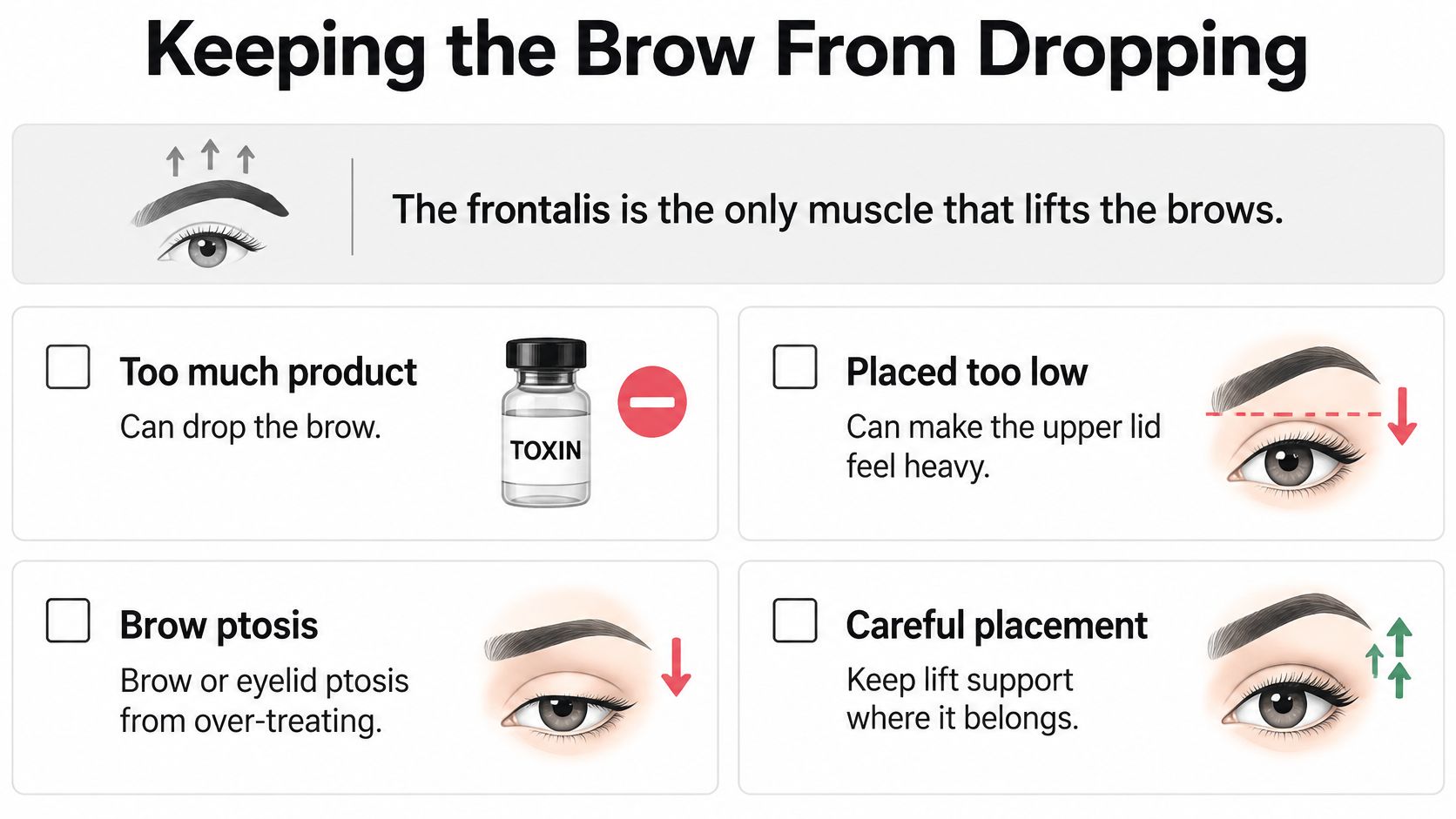
A smoother forehead isn't a good trade if your brows feel heavier afterward. The frontalis is the muscle that lifts the brows, so excessive weakening can lower brow position or make existing upper-lid heaviness more noticeable.
Brow ptosis and eyelid ptosis aren't identical. Brow ptosis means the brow sits lower; eyelid ptosis means the upper eyelid itself droops. You don't need to diagnose the difference yourself, but you should report a new change rather than assume every heavy sensation is routine.
Protect the lift before chasing the crease
A forehead pattern shouldn't just trace the wrinkles immediately above the brows. The injector needs to identify which areas can be relaxed while leaving enough functional lift.
Higher placement can help protect support, but it isn't a guarantee against drooping. The overall amount, distribution, baseline anatomy, and response all contribute to the result.
Give extra attention to the assessment if you have:
- Low brows: There may be little tolerance for losing additional elevation.
- Heavy upper lids: You may already use the forehead to make the eye area feel more open.
- Persistent forehead tension: Raising your brows habitually can be compensatory rather than purely expressive.
- No previous treatment map: A conservative first pattern gives the clinician a clearer basis for future decisions.
Our explanation of whether Botox can raise eyebrows helps distinguish a planned change in brow balance from indiscriminate forehead relaxation. A brow-lifting goal requires attention to the muscles pulling down as well as the muscle lifting up.
Leaving useful movement is often a better result than removing every horizontal line.
Know what deserves a call
A sensation of tightness isn't the same thing as a visibly lowered brow or an eyelid covering more of the eye. New asymmetry, increasing lid heaviness, or a clear change in eye opening warrants contact with the treating clinician.
Don't seek extra units because one area feels unfamiliar. More toxin cannot reverse an area that has already been excessively weakened, and additional treatment can complicate the assessment.
Arrange a follow-up with the injector and ask when the result will be ready to judge. Take clear photographs if a change is difficult to describe, keeping your head position and expression consistent.
Seek urgent medical attention for trouble breathing, swallowing, or speaking, or for generalized weakness. Those symptoms shouldn't wait for a cosmetic follow-up.
How Dysport Units Differ From Botox
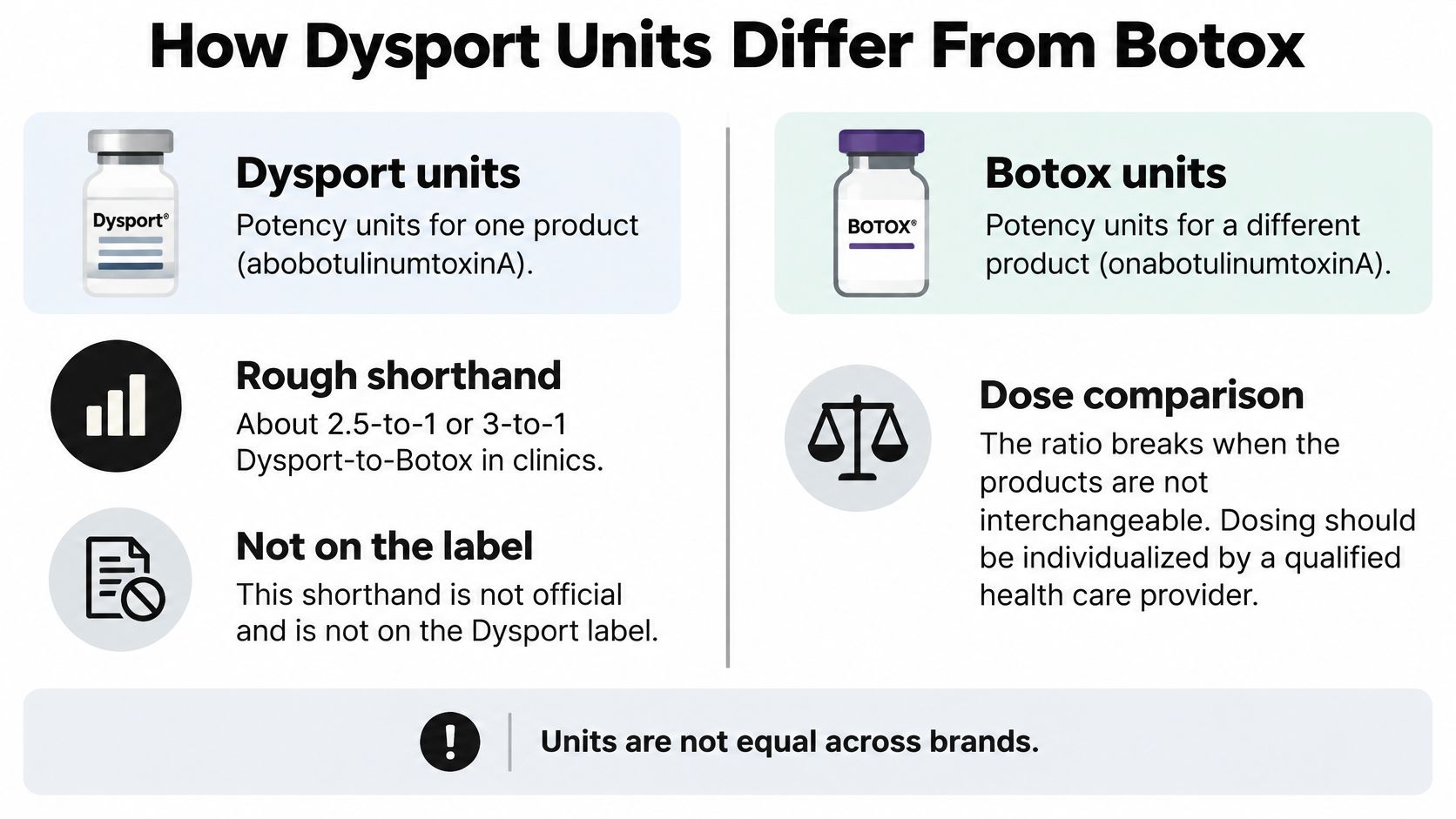
Dysport and Botox units measure potency for different products. The Dysport prescribing information states that its units aren't interchangeable with those of other botulinum-toxin products and gives a cosmetic reference of 50 units in five glabellar injection sites, not a forehead conversion formula.
Dysport and Botox for forehead planning
| Question | Dysport | Botox |
|---|---|---|
| Unit meaning | Product-specific Speywood units | Separate Botox units, not interchangeable |
| Forehead talk-range | Individualized off-label planning | Use its own product-specific assessment, not a converted Dysport range |
| Labeled cosmetic reference | Glabellar regimen described above | Its own labeled regimen; don't assume unit-for-unit equivalence |
| Typical feel | May be selected for a distributed forehead pattern | May be retained when an established pattern already works |
| Onset and stay | Assess your documented response | Assess your documented response |
| Sensible switch | Only after a fresh muscle assessment | Staying is reasonable if the previous treatment kept the brows even |
A larger number on a Dysport quote doesn't, by itself, mean a stronger treatment. It also doesn't prove better value. Comparing raw totals across brands is like comparing measurements without checking the scale.
A shorthand ratio isn't a treatment plan
You may hear a rough conversion shorthand in a clinic or see one in a comparison graphic. Treat it as a warning to clarify the units, not as permission to multiply your previous prescription.
A ratio leaves out where the product was placed, how much movement remained, and whether the previous clinician included the glabella in the recorded total. It also can't describe how your brows felt after treatment.
For a more detailed explanation of that distinction, our guide to Dysport versus Botox units focuses on why the unit systems shouldn't be treated as equivalent.
Brand reputation also won't predict your personal onset or duration precisely. Record when you first notice a change, when the result feels settled, and how movement returns. Those observations are more useful at the next appointment than expecting a fixed timetable.
Stay or switch according to your history
I would generally favor continuity when the previous product and pattern produced even brows, comfortable lids, and the amount of expression you wanted. Switching solely because another brand has a larger-looking unit total isn't a clinical reason to change.
A switch becomes more meaningful when you can describe what wasn't satisfactory. Was the result uneven? Did your brows feel heavy? Did the forehead still move in an area you wanted softened?
Bring those details to a new assessment. Keep forehead and glabella doses recorded separately, and make sure the record identifies the actual product rather than only a billing quantity.
LED Facial Mask Care Between Visits
An LED mask may be one part of a home skincare routine, while Dysport addresses muscle-driven movement. The two serve different purposes, and using a mask does not determine or change an injectable treatment plan.
Home LED devices have different instructions and treatment protocols. Follow the directions for your specific device, including session length, eye protection, and any cautions related to skin conditions or medications. More exposure is not automatically better.

Choose a routine you can use consistently
Comfort and clear instructions matter when choosing a home device. Check that you can follow its recommended routine and that it suits your skin and circumstances. For an overview of what LED light therapy is used for, read about the benefits of LED light therapy.
An LED mask is a skincare tool. It cannot assess brow support or determine a Dysport dose.
Keep hydration and light therapy distinct
Light therapy does not replace the basic steps of a skincare routine. Use a gentle cleanser, a moisturizer that suits your skin, and daytime sun protection. If you want a separate hydration step, a moisturising mask for your skincare routine is a different kind of product; check its ingredients for anything your skin does not tolerate.
After injections, follow your treating clinician's guidance about when to resume home-device use. If your brow position changes or an eyelid feels unusually heavy, stop using the device and arrange an assessment.
Book a Mapped Forehead Plan
A useful consultation turns a general dosing question into a decision about your face. Book an in-person assessment rather than requesting a number copied from a comment thread.
Bring unfiltered photographs of your forehead at rest and with your brows raised. Include images of a result you liked, if you have them, but explain what you liked about it: comfortable brows, softer movement, or less asymmetry.
Bring a treatment record, not just a total
The most helpful record identifies:
- The product and treatment date: Include recent treatment from another clinic, even if it involved a different area.
- The areas treated: Note whether the written total included the forehead, glabella, or other muscles.
- Your response: Describe heaviness, uneven lift, remaining movement, and anything you'd want changed.
- Your current goal: Say whether preserving expression matters more to you than stronger smoothing.
Mention medical conditions, medications, previous reactions, and any existing eyelid or brow concerns before treatment. Those details belong in the assessment, not in an afterthought once the injection marks are already drawn.
Leave with a plan you can explain
A useful written plan separates forehead treatment from glabella treatment and identifies the intended distribution. It should explain what movement will be preserved, when the result will be reviewed, and how residual asymmetry would be assessed.
Ask what would justify a touch-up and what would make the clinician recommend waiting instead. A review isn't automatically an appointment for more product.
BotoxBarb has a 5.00-star rating from 81 reviews marked as verified. Reviews can help you evaluate a practice, but your own assessment still needs to establish whether forehead treatment is appropriate and what trade-offs you're comfortable accepting.
A single total without an anatomical explanation isn't enough information to copy or compare confidently. The reason to book is to replace that uncertainty with an individualized clinical decision.
BotoxBarb offers injectable services including Botox, Dysport, and Restylane. For forehead lines, visit BotoxBarb to book an assessment and discuss a product-specific plan that accounts for your movement, brow position, and previous treatment history.

