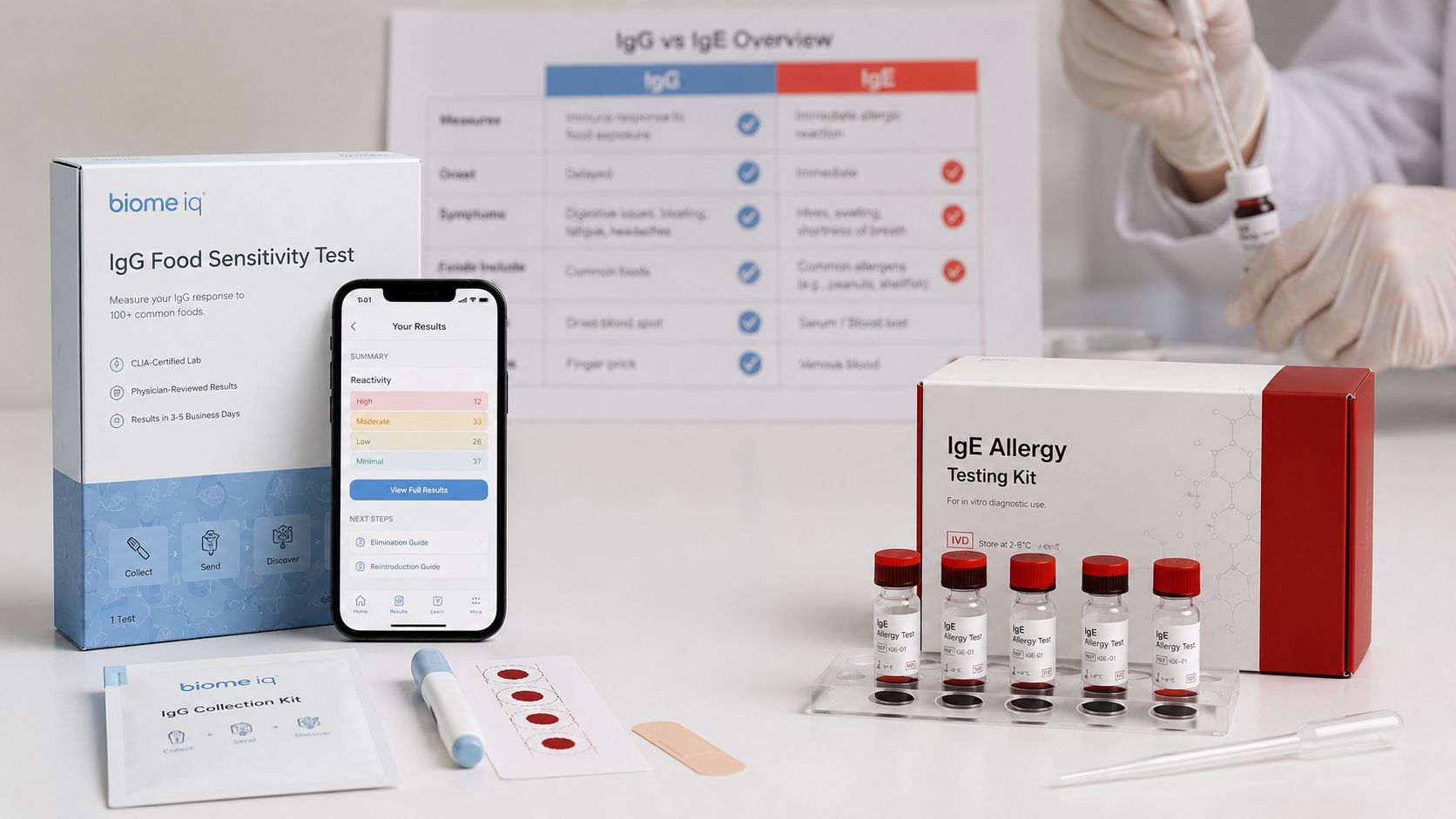
IgG vs IgE Allergy Testing: The Clinical Truth for 2026
If you're reading about IgG vs IgE allergy testing, chances are you're tired of guessing. One week it feels like dairy. The next week it seems like eggs, gluten, wine, or nothing you can clearly identify at all. You may have bloating, fatigue, headaches, skin flare-ups, or brain fog, yet the pattern never feels clean enough to trust.
That confusion is exactly where aggressive marketing for "food sensitivity" panels tends to land. The problem is that IgE and IgG testing are not interchangeable, and treating them as if they are can send you in the wrong direction. As Barb N.P., I want clients to understand which test is medically useful, which one often creates noise, and how to move toward a diagnosis that is helpful.
The Search for Answers to Unexplained Symptoms
A common story goes like this. Someone starts noticing that their stomach feels off after meals. Then the skin joins in with rashes or irritation. Energy drops, concentration slips, and suddenly every meal feels suspicious. At that point, it's easy to end up comparing dozens of online tests that all promise clarity.

Why the timing of symptoms matters
In practice, one of the first things I want to know is how fast symptoms show up. That detail often points us toward the right category of reaction.
IgE-mediated allergic reactions occur within minutes to hours of exposure, often causing immediate symptoms like hives, swelling, or anaphylaxis, while IgG- and IgA-associated responses are delayed, building over hours to days and showing up as symptoms like bloating, fatigue, brain fog, and headaches according to this explanation of immunoglobulin timing and symptoms.
That difference is why the phrase "food reaction" can be so misleading. It lumps together several very different problems.
- Immediate and high-risk: Hives, lip swelling, throat symptoms, wheezing, or a rapid reaction after eating.
- Delayed and harder to track: Bloating, fatigue, headaches, or vague skin changes that appear later.
- Not always immune-driven: Some food issues are intolerance, digestion, medication interaction, or another condition entirely.
Why people get pulled toward the wrong test
Delayed symptoms are frustrating because they don't create a neat cause-and-effect pattern. That's why people often search for broad food panels before they've had a proper clinical workup. If that sounds familiar, you may also find this guide on how to identify food sensitivities helpful as a starting point for organizing symptoms and triggers.
The more delayed and nonspecific the symptom, the more careful you need to be about assuming that a lab panel has found the answer.
When clients come in with a long list of "positive" foods from an online report, I often find that the list created more fear than clarity. The goal isn't to collect more red flags on paper. The goal is to identify whether you have a true allergy, a likely intolerance, or a pattern that needs a different kind of medical evaluation.
Understanding IgE The True Allergy Antibody
When we talk about a true food allergy, we're usually talking about IgE. This is the antibody tied to classic immediate allergic reactions, the kind that can escalate quickly and sometimes become dangerous.
What IgE actually tells us
A useful way to remember it is E for emergency. IgE is involved when the immune system reacts as though a food protein is a threat and mounts an immediate response. Clinically, that's the category associated with hives, swelling, and anaphylaxis after exposure.
IgE-mediated food allergy testing is clinically validated and highly reliable, with a negative IgE test result indicating a lack of food allergy to over 95% accuracy, and IgE blood tests and skin prick tests are the standard diagnostic tools used to confirm suspected immediate food allergies according to Colorado Allergy's review of food allergy versus food intolerance.
What valid IgE testing looks like
In real clinical use, IgE testing isn't a random shopping list of foods. It works best when the test is chosen based on symptoms and history.
The most common tools are:
- Skin prick testing: Often used when the symptom history suggests an immediate allergy and a clinician wants a fast office-based assessment.
- Specific IgE blood testing: Useful when bloodwork is the better fit, or when a broader look at suspected allergens is needed.
- Oral food challenge under medical supervision: This is used selectively and carefully when confirmation is needed.
Practical rule: A positive IgE result does not live in isolation. It has to match the clinical story.
What IgE can and cannot do
IgE testing is strong when it answers a focused question, such as whether a person with immediate symptoms after eating a specific food may have an allergy. It is not meant to replace judgment, symptom history, or physician oversight.
That matters because some clients assume a lab number tells them how severe a future reaction will be. Its operation is not so straightforward. Severity depends on the whole clinical picture, not just one printed result.
For clients with sudden reactions after meals, lip tingling, hives, facial swelling, or breathing concerns, IgE-based evaluation is the evidence-based path. That's the category medicine uses to investigate immediate food allergy.
Decoding IgG The Misunderstood Memory Antibody
IgG gets marketed as the answer to mysterious food symptoms. That's where a lot of confusion starts.
What IgG means in the body
The American Academy of Allergy, Asthma, and Immunology states that the presence of food-specific IgG is a normal physiological response to food exposure and should not be confused with a food allergy, as explained in the AAAAI public guidance on IgG food testing.
In plain language, IgG often means your immune system has seen that food before. It does not automatically mean the food is harming you. In some settings, higher IgG, especially IgG4, may even align with tolerance rather than a problem.
Why these reports can look convincing
An IgG panel often returns many positives. That can feel persuasive because the printout looks technical and personalized. But a long list of highlighted foods is not the same thing as a diagnosis.
Here's what tends to happen:
- You receive many flagged foods: The report may make normal exposure look abnormal.
- You start removing foods rapidly: Dairy, eggs, wheat, nuts, and other staples disappear.
- Your diet becomes harder to sustain: Meals get restrictive, social eating gets stressful, and nutrition can suffer.
- The root issue may still be unresolved: You may still need evaluation for true allergy, intolerance, GI conditions, or dermatologic triggers.
The clinical problem with IgG marketing
This is the heart of the issue in any honest discussion of IgG vs IgE allergy testing. IgG is frequently sold as if it diagnoses sensitivity or intolerance, but major allergy organizations do not accept it as a diagnostic tool for food allergy.
That's not a small technical disagreement. It changes what decisions should be made from the result.
A test that reflects exposure can look useful while still being clinically misleading.
There is also an important nuance. Emerging research has explored how allergen-specific IgG may play a therapeutic or blocking role in tolerance and immunotherapy contexts. That does not mean a consumer IgG food panel can diagnose the cause of your symptoms. Those are separate questions, and they shouldn't be blurred together in marketing.
If your report says you react to nearly everything you eat, that doesn't prove your body is "inflamed by all foods." More often, it means the test isn't answering the question you thought you asked.
IgE vs IgG Testing A Head-to-Head Clinical Comparison
If you want the shortest clinically sound answer, here it is: IgE testing is used to evaluate true immediate allergy. IgG testing is not accepted by major allergy societies as a diagnostic test for food allergy.
Here's the side-by-side comparison people usually need before they can make sense of the noise.
| Criterion | IgE Testing (The Clinical Standard) | IgG Testing (The Disputed Method) |
|---|---|---|
| What it measures | Allergen-specific IgE associated with immediate allergic response | Food-specific IgG associated with exposure and immune memory |
| Typical timing | Minutes to hours after exposure | Delayed patterns are often claimed, but interpretation is not validated for diagnosing allergy |
| Clinical role | Used in medical allergy evaluation | Not recognized as a diagnostic tool for food allergy |
| Common interpretation of a positive result | Sensitization that must be matched to symptoms and history | Often reflects that the food has been eaten, not that it is causing disease |
| Professional guideline status | Standard tool when used appropriately | Major allergy societies recommend against using it to diagnose food allergy |
| Follow-up path | Clinical history, targeted testing, and sometimes supervised challenge | Often leads to unnecessary food restriction without clear medical value |

What professional societies actually say
Major allergy societies like EAACI, AAAAI, and others explicitly recommend against IgG testing for diagnosing food allergy because IgG levels reflect food consumption and may even correlate with tolerance, leading to false-positive results and unnecessary dietary restrictions, as summarized by ADLM's review of the clinical utility of food testing.
That statement matters more than marketing language. It tells you where mainstream clinical allergy practice stands.
The trade-offs that matter in real life
People often ask me why disputed tests remain so popular. The answer is simple. They are easy to buy, easy to ship, and easy to misread as definitive.
The trade-offs look like this:
- IgE testing gives you medically actionable information when symptoms suggest an immediate allergic reaction.
- IgG testing often gives you more data than meaning, especially if you're hoping for a diagnosis.
- A broad panel can create false confidence: You may feel you've solved the puzzle when you've only generated a complicated food list.
- Restriction has consequences: When clients remove many foods without clear cause, eating becomes harder, not healthier.
For readers comparing test methods, this overview of allergy blood test vs skin test can help clarify which evidence-based option may fit a given situation.
If a result would push you toward major dietary changes, that result should come from a test with clinical validity.
In practical terms, the verdict is straightforward. Use IgE-based pathways to investigate suspected true allergy. Don't use IgG food panels as if they diagnose allergy or intolerance.
Getting a Real Diagnosis Your Action Plan
When symptoms are disruptive, people want a single test that settles everything. Medicine rarely works that way. The most reliable diagnosis comes from combining symptom history with the right tools in the right order.

Start with pattern recognition
Write down what you ate, how quickly symptoms appeared, what those symptoms were, and whether they repeated with the same food. Don't aim for perfection. Aim for a pattern.
A useful symptom diary should include:
- The food and form: Raw egg is different from baked egg. Shrimp in a mixed dish is different from shrimp alone.
- Timing: Immediate symptoms raise a different clinical question than symptoms appearing much later.
- Symptom type: Hives and throat tightness are not the same category as bloating or fatigue.
- Context: Exercise, alcohol, medications, and illness can change how reactions appear.
Use validated tools, not trend-driven ones
True food allergy is best diagnosed using a combination of specific IgE blood testing, skin prick testing, and oral food challenge, which is the gold standard, while IgG panels measure normal dietary exposure and lack validation for clinical decision-making according to this guide on how true food allergy is diagnosed.
That combination is what keeps patients from being overdiagnosed, underdiagnosed, or sent into unnecessary restriction.
A practical next step for home testing
If the concern is a possible IgE-mediated reaction, one option is the BotoxBarb at-home IgE Food & Environmental Allergy Test, available through Barb N.P.. It's relevant because it measures the clinically recognized antibody category used in true allergy workups, rather than relying on an IgG food panel. It should still be treated as part of a medical conversation, not as a stand-alone verdict.
A sound action plan looks like this:
- Track symptoms carefully.
- Identify whether the pattern suggests immediate allergy or something else.
- Use IgE-based testing when the history supports it.
- Review results with a qualified clinician.
- If needed, move toward supervised confirmatory testing.
Bring your symptom log to the appointment. A strong history often sharpens the value of any lab result more than people expect.
That approach is slower than buying the first panel advertised to you. It's also far more likely to protect both your health and your diet.
Managing Skin Health Amidst Sensitivities
Food reactions and skin symptoms often get tangled together. Clients may notice eczema, flushing, itching, or a generalized inflamed look and assume every flare must be driven by a hidden food allergy. Sometimes it is related. Often, the picture is more layered than that.

Treat the root cause and support the skin barrier
My advice is to separate two goals. First, identify whether there is a true allergic process that needs medical workup. Second, calm and support the skin you're living in right now.
That means focusing on basics:
- Low-irritation cleansing: Avoid harsh fragrance-heavy products when your skin is already reactive.
- Barrier support: Simple moisturization and ingredient discipline matter more than trendy actives during a flare.
- Trigger awareness: Heat, over-exfoliation, and aggressive treatment routines can worsen already stressed skin.
If eczema-prone skin is part of your picture, this guide to eczema friendly ingredients is a practical resource for choosing products more carefully.
Where LED can fit
A complementary tool I often recommend in a broader skin-support plan is the Barb N.P. Facial Mask. It's a wireless LED device designed for comfort on the face, which matters because people won't use a device consistently if it feels heavy or awkward. It also includes 3 lighting settings for different treatments, giving flexibility depending on whether the goal is calming, maintenance, or supporting overall skin appearance.
LED therapy doesn't replace a medical allergy evaluation. It can, however, fit well into a routine for clients who want to reduce visible skin stress and support a more settled complexion while they sort out internal triggers with the proper workup.
Calm skin and correct diagnosis should happen together. One doesn't replace the other.
Frequently Asked Questions About Allergy Testing
Is a food allergy the same as a food intolerance
No. A true food allergy involves an immune response consistent with allergy pathways. An intolerance may involve digestion, enzyme issues, or other non-allergic mechanisms. The symptoms can overlap, which is why self-diagnosis gets messy.
Why are at-home IgG food tests so controversial
Because IgG food panel testing is not a recognized diagnostic tool, is dismissed by major allergy academies, and these tests are generally not recommended because they have not been proven to identify food sensitivities or allergies, with insurance typically not covering them, according to this discussion summarizing the clinical stance on IgG testing.
If my doctor dismissed my symptoms, what should I do
Bring a concise symptom log, note the timing of reactions, and ask a more specific question. Instead of saying "everything bothers me," say "I develop hives within a short time of eating a specific food" or "I get delayed bloating and headaches and want help ruling out allergy versus intolerance."
Are allergy tests always accurate
They're useful when they're selected for the right reason and interpreted in context. A test without a fitting symptom history can mislead. This review of how accurate allergy tests are may help you understand why interpretation matters as much as the lab itself.
Should I cut out every food that shows up on a report
Not automatically. Broad elimination without clinical reasoning can make nutrition, digestion, and daily life harder. If a report is prompting major restriction, pause and get qualified interpretation before rebuilding your entire diet around it.
If you're trying to sort out reactions, skin changes, or symptom patterns that don't make sense, BotoxBarb offers access to curated wellness tools, including clinically relevant IgE-based allergy testing options and supportive skin-focused devices that can fit into a more thoughtful care plan.