A Guide to Laser for Age Spots Removal
If you’ve ever looked in the mirror and noticed those little brown spots on your face, hands, or chest, you’re not alone. Often called age spots, sun spots, or liver spots, these darkened patches are technically known as solar lentigines. They’re a direct calling card from years of sun exposure, where the sun’s rays have caused melanin—the pigment in your skin—to overproduce and clump together.
While they’re typically harmless, these spots can make your skin look uneven and older than you feel. The good news? Modern aesthetics offer incredibly precise and effective ways to clear them up, with laser treatments leading the charge as the gold standard.
Your Guide to Fading Age Spots With Laser Treatments

This is your complete guide to understanding how we can essentially erase that sun damage, revealing the clear, even-toned skin underneath.
Why Lasers Are the Gold Standard
You’ve probably seen countless creams and serums promising to fade dark spots. While some can help, they often take months to show even minimal results and struggle with stubborn, deep-set pigment. Lasers are different. They go right to the source.
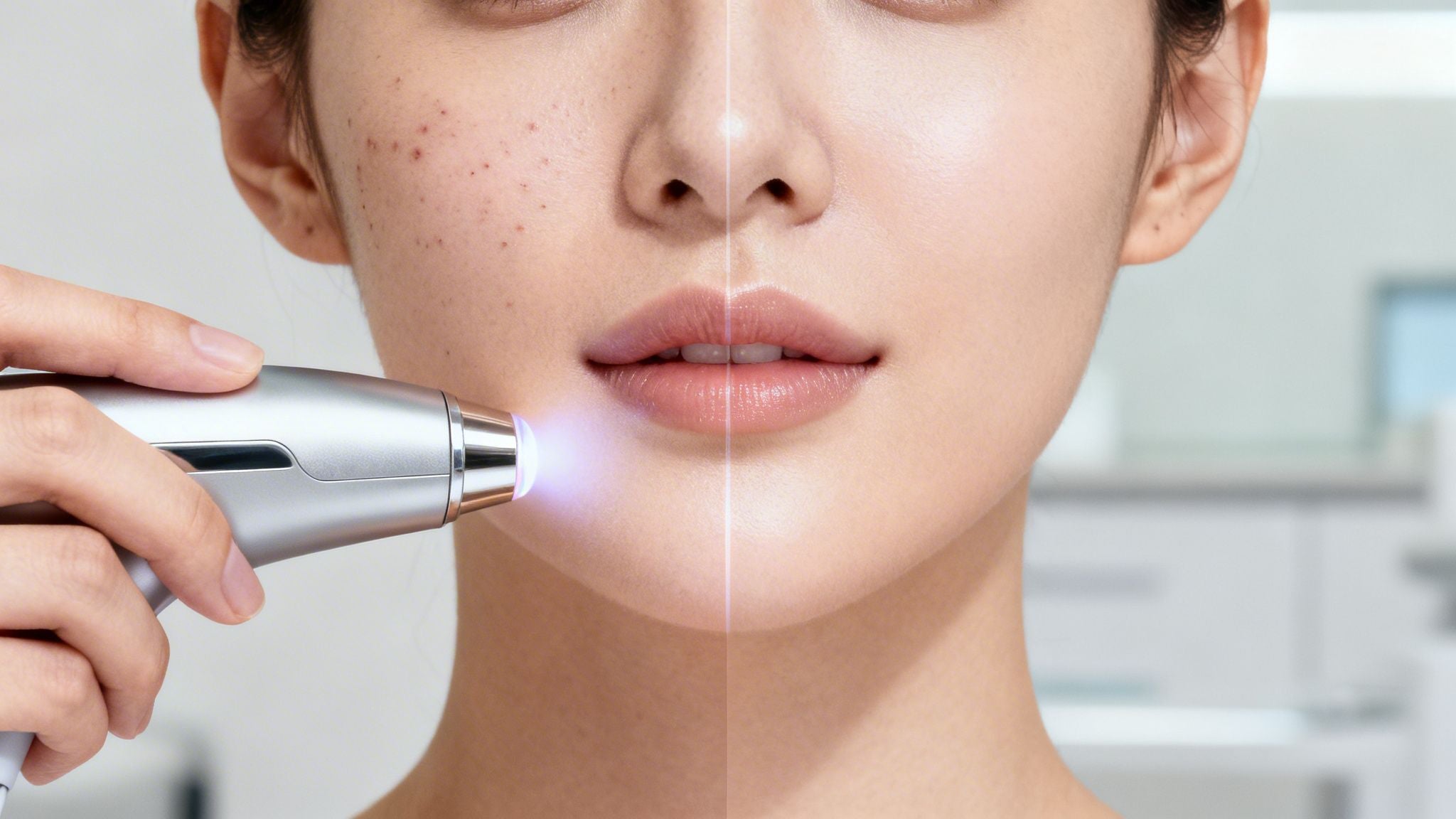
The technology works by sending a highly focused beam of light energy into the skin. This light is specifically tuned to a wavelength that is absorbed only by the concentrated melanin in the age spot.
Think of it like this: the laser is smart. It can see the dark pigment and ignores the healthy, normal-colored skin around it. Once that light energy hits the pigment, it shatters it into tiny, microscopic particles. From there, your body’s natural cleanup crew—the immune system—comes in, sweeps away the fragments, and the spot simply fades away. It's this precision that makes laser therapy so incredibly effective.
The demand for these kinds of results is huge. Clinical procedures like laser therapy are dominating the hyperpigmentation treatment market. In fact, the age spots segment alone grabbed a revenue share of 37.11% in 2025, a clear sign that people want advanced solutions that deliver real, visible change.
Here’s a quick overview of what to expect from laser treatments for age spots.
Laser Treatment for Age Spots at a Glance
| Aspect | Key Information |
|---|---|
| Treatment Goal | To break down and remove excess melanin causing dark spots. |
| How It Works | Focused light energy targets and shatters pigment without harming surrounding skin. |
| Best For | Light to medium skin tones with distinct, well-defined age spots. |
| Typical Sessions | 1-3 sessions, spaced 4-6 weeks apart. |
| Downtime | Minimal; spots may darken and flake off over 7-14 days. |
| Pain Level | Mild discomfort, often described as a rubber band snap. |
| Cost | Varies by location and technology, typically $300-$600 per session. |
This table gives you a snapshot, but we'll dive deeper into the specifics of different laser types, what the procedure feels like, and how to care for your skin afterward.
Beyond Treatment: A Proactive Approach
Here’s the thing about sun damage: erasing the spots you have now is only half the battle. To keep your skin clear for the long haul, you have to prevent new ones from forming. This is non-negotiable.
A comprehensive plan always combines professional treatments with diligent at-home care. A daily, high-quality sunscreen is your number one defense, but supportive skincare with antioxidants and brightening agents is also crucial. For a deeper dive, you might be interested in our guide on the best skincare for sun damage to build a protective and corrective routine.
By pairing smart treatments with even smarter daily habits, you can achieve and maintain that radiant, youthful complexion you deserve. Let’s get into the details.
How Lasers Target and Remove Pigment From Skin
Ever wonder how a beam of light can make a dark spot just… disappear? The science is actually pretty intuitive.
Think about wearing a black t-shirt on a hot, sunny day. You can feel it absorbing the sun’s energy and getting warmer than your friend’s white shirt. That’s because dark colors are naturally better at soaking up light. Lasers use this same exact principle, just with a whole lot more precision.
The official term for this is selective photothermolysis. It sounds complicated, but it just means using light (photo) to create heat (thermo) that breaks down (lysis) a very specific target. In our case, that target is the dark pigment—melanin—that makes up an age spot.
A specialized laser sends out a super-focused beam of light at one particular wavelength. This wavelength is the key. It's perfectly tuned to be absorbed by the concentrated melanin in your age spots, while the lighter, surrounding skin barely notices it. This is what allows us to target those spots with incredible accuracy, leaving your healthy skin completely untouched.
The Shattering and Clearing Process
Once the laser sends its quick pulse of light into the skin, the real action starts. The cluster of melanin in the age spot soaks up all that intense energy in a fraction of a second.
This happens so fast that the pigment doesn't just get warm; it shatters into teeny, microscopic particles.
Imagine an opera singer hitting a single, high note that matches the exact resonant frequency of a crystal glass. Only that one perfect note can make the glass vibrate until it shatters, while all other sounds have no effect. The laser’s light is that perfect note for your unwanted pigment.
After the pigment is broken apart, your body’s own cleanup crew steps in to finish the job.
- The Immune System Responds: Your immune cells, called macrophages, are alerted to these tiny pigment particles and recognize them as debris that needs to be cleared out.
- Debris Removal: These cells act like microscopic janitors, engulfing the shattered pigment fragments and carrying them away from the area.
- Natural Elimination: Over the next few days and weeks, your body naturally flushes these particles out through its lymphatic system.
This is why you’ll often see a spot get darker right after treatment—that’s a great sign it worked! It will then flake off or fade away, revealing the clearer, even-toned skin that was hiding underneath. This combination of precision technology and your body's natural healing is what makes laser treatments a go-to solution for age spots.
Beyond Pigment: Other Light-Based Therapies
While lasers are incredible at shattering existing pigment, other light-based technologies work differently to boost overall skin health. For example, LED light therapy uses various wavelengths to energize your skin cells, not destroy pigment. You can learn more about its unique benefits in our guide explaining what LED light therapy is and how it fits into a complete skincare plan.
The real beauty of laser technology is its pinpoint accuracy. It partners with your body, kicking off a natural clearing process to unveil the healthy, radiant skin you've had all along.
For at-home maintenance, a device like the Barb N.P. Facial Mask can be a great way to support your skin. It's wireless and comfortable, letting you move around during your session. With three different light settings, you can target various concerns—like using red light to stimulate collagen or blue light to fight acne bacteria—making it a versatile tool for keeping your skin healthy long after your professional treatments.
Choosing the Right Type of Laser for Your Skin
Diving into the world of laser treatments can feel a little overwhelming at first, but it's all about finding the right tool for the job. Not all lasers are created equal, and the best one for you hinges on your specific type of pigmentation, your skin tone, and what you’re hoping to achieve. You wouldn't use a roller to paint a fine detail, right? The same principle applies here.
The demand for these treatments speaks volumes about their success. The market for laser for age spots removal is booming, generating USD 356.1 million in 2023 and on track to hit USD 567.7 million by 2030. That’s a huge number of people turning to technology for clear, even-toned skin. You can dig into the numbers in the latest market report from Grand View Research.
To help you walk into your consultation feeling prepared and confident, let’s break down the three main types of light-based treatments we use for age spots.
Intense Pulsed Light (IPL) Photofacial
First up is Intense Pulsed Light (IPL), which isn't technically a laser but is one of the most popular and effective tools for pigmentation. Instead of a single, focused beam of light, IPL uses a broad spectrum of light delivered in quick, powerful flashes.
Think of it like a camera flash with a filter. IPL sends out multiple wavelengths that are absorbed by melanin (the brown pigment in age spots) and hemoglobin (the red in broken capillaries). This makes it fantastic for tackling widespread sun damage, general redness, and scattered freckles—not just a single dark spot.
- Best For: Lighter skin tones dealing with a mix of brown spots, redness, and overall sun damage.
- What to Expect: Most people need a series of 3-5 treatments. The sensation feels like a quick snap of a rubber band, but the downtime is minimal.
Q-Switched Lasers
If IPL is the wide-beam flashlight, Q-switched lasers are the precision sniper rifles. These are true lasers that fire an incredibly strong beam of energy in impossibly short, nanosecond pulses.
Why does that speed matter? It creates a photo-acoustic effect, which essentially shatters the pigment with a tiny shockwave instead of slowly heating it. This method is incredibly precise, protecting the surrounding skin from damage, which makes it a go-to for very dark, well-defined age spots. Because the energy is so focused, we can often clear a stubborn spot in just one or two sessions.
- Best For: Targeting specific, dark, and isolated age spots on lighter to medium skin tones.
- What to Expect: Treating a single spot takes just seconds. Afterward, the area will darken, form a small crust, and flake off naturally within 7-10 days.
Here’s a simple visual of how the laser energy targets pigment, which your body then clears away.

It’s the perfect partnership between advanced technology and your body's own amazing ability to heal and clean house.
Fractional Lasers
Fractional lasers take a completely different approach. Instead of treating the entire skin surface, these devices create thousands of microscopic treatment columns deep into the skin, leaving the tissue around them completely untouched.
It’s like aerating a lawn to get a healthier, greener yard. By creating these tiny, controlled channels, the laser kicks your body's natural healing response into high gear. As your skin repairs these micro-injuries, it pushes out old, pigmented cells and revs up collagen production. The result? Faded age spots, better skin texture, and softer fine lines.
Fractional lasers are my top choice for clients who want to tackle both pigmentation and signs of aging like fine lines or textural issues at the same time. It’s a comprehensive skin refresh.
There are two main types: non-ablative (which heats the tissue without vaporizing it) and ablative (which does vaporize the tissue in the columns for a more dramatic result). We’ll decide on the best fit for you based on your goals and how much downtime you’re comfortable with.
- Best For: Anyone with sun damage, age spots, and textural concerns like fine lines or mild scarring.
- What to Expect: Downtime can range from a few days of redness (non-ablative) to a week or more of healing (ablative).
What to Expect During and After Your Treatment
So, you’re thinking about laser treatments for those pesky age spots. It’s a fantastic choice, but it’s natural to wonder what the process actually feels like and what happens afterward. Let's walk through it, step by step, so you know exactly what’s coming.

Your journey with laser for age spots removal always begins with a personal consultation. This is where we get to know you, your skin, and your goals.
The Consultation and Prep
Before we even think about turning on a laser, we'll sit down for a thorough chat. Expect to cover:
- Your detailed medical history
- A close-up evaluation of your skin
- A clear discussion about your desired results and what’s realistically achievable
To make sure you’re completely comfortable, we often apply a topical numbing cream about 30 minutes before the treatment starts. This takes the edge off, making the whole experience feel much more manageable. You’ll be lying down comfortably, and we’ll also use a cooling device to blow chilled air onto your skin, minimizing any sensation of heat.
What Does the Laser Feel Like?
This is the number one question everyone asks! Most of our clients describe the sensation as a quick, tiny snap, almost like a rubber band flicking against the skin. It’s over in a fraction of a second.
“The cool breeze and precise pulses make the treatment very tolerable,” notes one of our certified laser specialists.
The system is smart—it alternates these short bursts of light with cycles of cooling air. This keeps the procedure comfortable from start to finish.
Your Recovery Timeline
Right after the session, you'll see some redness and maybe a little bit of swelling, similar to a mild sunburn. This is totally normal and usually calms down within a few hours.
The real magic happens over the next few days. Within 24 to 48 hours, you'll notice the treated age spots getting darker. They might look like tiny coffee grounds or flecks of pepper on your skin. Don't panic! This is a great sign—it means the treatment worked and your body is starting to clear out the shattered pigment.
- Days 1–3: Redness and minor swelling are at their peak.
- Days 4–7: Those darkened spots will begin to naturally flake or peel away.
- Days 7–10: Your skin tone starts to even out as the spots fade significantly.
By day ten, most clients are already seeing a dramatic improvement. The best part? There’s almost no real downtime. You can get back to most of your daily activities within 24 hours.
Aftercare: Protecting Your Investment
Post-treatment care is just as important as the treatment itself. Your skin is healing, so you need to be gentle with it. Think soothing, simple skincare.
For an extra boost of healing and rejuvenation, we love recommending the Barb N.P. Facial Mask. This wireless LED mask is a game-changer for at-home recovery and maintaining your results. Its comfortable design allows you to relax while the therapeutic light works its magic.
Tip: Add a session with the Barb N.P. Facial Mask to your routine three times a week to stimulate healing and collagen production.
The mask has three different settings to supercharge your results:
- Red light to boost collagen production
- Near-infrared light for deep cellular repair
- Blue light to calm any lingering irritation or redness
Essential Aftercare Tips
- Stay out of the sun. Avoid direct sun exposure for at least two weeks.
- Use sunscreen religiously. Apply a broad-spectrum SPF 30+ every single day, no exceptions.
- Be gentle. Use mild, fragrance-free cleansers and moisturizers.
- Hands off! Do not pick, scrub, or scratch at any flaky skin. Let it fall off naturally to avoid scarring.
- Hydrate from the inside out. Drink plenty of water and stick to a healthy diet.
To support your skin's recovery, we also recommend gentle, medical-grade products from the BotoxBarb collection. An antioxidant-rich serum or a specialty sunscreen can make all the difference in protecting your newly revealed skin.
Potential Side Effects and Downtime
Side effects are typically very mild and short-lived. Most people just experience a bit of redness or tenderness that goes away on its own.
Common reactions include:
- Mild redness (erythema) that lasts up to 48 hours
- Minor swelling that fades quickly
- Occasional pinpoint crusting
- A rare risk of temporary darker spots (hyperpigmentation) or lighter patches (hypopigmentation)
If you experience anything unusual, like persistent pain or significant pigment changes, call us right away. The team at BotoxBarb is here to support you through every step of your recovery.
Expert Advice: Give your skin a break for 48 hours. Avoid strenuous exercise, hot tubs, and saunas to help the healing process along.
Most clients come back for their next session in about four to six weeks, but we’ll create a personalized plan that’s perfect for you. Patience is key—your skin needs time to complete its natural repair cycle. By combining professional treatments with smart at-home care, you’ll get the smooth, clear complexion you’ve been dreaming of.
How to Maintain Your Results at Home

Getting clear, even-toned skin with laser for age spots removal is a fantastic first step, but the real work begins when you walk out of the clinic. Think of it like a professional deep clean for your home; to keep it looking pristine, you need a solid daily maintenance plan. Protecting your investment is everything.
The single most important part of your at-home care is defending your skin from the very thing that caused those spots in the first place: the sun. New spots can—and will—pop up with more UV exposure, making a dedicated sun protection strategy non-negotiable.
The Cornerstone of Your Routine: Sunscreen
Your new daily mantra is simple: sunscreen, every single day, no matter what. Unprotected sun exposure is the main trigger for melanin overproduction. Skipping this step can quickly undo all the beautiful progress you’ve made with your laser treatment.
We always recommend a medical-grade, broad-spectrum sunscreen with an SPF of 30 or higher. Brands like SkinCeuticals offer sophisticated formulas that give you robust protection against both UVA rays (the aging rays) and UVB rays (the burning rays). This isn't just for beach days; it's a daily shield for your skin's future.
Enhance Healing and Boost Collagen with LED Therapy
Once your skin is past the initial healing phase, you can bring in powerful tools to maintain and even enhance your clear complexion. This is where at-home light therapy becomes your best ally, supporting the results you got with your professional laser treatment.
To take your maintenance to the next level, we recommend adding the Barb N.P. Facial Mask to your weekly routine. This device was designed with your comfort and lifestyle in mind; it's completely wireless, so you can move around freely while you treat your skin. Its comfortable fit means you can actually relax during your session.
The Barb N.P. Facial Mask is the perfect partner to professional laser treatments. It empowers you to actively support your skin's health and maintain that post-laser glow from the comfort of your home.
The mask has three distinct light settings to tackle different skin needs, but one is especially brilliant after laser for age spots.
- Red Light Setting: This wavelength goes deep into the skin to kickstart cellular repair and fire up collagen production. Using the red light a few times a week helps speed up the final stages of healing, improves skin texture, and builds a stronger, more resilient complexion.
- Near-Infrared Light Setting: This mode works with the red light to calm inflammation and support deeper tissue rejuvenation.
- Blue Light Setting: Perfect for calming the skin and zapping any blemish-causing bacteria, keeping your canvas clear and healthy.
Brighten and Protect with Antioxidants
Beyond just protecting and repairing, you’ll want to add a product that actively brightens and defends your skin. A high-quality Vitamin C serum is the perfect final piece of the puzzle.
Vitamin C is a powerhouse antioxidant that neutralizes the free radicals created by UV exposure and pollution. It also acts as a tyrosinase inhibitor, which means it helps block the enzyme that tells your skin to produce excess pigment. Using it every morning under your sunscreen gives you a second layer of defense while actively working to keep your skin tone even and bright.
For more ideas on how to target dark spots with topicals, check out our guide on choosing a brightening serum for dark spots.
Figuring Out if Laser Treatment Is Right for You
While laser treatments for age spots can be incredibly effective, they aren't a one-size-fits-all solution. Figuring out if you’re a good candidate is the single most important step toward getting the clear, beautiful results you want—safely. A professional consultation is always a must, but you can start by understanding what we look for.
The best candidates for most laser pigment treatments have lighter skin, typically Fitzpatrick skin types I-III. In these skin tones, there's less natural melanin, which creates a strong contrast between your healthy skin and the dark pigment in the age spots. This contrast is key, as it lets the laser zero in on the unwanted pigment with amazing precision, leaving the surrounding skin untouched.
Key Factors We Look For
Beyond just your skin tone, a few other things help us decide if laser treatment is the best route for you. An ideal candidate usually has:
- Clear, well-defined age spots instead of more scattered, patchy discoloration like melasma.
- Good overall health without any active infections or skin conditions in the area we'd be treating.
- Realistic expectations about what the laser can do and an understanding that it might take a few sessions.
- A commitment to aftercare, especially being diligent with sunscreen to protect your investment and maintain your results.
Before we even think about turning on a laser, a thorough health evaluation is non-negotiable. This is why a complete physical check, including a comprehensive head to toe assessment, is so critical for your safety and success. This careful approach helps us build a plan that’s both effective and perfectly suited to you.
When We Need to Be More Cautious
Honesty and transparency are everything when it comes to aesthetic treatments. For some people, we need to take a much more careful approach, or they may not be candidates for laser treatment at all.
This often includes individuals with darker skin tones (Fitzpatrick types IV-VI). Because there’s more melanin throughout the skin, there’s a higher risk of the laser causing unwanted side effects like post-inflammatory hyperpigmentation (dark spots) or hypopigmentation (light spots). While certain advanced lasers can be used, it demands a provider with deep expertise and a very light touch.
It's so important to be upfront about your medical history. Certain conditions or medications can make your skin extra sensitive and really impact your treatment’s safety and outcome.
Other factors that might mean laser isn't for you include:
- Being pregnant or breastfeeding.
- Having a history of keloid or hypertrophic scarring.
- Taking photosensitizing medications (like certain antibiotics or acne treatments such as isotretinoin).
- Dealing with an active skin condition like eczema or psoriasis in the treatment area.
The demand for these non-invasive solutions is booming—the global laser treatment market was valued at USD 4.1 billion in 2023 and is expected to skyrocket to USD 11.8 billion by 2033. This massive growth just goes to show how crucial it is to find an expert provider who understands all the nuances of candidacy to deliver the safe, stunning results you deserve.
Your Questions About Laser Treatments, Answered
Stepping into the world of advanced skincare can bring up a lot of questions. To help you feel completely confident and informed about using a laser for age spot removal, we’ve gathered the most common questions we hear from clients just like you.
How Many Laser Sessions Will I Need to See Results?
Most of our clients see a dramatic improvement—or even complete removal—of their age spots in just 1 to 3 sessions.
The exact number really depends on a few things: the specific laser we use, how dark your spots are, and your skin’s unique response. During your consultation, we’ll map out a personalized plan so you know exactly what to expect.
Is Laser Treatment for Age Spots Painful?
Honestly, most people handle it incredibly well. Clients usually describe the sensation as a quick snap, a lot like a rubber band flicking against the skin. It’s over in an instant.
Your comfort is our top priority. We often use a topical numbing cream or a cooling device during the treatment to make the entire experience as easy and comfortable as possible.
The goal is always to deliver stunning results with minimal discomfort. The sensation is temporary, but the clear, even-toned skin you achieve is long-lasting.
Can My Age Spots Come Back After Laser Removal?
The laser permanently destroys the pigment in the spots we treat—those are gone for good.
However, it can’t stop new spots from forming if you get more sun exposure. This is why a daily, broad-spectrum sunscreen isn’t just a recommendation; it's absolutely non-negotiable for protecting your investment. Think of it as your daily insurance policy for beautiful, clear skin.
What Is the Average Cost of This Treatment?
The cost of laser treatments can vary quite a bit. It really comes down to the type of laser we use, the size of the area being treated (like your face versus your hands or chest), and how many sessions you'll need.
A single session can range from a few hundred to over a thousand dollars. We believe in being completely transparent, so we’ll give you a detailed and customized cost breakdown during your consultation before you commit to anything.
At BotoxBarb, our commitment is to help you achieve and maintain your best skin ever. To keep that glow going at home, we’ve curated a selection of medical-grade skincare products designed to protect and enhance your laser results.
Visit our online boutique to find the perfect additions to your routine.