Article: Nutrafol Side Effects: What to Know Before You Start

Nutrafol Side Effects: What to Know Before You Start
Which Nutrafol side effect would you notice?
Common answers include nausea, headache, or a rash. The reaction that changes a medical decision is quieter than any of those. It doesn't make you feel anything at all. It makes a blood test read wrong, and the wrong reading can steer a thyroid workup or a cardiac assessment in a direction that has nothing to do with what's happening in your body.
That gap between what a supplement makes you feel and what it makes a test say is where most discussions of Nutrafol side effects stop short. What follows separates the common mild reactions from the rare serious ones, flags the laboratory problem that rarely gets mentioned, and gives you a way to decide whether the product fits your history before the first capsule.
Nutrafol Side Effects at a Glance
Nutrafol is generally well tolerated in short-term studies, and the reactions people report cluster into a handful of groups: digestive upset, headache, skin reactions, rare liver signals, and one category that isn't a symptom at all. Sorting by effect rather than by ingredient is deliberate. You arrive at this question with a symptom, not with a pharmacology problem, and you need to find your symptom fast.
Mild nausea and stomach upset is the complaint that appears most often in the reviewed evidence. It tends to settle when the capsules are taken with food, or when the product is stopped. Trials recorded it, but they don't put a reliable frequency on it, which is exactly why the table below says "frequency not quantified" instead of inventing a percentage.
Reported Nutrafol side effects by type, likelihood and action
| Effect | Who it affects most | How often reported | What to do |
|---|---|---|---|
| Mild nausea or stomach upset | Most people who react at all | Reported in trials; frequency not quantified | Take with food; contact a clinician if it persists |
| Headache | People sensitive to saw palmetto | Possible; frequency not quantified | Tell your clinician; stop if severe or repeated |
| Skin rash or itching | People with fish or marine-protein allergy | Rare; frequency not quantified | Stop and seek care for swelling or breathing trouble |
| Jaundice, dark urine or abdominal pain | Anyone; higher risk with liver disease | Rare; one published case report | Stop and seek medical evaluation the same day |
| Falsely abnormal blood test results | Anyone taking biotin | Documented in laboratory studies; no symptoms | Tell the lab and your doctor before any blood test |
| Pregnancy or conception concerns | Pregnant or trying to conceive | Safety not established | Avoid unless a clinician approves |
Headache and gastrointestinal symptoms sit alongside saw palmetto in ingredient safety reviews, which is why the action column for headache isn't "take an painkiller and continue." A recurring headache on a new supplement deserves a conversation, not a workaround.
The rash row exists for one specific reason. Some formulas include marine collagen, and a fish or marine-protein allergy turns a capsule into an allergen with a predictable escalation path: itching first, then hives, then swelling or breathing trouble. That's a stop-and-seek-care sequence, not a wait-and-see one.
The liver row is the one often skipped past. Yellowing skin or eyes, dark urine, pale stools and pain in the upper right abdomen are not subtle symptoms to monitor for a few weeks. They're the reason a published case report exists.
The biotin row looks out of place because it is. It isn't a symptom, it's a testing artifact, and it's flagged separately throughout this article so it doesn't get lost among the things you can feel.
Read the table in one direction. Match your symptom to a row, follow the action column, and treat the bottom three rows as stop rules rather than watch-and-wait items.
What the Clinical Trials Show and What They Miss
The trial most often quoted is the 2018 randomized, double-blind, placebo-controlled study of a Nutrafol women's formula, which reported no adverse events among participants during the study period, according to the published clinical trial report. That's a genuine safety milestone and it deserves to be stated plainly. It is also not proof that side effects are impossible.
Trials are limited in size and duration. A study that runs for months in a few dozen volunteers has very little chance of catching a reaction that occurs in one user in several thousand, or one that takes a year of daily exposure to appear. The "no reported adverse events" finding supports short-term tolerability under trial conditions. It doesn't establish universal safety, and reading it as if it does is the single most common error in consumer coverage of this product.
The numbers behind the reassurance
An earlier six-month randomized, double-blind, placebo-controlled trial enrolled 40 healthy women with self-perceived hair thinning, with 26 receiving four Nutrafol capsules daily and 14 receiving placebo, as summarized in a review of the safety evidence. The same review notes that continuous exposure for two years or longer remains insufficiently studied, especially for medication interactions and the hormonal effects associated with saw palmetto.
Later evidence syntheses report few adverse events overall and no meaningful difference in adverse effects versus placebo in the Nutrafol Men trials. That consistency across formulas is worth something. So is the fact that many of these studies were sponsored by the manufacturer, which doesn't invalidate them but does mean you should read the safety conclusions with the funder in mind.
Whether the formula delivers on hair growth is a separate question from whether it's safe, and a closer look at whether Nutrafol really works covers the outcome data in detail.
The practical conclusion is narrow and honest. Common short-term effects appear uncommon in trials. Rare reactions and the effects of multi-year daily use remain uncertain, and no amount of trial data collected over six months can settle a question that takes two years to answer.
Ingredient Side Effects Explained
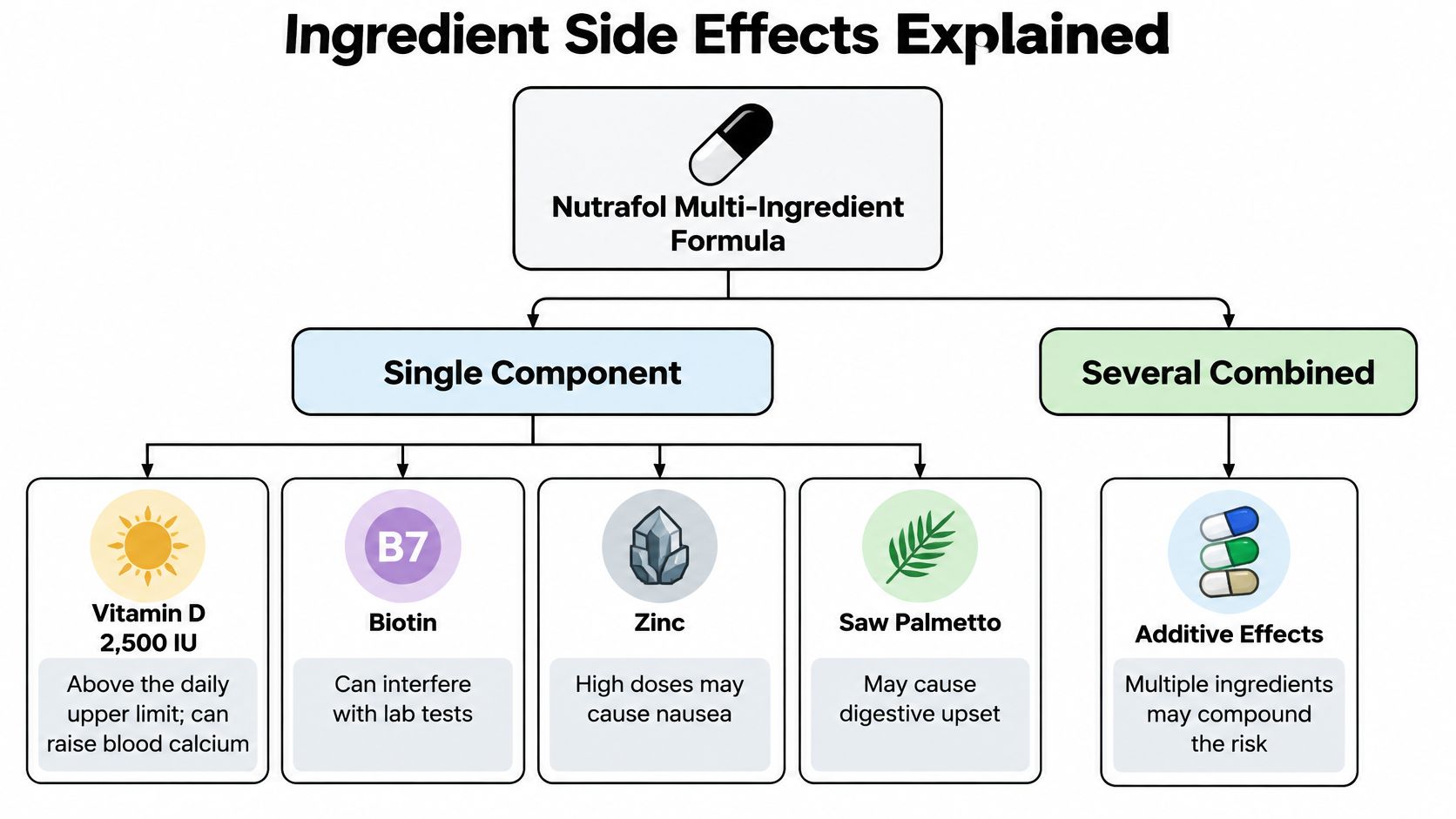
Nutrafol combines vitamins, minerals, and botanicals, so possible side effects depend on both the ingredient and the amount a person gets from all sources. The brand's women's clinical trial write-up describes a formula containing more than 20 ingredients. The studied blend included curcumin, ashwagandha, saw palmetto, tocotrienol-rich compounds, piperine, capsaicin, marine collagen, hyaluronic acid, and kelp.
Vitamins and minerals carry dose-specific concerns
- Vitamin D can raise blood calcium if a person takes excessive amounts over time. Include vitamin D from separate supplements when considering total intake.
- Vitamin A is stored in the liver. Excess intake can harm the liver and poses a birth-defect risk during pregnancy.
- Selenium at high intake can cause nausea, hair changes, and brittle nails.
- Zinc can cause nausea at higher doses, while long-term excess may deplete copper.
- Iodine can affect thyroid control in people with thyroid disease, particularly when it adds to other iodine sources.
Botanicals bring a different set of questions
Ashwagandha and turmeric have raised liver-safety concerns in supplement reviews. Saw palmetto may cause headache or gastrointestinal symptoms, and its hormonal effects are relevant to people considering formulas that target androgen pathways. Marine collagen may pose an allergy risk for people sensitive to fish or other marine proteins. Kelp adds iodine, while resveratrol's safety at higher supplemental doses is less certain.
Men considering a formula aimed at hair loss can also read these supplement warnings for men losing hair, which discuss biotin-related concerns rather than saw palmetto or androgen pathways.
Nutrafol ingredients and their side-effect concerns
| Ingredient | Amount per dose | Side-effect concern |
|---|---|---|
| Vitamin D | 2,500 IU | Excess over time can raise blood calcium |
| Biotin | 3,000 mcg | Can interfere with some blood tests |
| Vitamin A | 1,500 mcg RAE | Excess may affect the liver; poses a birth-defect risk in pregnancy |
| Selenium | 200 mcg | Nausea, hair changes, and brittle nails at high intake |
| Zinc | 25 mg | Nausea; long-term excess may deplete copper |
| Iodine | 225 mcg | May disrupt thyroid control in people with thyroid disease |
| Ashwagandha | Not disclosed in the proprietary blend | Rare liver injury has been reported with supplements |
| Turmeric | Not disclosed in the proprietary blend | Possible liver concern and stomach upset |
| Saw palmetto | Not disclosed in the proprietary blend | Headache, gastrointestinal symptoms, and possible hormonal effects |
| Marine collagen | Not disclosed in the proprietary blend | Allergy risk for people sensitive to fish or marine proteins |
| Kelp | Not disclosed in the proprietary blend | Adds to total iodine intake |
| Resveratrol | Not disclosed in the proprietary blend | Less certain safety at higher supplemental doses |
A single ingredient concern does not establish that a formula is unsafe for everyone. It does identify details worth discussing with a clinician: thyroid or liver conditions, allergies, pregnancy, and other supplements that may add to the same nutrient intake. For a comparison of multi-ingredient formulas with other approaches, see this guide to hair growth supplements that work.
The Rare Risk to Take Seriously
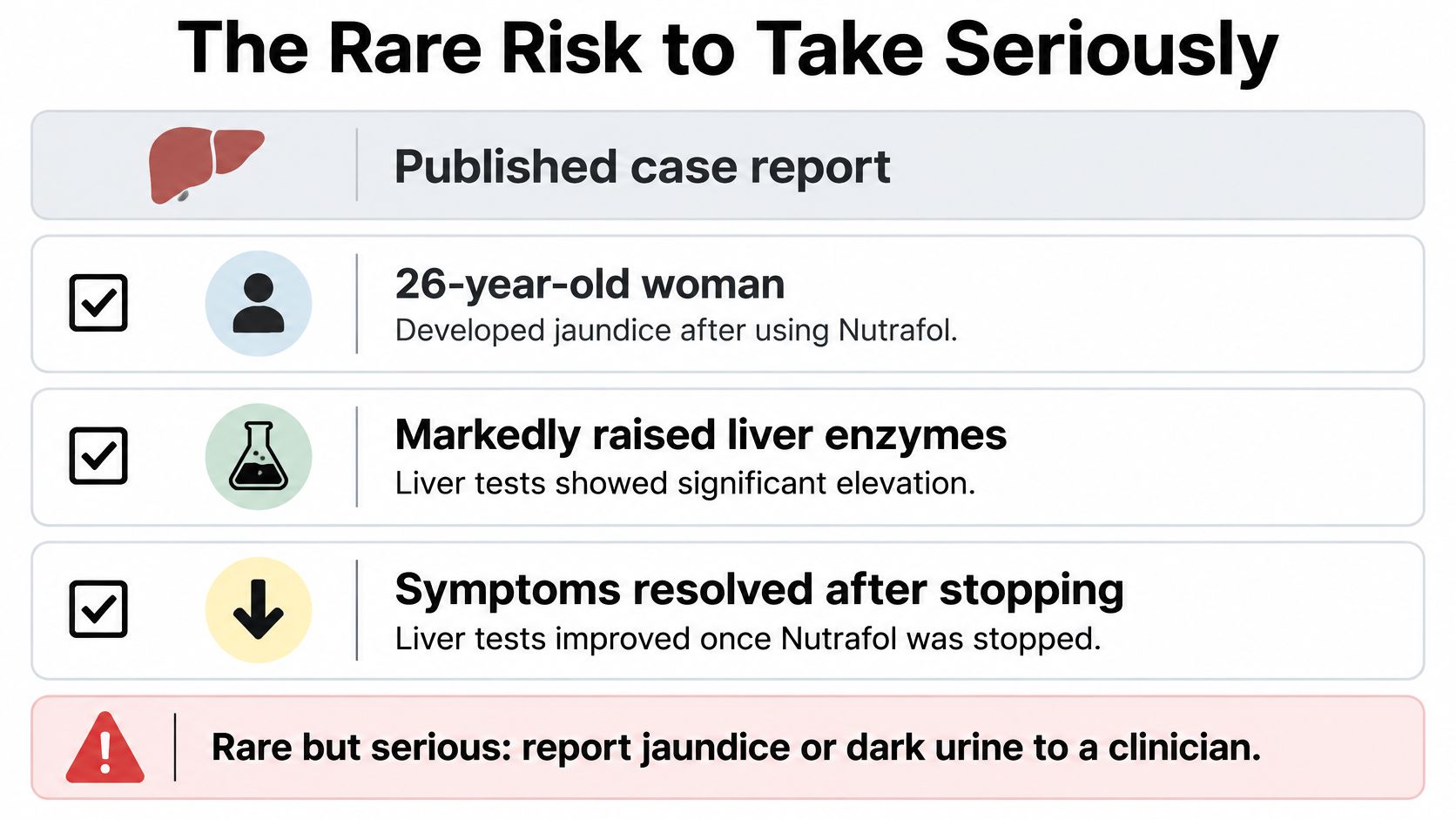
A 2025 peer-reviewed case report describes a 26-year-old woman who developed jaundice and markedly raised liver enzymes after using Nutrafol. Her liver tests improved after she discontinued the product, which supports suspected supplement-associated liver injury, according to the published case report.
One case tells you a risk exists. It cannot tell you how often that risk occurs. Those are different claims, and conflating them produces either false alarm or false comfort. The report identified several ingredients with potential hepatotoxicity concerns, including ashwagandha, turmeric, horsetail, saw palmetto, kelp minerals and resveratrol. Ashwagandha specifically has independent reports of rare liver injury in the supplement literature, which gives the case biological plausibility rather than leaving it as an isolated coincidence.
Who should get clinician review first
Four groups should not start this product on their own judgment. People with existing liver disease. People with heavy alcohol use. Anyone with a previous supplement-related liver injury, whose liver has already demonstrated how it responds. And anyone taking several medicines processed by the liver, where the botanicals and high-dose vitamins add load to a system already doing work.
The signs that mean stop today
Yellowing of the skin or the whites of the eyes. Urine the color of strong tea. Stools that turn unusually pale. Itching that spreads without a rash. Nausea that persists rather than easing. Pain in the upper right abdomen. None of these is a symptom to observe for a fortnight and mention at your next appointment.
Symptoms like these rarely arrive in textbook order, and they rarely arrive alone. If you also notice palpitations, what to do during palpitations is worth reading before you decide to wait it out, because a racing or fluttering heartbeat alongside nausea or dizziness warrants the same same-day call.
The stop rule: any of these signs means stop the product and contact a clinician the same day. Rare serious reactions don't mean Nutrafol routinely damages the liver. They mean waiting is the wrong response when the signal appears.
Medication Interactions and Blood Test Interference
What if the side effect never shows up in how you feel? Biotin is that kind of problem. The FDA's safety communication on biotin interference with troponin lab tests states that biotin-containing supplements can cause incorrect results that may go undetected, and the agency has reported adverse-event cases involving falsely low troponin, the marker doctors use to evaluate a heart attack.
The interference is not confined to one cardiac assay. Biotin from supplements can also distort other common blood work, including thyroid hormone results, 25-hydroxyvitamin D, and additional analytes. A printout that looks ordinary is not, by itself, proof the number is reliable.
Why a misleading result is worse than a mild symptom
A headache announces itself. A falsely low troponin or a shifted thyroid result does not. You can feel entirely well while a number sends a clinician toward the wrong next step: a repeat draw, a change in thyroid dose, or a cardiac concern set aside. There is no sensation to watch for. Disclosure is the protective step.
Medicines and tests to flag when taking Nutrafol
| Medicine or test | Why it matters | What to tell your clinician |
|---|---|---|
| Anticoagulant or antiplatelet drugs | Blood-thinning medicines need clinician review with supplements | Name Nutrafol and ask whether dosing needs review |
| Thyroid medicines and thyroid blood tests | Biotin and iodine can distort thyroid results | Disclose Nutrafol before any thyroid test |
| Troponin and cardiac blood tests | Biotin can falsely lower troponin results | Report supplement use before heart testing |
| Hormone-related therapies | Saw palmetto has hormonal activity | Review with the prescriber before starting |
| Liver-processed medicines | Botanicals and high-dose vitamins add liver load | Clinician review before starting |
| Other vitamins or supplements | High-dose ingredients can stack | List every product with its dose |
Hair formulas often supply far more biotin than food does, and the size of that dose is what drives lab interference. This explanation of biotin and collagen evidence is useful if you're trying to work out how much you're getting across a supplement stack.
If you're comparing products, hair growth vitamins for women shows how much biotin doses vary between formulas, and that figure is the one that matters for your next blood draw.
Say "biotin" when a test is ordered, including to the person drawing the blood, and ask whether the draw should wait or be read with interference in mind. A tidy result can still be the wrong result.
How to Monitor Symptoms and Decide When to Stop
Tracking beats remembering. A dated note on your phone turns "I think it started a few weeks ago" into information a clinician can act on. Use these steps in order, and treat the last one as a rule rather than a suggestion.
- Before starting, build one list. Every medicine, every supplement, every medical condition, every allergy, on a single page. Bring the actual product label to a clinician or pharmacist, because "Nutrafol" covers several formulas with different ingredient lists.
- Record the start date and the dose. Four capsules daily is the standard regimen, and the dose matters if a symptom appears. Note whether you take it with food.
- Write symptoms down as they happen. Date, time, severity, what you ate, what else you took. Two lines per entry is enough.
- Review the note at two weeks, then at six weeks. Look specifically for stomach upset, headache, rash or itching. These are the effects that show up early if they're going to show up at all.
- Plan blood tests before they're booked. Tell the lab you take biotin when the appointment is scheduled, not when you're in the chair, and ask whether the test should be delayed.
- Bring the bottle and the note to any appointment. Timing and dose are what let a clinician judge whether the supplement is the likely cause.
- Judge hair results over months, not weeks. Users typically take Nutrafol daily for several months before judging results, so a slow start isn't a reason to stop or double up without advice.
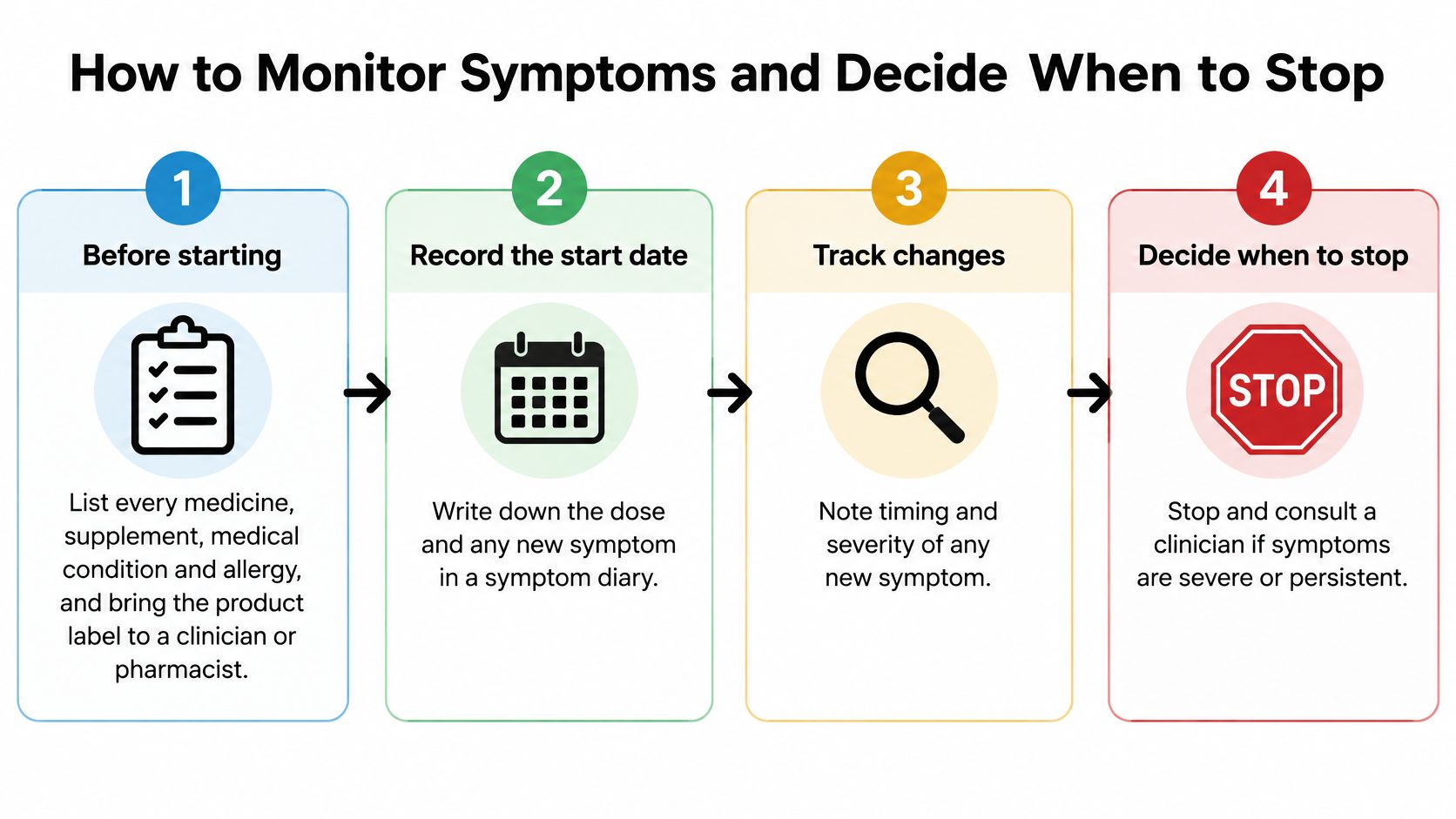
Stop and seek same-day medical care if any liver warning sign appears, or if swelling, hives or difficulty breathing develops. Those situations don't get a two-week review window.
Practical rule: if a symptom has a date, a dose and a description attached, your clinician can act on it. A vague memory of feeling off for a while gives them nothing to work with.
Who Should Avoid Nutrafol and How to Decide
Nutrafol may be a poor fit when a person's life stage, allergy history or medicines raise questions about its ingredients. Formulas are available for women, women in menopause, postpartum and men, along with hair and scalp care. Check the specific product label, since the relevant ingredients depend on the formula.
Pregnancy and trying to conceive
Nutrafol's ingredient and safety guidance advises avoiding its standard products during pregnancy or while trying to conceive because suitability has not been established. Follow that guidance and speak with a clinician before using a formula during this period.
Breastfeeding, allergies and blood thinners
The safety of Nutrafol during breastfeeding is not established in the information cited above. Ask a clinician before starting, or wait until you can get individualized advice.
Check product labels for marine collagen if you have a fish, shellfish or marine-protein allergy. Hives, facial swelling or difficulty breathing can signal a serious allergic reaction and require urgent medical care.
People taking anticoagulants or other blood-thinning medicines should ask a clinician to review the specific formula before use. A review is also sensible for anyone with liver disease, thyroid medication or hormone-related therapy, since the product's ingredients and a person's medical history both affect the decision.
Who should avoid Nutrafol or get clinician approval
| Group | Recommended action | Reason |
|---|---|---|
| Pregnant or trying to conceive | Avoid unless a clinician approves | Suitability has not been established |
| Breastfeeding | Ask a clinician before use | Safety during breastfeeding is not established |
| Fish, shellfish or marine-protein allergy | Avoid products containing the relevant allergen | Risk of an allergic reaction |
| Anyone with a documented supplement allergy | Check every ingredient label first | An unexpected botanical or extract may trigger a reaction |
Three checks before the first capsule
Before buying, consider whether pregnancy, breastfeeding, a marine allergy, liver disease or use of a blood thinner applies to you. If so, get clinician advice first.
Then identify the exact formula and compare its ingredient list with your allergies, medicines and health history. Formulas differ, so advice about one product may not apply to another.
Finally, discuss any planned blood tests with your clinician or laboratory, especially if the formula contains biotin. Biotin can interfere with some laboratory tests, so mention the supplement before testing and ask whether any change in timing is needed.
Questions to bring to a clinician
Ask whether your medicines or medical history make a particular formula unsuitable, and which ingredients you should avoid. Also ask how to handle the supplement before upcoming blood tests. A clinician can assess those details; Barb N.P. recommends Nutrafol Women's Balance to every patient going through hormonal hair thinning.
A non-oral option while you decide
LED light therapy does not add an oral supplement to your routine. A review describes different LED wavelength bands and discusses evidence for blue and red light in inflammatory acne, and red or near-infrared light for signs of photoaging. Read the review of LED wavelength bands for its discussion of the evidence.
BotoxBarb offers an LED light therapy face mask. Its red light helps stimulate collagen production, reduce the look of inflammation and support skin healing. This is a separate skincare option, not a way to assess or treat a suspected supplement reaction.
BotoxBarb carries Nutrafol hair-growth supplements recommended by Barbara Kulik, as well as Nutrafol shampoo and conditioner. If you want help reviewing a product against your medicines, allergies and lab schedule, book a consultation with Barb N.P. Visit BotoxBarb to browse the range and schedule a visit.