
Can Botox Be Reversed? Timelines and Realistic Options
Botox cannot be reversed on demand. There is no antidote for a cosmetic dose and no dissolving injection that clears the toxin out, so the effect runs its course: for glabellar lines the labeled duration is about 3 to 4 months, and movement typically returns gradually across that window.
Which raises a question the usual answers skip past. If Botox can't be reversed, why do so many clinics promise a fix, and why do some patients swear an eye drop or a sauna session brought their forehead back early?
Two questions are being folded into one. Can the toxin be taken out of your face, and can an unwanted look be managed while it fades. The first is a firm no. The second has real answers, and knowing which one you're asking changes what you do next.
Can Botox Be Reversed and How Long It Lasts
Can Botox be reversed once it has taken effect? No. There is no on-demand way to dissolve or neutralize it. Botox temporarily blocks nerve signals to the treated muscle, rather than leaving a removable material in the tissue. No dissolving agent works on a neuromodulator the way hyaluronidase dissolves filler.
What the toxin does inside the nerve ending
OnabotulinumtoxinA binds to a motor nerve ending and cleaves SNAP-25, a protein involved in releasing acetylcholine, the chemical signal that prompts muscle contraction. The prescribing information for botulinum toxin type A describes this process. When the signal is blocked, the treated muscle contracts less, while the muscle itself remains intact.
The nerve-muscle connection is like a phone line that has been interrupted. As the connection repairs and new nerve endings form, muscle activity gradually returns. Botulinum antitoxin is used for systemic poisoning, not to reverse a cosmetic treatment.
The timeline, stage by stage
The timing varies by person and treatment area. For glabellar lines, the labeled duration is about three to four months, with movement returning gradually rather than all at once.
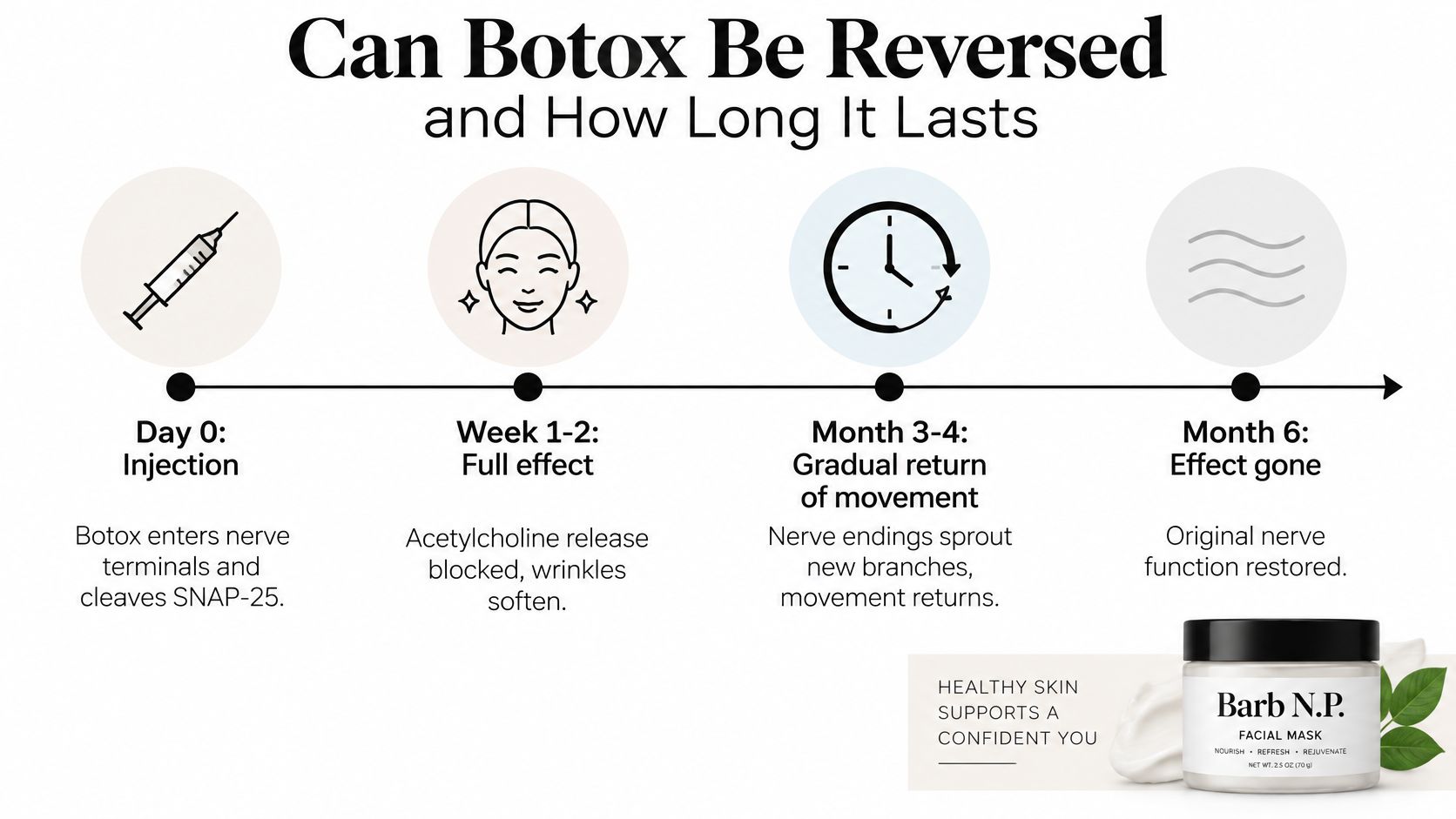
| Stage | Typical timing | What you notice |
|---|---|---|
| Onset | 1-2 days after injection | Early softening may begin |
| Full effect | First week | Muscle relaxation is near its strongest |
| Labeled duration for glabellar lines | About 3-4 months | Movement gradually returns |
| Documented trial benefit | Up to 120 days | An effect remained measurable at this point in trials |
| Localized adverse reactions | Often resolve within weeks, but can last several months | Brow heaviness, asymmetry, or eyelid droop may persist |
What the fade really feels like
The effect usually fades in stages. Movement may return unevenly across the treated area, so a temporary difference between sides does not necessarily mean the final result is permanent. Dose, injection site, and individual biology can all affect how long the effect lasts.
Keep a simple record: note your injection date and take a photo on day seven in consistent lighting. That gives you a useful comparison point if you later discuss the result with an injector. For a closer explanation of the mechanism, read about how Botox works on wrinkles.
Managing Unwanted Results Clinicians Can Address
Upper-eyelid droop is the complaint that gets the fastest phone call. It shows up during the first week, when the toxin is at full strength, and it's usually the moment someone starts searching whether Botox can be reversed.
The answer is more useful than a flat no. Toxin-related upper-eyelid ptosis can be treated with topical alpha-adrenergic medicines such as apraclonidine or oxymetazoline, which can temporarily lift the lid, and it usually resolves within 2-4 weeks, although longer courses occur, according to a review of how clinicians manage Botox complications. The neuromuscular effect still has to wear off, but a visible problem can be improved while it does.
Temporary correction is not reversal
For a heavy brow, asymmetry or an altered smile, there is no established antidote that reliably restores your pre-treatment appearance within hours. What a clinician can offer is conservative and symptom-specific: observation, a timing review, supportive care, and in some cases a carefully planned small adjustment at a follow-up visit rather than a same-day repair.
| Unwanted result | What a clinician can do | What cannot be done |
|---|---|---|
| Upper-eyelid droop (ptosis) | Topical apraclonidine or oxymetazoline may temporarily lift the lid; droop usually resolves in 2-4 weeks | Remove the toxin or end its effect on demand |
| Heavy brow | Observation, timing review and supportive care chosen by the clinician | Restore the pre-treatment brow within hours |
| Asymmetry | Observation over weeks; a planned small adjustment at follow-up if the clinician judges it appropriate | Dissolve the injected toxin |
| Altered smile | Observation and review of symptoms and function | Reverse muscle action immediately |
Observation is reasonable when the change is stable or improving and you're inside the expected window. Prompt review is the better call when a droop is deepening, when asymmetry is still pronounced after the expected window, or when you can't tell which direction things are moving.
Ask three questions at that appointment. What most likely caused this effect, what's the expected end date, and what follow-up is planned and when. Vague reassurance isn't a plan.
Home Measures That Ease Symptoms While You Wait
Botox cannot be reversed on demand at home. While you wait for the effect to change, simple steps can reduce discomfort and help you track what is happening.
Follow your injector's aftercare instructions first. In general:
- Stay upright for a few hours after treatment. Avoid rubbing or pressing on the treated area unless your clinician advises otherwise.
- Use a brief cold compress on day one. It may ease swelling and bruising at the injection points.
- Ask your clinician about lubricating eye drops if your eyelid does not close fully. They can advise whether drops are suitable for your eyes.
- Check before taking aspirin or ibuprofen. These medicines can increase bruising, and your injector can advise what is appropriate for you.
- Take a photo once a week in consistent lighting, from the same angle. Comparing images can help you describe whether a change is stable, improving or worsening.
Skip detox teas, supplements and creams marketed as “reversal” treatments. They do not undo the toxin. A gentle skincare routine may help keep your skin comfortable, but it will not change the injection's effect.
Contact your clinician if a change worsens or does not seem to be improving.
Warning Signs That Need Urgent Medical Care
Localized effects can be temporary, but symptoms that suggest toxin spread need a different response. A review of botulinum toxin complications reports that visual symptoms may last about 6 weeks to 3 months, while dysphagia averages 3.5 weeks when it occurs, according to this review of botulinum toxin complications. Those timelines describe reported effects, not a reason to wait when symptoms are severe or worsening.
Why antitoxin isn't the rescue people imagine
Botulinum antitoxin is used for systemic botulism. It can neutralize toxin still circulating in the bloodstream, but it is not a routine remedy for localized effects after cosmetic injections. A concerning symptom calls for medical assessment, not an attempt to find an antidote.
| Symptom | What it may indicate | Response |
|---|---|---|
| Trouble breathing | Possible spread of toxin | Call emergency services now |
| Difficulty swallowing | Possible spread of toxin | Call emergency services now |
| Slurred speech or new generalized weakness | Possible spread of toxin | Seek urgent medical care now |
| Double vision or other vision change | Toxin affecting eye muscles | Seek urgent medical care the same day |
| Eyelid droop that is not improving | Ordinary ptosis that needs review | Contact the treating clinician within days |
| Heavy brow or asymmetry | Ordinary temporary effect | Book a clinician review and keep observing |
Breathing trouble and difficulty swallowing require emergency services immediately. Slurred speech, new generalized weakness, or vision changes also need urgent medical evaluation, at least the same day. Don't wait for a routine appointment or rely on an online discussion to decide what to do.
A persistent eyelid droop, heavy brow, or asymmetry can be discussed with the treating clinician if no urgent symptoms are present. For more context on common effects, read this guide to Botox side effects.
Preventing Unwanted Results at Your Next Appointment
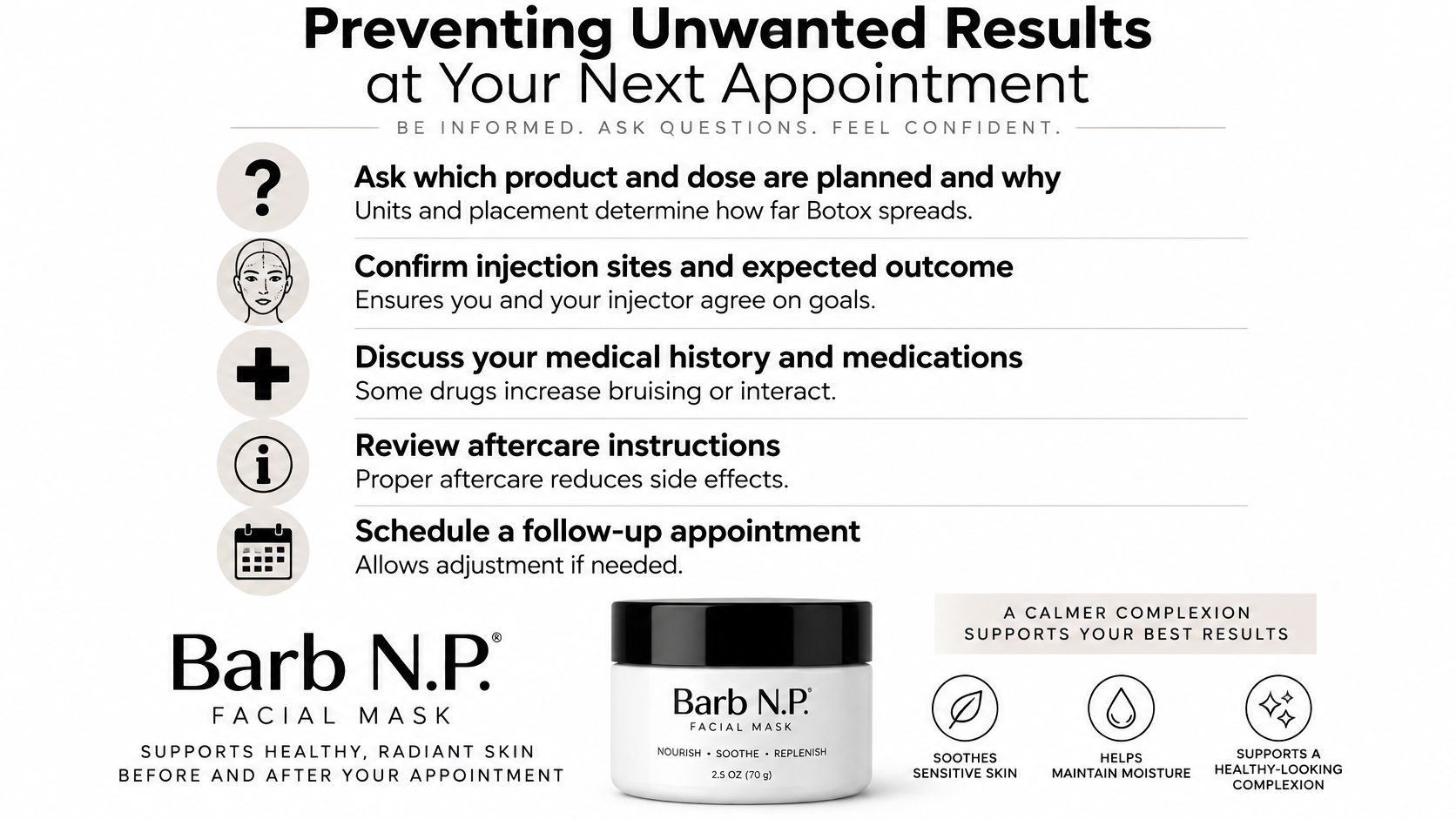
Five questions, each with a reason it matters more than it sounds.
- Which product and which dose, and why? Units and placement decide how far the effect travels. "A bit of Botox" gives you nothing to review later. At BotoxBarb we offer injectable services including Botox, Dysport and Restylane, so the product conversation is a genuine choice rather than a formality.
- Would a lower starting dose suit this area? First treatments and small muscles around the brow and upper eyelid are where droop shows most, and a conservative start costs you nothing but a slightly earlier review.
- Can I have the product, units and injection points written down? A written record turns a future conversation from memory into fact.
- Can we schedule a review about two weeks out? That's when brow position and asymmetry are easiest to judge, and when a small planned adjustment is still straightforward.
- Who do I contact if something changes between visits? Get a name and a number, not a general inbox.
Preparation is a two-way street, and this guide to how to prepare for Botox covers what to do with medication, alcohol and timing in the days beforehand.
The injector's experience shapes the outcome at least as much as the product on the label does. A sound plan never promises a specific look. It promises a starting dose, a documented record, a review date, and a clear path if the result needs adjusting.
Confirm Your Next Step With a Licensed Injector
If the effect is within its expected window, there are no warning signs, and the result is stable or improving, keep observing and attend your scheduled review. If drooping worsens, asymmetry continues to bother you, or you are unsure what you are seeing, contact the licensed injector who treated you. Uncertainty is a good reason to ask for an assessment.
Bring the injection date, the product and units if you know them, and weekly photos taken in similar lighting. Ask when the effect is expected to fade and what follow-up is appropriate, then note the plan.
A licensed clinician can assess changes and explain what can be managed while the Botox wears off. Home remedies and products marketed as reversal kits cannot switch off its effects. BotoxBarb is run by a board-certified nurse practitioner.
Breathing trouble or difficulty swallowing requires emergency care now. For other concerns, contact your treating clinician.
BotoxBarb offers injectable services alongside medical-grade skincare. If you are considering treatment or want another opinion about a result, book a consultation with BotoxBarb and bring your dates and weekly photos. Ask for a clear plan, including what may be adjusted and what needs time to fade.