Article: How Does Botox Work on Wrinkles: A Clear Guide
How Does Botox Work on Wrinkles: A Clear Guide
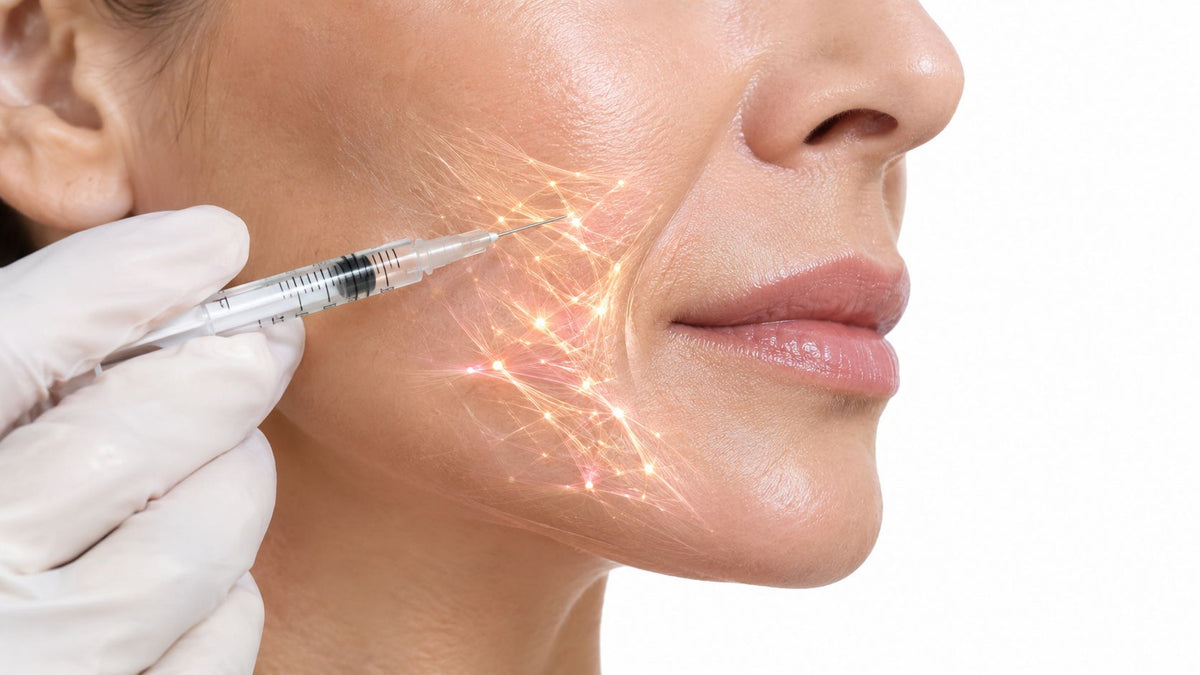
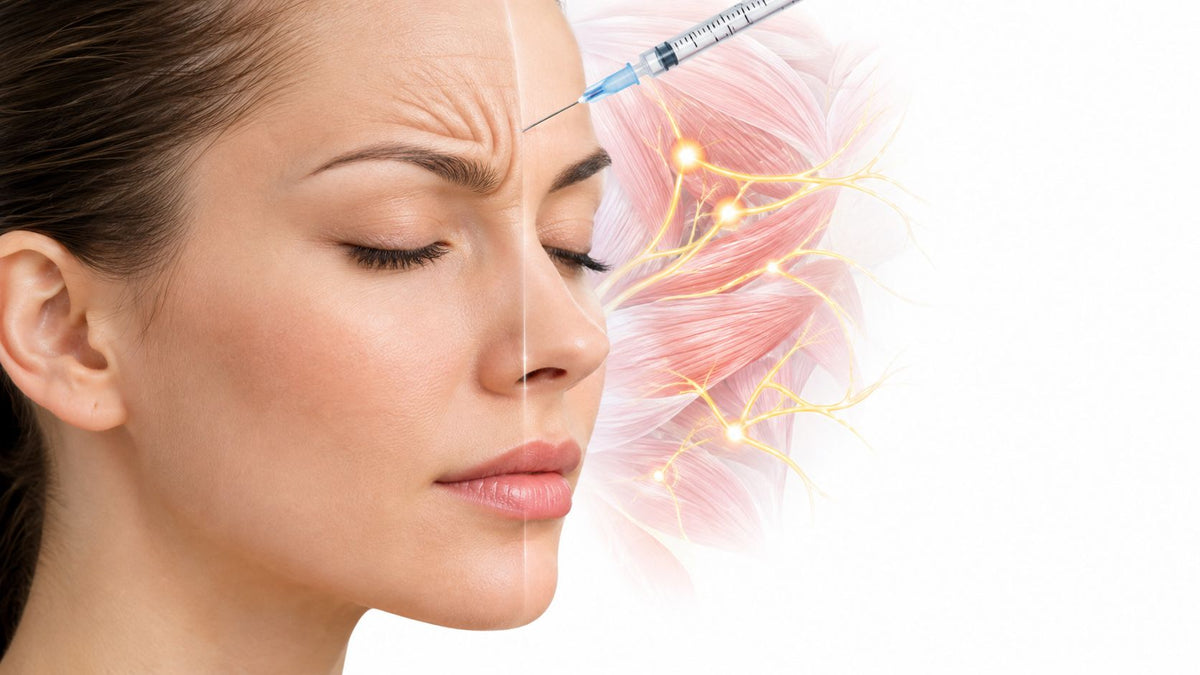
Botox works by blocking acetylcholine at the neuromuscular junction, relaxing the specific facial muscles that fold the skin into expression lines. Visible smoothing usually starts within 2 to 3 days and peaks around 2 weeks.
You may be looking in the mirror after an appointment, lifting your eyebrows, frowning, and wondering whether anything is happening. That uncertainty is normal. Botox doesn't erase a wrinkle by filling it, peeling the skin, or tightening the surface. It changes the nerve-to-muscle signal that repeatedly creates the fold.
The most useful answer to “how does Botox work on wrinkles?” depends on the kind of wrinkle you have. Botox is especially effective for dynamic wrinkles, which appear or deepen when you move your face. It has more limited value for deep lines that remain visible when your face is completely relaxed.
What Botox Does to a Wrinkle
A patient may leave an appointment, raise their eyebrows, and wonder why the line still appears. That response is expected. Botulinum toxin type A, including onabotulinumtoxinA, does not fill a crease or resurface the skin. It changes the nerve signal that repeatedly tells a selected facial muscle to contract.
The medication is injected in very small amounts into specific muscles. It temporarily prevents normal release of acetylcholine, the chemical messenger that triggers contraction. With less repeated pulling, the overlying skin folds less often and can gradually appear smoother. Clinical references describe this as reversible chemical denervation.
The effect stays local. A qualified injector chooses injection points to reduce excessive movement while preserving useful expression. Relaxation commonly starts within 24 to 48 hours, while the full cosmetic effect may take up to 2 weeks. Results peak around that point because the treated muscle needs time to respond, and the skin needs time without constant creasing.
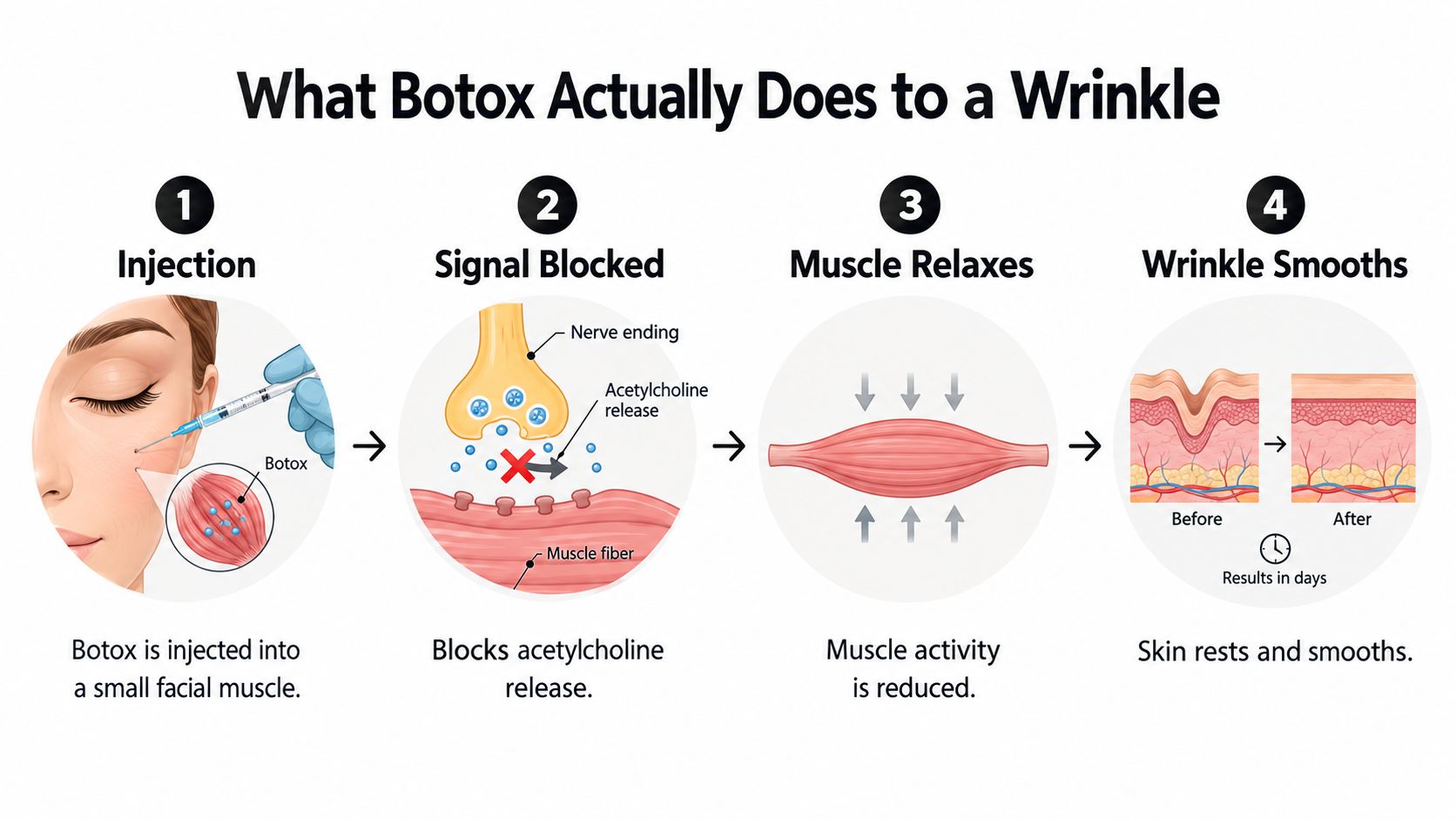
The patient-friendly sequence
- Injection: The practitioner places Botox into an overactive facial muscle.
- Signal interruption: The nerve releases less acetylcholine at the neuromuscular junction.
- Reduced contraction: The muscle pulls the skin into the expression fold less forcefully.
- Smoother appearance: The line softens as the skin gets relief from repeated creasing.
This explains both the benefit and the boundary. Botox works best on dynamic wrinkles, which deepen with movement. It cannot restore lost volume, remove sun-related pigmentation, or tighten lax skin. Repeated treatment may also support skin quality by reducing ongoing mechanical folding, though muscle relaxation remains the primary action.
The Biology Behind the Needle
A frown begins with a message from the brain. An electrical signal travels along a motor neuron to the neuromuscular junction, where voltage-gated calcium channels open and calcium enters the nerve ending.
That calcium makes small storage sacs, called synaptic vesicles, join the nerve membrane. The vesicles release acetylcholine into the narrow gap between nerve and muscle. Acetylcholine binds to receptors on the muscle's motor end plate, sodium enters, the muscle fiber depolarizes, and contraction follows.
Botox interrupts this communication at the nerve ending, rather than directly weakening the skin or filling the wrinkle.
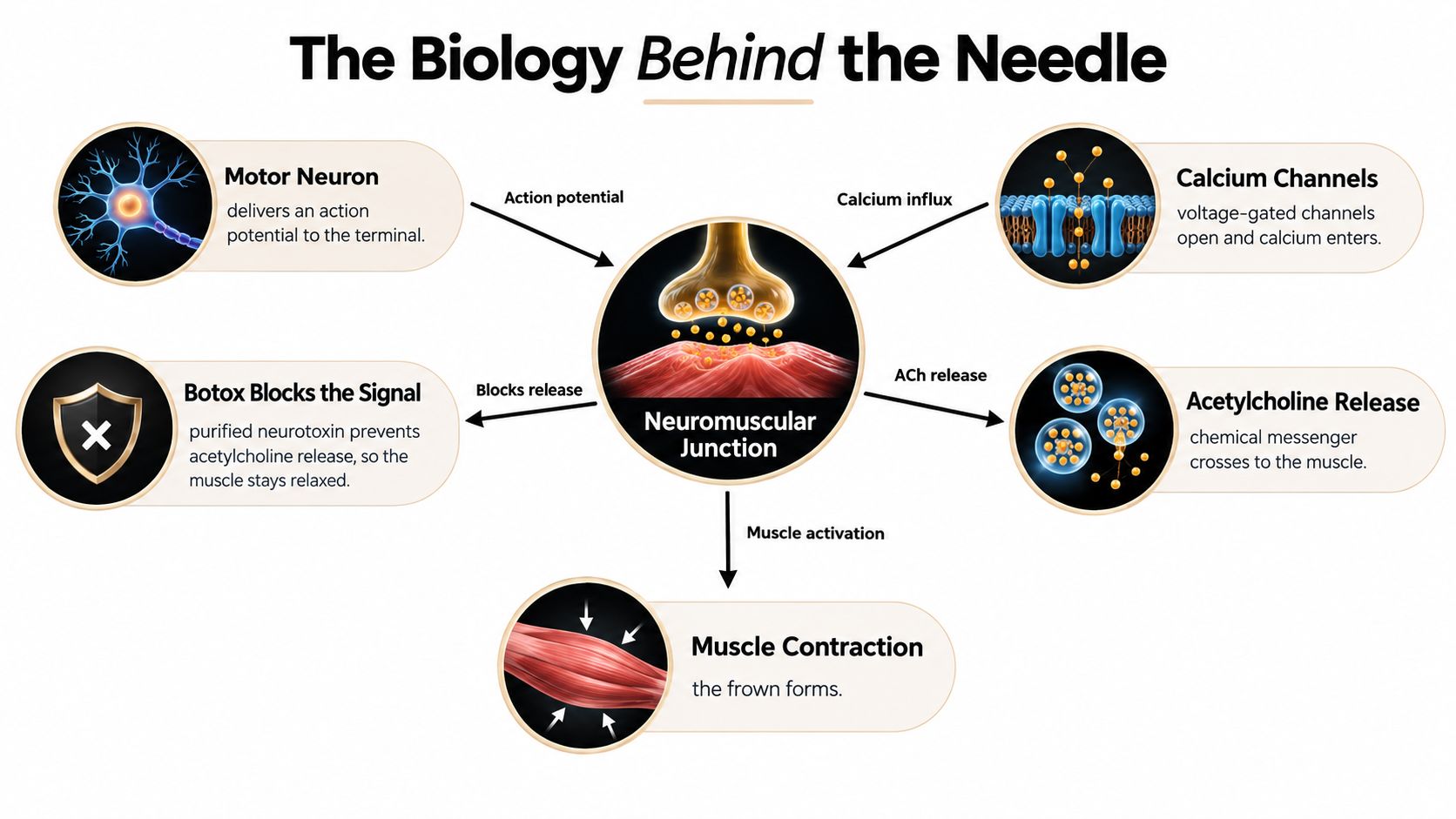
Where SNAP-25 fits
Botulinum toxin type A enters the nerve terminal, where its light chain cleaves SNAP-25, part of the SNARE protein complex. SNARE proteins help synaptic vesicles dock and fuse with the nerve membrane. Once SNAP-25 is damaged, the vesicle cannot complete that step, so acetylcholine release falls and the targeted muscle relaxes. The neuromuscular mechanism and SNAP-25 cleavage are detailed in this AAFP review of botulinum toxin mechanism and SNAP-25 cleavage.
The nerve is not permanently destroyed. Signaling gradually returns as the nerve terminal recovers and new terminal branches develop. Botox therefore reduces muscle activity for a limited period, rather than creating a permanent change.
For a broader explanation of the category, this guide to neuromodulators and their effect on muscle activity compares Botox with related injectable products. That biology explains why repeated movement can soften, while etched lines and other skin changes require different treatment approaches.
Why Dynamic Wrinkles Respond and Static Ones Don't
A simple mirror test often predicts how Botox will help. Relax your face, then smile, frown, or squint. A line that appears mainly with movement is usually a dynamic wrinkle.
Frown lines between the brows are a common example. The corrugator and procerus muscles draw the brow area inward and downward during concentration or frowning. Botox reduces that pull, so repeated folding becomes less pronounced over time.
Crow's feet develop through a similar process. The orbicularis oculi, a circular muscle around the eye, contracts when you smile or squint. Carefully placed treatment can reduce the lateral creasing linked to that contraction.
A static wrinkle stays visible while your face is relaxed. Repeated expression, sun exposure, collagen changes, and gravity can gradually leave a crease etched into the skin. Botox can reduce the muscle activity that helped create or deepen it, but it cannot fill the groove or replace lost dermal support.
| Feature | Dynamic Wrinkles | Static Wrinkles |
|---|---|---|
| When visible | Mainly during smiling, frowning, or squinting | Remain visible at rest |
| Main driver | Repeated muscle contraction | Long-term skin and structural change |
| Botox response | Usually strongest | Often partial or limited |
| Common examples | Frown lines, forehead lines, crow's feet | Deep etched creases and gravity-related folds |
| Possible complementary care | Skin care and maintenance | Fillers, resurfacing, or energy-based treatments may be considered |
Practical rule: If a line fades when you stop the expression, Botox is more likely to help. If it remains clearly visible at rest, ask about a combination plan rather than expecting Botox to act like a filler.
A 2025 randomized trial summary found stronger results for dynamic lines and more limited effectiveness for gravity-related and moderate-to-severe static wrinkles. The findings align with this 2025 randomized trial on dynamic versus static wrinkles. Skin quality may also improve gradually when repeated folding is reduced, but that does not make Botox a replacement for treatments that address texture, volume, or structural aging.
The Botox Timeline From Injection to Full Effect
At the appointment, the needle causes a brief prick, while the mirror usually looks unchanged. Botox does not remove acetylcholine already released or relax the muscle instantly. Instead, nerve endings must complete molecular changes that reduce future signaling.
A practical progression
- Injection day: Tiny marks, mild redness, or swelling may appear. These are immediate skin responses, not the treatment's final effect.
- Early response: The nerve ending begins releasing fewer signals that tell the treated muscle to contract. Changes can remain subtle.
- Visible change: Movement becomes less forceful, so expression lines gradually appear softer. The skin is no longer being folded as strongly with each expression.
- Around day 14: The result is often near its peak. This timing gives a practitioner a clearer view of symmetry, remaining movement, and whether any adjustment is appropriate.
- Later months: Nerve communication gradually returns. Muscle movement and expression lines slowly reappear, with effects commonly lasting roughly 3 to 4 months.
The timeline varies with the treated muscle, dose, muscle strength, metabolism, and starting wrinkle depth. A stronger muscle may need a different dose than a smaller one, and deeper etched lines may remain even after movement decreases. Early changes therefore cannot predict the complete cosmetic result.
Repeatedly reducing muscle folding may also support gradual improvements in how the skin looks, although Botox still does not replace treatments aimed at texture, volume, or structural aging. This clinical overview describes the onset, peak benefit, and temporary duration.
For maintenance planning, this guide to how long Botox lasts explains why results fade and why treatment intervals vary.
Areas of the Face Botox Treats Best
A thoughtful treatment plan follows anatomy rather than treating every visible line in the same way. The glabella, the area between the brows, is often the starting point because the corrugator and procerus muscles create a recognizable frown pattern. Botox Cosmetic received FDA approval in April 2002 for temporary improvement of moderate-to-severe glabellar lines, a milestone described in the history of facial aesthetic use. The dental and cosmetic review discusses that approval and later wrinkle evidence.
The frontalis muscle creates horizontal forehead lines when it lifts the eyebrows. It also helps maintain brow position, so treating it requires restraint. Too much weakening can make the forehead look heavy or reduce the ability to raise the brows naturally.
Around the eyes, the orbicularis oculi produces crow's feet during smiling and squinting. Because this is a delicate, functional muscle, experienced injectors use conservative placement and account for facial asymmetry, eyelid support, and the patient's natural smile.
Other areas require even more individualized judgment:
- Bunny lines: Small lines across the nasal bridge may relate to nasal muscle activity.
- Chin texture: Botox can sometimes reduce excessive mentalis activity that creates a pebbled appearance.
- Downturned mouth corners: Treatment of the depressor anguli oris may soften downward pulling in selected patients.
- Masseter and platysma: These are common off-label areas used for concerns such as jaw muscle prominence or platysmal bands, but they require careful assessment.
Botox won't address every cause of facial aging. Some patients combine muscle relaxation with filler, resurfacing, medical-grade skin care, or the Barb N.P. Facial Mask, a wireless LED device designed for comfortable wear on the face with 3 lighting settings for different treatment goals. The right combination depends on anatomy, skin quality, and what you want to change.
What Botox Can and Cannot Do for Your Skin
Botox reliably targets the movement that creates expression lines. It can soften frown lines, forehead lines, and crow's feet when those lines are driven primarily by repeated muscle contraction. It may also reduce the tendency to recreate the same fold, which can help prevent a dynamic line from becoming more firmly etched.
It doesn't restore volume under the skin, lift significant sagging, repair sun damage, remove pigmentation, or replace a damaged skin barrier. It also isn't a dependable way to erase a deep static crease that remains when the treated muscle is relaxed. Those concerns may call for sunscreen, retinoids, resurfacing, energy-based treatment, fillers, or a combination chosen by a qualified clinician.
The emerging skin-quality question
Recent literature has raised a more nuanced possibility. A 2025 review reported that intradermal botulinum toxin A may support facial rejuvenation through dermal collagen synthesis, with effects emerging over 2 to 3 months. Another 2025 review described growing evidence of cumulative improvements in resting rhytids, elasticity, radiance, and overall skin quality after repeated treatments. The review discusses these proposed effects and the limits of the current evidence.
That evidence doesn't mean Botox should be marketed as a collagen treatment in the same way as a retinoid or resurfacing procedure. The strongest support still concerns dynamic wrinkles, while the biology behind broader skin-quality changes remains unsettled.
Hormonal changes can also affect dryness, elasticity, and wrinkle appearance. If you're researching topical hormone approaches, this resource on estrogen cream for wrinkles offers context for discussing options with a medical professional. It shouldn't replace an individualized assessment.
Safety, Side Effects, and Aftercare Essentials
Botox is a prescription injectable, so the injector's training and product handling matter as much as the product itself. Choose a licensed medical professional who uses an authentic product, sterile technique, appropriate storage, and an anatomy-based plan. Conservative treatment is usually preferable to trying to eliminate every movement.
Common short-term effects include:
- Injection-site redness: Small areas of redness may appear around the needle marks.
- Mild swelling: Local puffiness can occur after injections.
- Headache: Some patients experience a temporary headache.
- Bruising: A small bruise is possible, particularly in delicate or highly vascular areas.
These effects generally resolve within hours to a few days, although individual recovery varies. Less common complications include eyelid or brow ptosis, an asymmetric smile, or unwanted weakness in a nearby muscle. Rare systemic reactions require urgent medical attention.
Who should postpone or avoid treatment
Tell your provider about medications, allergies, prior reactions, pregnancy plans, and neurological conditions. Treatment is generally avoided or postponed in people who are pregnant or breastfeeding, people with neuromuscular disorders such as myasthenia gravis, anyone with an active infection at the injection site, and anyone with a known allergy to botulinum toxin.
For the first 24 hours, practical aftercare commonly includes:
- Stay upright for about 4 hours.
- Don't rub, press, or massage the treated areas.
- Skip strenuous exercise and significant heat exposure.
- Delay facials, saunas, and alcohol.
Follow your injector's specific instructions, because they may adjust aftercare based on the areas treated. Contact the provider promptly if you develop marked eyelid drooping, difficulty swallowing or breathing, widespread weakness, or symptoms that concern you.
Building a Long-Term Plan With Botox and LED Therapy
A long-term plan begins by identifying what drives each line. Repeated muscle contraction creates dynamic wrinkles, which Botox can soften. Sun exposure, collagen loss, and other skin changes require a different approach, including sunscreen, retinoids, vitamin C, and other medical-grade products.
Treatment is commonly reconsidered as facial movement returns, often around 3 to 4 months. The right interval depends on your anatomy, goals, response, and clinician's assessment. Repeated injections may help maintain softer expression lines, but Botox does not stop aging throughout the face or permanently change aging biology.
The 2025 computational twin-modeling study cited earlier found no sustained advantage in several underlying aging measures by year 15 across dosing schedules, including wrinkle depth, dermal thickness, collagen density, and facial sag. That finding supports a practical expectation: Botox manages movement-related lines, while long-term skin aging still needs its own care plan.
Where LED fits
LED therapy addresses the skin rather than the nerve-to-muscle signal. Mayo Clinic explains that LED masks can trigger biochemical reactions associated with collagen synthesis and reduced inflammation, without direct heat damage. Regular use has been associated with subtle improvements in texture and wrinkles. Mayo Clinic's overview explains what LED masks can and can't reasonably do.
A wireless mask such as the Barb N.P. Facial Mask can fit between appointments. It is designed for comfortable facial wear and offers three lighting settings for different treatment approaches. LED does not block acetylcholine, so it cannot reproduce Botox's neuromuscular effect. Its role is to support skin quality while Botox reduces expression-related movement.
A sustainable routine also includes sun protection, sleep, nutrition, and daily skin care. This natural wrinkle prevention guide provides additional lifestyle context. You can review the benefits of LED light therapy when deciding whether LED belongs in your routine.
A good twelve-month plan does not aim for a frozen face. It combines controlled movement, natural expression, consistent skin care, and treatment choices matched to each wrinkle's cause.
BotoxBarb offers Botox and Dysport injections, dermal fillers, LED light therapy, PRP treatments, and medical-grade skin-care products under Barb N.P.’s guidance. Visit BotoxBarb to explore appointment options and products for expression lines and overall skin quality.