Article: Natural Looking Filler: A Practical Roadmap
Natural Looking Filler: A Practical Roadmap
You're standing in front of the bathroom mirror, turning your face from side to side. At rest, the filler looks acceptable. Then you smile, speak, or press your cheek, and something feels off. Maybe the cheek sits like a separate pillow above the jaw. Maybe your lip feels firm instead of flexible. Maybe the result looks fine in a photograph but doesn't look like you in motion.
That distinction is the heart of natural looking filler. A subtle result isn't defined by how little product was used or how smooth one carefully posed image appears. It's defined by whether the treated area belongs to the rest of your face when you talk, laugh, touch it, and forget about it during the day.
What Natural Looking Filler Actually Means
A patient once pulled her jaw forward in the mirror while examining recently treated cheeks. She wasn't asking whether the filler had technically added volume. She was asking why the upper cheek seemed to sit above the rest of her face, as though it had been placed on top rather than integrated into it. When she smiled, the area became more obvious. When she pressed it, it didn't feel as soft as the untreated tissue around it.
That's a useful clinical moment because photographs can hide problems that movement reveals. A still image may show a smooth contour, while speech exposes stiffness around the mouth, smiling reveals a change in cheek dynamics, or touch reveals a firm edge. A natural result has to work in all of those situations.
The practical benchmark: You should be able to see the improvement without seeing the treatment.
Natural-looking filler usually has three qualities:
- It moves with expression. Smiling, speaking, squinting, and laughing shouldn't make the treated area look disconnected.
- It feels integrated. Once swelling has settled, the area should compress and soften in a way that makes sense for its tissue layer.
- It has no visible border. The transition between treated and untreated skin should be gradual, not a sharp contour change.
That doesn't mean the face becomes flat. The goal may be to restore cheek support, improve chin proportion, soften a hollow, or shape the lips. Natural isn't the absence of structure. It's structure that respects the patient's existing anatomy.
The opposite approach treats volume as the goal itself. A provider keeps adding product because a feature still looks different from a beauty template, even though the face already looks balanced in motion. That can create lateral cheek fullness, a heavy mandibular border, or lips that look projected rather than expressive.
The filler category has changed considerably over time. The FDA's dermal filler materials trace the first FDA-approved filler, Zyderm collagen, to 1981, with collagen remaining the only commercially available FDA-approved filler in the United States for 22 years, until Restylane became the first hyaluronic acid filler approved in 2003. The later expansion of formulations gave injectors more options for choosing products that behave differently in soft, mobile, and structural areas.
The sensory test remains simple: can you see it move naturally, can you touch it without finding an obvious implant-like section, and does the result still look like your face rather than a template?
How Filler Rheology Shapes a Subtle Result
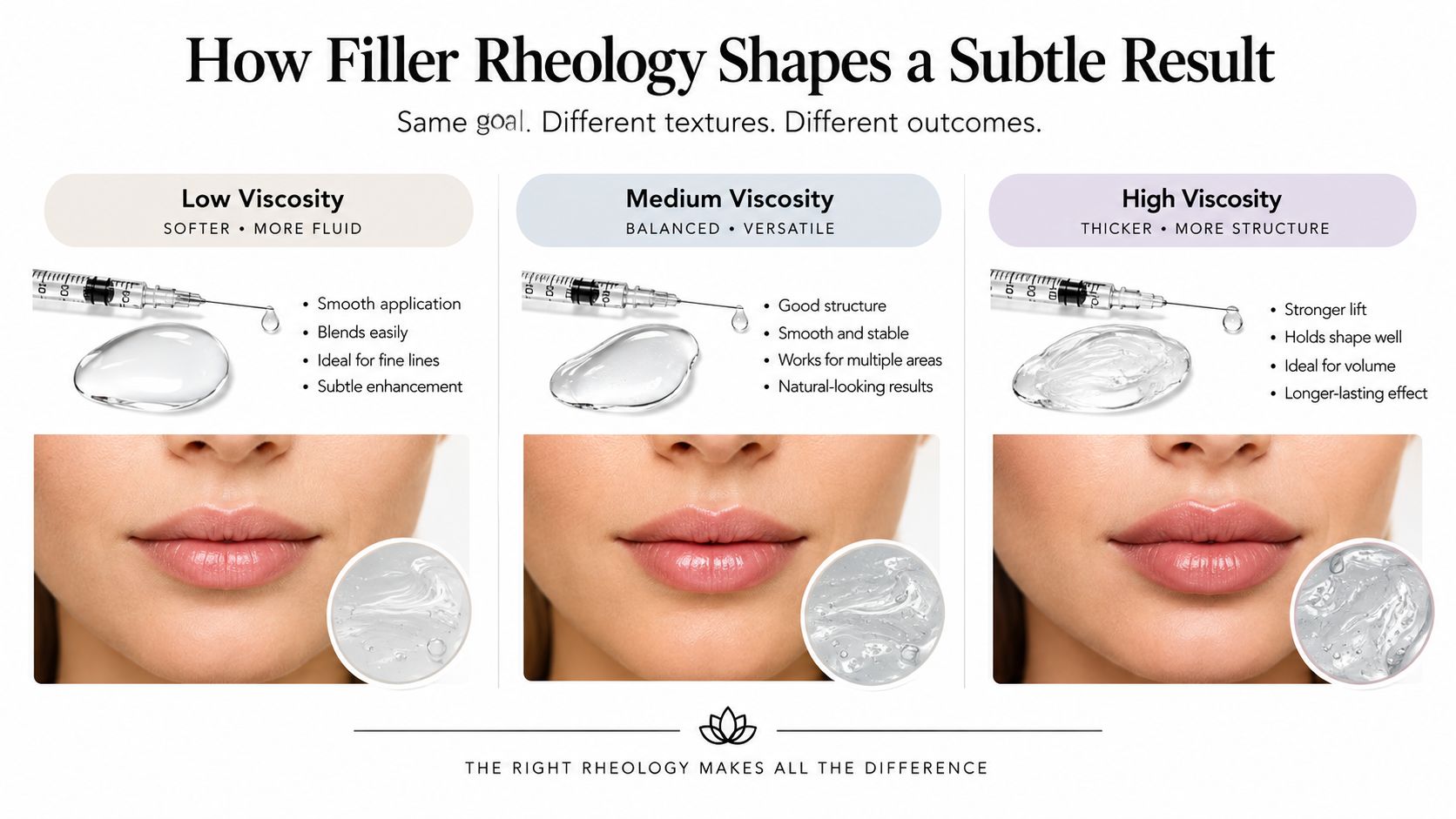
Product behavior matters because filler isn't a single material with one universal texture. Rheology describes how a hyaluronic acid gel responds to pressure, movement, and deformation. Your injector should select that behavior according to the tissue depth and the job the filler needs to perform.
Three terms are especially useful:
Firmness, cohesion, and swelling
G prime describes a gel's resistance to compression. A higher-G-prime filler is firmer and can provide projection or structural support. Placed over bone, it can act like a supportive cushion that helps restore cheek or chin architecture.
Cohesivity describes how well the gel holds together. A cohesive product maintains a more unified shape, which can be useful when an injector wants controlled support rather than widespread dispersion.
Water uptake describes how much the gel attracts and binds water after placement. More water interaction may contribute to fullness during the settling period, which is one reason an injector needs to account for the product's behavior rather than judge the final result immediately.
A firm gel used for cheek projection can feel like dense memory foam. It resists compression and maintains shape. A softer, more elastic gel used in the lips behaves more like a flexible silicone implant, yielding with movement instead of pushing back rigidly against every expression. These are analogies, not interchangeable product descriptions, but they help explain why a gel that works well in the cheek may feel wrong in the lip.
Matching the gel to the tissue
Higher G prime can make sense over bone in the cheeks or chin, where the injector is building a foundation. Lower G prime, greater stretch, and a softer feel are generally better suited to highly mobile areas such as the lips. Cross-linking density also affects firmness and durability. Thicker skin may camouflage a stiffer product more effectively than thin periorbital skin, where an overly firm or water-attracting gel can become visible or palpable.
Patients often ask for a brand by name. A more useful question is: Why this product, in this layer, for this movement pattern? The answer should connect the filler's behavior to your anatomy.
For a plain-language overview before your consultation, BotoxBarb's explanation of what dermal fillers are made of can help you understand why different formulations don't behave identically.
Brand loyalty shouldn't decide product selection. Tissue depth, skin thickness, facial mobility, and the desired sensory result should. The right gel in the wrong plane can still look artificial. The right gel in the right plane, used conservatively, is much more likely to become part of the face rather than sit on top of it.
Placement Strategy That Keeps Expressions Real
A natural result depends on more than the amount injected. The injector has to decide where the gel belongs in relation to bone, muscle, fat compartments, and skin. Deep placement creates structure. Superficial placement can refine a contour, but only when the overlying tissue can camouflage it.
Cheeks need a foundation, not a pillow
For cheek support, a conservative approach usually begins deep on bone. This creates lift and projection from a stable foundation rather than spreading volume broadly through the superficial cheek. If a shadow remains after the deeper correction settles, a small superficial pass may refine the transition.
The lateral cheek deserves restraint. Too much volume placed outward can create the familiar pillow effect, where the cheek appears detached from the jaw and lower face. The best cheek correction often improves light and proportion without announcing itself as cheek filler.
Lips should remain mobile
Lip treatment is where product behavior and technique become obvious. Injecting only along the border can create a sharp outline or a “shelf” effect, especially when the body of the lip remains flat. A more integrated approach may place product within the body of the lip while respecting the wet-dry line and preserving the natural transition between inner and outer tissue.
Full volume rarely needs to be pursued in one appointment. Staging across two sessions lets the injector assess how the lips move, how the patient feels the product, and whether additional volume would improve the result or make it more noticeable.
The dermal filler procedure overview offers useful background on what treatment involves, but the injection plan still has to be individualized.
Under-eyes require a high threshold
The tear trough is not automatically a filler problem. If true volume loss exists, an injector may use a low-G-prime product placed on the periosteum, often with a cannula, to restore support without chasing the texture of thin skin. Fine crepiness, pigment, laxity, and puffiness won't reliably improve just because filler has been added.
This is an area where doing less can be safer and more attractive. Product placed too superficially may remain visible, attract water, or create an irregular contour that's harder to disguise.
Jawline and chin need an endpoint
Chin and jawline work should build structure along bone, soften the pre-jowl sulcus subtly, and stop before the mandibular border becomes heavy. A strong lower face isn't automatically a more harmonious lower face. The injector should watch the result from the front, profile, and three-quarter angles, then reassess it during speech and smiling.
A useful stopping rule: If the next syringe improves a measurement but worsens movement, softness, or facial balance, it isn't an improvement.
Conservative dose ceilings are not about withholding treatment. They create room for the patient and injector to evaluate the first layer before committing to more.
Choosing the Right Injector for Natural Outcomes
The injector is the highest-impact decision in your treatment. Product, price, and clinic location matter, but none can compensate for weak anatomical judgment or poor emergency preparation.
A qualified provider may be a board-certified physician, nurse practitioner, or physician assistant with documented continuing education in facial injectables. Credentials alone don't prove aesthetic skill, so ask how frequently the provider performs filler treatments and whether facial assessment is part of the consultation rather than an afterthought.
Review the work beyond the pose
A gallery of static, filtered images isn't enough. Ask to see unedited before-and-after results under different lighting and, when available, in multiple facial expressions. Look for patients whose outcomes remain believable from the front, profile, and three-quarter views.
Pay attention to whether the provider shows different treatment styles. Natural results shouldn't all produce the same cheek, lip, chin, or jawline shape. A practitioner who applies one template to every face may be optimizing for a recognizable signature rather than your anatomy.

Use the consultation as an assessment
During the appointment, the injector should palpate your tissue, observe your facial movement, and ask about previous filler. Existing product can alter the injection plane and the way a new treatment is planned. A provider who never examines your face while it moves is missing information that photographs cannot supply.
You can also use an independent product resource, such as this Andalou Age Defying filler review, to become more familiar with how consumer-facing filler information is presented. It shouldn't replace a medical consultation, but it can help you separate product discussion from individualized treatment advice.
Ask direct safety questions:
- Emergency medication: Does the clinic keep hyaluronidase on site?
- Vascular protocol: Does the team follow a written response plan for suspected vascular occlusion?
- Referral access: Can the provider arrange direct referral to a vascular surgeon or oculoplastic specialist if needed?
- Staging policy: Will the injector recommend waiting or dividing treatment when more product isn't clearly justified?
Dismissive answers are a warning. So are package deals that pressure you to buy large amounts, refusal to stage treatment, or claims that complications cannot happen. A confident practitioner can explain limitations, welcome a second opinion, and decline a case that falls outside their competency.
For preparation questions and consultation expectations, BotoxBarb's dermal filler consultation guide is a practical starting point.
Safety, Risks, and the Real Complication Numbers
Hyaluronic acid fillers have a favorable safety profile overall, but “safe” doesn't mean risk-free. The everyday effects are usually swelling, bruising, redness, tenderness, or soreness. The uncommon events that deserve the most attention are vascular injury, tissue damage, and visual complications.
A high-level review in Medicine found no significant increase in moderate-to-severe adverse events for HA fillers compared with controls, with most short-term reactions described as mild to moderate and self-limited. The same review reported delayed inflammatory reactions at approximately 0.0005 events per patient-year, while another review found overall delayed inflammatory reaction rates near 0.02%, with variability by product. Vascular occlusion remains the critical low-frequency, high-severity complication, with one review estimating rates of up to 3 per 1,000 injections.
Those figures shouldn't be used to create false reassurance or unnecessary fear. A rare event can still require immediate action, and an injector's preparation matters because hyaluronidase may be used to dissolve HA when vascular compromise is suspected.
Filler complication rates at a glance
| Complication | Approximate rate | Typical resolution |
|---|---|---|
| Short-term reactions such as swelling, bruising, and tenderness | Usually mild to moderate in pooled safety data | Often resolves within two weeks |
| Delayed inflammatory reactions | About 0.0005 events per patient-year | Variable, depending on severity and treatment |
| Delayed inflammatory reactions in another review | Near 0.02%, with product variability | Variable |
| Vascular occlusion | Up to 3 per 1,000 injections | Requires urgent assessment and treatment |
The practical patient-side distinction is straightforward. Bruising and moderate swelling can be expected after treatment, but severe or escalating pain, blanching, unusual discoloration, cool skin, or any visual disturbance requires same-day contact with the injector or emergency medical evaluation. Don't wait for a routine follow-up if those symptoms appear.
The best safety conversation centers on approved products, anatomy, injection technique, and emergency readiness. It shouldn't reduce the decision to either “fillers are harmless” or “fillers are dangerous.” The meaningful question is whether the provider can recognize a problem and respond without delay.
Maintenance, Settling, and Long-Term Skin Support
A filler appointment is not the end of the process. The first hours reflect injection trauma and swelling, not the final aesthetic result. Most swelling improves over the first 72 hours, while more subtle settling continues for two to four weeks as the gel binds water and surrounding tissue adapts. These timing details are summarized in the clinical discussion of natural results with HA fillers.
Reassessment protects subtlety
Schedule reassessment no earlier than day 14, unless your provider asks to see you sooner because of a concern. At that point, the injector can distinguish residual swelling from under-correction, minor asymmetry, or a contour that needs attention.
A refinement syringe may be appropriate, but it isn't automatically required. The natural-looking result often comes from stopping after the first treatment and allowing the face to settle. If you keep correcting temporary swelling, you risk building excess volume before the original product has fully integrated.
The FDA's clinical materials on dermal fillers estimate approximately 2.7 million dermal filler treatments per year in the United States, which reflects how common the procedure has become. That scale makes disciplined follow-up more important, not less. A mature treatment category still depends on individual anatomy and careful review.
Support the skin, not just the volume
Maintenance should focus on the tissue supporting the filler. Daily sunscreen helps limit photoaging, while a suitable retinoid may support skin texture and collagen turnover when tolerated. In-office options such as microneedling and radiofrequency can address skin quality, but they should be scheduled according to your injector's aftercare guidance.
Red light therapy is another supportive option. The Forbes guide to LED face masks identifies red light, commonly in the 630 to 680 nm range, as the most established wavelength for cosmetic skin support. Blue-light settings are commonly centered around 415 nm and are used to target acne-associated bacteria and breakouts, as described by The Guardian's LED mask coverage.
For home use, the BotoxBarb Facial Mask is one device option to discuss with your provider. Its listed design is wireless, intended to sit comfortably on the face, and includes three lighting settings for different treatment goals. A tri-light LED mask with blue 415 nm, red 630 nm, and near-infrared 830 nm modes illustrates how multiple settings can support a more customizable routine. LED therapy shouldn't be treated as a substitute for filler or as a guaranteed way to extend its duration, and evidence for post-procedure redness remains preliminary.
Most HA fillers last nine to eighteen months, depending on the product and treated area. Lips and other highly mobile zones may fade faster. Plan maintenance around reassessment and anatomy rather than automatically adding product whenever you notice a change. Keep records of the product, lot, injection plane, treated areas, and any reaction after every session.
Your Natural Looking Filler Checklist
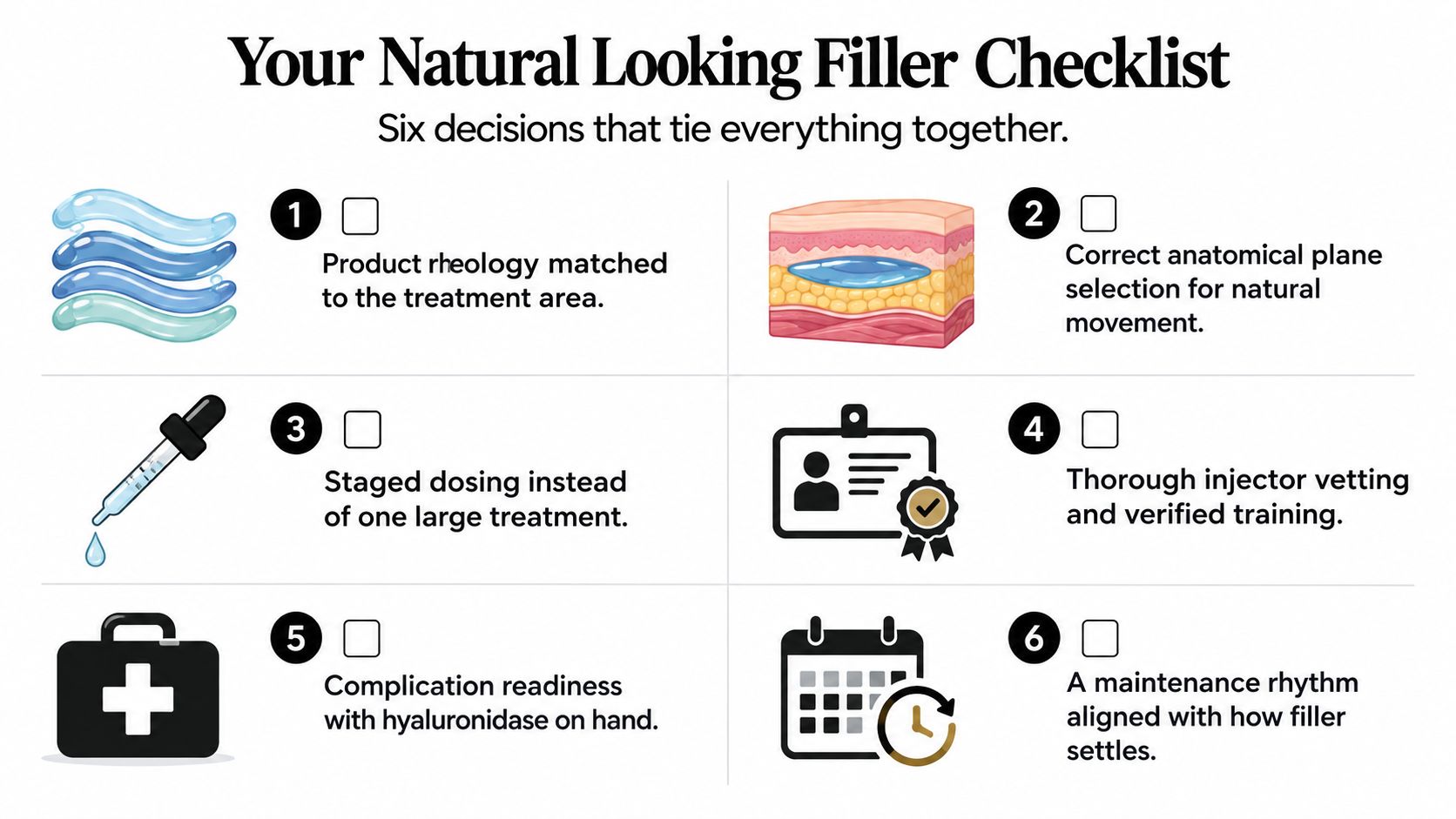
Use this checklist before every appointment, not only your first one. A natural-looking result is created through a sequence of decisions, and each decision should support the same standard: the face remains expressive, the tissue feels integrated, and the treatment doesn't dominate your attention.
On consultation day
- Clarify the sensory goal: Explain how you want the area to look when you smile, speak, or turn your head, not only how you want it to appear in a photo.
- Ask about rheology: Find out whether the provider is choosing a firm, cohesive gel for deep structure or a softer, more flexible product for mobile tissue.
- Review the plane: Ask whether the product will sit on bone, within a deeper fat compartment, or more superficially, and why that layer suits your skin and movement.
- Discuss previous filler: Tell the injector what you've had, where it was placed, and whether it ever felt firm, swollen, or uneven.
- Check emergency readiness: Confirm that the clinic has hyaluronidase and a written response pathway for vascular complications.
On treatment day
Agree on the smallest plan that can answer the clinical problem. That may mean deep cheek support instead of broad lateral volume, body-of-lip correction instead of border-only injection, or no tear-trough filler when texture rather than volume loss is the main concern.
Ask your provider to show you the treated areas from more than one angle. Natural-looking filler isn't a contest to use every available syringe. It's a controlled intervention followed by observation.

At the two-week reassessment
Check whether the area moves normally, feels soft enough for its location, and transitions smoothly into untreated tissue. Look for changes that only appear during animation, such as stiffness when smiling, altered speech, or a visible edge when the skin compresses.
If the result is balanced, stop. If a small correction is justified, staged refinement is usually more sensible than treating the original appointment as incomplete.
At the longer-term review
Review photographs, movement, comfort, and how quickly the result changed. The next appointment should respond to the way your filler settled, not to a generic calendar or a pressure to maintain maximum volume.
A natural result isn't necessarily invisible in a mirror. It's easy to live with. You can feel the tissue, watch your expressions, and recognize yourself without mentally checking the treatment. If you can't, the issue may be product behavior, plane, dose, or injector judgment, and adding more volume rarely solves all four.
BotoxBarb offers personalized Botox, Dysport, dermal filler, and LED light therapy services, along with medical-grade skincare for patients who want a coordinated approach to facial structure and skin quality. Visit BotoxBarb to explore treatment options, book a consultation, and discuss a natural-looking plan based on how your face looks and feels in motion.