Article: Dermal Filler Consultation: What to Expect and Ask
Dermal Filler Consultation: What to Expect and Ask
You've found a provider whose before-and-after photos look natural, chosen the area you'd like to soften or restore, and perhaps even checked the price of a syringe. The appointment may seem like a quick conversation before treatment. In a responsible practice, it's much more important than that.
A dermal filler consultation is the safety checkpoint where your medical history, facial anatomy, treatment goals, product choice, consent, and emergency planning come together. Filler complications are uncommon, but an accidental injection into a blood vessel can cause tissue death, blindness, or stroke, and the FDA warns that these outcomes may be serious and permanent. (FDA guidance on dermal fillers)
A good consultation should leave you informed, not hurried. You should understand what may help, what won't help, what the risks are, how the provider would respond to a complication, and whether you need treatment at all.
What Happens During a Dermal Filler Consultation
You check in at the front desk, complete your paperwork, and sit down expecting a quick discussion. Instead, a careful provider begins by confirming who you are, what you want to change, and whether filler is medically appropriate for you.
The appointment, step by step
First comes the greeting and consent paperwork. This may include privacy documents, treatment history, and permission to take clinical photographs. The provider should explain that consultation doesn't obligate you to proceed. You can ask questions, decline treatment, or go home and think.
Next, expect a detailed health review. You'll be asked about previous fillers, Botox or Dysport, facial surgery, dental work, allergies, medications, supplements, tobacco and alcohol use, pregnancy or breastfeeding, autoimmune conditions, bleeding disorders, and active skin problems. The American Society of Plastic Surgeons' consultation guidance also describes facial examination, measurements, photography, and treatment planning as important parts of the process.
The provider then takes baseline photographs, usually with a neutral expression and consistent lighting. These images aren't just for marketing. They create a reference for asymmetry, facial movement, swelling, and later review.
After that, you'll describe your goals in plain language. “I look tired” needs clarification. You may mean under-eye hollows, loss of cheek support, lines around the mouth, or a change after weight loss. Bring reference photos if they help, but remember that your anatomy, proportions, and skin behave differently from another person's.

The clinical plan
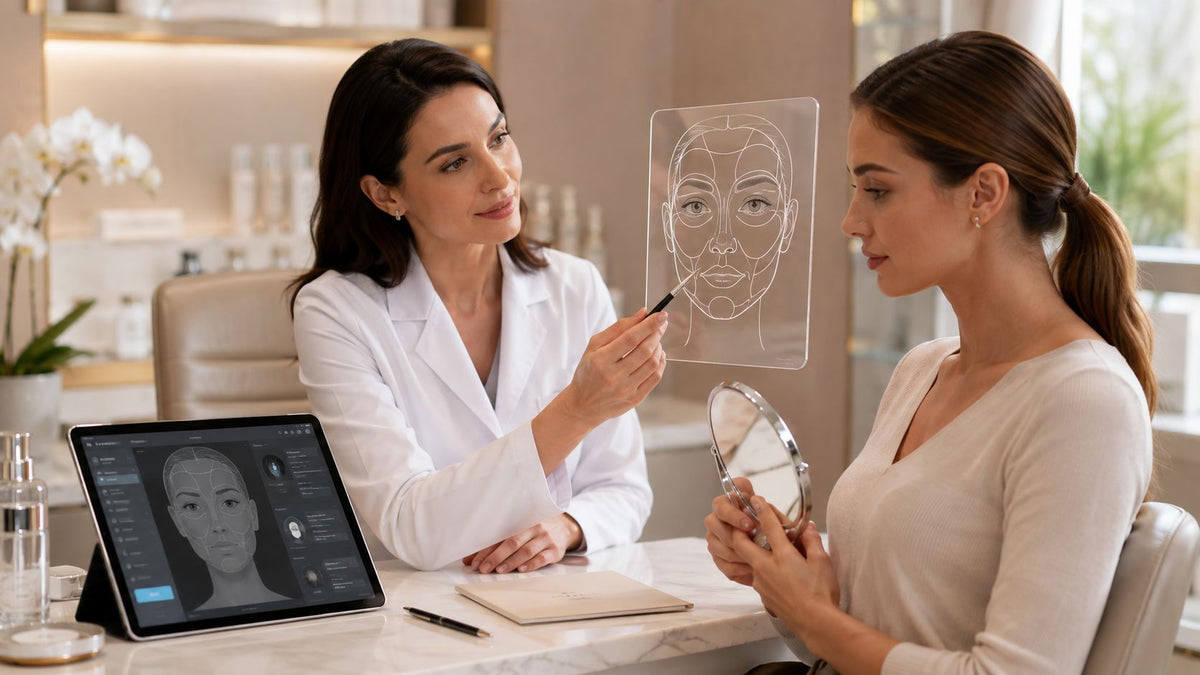
During the facial exam, the injector may ask you to relax, smile, pout, clench your teeth, or turn your head. A mirror helps you see the same concerns the provider is assessing. The treatment map should connect your goals to anatomy, not just mark every area you mention.
You should receive a recommendation for the product type, placement, amount, sequence, and expected maintenance. BotoxBarb lists Restylane®, JUVÉDERM®, and Revanesse Versa among its filler services, but the brand alone doesn't determine whether a treatment is suitable. The injector must match the product's characteristics to the area and your anatomy.
The final part covers pricing, scheduling, aftercare, and follow-up. If you prefer to leave without booking, that's a reasonable choice. A trustworthy clinic will give you written information and a way to contact them with questions. For a broader overview of the treatment itself, review what to know about the dermal filler procedure.
In-Clinic Versus Virtual Filler Consultations
Virtual appointments can be useful, but they can't replace the physical assessment required before an injection. A video call lets you explain your goals, review photographs, discuss broad treatment options, and assess how clearly the provider answers questions. It also gives you a convenient way to vet a clinic before arranging travel or taking time away from work.
An in-clinic consultation does more. The provider can palpate the tissues, assess skin thickness, observe facial movement, measure asymmetry, inspect the skin closely, and discuss the injection plan with your face in front of them. You can also complete consent in person and clarify whether treatment will happen that day or at a later appointment.
| Capability | In-Clinic | Virtual |
|---|---|---|
| Discuss goals and preferences | Detailed | Detailed |
| Review medical history | Yes | Yes, subject to verification |
| Examine skin and tissue | Direct examination | Limited by camera quality |
| Palpate facial structures | Yes | No |
| Assess vascular and anatomical considerations | More reliable | Cannot be confirmed fully |
| Review photographs | Yes | Yes |
| Confirm final treatment plan | Yes | Preliminary only |
| Same-day treatment discussion | Possible | Not applicable until in-person review |
| Convenience | Requires travel and appointment time | Easier scheduling and access |
A virtual consultation is reasonable as a first screening conversation, particularly if you're comparing providers or need preliminary pricing information. It shouldn't be the only assessment before a first injection. Even an excellent video call can't confirm tissue depth, skin condition, or the full anatomy relevant to safe placement.
For established patients, a virtual visit may help with a straightforward touch-up discussion, but the provider should still decide whether an in-person examination is necessary. Use the same care you'd apply when evaluating a clinic's online presence. A practical resource such as this TikTok guide for beauty brands can help you understand how providers present themselves online, but polished content isn't a substitute for credentials, examination, and safety planning.
Who Is a Good Candidate and What Gets Reviewed
Candidacy isn't a single yes-or-no question. I assess it in layers, beginning with your goals and general readiness, then moving through health history, medications, allergies, and the condition of your skin on the day of treatment.
Start with readiness
You should meet the applicable age-of-consent requirements, understand what filler can and can't change, and have expectations that fit your facial structure. Stable circumstances make planning easier. Major weight changes, a recent illness, or pressure from someone else may be reasons to wait.
You also need to be willing to attend follow-up if the provider recommends it. Filler is elective, so the decision shouldn't feel urgent.
Review health before discussing product
Tell the injector about autoimmune disease, bleeding disorders, active acne or skin infection, pregnancy, breastfeeding, and recent dental or surgical work. These details can affect infection risk, bruising, healing, and whether the appointment should be deferred.
Disclose all previous facial procedures, including filler placed elsewhere. Old product can alter the tissue, affect symmetry, and change the safest treatment plan. A provider who doesn't ask about prior injections is missing information that matters.
The medication and supplement list deserves equal attention. NSAIDs, fish oil, vitamin E, blood thinners, and some acne treatments may affect bruising or treatment suitability. Never stop a prescribed blood thinner on your own. Ask the prescribing clinician whether any medication change is safe.

Check product-specific concerns
For hyaluronic acid fillers, the provider should ask about known allergy to lidocaine and sensitivity to gram-positive bacterial proteins, depending on the product under consideration. The review should also cover any history of unusual inflammatory reactions or delayed swelling after previous injectables.
Temporary deferral may be appropriate when you have an active skin infection, significant facial inflammation, an unresolved dental issue, recent surgery, an acute illness, or a medication question that hasn't been safely clarified. The exact decision belongs to a qualified clinician who has reviewed your history.
How Your Face Is Assessed and a Plan Is Built
A useful facial assessment moves from structure to skin to movement. The injector isn't just looking for a wrinkle to fill. They're deciding whether the visible concern comes from volume loss, bone structure, skin quality, muscle activity, tissue descent, or a combination.
Structure comes first
The provider evaluates bone support, midface volume, chin projection, jawline relationships, and lip proportions. A hollow or line may look different once the surrounding support is considered. Treating the most visible line first can produce heaviness or an unbalanced result if the underlying structure hasn't been assessed.
Skin quality comes next. Elasticity, thickness, hydration, texture, redness, and laxity all influence whether filler is appropriate and how visible it may become. Superficial placement is associated with visible lumps and bumps, while more superficial injections also correlate with erythema, edema, and bruising. That's why depth is a clinical decision, not a detail to leave until the syringe is open.
Product and plane must match the purpose
A soft hyaluronic acid gel may suit delicate lip movement, while a firmer, cohesive gel may provide more structural support in the cheek or chin. The injector should explain why a particular product is being recommended, where it will sit, and whether the result can be adjusted or reversed.
Placement may be subdermal or deeper near the periosteum, depending on the area and objective. Expected longevity also varies by product, location, movement, metabolism, and technique. A staged plan often gives better control than trying to correct every concern in one appointment.

Before photographs, markings, and mirror-based confirmation create a shared visual reference. Ask the injector to show you what each marking represents and to explain which areas are being left untreated. You should be able to say, “That amount feels too much,” or “I want balance rather than projection,” before any needle or cannula is used.
Practical rule: If the treatment plan can't be explained in terms of anatomy, product behavior, placement, and trade-offs, it isn't ready for consent.
Smart Questions to Ask Your Filler Provider
The question “Are you experienced?” usually produces a reassuring answer but little usable information. Better questions ask for specifics about training, patient volume, product choice, outcomes, and emergency response.
| Weak Question | Better Question |
|---|---|
| Are you experienced? | What training and licensing do you hold, and how regularly do you perform the area I'm considering? |
| Is this filler safe? | Why does this product fit my anatomy, and what alternatives would you consider? |
| Will I look natural? | What change is realistic for my face, and what would make you recommend less product? |
| Are complications rare? | What warning signs require urgent contact, and who manages them after I leave? |
| Can you fix a problem? | Do you keep hyaluronidase on-site, and what is your documented vascular-occlusion rescue protocol? |
| Do you have before-and-after photos? | May I see comparable cases photographed in consistent lighting, with permission? |
| How much does it cost? | What does the quote include, including follow-up, touch-ups, and any reversal treatment? |
| Can we treat everything today? | Would a staged plan be safer or more natural for my goals? |
| Will there be swelling? | What recovery should I plan for, and which symptoms are expected versus urgent? |
| Can I call if I'm worried? | What is the after-hours contact pathway, and who answers if you suspect a complication? |
Ask about hyaluronidase competency, not just whether a vial exists in the building. Hyaluronidase is used to dissolve hyaluronic acid filler in appropriate situations, but the important issue is whether the clinical team can recognize a vascular compromise, assess it promptly, and follow an evidence-based rescue plan.
The FDA-adjacent safety review of adverse-event reports identified 3,782 dermal filler complications in the MAUDE database. The reported product categories included hyaluronic acid fillers at 44%, poly-L-lactic acid at 40%, calcium hydroxylapatite at 15%, and polymethylmethacrylate at less than 1%. (Review of dermal filler adverse events) These figures don't predict your personal outcome, but they explain why product knowledge and complication readiness belong in the consultation.
Ask whether the provider has a written emergency pathway, after-hours access, and a policy for asymmetry, delayed swelling, overcorrection, or a result you dislike. Write the answers down. Anxiety and excitement make it easy to forget details once you leave.
Cost, Timelines, Consent, and Safety Planning
A per-syringe quote doesn't tell you what you're paying for. The total reflects the product, the injector's training and judgment, clinic overhead, the complexity of the anatomical area, sterile supplies, follow-up, and the clinic's ability to respond if something goes wrong.
A low price may look attractive, but it can conceal limited follow-up or an unclear rescue pathway. A higher fee isn't proof of quality either. Ask for an itemized explanation and confirm whether assessment, photographs, review appointments, and reversal are included or billed separately.
Consent should be specific
Informed consent should cover the intended treatment, alternatives, common short-lived reactions, rare serious complications, expected recovery, and the option to decline. You should understand whether photographs may be used for clinical records or marketing, and how emergency contact information will be handled.
The FDA lists bruising, redness, swelling, pain, tenderness, itching, and rash among common filler side effects. (FDA dermal filler safety information) The same FDA information warns that inadvertent injection into a blood vessel can cause tissue death, stroke, or blindness.
A clinic should explain the warning signs that need immediate attention, such as unusual or escalating pain, blanching, mottled skin, changes in vision, or neurological symptoms. The rescue plan should identify who you call, where you go, how quickly you're assessed, and whether the provider has the appropriate supplies and training.

Results and recovery need honest framing
Most hyaluronic acid reactions are short-lived injection-site responses that resolve on their own. A retrospective study of 290,307 hyaluronic acid injections reported severe complications in 0.0041% of cases, including 10 vascular obstructions and 2 infections. (Study of severe complications after HA injections) A low rate doesn't make emergency preparation unnecessary. It makes clear communication more important.
Initial improvement may be visible before swelling settles, so don't judge the final appearance immediately. Ask when the provider wants to review you, what changes are expected, and which symptoms fall outside normal recovery. Pressure to pay immediately, dismissing your questions, or asking you to waive a cooling-off period are red flags.
For a practical explanation of expected reactions and warning signs, read dermal filler side effects and what they can mean.
How to Prepare and What to Do After the Consult
Use the days before your appointment to make the consultation more useful, not to self-prescribe a medication plan. Ask the clinician who prescribed any blood thinner or other medication whether changes are safe. Don't stop necessary treatment without that approval.
Arrive with a clean, bare face if possible. Bring a complete list of medications, supplements, allergies, previous injectables, surgeries, dental procedures, and relevant medical conditions. Reference photos can help you describe the level of change you prefer, especially if your goal is subtle balancing rather than obvious volume.
Limit alcohol before treatment if your provider recommends it, stay well hydrated, and plan for the possibility of bruising or swelling. The provider may advise postponing treatment if your skin is inflamed, you're unwell, or a recent procedure changes the risk profile.
After the consultation, you don't have to book immediately. Take time to compare the proposed plan with your goals. A second opinion is sensible when the recommendation feels too aggressive, the product choice isn't explained, the provider won't discuss rescue protocols, or you feel pressured.
BotoxBarb Facial Mask can be considered as a complementary LED facial mask option between filler sessions and during recovery, subject to your injector's instructions. Its wireless design, face-contouring fit, comfortable wear, and three lighting settings are intended for different treatment routines. LED devices are regulated medical devices in some cleared examples, including masks with multiple light modes, but clearance doesn't mean every device is appropriate immediately after every injectable. (FDA-cleared LED facial mask example)
Use a simple contact timeline: ask questions before booking, confirm preparation instructions before treatment, follow the clinic's immediate aftercare guidance, and contact the provider promptly if symptoms seem unusual. Keep the emergency number accessible rather than relying on a general office inbox. More recovery guidance is available in dermal filler aftercare recommendations.
Your Pre-Consultation Checklist and Final Takeaways
Save this checklist to your phone or print it for the waiting room.
Documents to bring
- Medication list: Include prescriptions, over-the-counter medicines, and supplements.
- Procedure history: Note previous fillers, neurotoxins, surgery, and dental work.
- Reference photos: Bring examples that show your preferred level of change.
- Questions in writing: Leave space to record the answers.
Health history to disclose
- Allergies: Include lidocaine and previous filler reactions.
- Medical conditions: Mention autoimmune disease, bleeding disorders, and skin problems.
- Current status: Disclose pregnancy, breastfeeding, recent illness, and inflammation.
- Medication changes: Ask the prescriber before stopping anything.
Questions to ask
- Credentials: What training and licensing support this treatment?
- Product: Why is this filler appropriate for my anatomy?
- Rescue plan: Is hyaluronidase available, and who handles emergencies?
- Follow-up: When will I be reviewed, and what happens if I'm concerned?
Before you leave
- Written plan: Confirm area, product, amount, and sequence.
- Total quote: Ask what follow-up and reversal care include.
- Contact pathway: Save routine and after-hours numbers.
- Decision time: Leave if you need space to think.
The consultation is a safety checkpoint, not a sales conversation. Rescue protocols and complication training matter alongside injection technique. Patients who ask specific questions can make clearer decisions and set more realistic expectations.
BotoxBarb offers in-clinic consultations and aesthetic services including dermal fillers, Botox, Dysport, LED light therapy, and curated medical-grade skincare. Visit BotoxBarb to review available services, book an appointment, and choose products that support your consultation and longer-term skin routine.