Article: Sculptra for Marionette Lines: What to Expect
Sculptra for Marionette Lines: What to Expect
You notice them in a photograph first, then in the bathroom mirror: two lines descending from the corners of your mouth, making your resting expression look tired or disappointed. Marionette lines can appear even when you feel well rested, and treating them successfully requires more than placing filler directly into a crease. The lower face changes through volume loss, collagen depletion, and structural descent, so the right plan must address the layer responsible for your particular pattern.
Sculptra can be an excellent option when marionette lines reflect gradual loss of support and skin quality. It isn't a universal eraser, though. Some patients need a combination of collagen stimulation, strategic hyaluronic acid filler, muscle treatment, or skin-focused care to achieve a balanced result.
Why Marionette Lines Are Different from Other Facial Wrinkles
A patient may point to the line beside her mouth and ask for it to be filled. On examination, the visible crease is often only the endpoint of a broader change. The mouth corner has descended, the tissue above it has shifted, and the skin has lost some of the resilience that once held the lower face smoothly in place.
Marionette lines run downward from the mouth corners toward the chin and can create a sad or downturned expression at rest. Forehead lines and crow's feet are more closely associated with repeated muscle movement. Marionette lines can involve expression, but they also reflect loss of facial support and descent of lower-face tissue, which is why a superficial correction may look incomplete.

The lower face has two problems to solve
Weight fluctuation can change facial fullness. Gravity gradually pulls descended tissue toward the jawline, while collagen depletion leaves the skin less able to resist folding. The result isn't just a line in the skin. It's a transition between areas that have lost volume and areas where tissue has collected or sagged.
That distinction changes the treatment conversation. A carefully placed hyaluronic acid filler may soften a defined crease immediately, but directly filling every visible depression can add weight to an already heavy lower face. Sculptra is more useful when the broader concern is foundational support and declining skin quality, rather than one isolated furrow.
Practical rule: Treat the anatomy that creates the line, not only the line you can see.
A useful explanation of the difference between marionette lines and other lower-face concerns appears in this marionette-line treatment guide. The important takeaway is simple: the best result usually looks like a softer, better-supported lower face, not a mouth area that has been overfilled.
How Sculptra Works for Lower Face Rejuvenation
Sculptra is an injectable made with poly-L-lactic acid, or PLLA, along with carboxymethylcellulose, mannitol, and sterile water for injection. The FDA describes it as a biocompatible, biodegradable injectable placed beneath the skin, with approved uses involving facial wrinkles and folds and later labeling covering fine lines and wrinkles in the cheek region for immune-competent people. The FDA product update provides the regulatory context.
Think of traditional hyaluronic acid filler as placing material where support is missing. Sculptra works more like repairing the framework of a house before refinishing the walls. The injected PLLA creates a stimulus for your own fibroblasts, the cells involved in collagen production, to rebuild support gradually.
Four stages of the treatment
The original FDA PMA for Sculptra, P030050, was approved on August 3, 2004, for restoration and correction of facial fat loss in people with HIV-associated lipoatrophy, as documented in the FDA approval documentation. That history matters because it established Sculptra as a collagen-stimulating injectable intended for gradual volume restoration, not as a product designed to erase one line instantly.
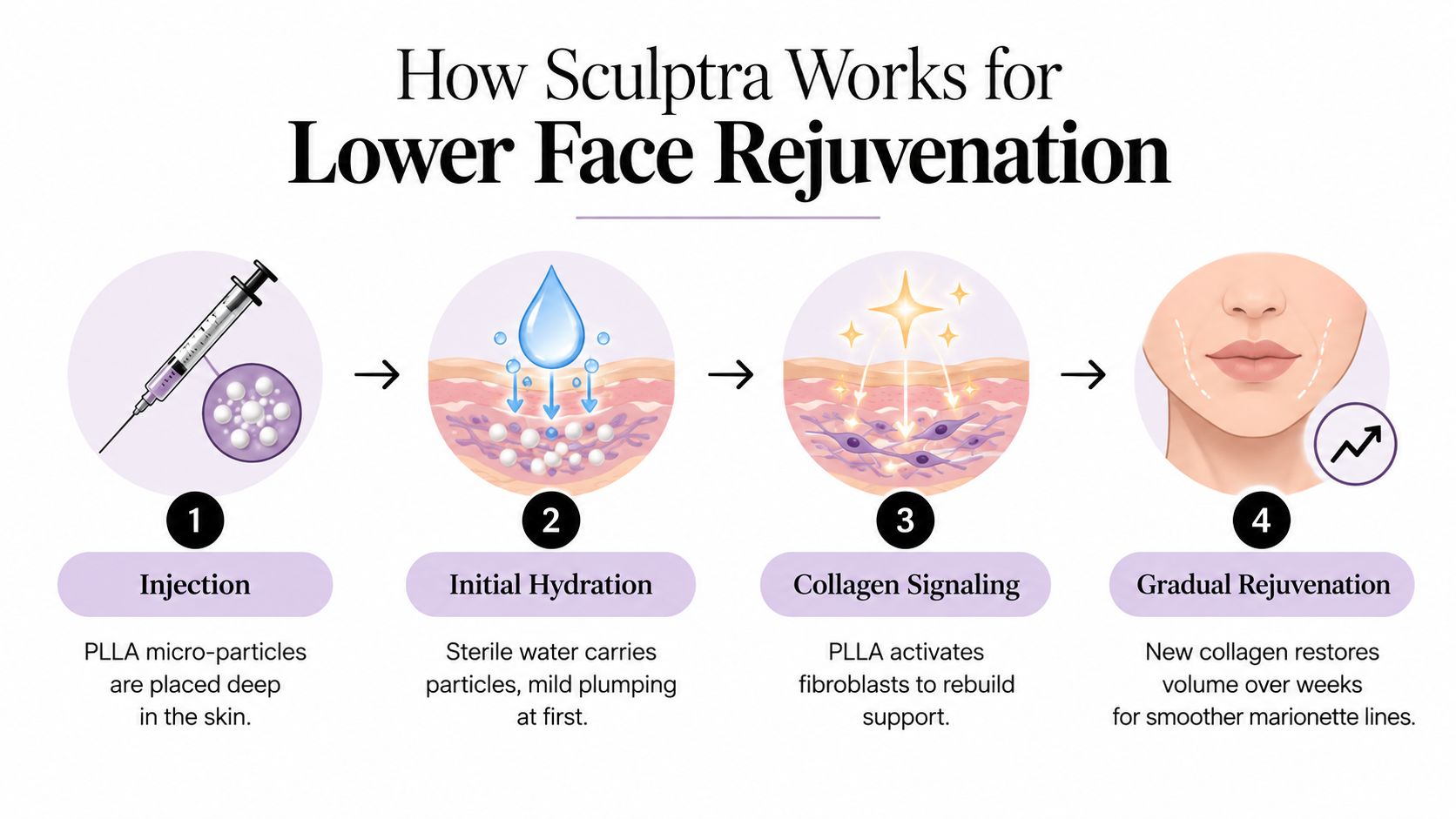
The lower-face process is best understood in stages:
- Injection: The clinician places PLLA particles at the planned depth and location.
- Initial hydration: Sterile water carries the particles, so the area may look mildly fuller at first.
- Collagen signaling: The PLLA stimulates a healing response involving fibroblast activity.
- Gradual rejuvenation: New collagen develops over time, improving support and softening the appearance of marionette lines.
The early fullness shouldn't be mistaken for the final result. Modern product information describes visible improvement as early as 1 month, with results lasting up to 2 years, as summarized in the FDA-linked labeling. For a broader explanation of this treatment category, the biostimulator injection guide is a useful companion resource.
Sculptra's advantage is subtle structural improvement. Its limitation is timing. It won't provide the instant, precisely adjustable correction that makes HA filler useful for a sharply defined shallow line.
What Clinical Research Shows About Marionette Line Improvement
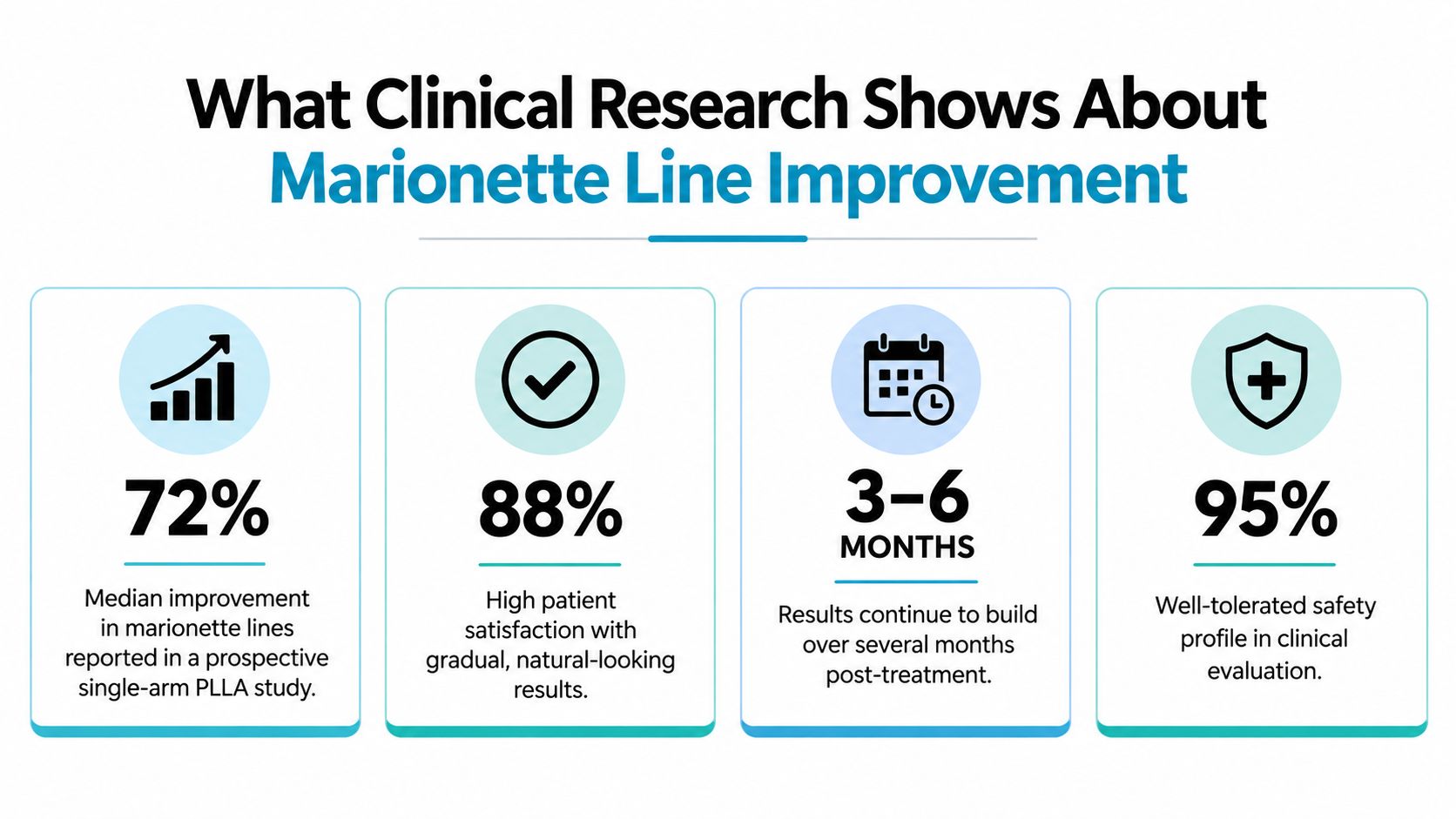
The most relevant evidence isn't a generic claim that Sculptra makes people look younger. It's whether the treatment changes the specific feature patients want addressed. In a prospective single-arm study of poly-L-lactic acid, researchers evaluated marionette-line severity after treatment and found a measurable improvement over time.
The median marionette-line grade fell from 2.0 at baseline to 1.0 at 6 months after the final treatment, a one-grade median improvement. The same study reported that 90.4% of participants, or 47 of 52, showed improvement in their marionette lines. These figures come from the published prospective PLLA study.
What the numbers mean in practice
The study's mean marionette-line score decreased from 2.04 to 0.50 by 6 months, and no serious adverse events occurred. Reported treatment-related adverse events were mild and transient. That safety result is reassuring, but it doesn't remove the need for careful patient selection, accurate depth, conservative planning, and appropriate follow-up.
The timeline also matters. A patient shouldn't judge the final outcome in the first few days, when swelling or temporary hydration can distort the appearance. Sculptra's value is measured through progressive change, with the product information describing results beginning around 1 month and lasting up to 2 years.
Gradual improvement is not a weakness of Sculptra. It's the reason the result can look like your face has improved rather than your face has been filled.
Clinical evidence doesn't mean every patient will reach the same degree of correction. Baseline anatomy, skin laxity, volume loss, treatment technique, and whether other lower-face structures need attention all influence the outcome. A study result helps set expectations, but it can't replace an examination.
Sculptra Versus Hyaluronic Acid Fillers and Neurotoxins
The simplest way to choose among treatments is to identify what drives the visible concern. Sculptra supports collagen rebuilding, HA fillers provide immediate volume, and neurotoxins reduce selected muscle activity. These categories overlap in real treatment plans, but they aren't interchangeable.
| Treatment | Best For | Onset | Duration |
|---|---|---|---|
| Sculptra | Gradual support, diffuse volume depletion, and skin-quality concerns | Gradual, with visible improvement as early as 1 month | Up to 2 years |
| Hyaluronic acid filler | A defined shallow or moderate crease requiring immediate correction | Immediate | Product and patient dependent |
| Neurotoxin | Dynamic muscle activity contributing to downward mouth movement | Gradual muscle relaxation | Product and patient dependent |
Sculptra makes the most sense when the lower face looks depleted and the skin feels thinner or less resilient. It can improve the overall foundation, but it won't instantly sculpt a precise edge. HA filler is more useful when a patient wants immediate softening or when a small, well-defined area needs controlled correction. It can also be dissolved, which gives it a different risk and reversibility profile.
Neurotoxins have a narrower role. They don't replace lost volume, and they won't correct lax skin or a deep structural fold. They may be considered when muscle activity contributes to a downturned mouth, but treatment must remain conservative because excessive weakening can affect expression, speech, or oral function.
Patients comparing injectable options often encounter hyaluronic acid as an ingredient in both aesthetic products and supplements. A medically oriented glucosamine, hyaluronic acid, chondroitin, and MSM guide from NexiHerb LLC can help distinguish those categories, but an oral supplement isn't a substitute for an injectable treatment plan.
The practical answer is often layered: Sculptra for diffuse support, HA filler for a focal crease, or a carefully selected neurotoxin when muscle pull is part of the picture. The injector should decide the sequence after assessing the full face, not by treating the most visible line in isolation.
Your Sculptra Treatment Journey, Sessions, Timeline, and Results
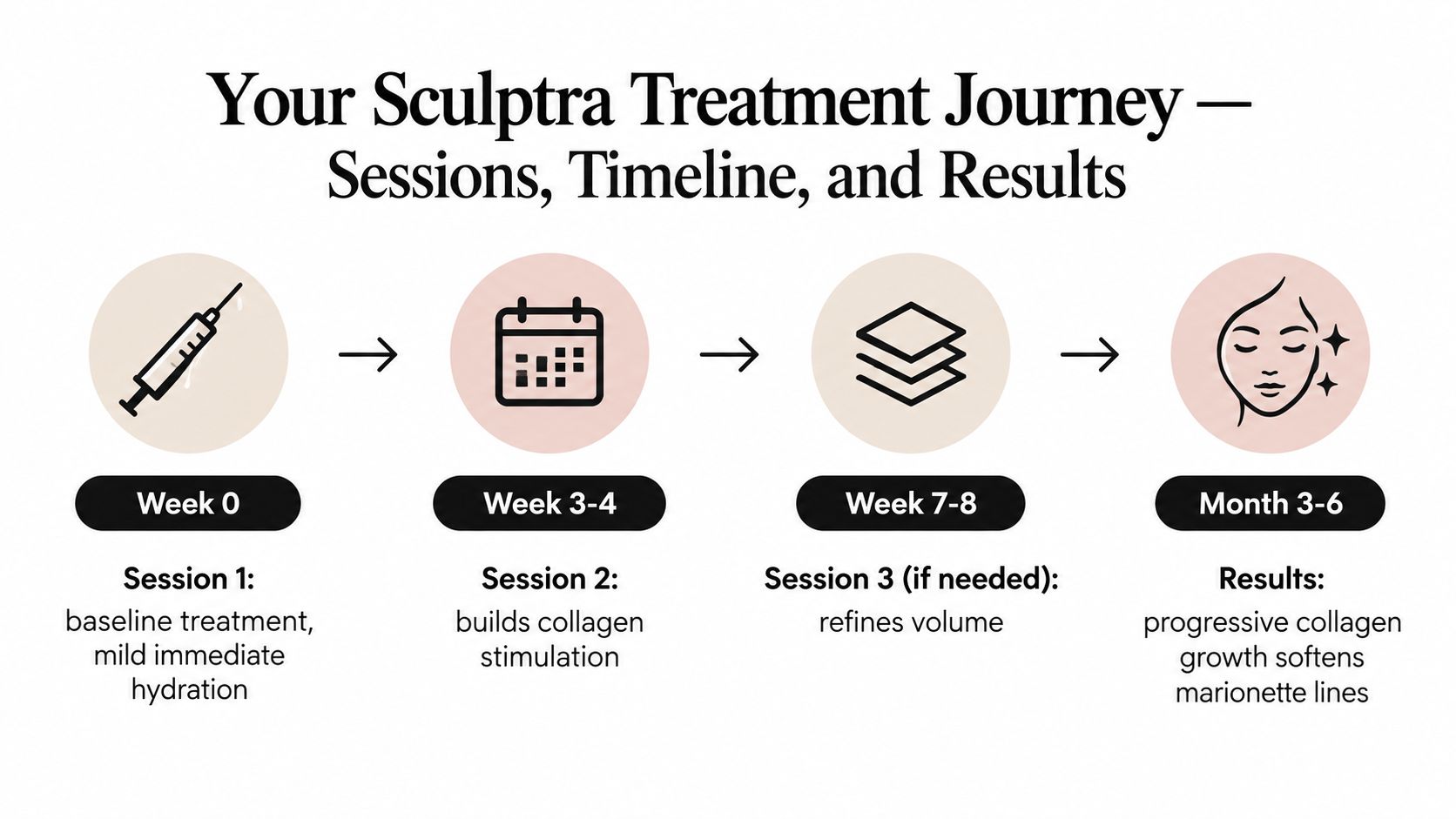
A Sculptra plan usually unfolds over several visits rather than one dramatic appointment. Two to three sessions, commonly spaced three to four weeks apart, reflect the product's gradual biostimulatory design, as described in modern product information. Each visit allows the clinician to assess how your tissue responds before adding more support.
What happens at each stage
Consultation comes first. The assessment should include the mouth corners, marionette lines, chin, jawline, skin quality, and the areas above the lower face that may be contributing to descent. A good plan also defines what Sculptra won't fix alone, such as pronounced laxity or a heavy jowl shadow.
At treatment, the area is cleansed and mapped. The injector selects the depth, entry points, and distribution based on anatomy rather than using an identical pattern for every patient. Mild swelling, tenderness, or bruising can occur, so scheduling the appointment with recovery time in mind is sensible.
Between visits, follow the aftercare instructions given by your injector. Gentle massage may be advised, but the exact technique and frequency should come from the treating practice. Avoid judging the treatment too early, because the initial appearance reflects temporary treatment effects before collagen remodeling has had time to develop.
Visible improvement may begin around 1 month, while the more meaningful change takes shape over subsequent months. Results are described as lasting up to 2 years, but maintenance remains individualized. Some patients return when they notice a change in support, while others require a different combination approach as the lower face continues to age.
Patient expectation: Sculptra should make a face look progressively better supported. It shouldn't create an overnight, overfilled appearance.
Combining Sculptra with LED Light Therapy for Better Outcomes
Sculptra and LED therapy work at different levels. Sculptra addresses deeper support through PLLA-driven collagen stimulation. LED light therapy is a surface-focused routine that can support the appearance and condition of the skin between professional treatments.
The Barb N.P. Facial Mask is a wireless device designed for comfortable wear across the face. It offers three lighting settings: red for signs associated with aging, blue for acne-focused care, and a combined mode for mixed concerns. Its cordless format makes it easier to use without remaining attached to a console, and a comfortable fit matters because consistency is more realistic when the mask isn't cumbersome.
A reviewed LED mask category includes red light at 633 nm, near-infrared at 830 nm, deep near-infrared at 1,072 nm, blue light at 415 nm, green light at 532 nm, and yellow light at 590 nm, according to The Guardian's reviewed LED mask coverage. Individual devices vary, so the specifications for the mask you choose should always be checked directly.
Use LED as maintenance, not replacement
Red light can complement a Sculptra plan by supporting the skin's surface appearance, while blue light is directed toward acne-related concerns. The combined setting can suit people managing more than one skin issue. None of these settings replaces an injector's evaluation, correct Sculptra placement, or treatment of substantial laxity.
The LED light therapy benefits guide offers additional context on how at-home light devices fit into a broader skincare routine. Follow the device instructions, protect your eyes as directed, and pause use if your skin reacts unexpectedly.
For lower-face rejuvenation, the strongest rationale is complementary care. Sculptra works on foundational support, while LED helps maintain attention to skin quality. That combination can be more coherent than expecting one injectable to solve every visible sign of aging.
When Sculptra Alone Isn't Enough, Combination Treatment Realities
Sculptra is valuable, but it isn't a universal answer for every marionette line. A patient with significant skin laxity, prominent jowls, or shadowing from descended tissue may see improvement in skin quality without getting the lift or contour change she expected. Likewise, volume loss extending beyond the mouth corners may require support in other facial regions.
Treatment planning becomes more important than product loyalty. A clinician may consider Sculptra for diffuse collagen loss, HA filler for a focal depression, or contour-based treatment when the chin and jawline affect the lower-face balance. The aim is to distribute correction rather than place excessive product into the marionette crease.
Growing interest in layered treatment reflects that reality. A 2025 phase IV study presented at ASDS reported improvement in facial wrinkles, firmness, and contour deficiencies when Sculptra was paired with HA fillers in patients affected by medication-driven weight loss, as summarized in the available clinical background. That finding supports a combination-minded approach, but it shouldn't be treated as proof that every patient needs both products.
Situations that deserve a broader plan
- Heavy jowling: Collagen stimulation may improve skin quality, but it won't reposition every descended structure.
- Deep focal folds: HA filler may provide the immediate precision Sculptra lacks.
- Downward mouth movement: A neurotoxin assessment may be relevant if muscle activity contributes substantially.
- Surface texture concerns: LED, skincare, microneedling, or other skin treatments may address issues the injectable cannot.
The safest plan is the one that matches the anatomy without promising complete erasure. Sometimes the correct recommendation is Sculptra alone. Sometimes it is a staged combination. Occasionally, a patient needs to reconsider whether an injectable can deliver the degree of lift she wants.
Is Sculptra Right for Your Marionette Line Concerns
Sculptra is usually a strong candidate when marionette lines reflect gradual volume depletion, thinner skin, and reduced collagen support. It suits patients who prefer a progressive change and accept a multi-session plan rather than expecting immediate line removal.
A different option may fit better when the line is shallow and sharply defined, especially if immediate correction matters. HA filler offers more direct volumization. If the dominant issue is repeated downward muscle activity, a neurotoxin discussion may come first. Significant laxity, jowling, or widespread lower-face descent calls for a broader consultation rather than a product decision made from a photograph.
At BotoxBarb, Barb N.P. and her team assess the facial architecture around the mouth, not just the crease itself. They consider skin quality, volume distribution, movement, and long-term aesthetic goals before recommending Sculptra, HA filler, LED care, or a combination plan.
BotoxBarb offers consultation-led injectable treatments and skin-focused options for patients considering Sculptra for marionette lines, including professional assessment of whether collagen stimulation is enough for the lower face. Visit BotoxBarb to explore treatment appointments and the Barb N.P. Facial Mask, then discuss a plan designed around your anatomy and desired pace of change.