Article: Botox Brow Lift Gone Wrong: Recognition & Recovery Guide
Botox Brow Lift Gone Wrong: Recognition & Recovery Guide
You look in the mirror after a brow lift and notice that one eyebrow sits higher, your forehead barely moves, or one upper eyelid seems heavier than before. The change can feel shocking, especially when you expected a subtle, refreshed appearance. Searching for “botox brow lift gone wrong” in that moment is understandable, but the next step should be careful observation and medical guidance, not panic.
Most unwanted upper-face effects are recognized complications of temporary muscle weakening. The important questions are what you're seeing, when it started, whether it's changing, and which symptoms require prompt assessment.
Understanding Common Botox Brow Lift Complications
A patient may leave treatment feeling pleased, then notice a different result as the toxin takes effect. One brow can appear more arched, the forehead may feel unusually still, or the upper eyelid can look heavier on one side. These changes are emotionally difficult because the face is central to identity and communication, yet they often reflect altered muscle balance rather than permanent injury.
The most frequently discussed complication is brow ptosis, meaning the brow drops after the frontalis muscle has been weakened. The frontalis helps lift the brow. If its lower fibers are weakened too much, the brow can descend and create a tired or hooded appearance. Eyelid ptosis is different. It involves drooping of the upper eyelid itself and can make the eye look smaller.
What the main failure patterns look like
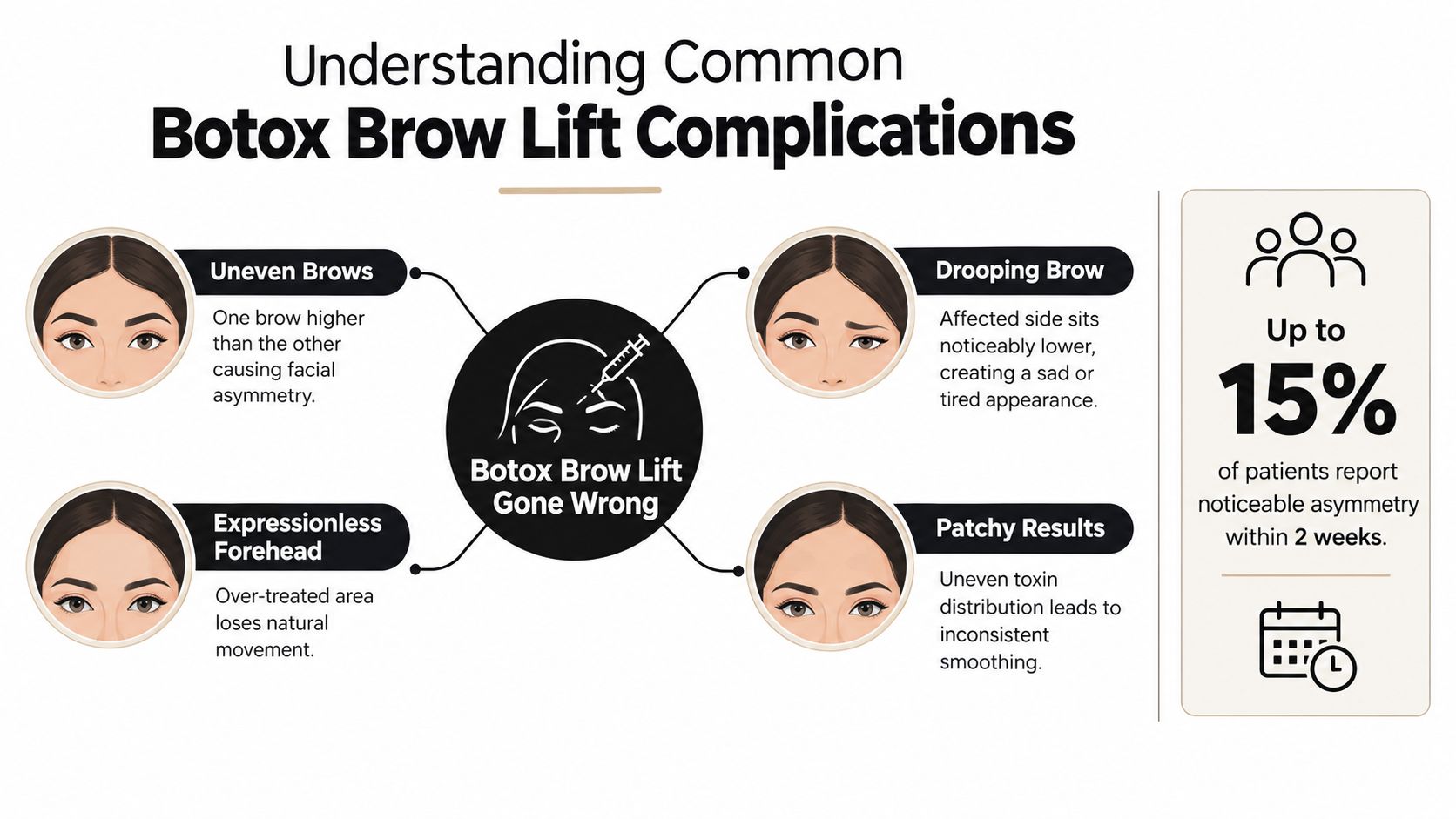
Eyebrow asymmetry means the brows sit at different heights or have different curves. A raised outer tail, a sharply peaked arch, or one flatter brow may appear when the toxin affects muscles unevenly.
An expressionless forehead occurs when the treated area loses more movement than you wanted. Smoothness can come at the cost of natural expression if the dose or placement doesn't suit your anatomy.
Patchy results describe uneven smoothing or inconsistent movement across the forehead. This doesn't always mean the product was defective. Injection pattern, muscle strength, natural asymmetry, and dose placement all influence the result.
Reviews of aesthetic botulinum toxin treatment describe brow ptosis across a range from less than 1% to 5%, and one study of 25 patients treated for forehead lines found that 22 developed a mean brow ptosis of 2.3 mm, according to a review of botulinum toxin complications. Those findings don't predict what will happen to one individual, but they confirm that the problem is known and measurable.
A result can look permanent before the muscle balance has settled. Documenting the change and getting an examination is more useful than repeatedly checking the mirror.
For a broader explanation of nonsurgical brow elevation and its trade-offs, the brow lift without surgery complete guide offers useful context. You can also review BotoxBarb's guidance on where to inject Botox for an eyebrow lift before discussing future treatment.
Recognizing the Signs of an Uneven or Dropped Brow
Start with function, not just appearance. Raise both eyebrows, relax your face, blink normally, and compare the brow position on both sides. Take a front-facing photograph in neutral lighting, with your head level and your expression relaxed. Avoid judging the result only from a close-up selfie, because camera angle can exaggerate asymmetry.
A dropped brow usually sits lower than it did before treatment and may press toward the upper eyelid. The eye can look smaller or the face can appear tired. With eyelid ptosis, the eyelid margin itself descends. With brow ptosis, the eyebrow and surrounding forehead tissue sit lower, even if the eyelid margin has not moved substantially.
Why the balance changes
The upper face works as a coordinated system. The frontalis lifts the brow, while brow depressors pull it downward. Botulinum toxin creates a lift by reducing activity in selected depressor muscles, but excessive weakening of the lower frontalis can remove too much support for elevation. Uneven treatment can also leave one side with stronger opposing activity, producing a higher tail or an uneven arch.
A systematic review summarized brow ptosis at 3.1% and blepharoptosis at 2.5% in aesthetic upper-face treatment, while another cohort reported eyelid ptosis at 0.71% and eyebrow ptosis at 0.98%, as reported in the StatPearls review of botulinum toxin complications. The variation matters. It shows why a single rate can't tell you whether your own change is normal, significant, or caused by a particular mistake.
Signs worth reporting
Tell your injector precisely whether you have:
- A lower brow: One side rests lower, especially when your face is relaxed.
- Heavy upper lids: The eyelids feel weighted or look hooded without a change in your sleep or general health.
- Unequal movement: One brow raises while the other barely moves.
- A sharper arch: The outer brow tail or central brow appears unusually raised.
- A functional change: Vision is obstructed, blinking feels abnormal, or double vision develops.
The FDA labeling cited in the literature lists brow ptosis at 2% for forehead lines and eyelid ptosis at 3% for glabellar lines, reinforcing that these effects are uncommon but documented in aesthetic use. A clinician should assess the actual anatomy rather than dismissing a visible change or promising an immediate fix.
Immediate Steps to Take After Noticing Issues
The first response should be organized. Don't massage the area, perform aggressive facial exercises, or add another treatment without an examination. Manipulating recently treated tissue won't reliably reverse the effect and may complicate the assessment of what happened.
A calm first-48-hour protocol
- Record the baseline. Take clear photographs from the front and both sides. Use neutral expression, raised brows, and relaxed brows. Note the treatment date, treated areas, product name if known, and when you first noticed the change.
- Contact the original provider. Send a concise message with the photographs and describe the specific issue. “One brow is lower and my right upper lid feels heavy” gives the clinical team more useful information than “my Botox looks bad.”
- Ask for an in-person review. The provider should examine brow position, eyelid position, forehead movement, facial symmetry, and any visual symptoms. A follow-up can distinguish early swelling from established muscle imbalance.
- Follow individualized instructions. Your clinician may recommend observation, documentation, or a targeted intervention if some movement remains. Don't accept additional injections just because you feel pressured to correct the appearance immediately.
Practical rule: Don't try to out-treat an unexpected result before someone qualified has examined it.
What not to do
Avoid rubbing, pressing, or repeatedly manipulating the injection sites. Skip unapproved eye products and prescription drops unless a clinician has evaluated you and recommended them. Facial exercises aren't a dependable antidote to botulinum toxin, and forceful movements can irritate the skin without restoring the intended muscle balance.
Seek prompt medical attention for double vision, significant vision changes, difficulty swallowing or speaking, breathing problems, severe generalized weakness, or signs of an allergic reaction. These symptoms aren't typical cosmetic inconveniences and require direct clinical assessment. Rare systemic complications are discussed in the medical literature as outlier events, not as the expected course after an aesthetic brow treatment.
Keep communication factual and respectful, even if you're upset. A reputable provider should review the outcome, explain what can and can't be changed, and document the assessment. If the original clinic won't examine you or minimize symptoms that affect vision or function, arrange an independent opinion from a qualified medical professional.
Supportive Care During the Recovery Window
A brow that looks lower or uneven can make each mirror check feel urgent. During this waiting period, the goal is to protect comfort and keep expectations realistic. Skincare and LED light may support the surface of the skin, but neither can restore frontalis movement or neutralize botulinum toxin. A familiar routine can still give you practical structure while the treated muscles regain activity.
Botulinum toxin effects are temporary. A systematic review of botulinum toxin safety describes upper-face effects as typically lasting three to six months and lists asymmetry, brow ptosis, eyelid ptosis, dry eye, and diplopia among recognized adverse effects. Your timeline may differ according to the product, dose, muscle activity, treatment pattern, and individual response.
Keep the routine gentle
Choose a mild cleanser, a moisturizer that does not sting, and daily sun protection. Avoid introducing several strong active ingredients while the injection sites remain tender or irritated. A short, consistent routine also makes new redness, itching, or discomfort easier to track.
LED masks can be used as skin-focused care because they act at the surface rather than trying to reactivate the frontalis. They do not correct ptosis. Stop using one and seek medical advice if light exposure worsens eye discomfort, headaches, or visual symptoms.

Choosing a comfortable device
The Barb N.P. Facial Mask can provide a low-effort skincare ritual during the waiting period. It is wireless, comfortable to wear, and has three lighting settings, which lets you maintain a routine without treating the mask as a correction for ptosis. A market example described in this LED facial mask market guide uses red, blue, and combined red-plus-blue modes with a short daily session. Those specifications apply to that example product, not automatically to every device or the Barb N.P. mask.
Follow the device instructions and use the recommended eye protection. Red or blue light will not lift a drooping brow. Its role is limited to routine, comfort, and skin care while the neurologic effect follows its own biological timeline. If the change is upsetting, set a simple review point with your clinician rather than judging progress in every mirror check.
Long-Term Correction Options and Prevention Strategies
Correction depends on what remains active. If one side still moves strongly while the other side is fully relaxed, a qualified injector may consider a small, targeted adjustment to rebalance the appearance. If the forehead and brow are already heavily weakened, adding more toxin can make heaviness or immobility worse. In that situation, observation is often safer than chasing symmetry immediately.
A clinician may also discuss targeted alpha-adrenergic agonist treatment for selected eyelid-ptosis presentations. These prescription approaches can temporarily improve eyelid elevation in appropriate patients, but they aren't suitable for everyone and won't reverse the underlying toxin effect. An eye or medical evaluation matters before using any medication around the eyelids.
A practical provider decision matrix
| Credential Check | Experience Level | Technique Focus |
|---|---|---|
| Confirms an active medical license and appropriate aesthetic training | Regularly evaluates facial asymmetry and upper-face complications | Assesses the frontalis, depressors, brow shape, and pre-existing asymmetry |
| Explains the product, treatment plan, risks, and follow-up process | Can show relevant, consented before-and-after examples | Uses a conservative, anatomy-led plan rather than a fixed injection map |
| Works in a proper clinical setting with emergency procedures | Welcomes questions and offers an assessment if results are unexpected | Protects natural movement and explains what cannot be corrected immediately |
Preventing a repeat outcome
Bring photographs from before treatment if you have them. Ask which muscles the injector plans to treat, how the approach will account for your natural brow shape, and what the follow-up plan includes. A good consultation should make room for your preferred degree of movement, not just the injector's preferred aesthetic.
Improper placement, high dose, and poor patient selection increase the risk of brow ptosis, according to this review of botulinum toxin complications. The point isn't to blame every complication on poor technique. Even skilled clinicians work with variable anatomy and an imperfectly predictable response. The point is to choose a provider who can explain those variables and respond responsibly.
Don't let a low price replace credential checks, examination, and informed consent. Before your next appointment, review practical guidance on avoiding these mistakes after Botox, then ask your injector to tailor aftercare to your treatment rather than following generic internet advice.
If you need a second opinion, choose a licensed clinician experienced in facial injectables, dermatology, plastic surgery, or oculoplastic assessment. Bring your treatment record and photographs. A fresh evaluation can prevent unnecessary repeat injections and clarify whether the issue is brow position, eyelid position, swelling, or a pre-existing asymmetry that became more visible.
Reclaiming Confidence After an Adverse Outcome
A botox brow lift gone wrong can affect far more than your reflection. It can change how comfortable you feel at work, in photographs, or in ordinary conversations. That reaction isn't vanity. Facial changes are personal, and uncertainty makes them feel larger.
The most useful perspective is that botulinum toxin produces temporary muscle weakening. Many unwanted results improve as the effect fades, although the pace varies and upper-face effects commonly last three to six months, as noted in the earlier review. Use that window for observation, clinician-guided care, gentle skincare, and thoughtful planning rather than repeated attempts to force a correction.
Your next consultation should include photographs, treatment details, your original goals, and a clear description of what changed. BotoxBarb's educational material on Botox injections before and after can also help you frame realistic expectations for future discussions.
BotoxBarb offers medical aesthetic appointments, including Botox brow-lift services, along with LED light therapy and medical-grade skincare. Visit BotoxBarb to review available services and products, then arrange a consultation if you need help assessing an unexpected result or planning a more conservative next treatment.