Article: What Is Dysport vs Botox: A Clinician's Complete Guide
What Is Dysport vs Botox: A Clinician's Complete Guide
A patient sits down, turns toward the mirror, and points to the lines between her eyebrows. “What is Dysport vs Botox, and which one should I get?” She usually isn't asking for a chemistry lecture. She wants to know which option will look natural, work soon enough for an upcoming event, last reliably, and make sense for the money.
That question matters, but the brand name isn't the best starting point. Botox and Dysport are both botulinum toxin type A neuromodulators, and the final result depends on more than the vial. Muscle strength, facial anatomy, injection depth, product-specific dosing, diffusion, injector technique, and your treatment goal all influence the outcome.
This guide breaks down the practical differences patients notice: mechanism, onset, longevity, spread, dosing, cost per day of result, and the facial zones each product may suit best. It also explains why a higher number of Dysport units doesn't mean a stronger treatment, how to think about value over repeat appointments, and what a thoughtful consultation should include.
The Question Every Patient Asks First
The patient in my chair often has already searched both products online. One website says Dysport works faster. Another says Botox is more precise. A third compares unit prices without explaining that the units aren't interchangeable. She leaves with more information but less certainty.
The useful question isn't "Which brand is better?" It's "Which formulation and dosing plan fit my muscles, treatment area, timing, and tolerance for spread?" A patient with broad, strong forehead movement may value coverage and a quicker early change. Someone concerned about a subtle lateral brow adjustment may care more about controlled placement than speed.
What both products have in common
Botox and Dysport temporarily reduce the nerve signal that tells a targeted muscle to contract. Less repetitive contraction can soften dynamic lines, while preserving an appropriate amount of movement when the injector uses a conservative, anatomically informed plan.
Their differences appear in how each product is formulated, measured, and distributed after injection. Those differences can influence the way I plan a forehead, glabella, crow's feet, or lip flip, but they don't replace an assessment of the face in motion.
Practical rule: The product should follow the treatment goal, not the other way around.
By the end of this article, you'll have a clearer framework for seven decisions:
- Mechanism: Why both products relax expression muscles.
- Onset: Why Dysport may become noticeable earlier for some patients.
- Longevity: Why both commonly provide several months of effect.
- Diffusion: When broader spread helps and when it creates risk.
- Dosing: Why product units can't be swapped directly.
- Cost per day: How duration can matter more than the vial price.
- Treatment zones: Why a broad forehead and a delicate eye area may call for different planning.
For a plain-language introduction to the treatment category, the guide to neuromodulators offers useful background. Patients who are also building a broader wrinkle-care routine may find an age defying wrinkle product relevant as a topical skincare resource, although it isn't a substitute for a neuromodulator consultation.
How Dysport and Botox Actually Work
Both treatments act at the neuromuscular junction, the communication point between a nerve and a muscle. The active toxin reduces the release of acetylcholine, a chemical messenger involved in muscle contraction. With less signal reaching the muscle, repeated movements become quieter for a period of time, and the overlying skin can appear smoother.
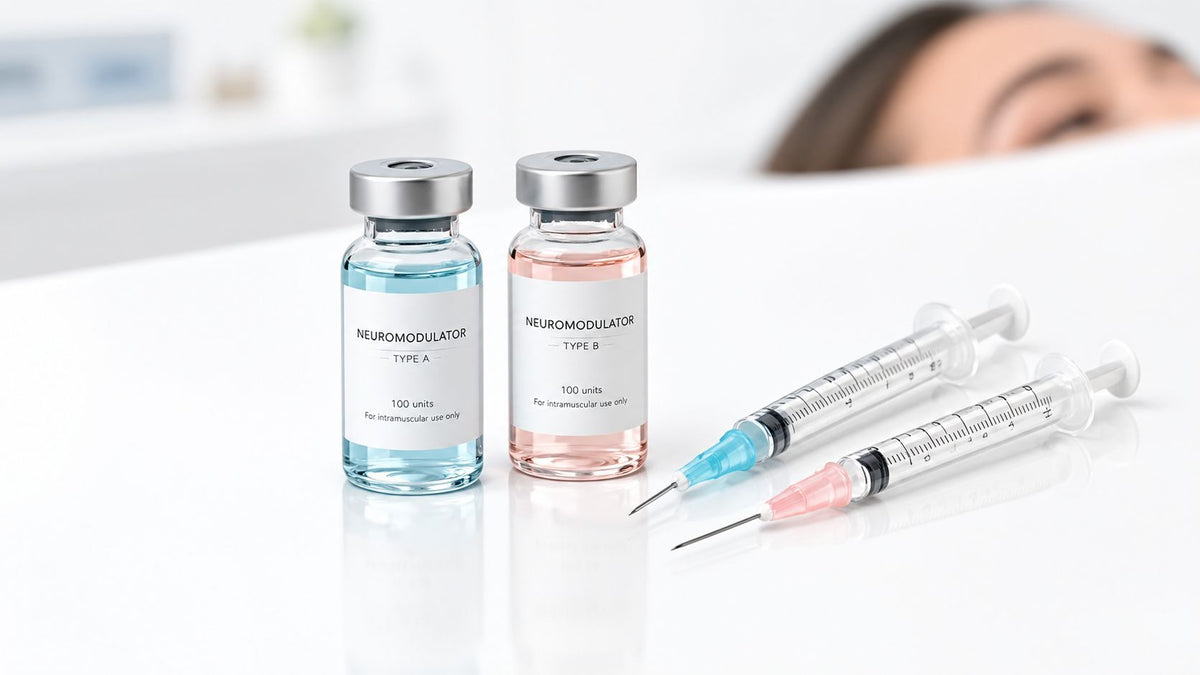
Botox contains onabotulinumtoxinA. Dysport contains abobotulinumtoxinA. They belong to the same botulinum toxin type A family, but they aren't identical commercial formulations. Dysport includes accessory proteins, while modern Botox formulations have had complexing proteins removed. The clinically important point is that each product has its own potency assay and dosing language.
The approval timeline needs clarification
Many online comparisons use a cosmetic approval timeline that oversimplifies the history. The FDA first approved Botox on December 9, 1991, while Dysport received U.S. approval on April 29, 2009, an 18-year gap documented in the FDA product history. Botox later received cosmetic approval for glabellar lines in 2002, while Dysport entered the U.S. cosmetic market in 2009.
Dysport's history extends beyond facial aesthetics. The FDA later approved it for upper-limb spasticity in July 2015, lower-limb spasticity in June 2017, and pediatric upper-limb spasticity in September 2019. In Europe, Dysport had approval for specific dystonias in December 1990 and has marketing authorizations across 75 countries, illustrating its established therapeutic and international presence.
Why the molecule matters at the injection site
The labelling difference becomes practical when fluid meets muscle. Spread depends on product behavior, dilution, injection depth, volume, dose, tissue planes, and anatomy. A formulation that covers a broader field can be useful across a wide muscle, but the same behavior requires caution beside a brow, eyelid, or other structure where a small amount of unintended weakening can change expression.
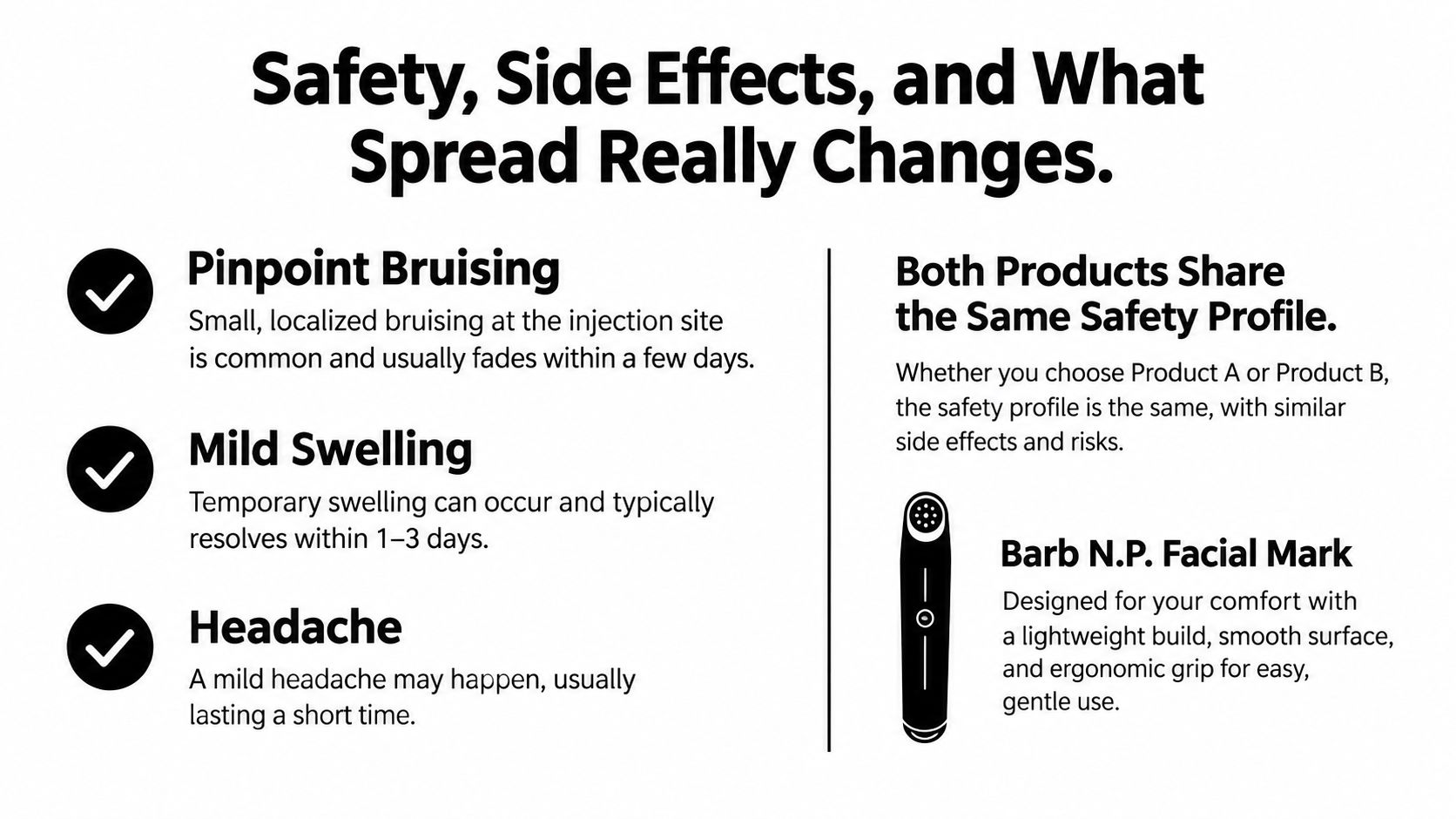
Both products can cause familiar short-term effects such as pinpoint bruising, mild swelling, or headache. The safety infographic summarizes those issues and includes the Barb N.P. Facial Mark's comfort-focused device features, including wireless use and treatment lighting options.
Side by Side on Onset, Duration, Spread, and Dosing
A patient booked for an event may care most about onset. Someone maintaining treatment year-round may care more about duration, spread, and the amount used at each visit. I assess all four because a faster early change does not necessarily mean a better final result.
| Metric | Botox (onabotulinumtoxinA) | Dysport (abobotulinumtoxinA) |
|---|---|---|
| Early onset | Usually begins working within a few days | May begin earlier for some patients, with median onset of 2 to 3 days in clinical studies |
| Peak effect | Commonly assessed as the result develops over approximately 7 to 14 days | Also assessed after the result develops, with early change often noticed sooner |
| Typical duration | About 3 to 4 months at an equally potent dosage | About 3 to 4 months at an equally potent dosage |
| Diffusion behavior | More localized spread can support precision | Broader diffusion can support coverage across wider muscles |
| Unit relationship | One Botox unit is generally comparable to about 3 Dysport units | Commonly requires a higher numerical unit count, not a stronger product |
Cleveland Clinic describes the practical relationship as approximately one Botox unit to three Dysport units, while clinical literature commonly discusses conversion conventions around two to three Dysport units for one Botox unit. Those figures help with planning, but they are not a universal conversion formula. For a detailed explanation, see this guide to Dysport vs Botox units and why the numbers are not interchangeable. The FDA Dysport prescribing information states that Dysport units are assay-specific and can't be converted into units of another botulinum toxin product.
What the timing feels like
The Dysport professional information reports that some users saw results within 24 hours, with more than half improving in as little as 2 to 3 days. Clinical studies reported a median onset of 2 to 3 days. That earlier change can be useful before an event, but patients still need to wait for the treated muscles to reach their settled result.
Both products continue developing over several days. A split-face comparative study reported better improvement by day 2 with abobotulinumtoxinA. A phase IV upper-limb spasticity study found a mean response duration of 14.2 weeks for Dysport versus 13.8 weeks for Botox, with non-inferior safety and similar adverse-event rates (comparative clinical study). Those findings do not guarantee the same duration in a cosmetic patient, where dose, muscle strength, metabolism, and treatment area affect the result.
What spread changes
Dysport can produce a wider field of diffusion at some dose ratios. One report found similar fields of effect at a 2.0 to 1.0 Dysport-to-Botox ratio, but significantly larger anhidrotic fields for Dysport at a 2.5 to 1.0 ratio (JAMA Dermatology report). That broader field may suit a wide, active muscle. Around the eyelid, brow, or lip, tighter placement may offer more control.
The unit number measures the product's dosing system, not its strength. A plan using more Dysport units can be pharmacologically appropriate without being more aggressive than a Botox plan. The injector's dilution, placement, depth, and knowledge of the patient's anatomy often influence the outcome as much as the brand.
Which Product Fits Which Treatment Area
The treatment zone often tells me more than the brand preference. Dysport's broader diffusion can be useful when a patient has a wide, forceful muscle pattern and wants an even softening across a larger field. Botox's more localized behavior can be useful when the treatment requires a narrow margin of error.
| Treatment Zone | Preferred Product | Reason |
|---|---|---|
| Broad forehead bands | Dysport may suit some patients | Wider coverage can soften a broad frontalis pattern |
| Full glabellar complex | Dysport may be useful | Diffusion can cover repetitive movement across the complex |
| Crow's feet asymmetry | Botox often offers practical control | Tighter placement can help manage delicate, uneven periorbital movement |
| Pebbly chin | Botox may be preferable | Precise treatment helps target small mentalis movements |
| Bunny lines | Botox may be preferable | Narrow placement reduces unintended spread along the nasal sidewall |
| Lip flip | Botox may offer finer control | Small changes around the lip demand careful dosing and placement |
| Lateral brow lift | Botox may be preferable | Excessive spread can contribute to brow heaviness or unwanted weakening |
Match the product to the muscle
A thicker frontalis in a larger forehead may respond well to a broader plan, especially when the goal is to reduce a continuous band of movement rather than chase isolated lines. The injector still needs to respect the patient's baseline brow support. Treating forehead movement without accounting for the brow depressors can make the face look heavier.
Fine periorbital skin and shallow muscles need a different level of restraint. With crow's feet, a small asymmetry can become more visible if the product affects one side differently from the other. Precision matters more than covering a large field.
Consider two common consults. A first-time patient worried about a heavy brow may benefit from conservative placement, careful observation of frontalis compensation, and a preference for control. A repeat patient who wants visible softening before an event may value Dysport's potential for earlier onset, provided there is enough time for a proper assessment and the product is appropriate for the anatomy.
Bigger area, more movement, and a preference for earlier visible change can favor Dysport. Small area, delicate anatomy, and a lift-required goal can favor Botox.
That rule helps narrow the conversation, but it isn't a prescription. The same product can perform differently in two faces because muscle strength, tissue thickness, prior treatment, and injection technique vary.
Safety, Side Effects, and What Spread Really Changes
Botox and Dysport share the core safety considerations of botulinum toxin type A. The common short-term effects patients may notice include pinpoint bruising, temporary redness, headache, and mild swelling around injection sites. These effects are usually limited and temporary, but a patient should still understand what is expected before treatment.
The clinically meaningful difference is often distribution. Dysport's broader diffusion can be helpful in a wide muscle, but unintended movement beyond the target can contribute to brow heaviness or eyelid ptosis when placement, dose, depth, or anatomy isn't handled carefully. Botox's tighter spread can protect a delicate zone, yet an under-dosed broad muscle may look uneven or patchy.
Symptoms that deserve a call
Contact the treating clinic if you notice:
- Unexpected eyelid or brow drooping: Report new asymmetry, especially if it progresses.
- Marked swallowing or speech difficulty: Seek prompt medical guidance rather than waiting for a routine review.
- Breathing difficulty or generalized weakness: Treat this as urgent and seek immediate medical care.
- Persistent or worsening pain, redness, or swelling: Ask whether the reaction fits the expected post-treatment course.
- Vision changes or severe headache: Contact the practice promptly and describe when the symptoms began.
The products carry a boxed warning about distant toxin spread. Cosmetic treatments use localized dosing, but a qualified clinician should still review medical history, medications, previous toxin reactions, neuromuscular conditions, pregnancy or breastfeeding considerations, and the treatment area's skin condition.
Technique outweighs branding
Injector skill, anatomical mapping, dilution, injection depth, dose selection, and aftercare instructions influence safety more than a consumer's loyalty to one label. A careful provider watches how the patient recruits the forehead and glabella at rest and in motion instead of treating a static line in isolation.
The side-effects guide for Dysport injections can help patients prepare questions, but online education doesn't replace an individualized assessment.
Cost Per Day of Result and Smart Add-Ons
A unit price can mislead repeat patients. Dysport usually uses a higher numerical unit count because its units aren't equivalent to Botox units, so comparing the printed number on each invoice doesn't tell you which treatment offers better value.
A more useful calculation is:
session price divided by days of visible result equals cost per day of result.
The following example uses the supplied treatment assumptions, not a universal clinic price or guaranteed duration:
| Metric | Dysport | Botox |
|---|---|---|
| Example session price | $550 | $600 |
| Example duration | 120 days | 105 days |
| Cost per day | $4.58 | $5.71 |
| Difference in this example | Lower daily cost | Higher daily cost |
In that example, the Dysport session costs $4.58 per day of result, while the Botox session costs $5.71 per day. The annualized comparison represents a 25 percent difference under those same assumptions, with Dysport providing the lower daily cost. It doesn't prove that Dysport will last longer for every patient, and it shouldn't be used to predict a personal annual bill.
Build the calculation around your own history
Track the date of treatment, the zones treated, the product, the labeled dose, the date movement returns, and the session fee. After several visits, you and your injector can compare your actual maintenance pattern rather than relying on a generic promise.
A longer-lasting result may reduce re-treatment burden, but duration varies by indication, muscle activity, dose, metabolism, and individual response. A study in adult upper-limb spasticity found a modestly longer mean response with Dysport, but medical treatment data shouldn't be treated as a guaranteed cosmetic forecast.
Protect the skin between appointments
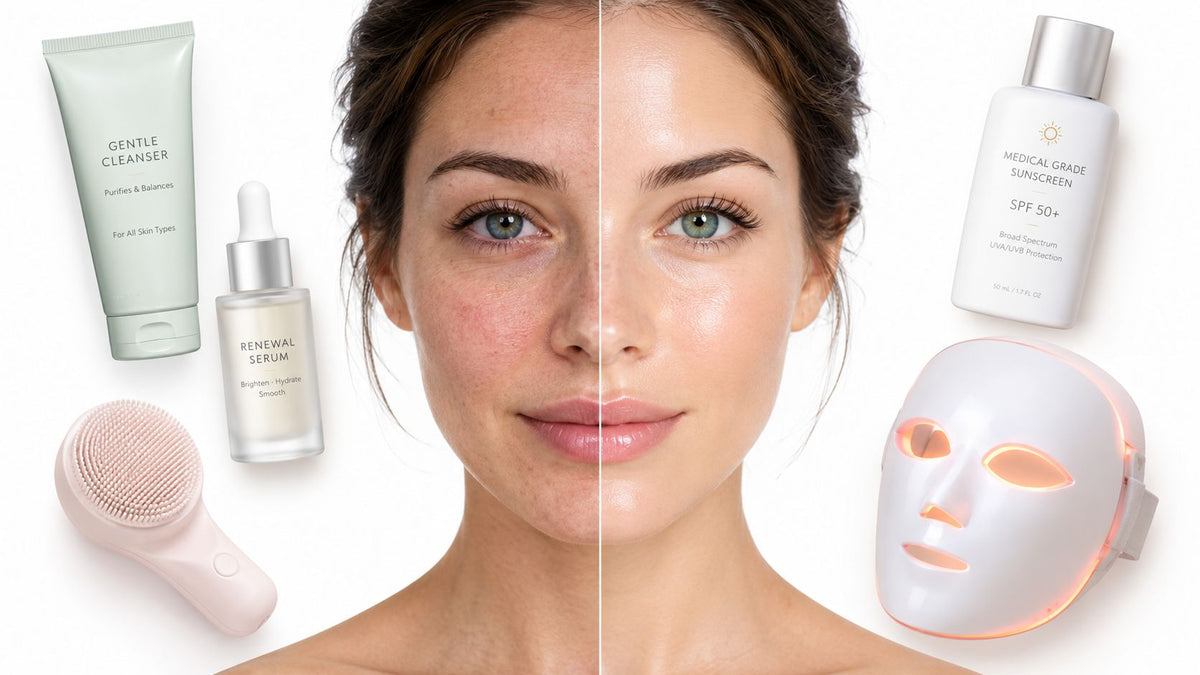
Consistent sunscreen and a simple, tolerable skincare routine help protect the appearance you're investing in. Patients may also discuss supportive options such as an LED Facial Mask for between-session skin care. The Barb N.P. Facial Mark is a wireless device designed for comfort on the face and offers three lighting settings for different treatments, making it a practical at-home add-on for patients who prefer hands-free sessions.
LED therapy isn't a replacement for toxin, sunscreen, or medical treatment, and it shouldn't be applied over compromised skin without appropriate guidance. Package pricing and loyalty programs at reputable clinics can also change the long-term calculation, so ask for the full maintenance cost rather than only the per-unit rate.
Choosing Between Them and Booking at BotoxBarb
A useful decision framework starts with the goal, then checks the anatomy.
- You need earlier visible softening: Discuss Dysport, while allowing time for assessment and the full result to develop.
- You want broad forehead coverage: Ask whether Dysport's diffusion fits the frontalis pattern and brow support.
- You need precision around crow's feet, the chin, nose, or lip: Botox may offer the control your zone requires.
- You're concerned about a heavy brow: Prioritize conservative mapping and muscle balance over a faster onset.
- You've had previous treatment: Bring the product, dose, dates, duration, and any side effects to the consultation.
- You're comparing prices: Request the product-specific dose, total session fee, expected maintenance interval, and aftercare plan.
What the appointment should include
A responsible consultation isn't a quick choice between two brand names. At BotoxBarb, the process can include a medical history review, facial mapping at rest and during expression, a discussion of product-specific dosing, and an aftercare plan. Follow-up timing should also be clear, especially if the clinician wants to assess symmetry or decide whether a refinement is appropriate.
I recommend arriving with three questions:
- Which muscle pattern are we treating?
- Why does this product fit that zone and goal?
- How will we evaluate the result and plan maintenance?
Product choice should be finalized after assessment, not before. If you're contacting the practice, a direct message can say: “I'd like a consultation for dynamic lines in my forehead and glabella. Please assess whether Botox or Dysport better fits my anatomy, timing, and maintenance goals, and explain the product-specific dose and total cost.”
BotoxBarb offers consultations and in-clinic Botox and Dysport treatments, with facial mapping, product-specific dosing discussions, and aftercare planning suited to your treatment goals. Visit BotoxBarb to request an appointment and discuss which option fits your facial zones, timing, and long-term maintenance plan.