Skin Care Fridge: A Guide to Chilling Your Actives
You bought a vitamin C serum that wasn't cheap. Maybe you also have growth factors, eye patches, a peptide cream, and a post-procedure gel you don't want to ruin by storing it badly. Then you see the mini beauty fridges all over social media and wonder whether a skin care fridge is useful or just another pretty appliance.
That question matters more than people think. Storage changes texture, comfort, and sometimes stability. But a cold product isn't automatically a better product, and a cute fridge isn't the same thing as a reliable one. In practice, the right answer depends on the formula, the ingredient, and whether the unit holds a consistent temperature instead of swinging up and down all day.
The Rise of the Skin Care Fridge
A lot of patients ask this after they start investing in medical-grade skin care. They've moved past cleanser and moisturizer. Now they're using active serums, eye products, masks, and post-treatment care, and they want to know how to protect that investment.
That interest isn't imagined. The global beauty fridge market was valued at USD 146.67 million in 2022 and is projected to grow at an 8.4% CAGR from 2023 to 2030, according to Grand View Research's beauty fridge market report. That tells you this category has moved beyond novelty and into a real consumer segment.
Why the trend took off
Part of the appeal is sensory. Chilled eye patches feel good. A cold gel mask can calm skin after travel, heat exposure, or an in-office treatment. A dedicated fridge also keeps products out of a warm bathroom cabinet, which is often a poor place to store active formulas.
The other part is psychological. When people spend more on skin care, they become more intentional about storage, expiration, and routine design. A skin care fridge fits neatly into that mindset.
A skin care fridge makes the most sense when it solves a storage problem, not when it only solves a decor problem.
What the hype often misses
The problem with influencer-style advice is that it treats refrigeration like a universal upgrade. It isn't. Some products benefit from cool storage. Some only feel nicer when chilled. Some do better at stable room temperature.
That's the distinction I want patients to understand. You don't need a fridge because a routine looks more luxurious inside one. You need one only if it gives a real advantage for the formulas you use.
What Exactly Is a Skin Care Fridge
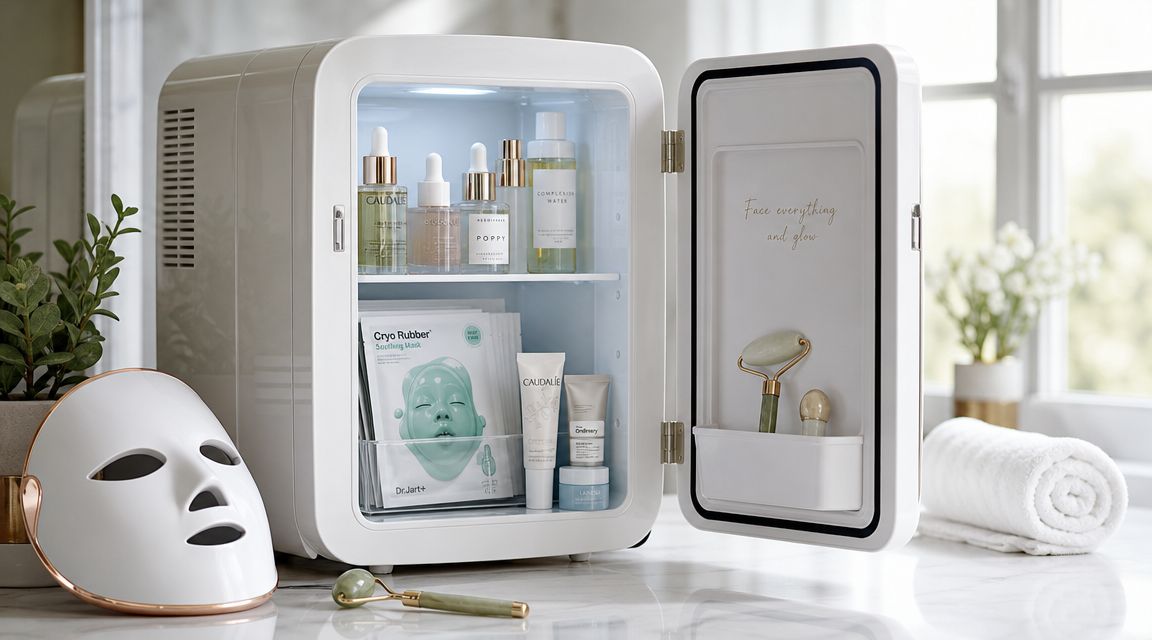
A skin care fridge is a small refrigerator designed to keep cosmetics and skin care products cool without pushing them into the harsh cold of a standard kitchen fridge. That difference matters.
Kitchen refrigerators are built for food safety. Skin care fridges are useful only when they stay in a gentler range that cools products without freezing water-based formulas or stressing emulsions.
The temperature that matters
Product-grade beauty fridges target a stable range of 42–65°F (5.5–18°C), which Summit identifies as appropriate for many beauty products and organic creams in its BeautiFridge product information. That range helps slow temperature-driven degradation while avoiding the bigger risk of overchilling.

Think of it this way. A kitchen fridge is a winter coat. A skin care fridge should behave more like a light jacket. Cool enough to protect. Not so cold that it changes the product in ways the formulator didn't intend.
Thermoelectric versus compressor
Not all units cool the same way. Buyers often get distracted by mirrors, lights, and color options here, ignoring the feature that matters most.
- Thermoelectric units are common in compact beauty fridges. They're often lightweight and convenient for a vanity setup, but cooling can be more dependent on the surrounding room temperature.
- Compressor-based units are closer to traditional refrigeration technology. When temperature reliability matters, especially for high-value inventory, this design is often the better benchmark.
- Setpoint stability is more important than how cold the unit feels when you open the door. Skin care does better with steady storage than with repeated swings.
Practical rule: Don't judge a skin care fridge by the chill on the shelf wall. Judge it by whether your products stay consistently cool over time.
A dedicated cosmetic space
A skin care fridge also separates your products from food odors, kitchen traffic, and constant door opening. That won't magically improve every serum, but it does create a cleaner, more controlled storage environment.
For patients using premium topicals, that distinction is often a core advantage.
The Science of Chilling Your Skincare
Cold storage can help. It can also be unnecessary. Both statements are true.
The main scientific idea is simple. Heat speeds up change. When a formula sits in a warm environment, ingredients can degrade faster, textures can shift, and emulsions can become less elegant over time. Cooling slows some of that movement. But colder isn't always better, and not every formula becomes more stable in the fridge.
What cold actually does
Refrigeration mainly affects skin care in two ways.
First, it can support storage stability for selected products by reducing temperature stress. Second, it can improve the experience on application, especially for puffiness-prone or reactive skin.
Cooling is selective, not universal. Expert commentary summarized by Editorialist's discussion of mini fridges for skincare notes that chilled storage is most useful for products like gel masks and eye patches, while the need for many serums and creams is much more debatable.
Where patients notice a real difference
The easiest win is with products used for comfort rather than deep formula preservation.
- Eye patches and eye gels often feel better cold because the temperature itself helps reduce morning puffiness.
- Gel masks and calming masks can be soothing after sun exposure, travel, or treatments.
- Facial mists can feel refreshing, especially in hot climates.
- Cold tools like rollers or gua sha stones may add comfort during massage.
That's different from saying cold makes every active ingredient stronger. It doesn't.
Stability is about consistency, not extremes
Many people make the same mistake. They assume that if cool is good, very cold must be better. That's where problems start. Repeated warming and cooling can stress formulas. So can storing products in a unit that runs unevenly.
For active categories that already need thoughtful use, irritation control still matters more than gadgets. If you're building a routine around retinoids, it's worth understanding retinol serum side effects before assuming refrigeration will solve tolerance issues. A cold bottle doesn't change the biology of how a retinoid behaves on the skin.
A chilled product can feel anti-inflammatory even when the formula itself hasn't become more potent.
What cold won't fix
A fridge won't rescue an oxidized serum, reverse contamination, or extend the life of a product that's already breaking down from age and repeated exposure to air. It also won't make an incompatible formula suddenly suitable for sensitive skin.
That's why I advise patients to think of a skin care fridge as a targeted storage tool. Not a universal upgrade. Not a treatment in itself.
Your Guide to Refrigerated Skincare Products
The right question isn't “Should I buy a skin care fridge?” It's “Which products in my routine benefit from one?”
That answer depends more on formula type than price point. Some products gain sensory value. Some may benefit from cooler storage. Others become harder to use or less stable when chilled.

Skincare Refrigeration Cheat Sheet
| Product/Ingredient | Refrigerate? | Reason |
|---|---|---|
| Vitamin C serums | Sometimes | Cooler storage may help protect sensitive antioxidant formulas, especially if the product is heat-exposed in your home |
| Eye creams and eye gels | Yes, often | Mainly for comfort and depuffing on application |
| Sheet masks | Yes, often | Cold application feels soothing and calming |
| Gel masks | Yes, often | Useful for redness-prone or post-procedure comfort |
| Facial mists and toners | Sometimes | Chilling adds a refreshing effect, especially in warm climates |
| Water-based calming serums | Sometimes | Can feel soothing, but benefit depends on formula |
| Facial oils | Usually no | Cold can thicken or cloud the oil and change texture |
| Balms and wax-heavy products | Usually no | They may become too firm to spread evenly |
| Clay masks | Usually no | Cold can make them less workable and less pleasant to apply |
| Thick emulsions | Depends | Some tolerate cooling well, others may separate if stressed by temperature shifts |
| Suspension formulas | Usually no | Texture and dispersion can become less uniform |
| Sunscreen | Usually room temp | Best stored according to label directions and away from avoidable temperature swings |
What usually belongs in the fridge
For most patients, I'd reserve chilled storage for the small group of products you reach for when you want a calming effect.
If you use vitamin C and want help deciding where it belongs in your routine before deciding where it belongs on a shelf, read this guide on how to use vitamin C serum. Good application habits matter just as much as storage.
Some people also like to explore adjacent topical categories when they're building a soothing routine. If that's relevant to you, you can explore CBD skin health solutions for ingredient context and formulation ideas.
What I'd keep out
I'm more cautious with oils, balms, clay products, and anything with a texture that already tends to be thick or temperamental. These formulas often become annoying to use when cold, and in some cases the texture shift is the first sign that refrigeration wasn't helping.
The simplest approach is this:
- Chill for feel when the product is gel-based, calming, or de-puffing.
- Chill for protection only when the formula is temperature-sensitive and the unit is reliable.
- Skip the fridge when cold changes texture more than it protects stability.
How to Choose the Right Skin Care Fridge
Most buyers focus on the door design and overlook the feature that matters most. Temperature reliability beats aesthetics every time.
That doesn't mean appearance is irrelevant. If the unit lives on your vanity, you should like how it looks. But a stylish shell won't help if the interior runs too cold, warms up constantly, or becomes crowded enough that air stops circulating.

Start with your actual routine
A lot of people only need enough space for a few essentials. That lines up with market behavior. The up-to-4-liter capacity segment held 43.6% of market share in 2022, indicating strong demand for small countertop units, as noted in the earlier market data section.
If your goal is to chill eye masks, one serum, a mist, and a calming gel, a compact unit is often enough. If you're trying to refrigerate half your regimen, that usually signals a storage strategy problem, not a capacity problem.
The buying checklist I use
- Stable cooling: Look for a unit designed to hold a consistent cosmetic-safe range, not one that only advertises that it gets cold.
- Enough but not excessive space: Choose capacity based on your real lineup. Empty space helps airflow. Overpacking works against you.
- Shelf flexibility: Removable or adjustable shelves matter more than mirrored doors or decorative lighting.
- Noise level: If the fridge will live in a bedroom, low operational noise matters.
- Placement needs: A vanity, bedroom, and bathroom all have different heat and humidity patterns.
- Cleaning access: Smooth interiors and removable shelving make hygiene easier.
Barb N.P. advice: choose the unit that stores your products at a steady cool temperature and fits your routine cleanly. Skip features that look fun but don't improve stability, airflow, or sanitation.
A few features that are worth paying attention to
Door style, handle placement, interior shelf design, and whether the unit is easy to wipe down all matter in daily use. The best fridge for a patient is often the one that encourages consistent habits instead of becoming an overstuffed display case.
I'd also rather see someone buy a plain unit with better organization than a trendy one that turns every morning into a scavenger hunt.
Professional Use Maintenance and Hygiene
A skin care fridge only helps if the inside stays clean. This gets overlooked constantly.
Products go in with fingerprints on the bottle, residue around the cap, and moisture on the outside after use. If you never wipe the shelves or let condensation sit, you create a messy storage environment for products that go directly onto the face.
The cleaning routine I recommend

Keep it simple and repeatable.
- Empty the fridge completely. Check for leaks, sticky bottle rims, and products you no longer use.
- Wipe shelves and walls. Dry surfaces fully before replacing anything.
- Clean product exteriors. Bottles and jars collect residue. Don't put that residue back into a clean compartment.
- Leave airflow room. Don't press products tightly against each other.
- Check for texture changes. If a cream looks grainy or separated, storage may not be helping it.
Storage habits that make a difference
- Keep only current-use products inside: The fridge isn't long-term archives for every backup bottle.
- Use upright storage when possible: Serums and pumps are less messy when stored vertically.
- Avoid frequent door opening: If you stand there deciding what to use, the unit loses its advantage.
- Don't store compromised packaging: A cracked jar lid or leaking pump belongs in the trash, not in a colder environment.
Using chilled tools with treatment recovery
This is one place where a skin care fridge can pair well with a device. The BotoxBarb LED Facial Mask is a wireless mask with a comfortable face fit and three lighting settings for different treatments. If you chill the mask briefly before use, the cooling sensation can make post-treatment sessions feel more soothing, especially when skin is warm or mildly reactive.
That benefit comes from comfort and routine design, not from making the LED stronger. Cold can calm. Light can support a treatment plan. They do different jobs.
Clean every device before it goes back into the fridge. A chilled tool should never become a storage site for residue, makeup, or skin oils.
Frequently Asked Questions
Can I store prescription topicals in a skin care fridge
Only if the product label, pharmacist, or prescriber says that's appropriate. Prescription topicals and procedure-related products may have specific storage instructions. Follow those directions over any general beauty advice.
If the instructions say room temperature, keep it there. Medical products aren't the place to improvise.
Can I use a skin care fridge for travel
Portable units can be useful on the road, but practicality matters. You need reliable power access, safe placement, and realistic expectations about temperature control during transit.
For air travel, I'd focus less on bringing the appliance and more on packing only the formulas you need. A simplified routine travels better than a full refrigerated setup.
Does opening the fridge a lot reduce its usefulness
Yes. Many compact units cool relative to the room around them. Some can cool to roughly 40°F to 50°F below ambient room temperature, but overpacking and poor airflow reduce performance, as described in this compact skincare mini refrigerator product listing.
That matters in daily use. If the fridge is packed tightly or opened repeatedly, internal temperatures become less consistent.
Can a skin care fridge warm products too
Some consumer units offer warming modes, but that doesn't mean every formula should be heated. In general, I'm more comfortable recommending cooling for selected products than warming as a routine habit.
What should I organize first if I'm not sure what belongs inside
Start with the products you want for comfort: eye gels, sheet masks, calming gels, and one or two sensitive formulas if the label supports cooler storage. Keep the rest in a cool, dark cabinet and make sure your layering routine is sound. If you need help with that part, this guide on how to layer serums is a better place to start than buying more tools.
Is a skin care fridge necessary
For many individuals, no. For certain routines, yes.
If you use only a few stable basics, a cool cabinet away from heat and steam is often enough. If you use premium actives, soothing gels, eye products, or post-treatment skin care and want a dedicated, controlled space, a skin care fridge can be worthwhile. The key is using it selectively.
If you want to build a smarter routine around medical-grade skin care, treatment recovery, and practical tools that support real results, browse the curated options at BotoxBarb. The goal isn't to buy more. It's to store, use, and combine products in a way that makes sense for your skin.