Article: What Happens When Botox Wears Off: Timeline and Next Steps

What Happens When Botox Wears Off: Timeline and Next Steps
You catch your reflection while raising your eyebrows and notice a crease that wasn't there a little while ago. Your Botox looked smooth, so why is your forehead moving again? And does that mean you need another appointment right away?
Usually, that change is your treatment fading. Understanding what happens when Botox wears off means watching the pattern of returning movement, not judging your face by a single crease. The important distinction is between a gradual return of familiar expressions and an unexpected symptom that needs medical attention.
Botox Wear-Off Timeline Week by Week
If you notice movement returning before your lines look the way they did before treatment, that can be part of the normal fade. Botox generally begins to take effect within 1–2 days, strengthens during the first week, and reaches its strongest effect around 1–2 weeks. The FDA's Botox Cosmetic prescribing information describes cosmetic improvement lasting approximately 3–4 months. In glabellar-line studies, wrinkle severity remained reduced for as long as 120 days compared with placebo.
These are treatment benchmarks, not a countdown for every face. One person may notice a little brow movement while frown lines remain softened. Another may still see smoothing after expressions have started to return. The change is usually gradual, like a dimmer being turned up, rather than an overnight switch back to baseline.
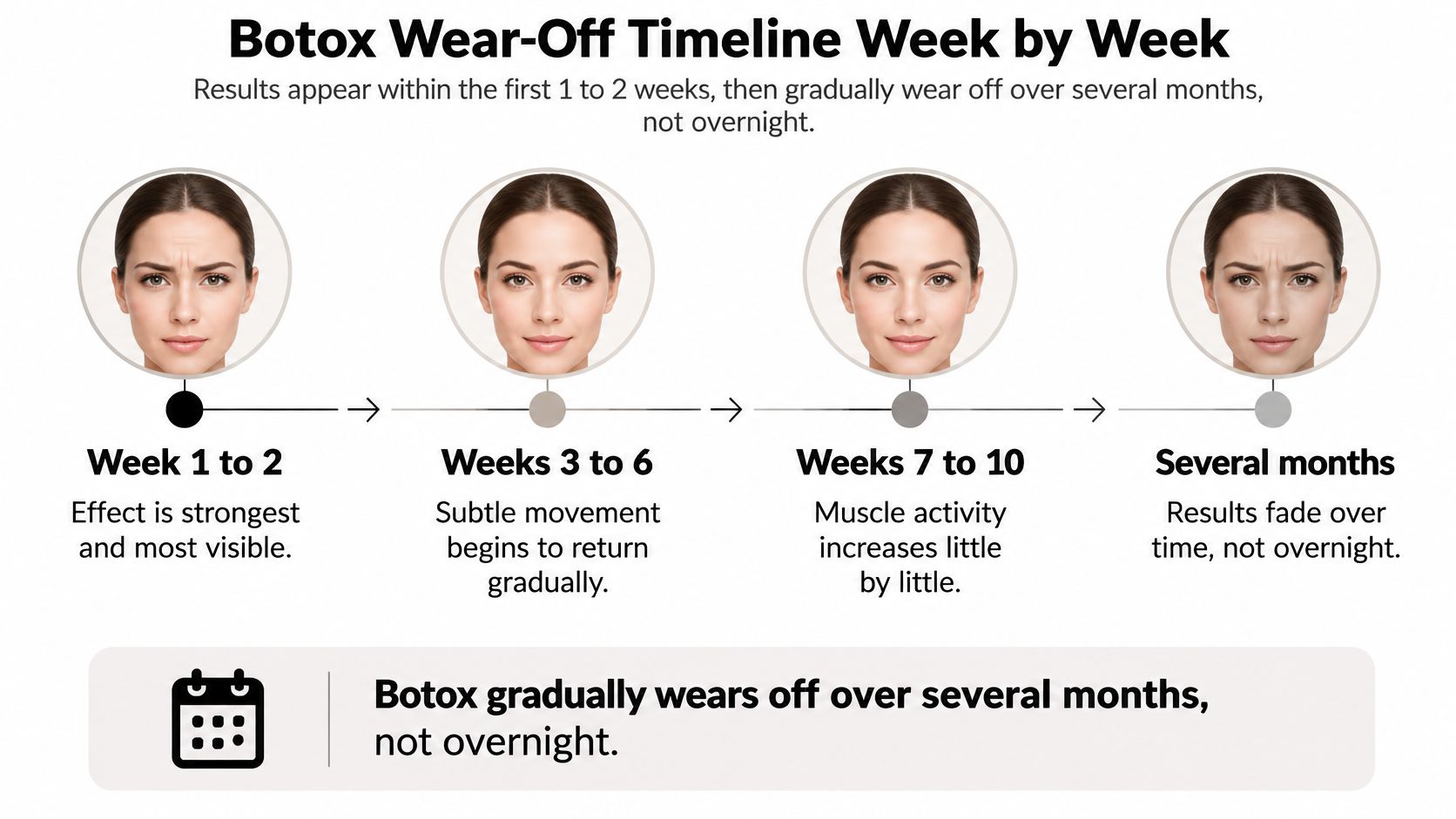
Botox Wear-Off Timeline by Phase
Use the phases as a general guide. The middle windows describe a possible progression, not fixed deadlines for every treated muscle.
| Timing | Muscle Activity | What You Notice |
|---|---|---|
| Days 1–3 | The effect begins, and muscle contraction starts to soften | Little visible change yet |
| Days 3–14 | The effect strengthens, reaching its peak around 1–2 weeks | Lines look smoothest |
| Weeks 4–8 | Nerve-muscle signaling may gradually recover | Subtle movement; you may still look treated |
| Weeks 8–12 | Muscle contraction increases as signaling returns | Expression lines may reappear, often in more active areas |
| Months 3–4 | Many treated muscles approach their pre-treatment activity | Lines move toward their untreated appearance |
| Month 4 onward | Recovery may take longer in some areas | Movement can return at different rates; ask your provider if unsure |
Read the Pattern, Not Just the Date
Early on, look for the treatment effect to develop. Later, consider whether returning movement is changing the result you wanted. A forehead crease that appears only when you deliberately lift your brows does not necessarily mean the whole treatment has ended. You may still have smoothing at rest and in other treated areas.
Practical rule: Use the timeline to identify your general phase, then compare your movement with your treatment goals.
The later phases do not mean you need to rebook immediately. Dose, treatment area, muscle strength, metabolism, and individual response can all affect how long results last. For BotoxBarb clients, maintenance planning can follow the return of meaningful movement, rather than a sudden switch from treated to untreated.
Why Botox Fades Gradually Instead of Overnight
Botox works more like a dimmer turned down than a light bulb that suddenly burns out. As its temporary effect resolves, the treated muscle progressively receives more of the signal that tells it to contract.
The FDA's Botox prescribing information describes an initial effect generally appearing within 3 days and reaching its strongest point at approximately 1–2 weeks. Its description of the nerve-muscle mechanism explains why both the development and fading of the result take time.
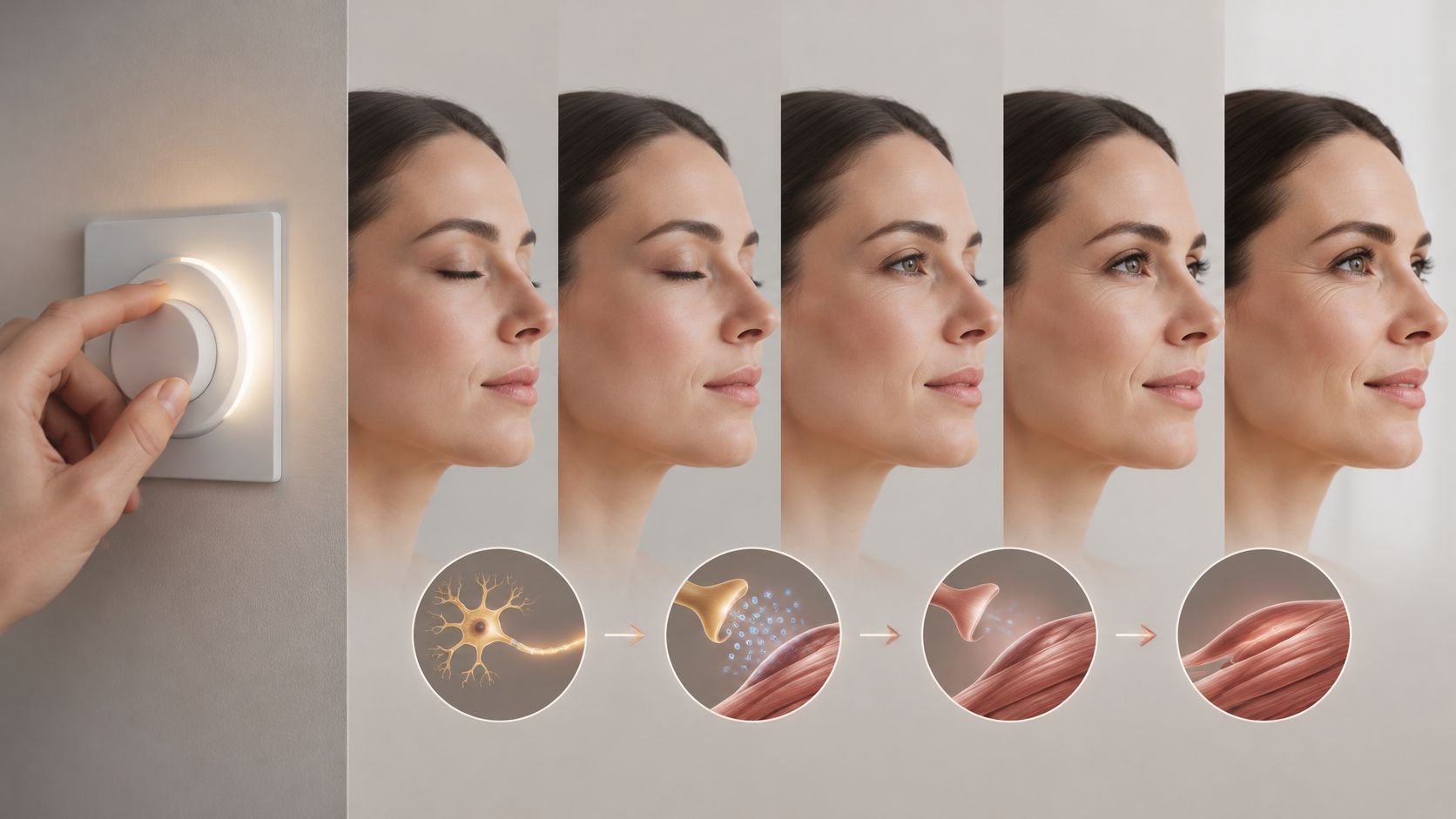
The Nerve-to-Muscle Sequence
- The toxin binds to motor nerve endings. These are the nerve terminals that communicate with the targeted muscle.
- It interrupts release of the contraction message. Botox cleaves SNAP-25, a protein needed for neurotransmitter-containing vesicles to dock and release their contents. This prevents release of acetylcholine, the messenger that tells the muscle to contract.
- Signaling eventually resumes. As the temporary block resolves, the muscle can contract again, and the skin above it can fold during expression.
That explanation matters because Botox doesn't work by filling a crease or holding the skin in place. Its cosmetic effect comes from reducing the muscle activity underneath an expression line.
A Returning Crease Isn't Evidence of Damage
Say a woman notices her forehead creasing when she raises her brows around week twelve. If she initially had a satisfactory result and the movement has returned gradually, that crease fits the expected recovery of muscle activity.
It doesn't mean her forehead has become dependent on injections. Nor does ordinary wearing-off mean that the injection has created extra wrinkles or permanently removed collagen.
The direction is toward the untreated baseline, not a pharmacologic rebound. Seeing familiar lines again can feel dramatic after becoming used to smoother skin, but the visual contrast isn't proof that treatment made the face worse.
A sudden change, new drooping, or an unexpectedly uneven expression deserves a different response. Those findings shouldn't be dismissed as the dimmer turning back up.
Which Lines Return First and Why
A forehead crease may reappear before crow's feet, or the reverse. The order depends on which treated muscles are recovering and how often you use them. There is no universal sequence, so compare each area with its own starting point rather than expecting every line to return together.
Typical Return Window by Facial Area
| Treated Area | Typical Return Window | Why It Shows First |
|---|---|---|
| Glabella, or frown lines | About 3–4 months, the FDA benchmark | Repeated frowning makes returning contraction noticeable |
| Forehead lines | Varies from person to person; the 3–4 month benchmark applies to frown lines | Brow lifting folds the forehead |
| Crow's feet | Varies from person to person; the 3–4 month benchmark applies to frown lines | Smiling and squinting activate the surrounding muscle |
| Bunny lines | Varies from person to person; the 3–4 month benchmark applies to frown lines | Nose scrunching reveals returning movement |
| Lower face and neck | Individual assessment based on dose and treated muscle activity | Speaking, mouth movement, and neck contraction can reveal changes |
In a controlled study described in the FDA's Botox labeling, most subjects had returned to pre-treatment status by approximately 3 months. That is a study finding, not an area-by-area schedule or a promise that everyone will notice changes at the same time.
Pre-treatment status means movement and appearance returning toward your own baseline. As the effect fades, familiar expression lines can become visible again; they are not evidence of a rebound beyond where you started.
Compare Like With Like
Photos can make gradual changes easier to judge than repeated mirror checks under different lighting. On treatment day, photograph your face at rest, then while frowning, smiling, and raising your brows. Repeat the same views monthly, keeping the lighting, camera distance, and head position consistent.
Match the expression, too. A full frown compared with a relaxed brow can make a small change look larger than it is.
- Compare movement with movement. Look at smiling photos together, rather than comparing a smile with a resting face.
- Check both sides. Notice whether movement is returning in a familiar pattern or whether the expression looks newly uneven.
- Separate resting lines from expression lines. A crease visible when your face is relaxed differs from one that appears only during a strong expression.
If you are considering a topical accessory for the frown area, you can explore Cleverfy Beauty's stress-line patches. Keep that separate from assessing injectable wear-off: a patch does not show whether muscle movement is returning or replace a clinical review.
Familiar movement returning gradually can be a reason to plan a consultation if you want another treatment. Sudden change or new unevenness calls for a conversation with your provider, rather than assuming it is routine fading.
Factors That Shorten or Stretch Your Results
The usual duration is a benchmark, not a promise. A British Dental Journal literature review found reported effects ranging from two to more than six months, with many studies clustering around three to four months and using inconsistent endpoints.
That last detail explains some apparently conflicting advice. A study measuring the first return of movement isn't measuring the same thing as one measuring complete return of wrinkle severity.
| Factor | How It Can Affect Apparent Duration |
|---|---|
| Treated area | Different muscles perform different jobs and show returning movement differently |
| Dose and placement | The treatment plan influences the degree and distribution of muscle relaxation |
| Physical activity | Higher activity has been associated with faster fading in a controlled trial, but doesn't predict everyone's outcome |
| Repeated treatments | Reduced muscle activity or localized muscle atrophy may alter subsequent duration |
| Metabolism and individual response | People don't recover nerve-muscle activity at an identical rate |
| Definition of wear-off | First movement, visible lines, and full return to baseline are different endpoints |
A 2023 controlled trial published in Toxins, involving 60 participants, found faster fading over three months among highly physically active participants than sedentary participants, as summarized by Health. That finding supports discussing intensive training with your injector, not assuming that exercise will erase your results.
Repeated treatment needs similar nuance. An NCBI clinical reference notes that injections may cause localized muscular atrophy that could extend results, and summarizes a retrospective study of 945 patients receiving at least three consecutive treatments that found no loss of effect. Neither finding guarantees that each appointment will last longer than the last.
Normal Fading or an Incomplete Initial Response?
The sequence matters more than the word fading. If your result initially met your expectations and movement later returned progressively, that pattern fits waning treatment effect.
If you never saw meaningful improvement, calling it rapid wear-off may miss the underlying issue. Your clinician should review the original movement pattern, dose, placement, expectations, and relevant product-handling considerations.
A treatment that worked and later faded is a different clinical question from a treatment that never seemed to work.
Bring the date you first noticed improvement and the date you first noticed returning movement. That history gives your provider more useful information than just saying the Botox didn't last.
How to Maintain Results Between Appointments
A crease may become more noticeable as facial movement gradually returns. Your skincare routine can support your skin's appearance, but it cannot prevent the injected muscle from recovering its movement. Think of skin care and Botox as addressing different layers: one supports the skin, while the other temporarily reduces muscle activity.
Consistency is more useful than adding products every time a line appears. Choose products your skin tolerates and use them regularly.
A Practical Maintenance Checklist
- Use daily broad-spectrum sun protection, SPF 30 or higher. Sun-related skin changes can remain visible whether the underlying muscle moves more or less. Apply sunscreen to exposed skin and follow its reapplication directions, especially when outdoors.
- Keep your skincare routine gentle and repeatable. A cleanser, moisturizer, and serum suited to your skin type can support your skin when used consistently. If you're considering a SkinCeuticals serum, choose it for your skin concern and tolerance, not with the expectation that it will prolong muscle relaxation.
- Consider an at-home LED light device as an optional skincare step. Light-based treatment may support skincare, but it does not change how the injected muscle moves or replace injectables. Ask your provider whether it suits your skin, and follow the manufacturer's instructions.
- Discuss intensive exercise with your provider. Share what your training involves rather than stopping activity out of concern about cosmetic longevity. Your injector can consider your routine when interpreting how your results develop and fade.
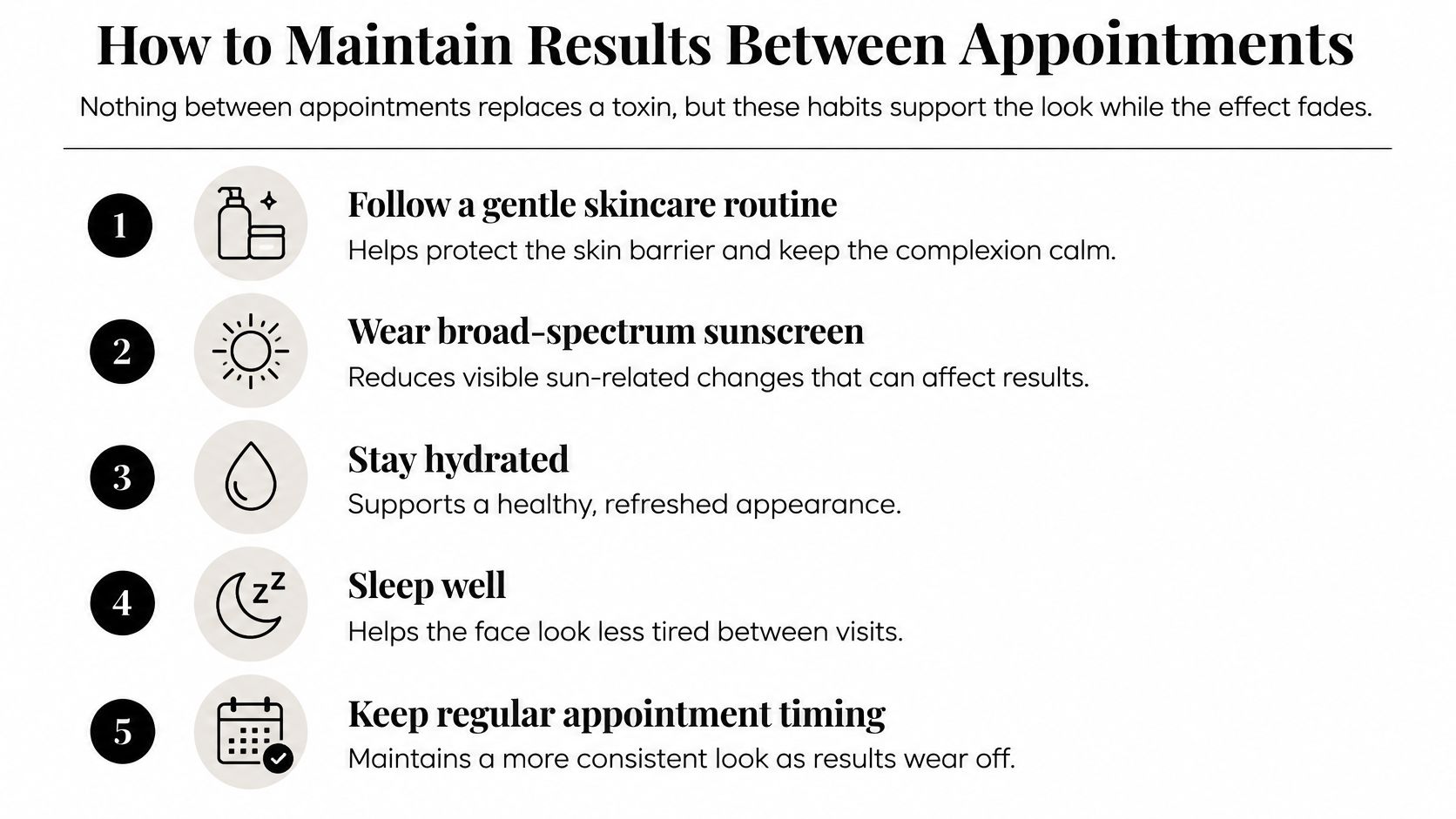
Keep Expectations Separate
Well-cared-for skin can still show expression as movement returns. Reduced muscle movement also does not remove the need for sun protection or moisturization. These changes are not signs that your routine has failed; they reflect the difference between caring for skin and treating muscle activity.
The guide to helping your Botox results last longer can help you organize aftercare questions for your next visit. Bring the names of your products and any device instructions if you're unsure how they fit into your routine.
A small crease does not automatically call for an early injection. Use your routine to care for your skin, and consider retreatment based on returning movement and your provider's guidance, rather than trying to correct every expression as soon as it appears.
Retreatment Schedules Compared
Repeat treatment should follow diminished clinical effect, generally no sooner than 12 weeks after the preceding injection, according to FDA labeling. Reaching that point makes a review reasonable; it doesn't automatically make another injection necessary.
There's also a difference between visible wear-off and a complete biological reset. An NCBI clinical review describes residual muscle changes with repeated treatment and notes that evidence on repeated aesthetic use beyond 12 months remains limited. Long-term schedules therefore deserve reassessment rather than an assumption that the same interval will always fit.
Retreatment Strategies Compared
| Strategy | When to Retreat | Main Trade-Off |
|---|---|---|
| Wait for full wear-off | Around 3–4 months, or when most movement has returned | Lines may return fully between sessions; potentially fewer sessions |
| Retreat at first movement | From week 12 at the earliest, once movement is clearly returning | May support a smoother appearance, but can mean more frequent sessions |
| Fixed calendar | Every 3–4 months, subject to clinical assessment | Predictable budgeting and scheduling, but may not match muscle activity |
These approaches serve different preferences. Someone comfortable with expression returning may prefer waiting, while someone seeking a more consistent look may choose an earlier eligible review.
A fixed appointment can be useful as a check-in, not a commitment to receive injections regardless of the examination. If you still like the result or the clinician finds residual weakness, postponing treatment may be appropriate.
Decide With Your Face, Not Just Your Calendar
Your provider should consider:
- Movement: Which treated muscles are contracting, and how strongly?
- Symmetry: Does the face look balanced at rest and during expression?
- Your goal: Are you seeking subtle softening or a more consistently smooth appearance?
- Adverse effects: Has anything occurred that needs assessment before further treatment?
The guide to how often to get Botox offers additional context for discussing appointment timing.
Scheduling principle: Retreat when returning movement means your goal is no longer met, provided your clinician considers treatment appropriate.
You don't have to wait for every line to return, and you don't have to book because a date has arrived. The decision should remain individualized at each cycle.
Decide Whether to Book or Call Your Provider
A gradual return of familiar movement after a good initial response usually means it's time to plan. New weakness, drooping, or difficulty with normal functions belongs in a medical conversation, not a routine rebooking request.
FDA labeling warns that some Botox-related problems can appear from hours to weeks after injection. Don't use the calendar alone to decide that an unusual symptom must be ordinary fading.
Normal Wear-Off Versus Symptoms to Report
| Situation | Normal Wear-Off? | What to Do |
|---|---|---|
| Gradual return of frown or forehead lines around 3–4 months | Yes | Plan your next visit |
| Little or no initial improvement | Not expected | Ask your provider to review dose, placement, and expectations |
| Drooping eyelid or brow, uneven smile, or localized weakness | Not expected | Contact your provider promptly |
| Trouble swallowing, speaking, or breathing, or widespread weakness | Not expected | Seek urgent medical care now |
An uneven return of small amounts of movement isn't automatically an emergency. However, you shouldn't try to diagnose a drooping eyelid or new weakness from photographs alone, and you shouldn't assume another injection is the solution.
If the concern is that treatment never produced the expected result, the guide to why Botox may not seem to be working can help you describe the problem clearly. Your treating clinician still needs to assess the cause.
Your Booking Sequence
- Review your photographs. Note which expressions have returned and whether the change developed progressively.
- Check your treatment date. Confirm that at least twelve weeks have passed before considering routine repeat treatment. If they haven't, ask for advice rather than requesting an early top-up.
- Arrange your visit through BotoxBarb appointment booking. Describe whether you're seeking routine maintenance or a review of an unexpected result.
- Bring your photos and symptom notes. Include when each change started, whether it's improving, and whether it affects vision, speech, swallowing, or everyday activity.
Book when the returning movement no longer fits your cosmetic goal, not because you feel you must prevent all expression. Call your provider the same day for warning signs, and seek urgent medical care immediately for trouble swallowing, speaking, or breathing, or widespread weakness. Don't wait for a cosmetic appointment to address those symptoms.
BotoxBarb offers aesthetic consultations, injectable treatments, and skincare options to support an individualized maintenance plan. Visit BotoxBarb to arrange a review of your returning movement, bring your treatment photos, and discuss whether another appointment or a longer interval makes sense for you.