
Botox vs Dysport for Glabellar Lines: Which to Choose
The labeled glabellar dose for Dysport is 50 units divided into five equal 10-unit injections, and the Dysport prescribing information states those units are product-specific and shouldn't be converted directly to Botox units. That single fact reframes Botox vs Dysport for glabellar lines. You're not choosing between 20 of one thing and 50 of the same thing. You're choosing between two separate potency scales, two trial programs, and two labeled protocols that happen to target the same frown muscles.
Botox and Dysport Side by Side for Glabellar Lines
Both products are botulinum toxin type A treatments for temporary improvement of moderate-to-severe glabellar lines. Their shared mechanism does not make their trial results or units interchangeable. The useful comparison is what each label and trial actually measures.
Botox and Dysport at a glance for glabellar lines
| Factor | Botox | Dysport |
|---|---|---|
| Active ingredient | onabotulinumtoxinA | abobotulinumtoxinA |
| Mechanism | Blocks acetylcholine release at the neuromuscular junction | Blocks acetylcholine release at the neuromuscular junction |
| FDA approval for glabellar lines | April 2002 | April 29, 2009 |
| Onset signal | Begins within 1-2 days and intensifies during the first week | Median time to response of 3 days in pivotal trials |
| Labeled duration | About 3-4 months | Up to four months |
| Day-30 success in pivotal trials | No matched composite figure under the same trial design | 55%, 52% and 60% across three trials |
| Labeled dose for glabellar lines | 20 units across 5 sites | 50 units across 5 sites |
Reading the Approval and Trial Rows
Botox was approved for glabellar lines in April 2002; its earlier U.S. approvals were for blepharospasm and strabismus. Dysport received U.S. approval for glabellar lines on April 29, 2009. The longer Botox history does not establish better results for this indication. It reflects different regulatory timelines, not a head-to-head comparison.
Dysport's approval included three placebo-controlled randomized trials in healthy adults aged 19 to 75 with at least moderate glabellar lines. Participants received 50 Dysport units divided among five injection sites. At day 30, treatment success was 55%, 52%, and 60% across the trials, compared with 0% for placebo. Median time to response was three days.
The table does not give a Botox day-30 percentage from the same trial design, endpoint, and population. That absence limits direct comparison; it is not evidence of a weaker Botox result. Comparing percentages across unmatched studies would imply a precision the evidence does not provide.
What the Dose Row Does Not Mean
The 20-unit Botox dose and 50-unit Dysport dose are product-specific potency measures, not quantities on a shared scale. Their numerical difference does not show that Dysport requires more active treatment or delivers more effect. Per-unit price and total unit count therefore cannot establish which option is better value. The labeled protocol and the clinician's treatment plan are more informative than either number alone.
For a patient-focused discussion of matching product choice to anatomy and goals, Botox guidance from Ideal Face & Body offers context alongside the label data. Use the table to orient the comparison, then interpret each result within its own protocol and study design.
A missing matched figure reflects noncomparable trial evidence, not a failed treatment.
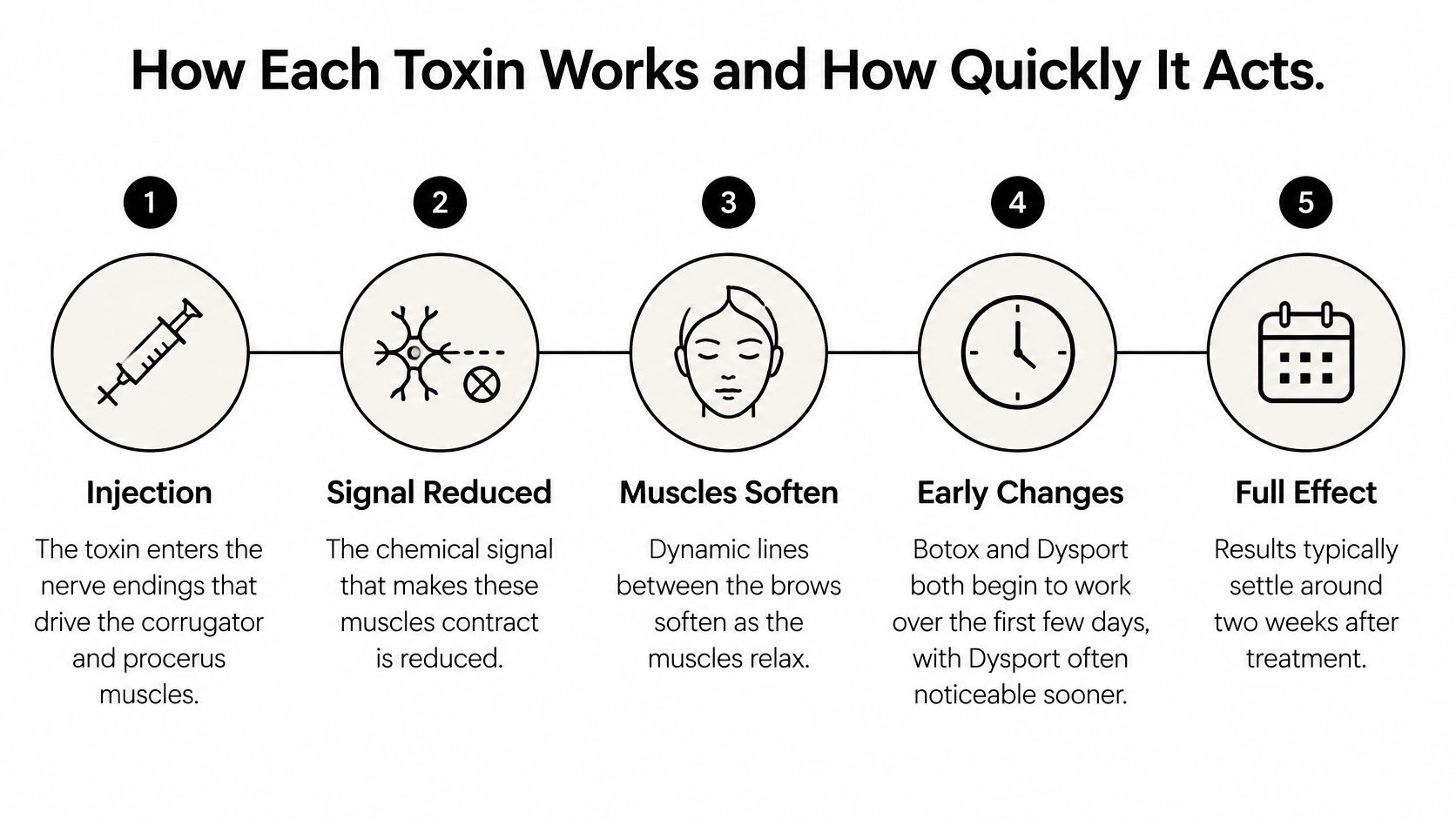
How Each Toxin Works and How Quickly It Acts
Both products reduce the chemical signal that prompts the corrugator and procerus muscles to contract. As the brows pull together less strongly, repeated frowning softens and vertical lines at maximum frown become less pronounced.
The effect targets dynamic lines while the product is active. It does not add volume, resurface skin, or prevent other aging changes. A line etched into the skin at rest by sun damage or skin change may therefore soften only partly when the muscle relaxes.
Onset in the First Week
Botox generally begins to take effect within 1 to 2 days and strengthens over the first week, according to Botox Cosmetic labeling summarized in FDA material. That early biological activity does not mean the finished result will be visible on day two.
In a phase 3 randomized placebo-controlled study indexed on PubMed, 60% of abobotulinumtoxinA patients reported treatment response on or before day 3, significantly more than patients receiving placebo. This supports a relatively early response for some Dysport patients. It does not establish that every patient will notice a change by day three.
The same nerve-signal mechanism is discussed in other settings, but evidence and expectations do not automatically carry over between treatment areas. For example, a Scottsdale patient's jaw pain guide describes muscle relaxation in the context of jaw pain, not glabellar dosing or results.
Peak Effect and Durability in a Head-to-Head Trial
A randomized double-blind trial published through Wiley Online Library compared 62 patients with moderate-to-severe glabellar frown lines. One-grade improvement peaked at week 8: 94% of patients receiving 20 units of onabotulinumtoxinA and 97% receiving 50 units of abobotulinumtoxinA improved. At that assessment, outcomes were close.
By week 16, improvement remained in 53% of the Botox group and 28% of the Dysport group, with P = 0.04 reported for the difference. That is a result from this trial, not a universal rule about which product lasts longer. Technique, muscle strength, anatomy, dose selection, and the definition of response can affect observed duration.
The comparison also cites median durations of 85 days and 117 days in key onabotulinumtoxinA trials. Those figures depend on the study endpoint, so a duration estimate is meaningful only alongside its response definition and study population.
Practical rule: Assess onset during the first week, compare results using standardized frown photos, and judge durability by when your own movement returns.
Check your response around day 3, after the effect settles, and near month 3. These observations separate early onset, peak effect, and duration rather than treating them as one outcome.
Why Units Cannot Be Converted Between Botox and Dysport
A quote of 20 units for Botox Cosmetic and 50 units for Dysport does not mean the second treatment is stronger or better value. Each number measures the potency of a different product, so the unit totals cannot be compared directly.
Labeled glabellar dosing for Botox Cosmetic and Dysport
| Dosing element | Botox Cosmetic | Dysport |
|---|---|---|
| Labeled total dose | 20 units | 50 units |
| Injection sites | 5 sites | 5 injections |
| Units per site | 4 units | 10 units |
| Units interchangeable with the other product | No | No |
| Retreatment spacing | As the 3 to 4 month effect wears off | No more often than every 3 months |
The FDA-approved Botox labeling specifies 20 units of Botox Cosmetic for glabellar lines, given as 4 units at each of five sites. Dysport labeling specifies 50 units across five 10-unit injections. Both products use product-specific potency units. The Dysport label limits retreatment to intervals no more frequent than every three months.
Why Conversion Ratios Mislead
Online conversion ratios suggest that the unit counts share an exchange rate. They leave out details that shape the treatment plan and its result:
- Dilution volume: The amount of fluid used to prepare the product affects how it can be placed.
- Injection technique: Depth, angle, and point selection influence which muscle fibers are treated.
- Muscle anatomy: A strong corrugator complex may respond differently from a smaller, less active one.
- Treatment goal: Preserving some movement calls for a different approach from aiming for minimal movement at full frown.
A ratio also cannot account for brow position or a patient's prior response. Two people given the same labeled total can have different outcomes because their anatomy and placement needs differ. The unit count is a dosing measure for one product, not a common scale for comparing treatment strength.
Questions That Reveal More Than Unit Count
Ask for the planned total dose, the number of injection sites, and the amount assigned to each site. Ask how muscle strength shaped the plan, what dilution will be used, and what response to expect early and at the settled review.
Also ask when retreatment would be appropriate and what result might lead the provider to choose a different product next time. Those answers clarify the product-specific plan. A quote based only on price per unit does not.
Where Spread and Placement Make the Difference
Diffusion means toxin effect extends beyond the intended muscle after injection. In the glabella, small placement errors matter because the target muscles sit close to structures that lift the brow and eyelid.
Spread into the frontalis, the forehead muscle that raises the brows, can make the brow feel heavy or sit lower. Spread toward the levator muscle can contribute to eyelid droop. The brand name alone doesn't prevent either outcome.

Factors the Injector Can Control
Dose at each point, dilution volume, injection depth, and distance from the orbital rim all influence where the effect is concentrated. Brow position, eyelid heaviness, muscle mass, and facial asymmetry influence how much margin for error a patient has. A careful injector maps those features while you frown, relax, and raise your brows before choosing points.
A diagram of Botox injection sites on the face can help you visualize why glabellar points aren't interchangeable with forehead points. The glabella and frontalis work against each other in brow positioning, so treating one without assessing the other can unbalance the result.
You'll often hear that Dysport spreads more widely while Botox stays more precise. Treat that as a clinician-observed tendency to discuss, not a settled rule that predicts your result. Preparation and placement can outweigh any simple brand slogan, and a wider field isn't automatically bad or good. It depends on muscle shape and the intended pattern.
What Careful Placement Looks Like
Injection points should be planned with respect to the orbital rim and your resting brow height. Patients with low or heavy brows generally need a more conservative approach and an explicit discussion of heaviness risk. At the follow-up exam, the provider should check brow height, eyelid position, symmetry, and remaining frown strength rather than asking only whether lines look softer.
Before consenting, ask where the points sit relative to your brow and orbit, how the product is diluted, and how the plan changes because of your brow position. If the answer is the same template used for every face, placement hasn't been individualized.
Side Effects and Safety Differences to Weigh
For glabellar treatment, Botox and Dysport share the same broad safety conversation. Most effects are mild and temporary, and the important distinction is usually dose plus spread, not a separate safety class for each brand. Choosing one name over the other doesn't remove the risks created by poor placement.
Common glabellar treatment effects, timing and management
| Effect | Typical timing | Usual driver | Usual management |
|---|---|---|---|
| Brow heaviness or drooping | Days to about 2 weeks | Toxin spread into the frontalis | Assess at follow-up; many resolve as the effect wears off |
| Eyelid droop (ptosis) | Days to about 2 weeks | Spread toward the levator muscle | Clinical review promptly; often temporary |
| Headache | First 1-3 days | Post-injection response | Usually mild; ask the provider about relief options |
| Bruising or swelling at injection points | Within hours to days | Needle trauma | Usually settles on its own |
| Asymmetry | About 1 to 2 weeks as effect settles | Uneven dose or placement | Touch-up assessed by the provider at follow-up |
Effects Driven Mainly by Placement
Brow and eyelid effects deserve the closest attention because they alter function and appearance, even when temporary. They point back to anatomy, dose distribution, and distance from nearby muscles. A provider should examine eyelid position and brow movement in person rather than reassuring you from a brief message.
Asymmetry often becomes clear only after both sides settle. One corrugator may be stronger, one brow may start higher, or one side may receive a slightly different effective dose. The usual response is assessment at follow-up and, when appropriate, a small touch-up, not an immediate full repeat treatment.
Dry or irritated eyes, redness, tenderness, and swelling can also occur after injections around the brow. Record when each symptom starts and whether it's improving. Timing helps the provider separate ordinary needle effects from toxin spread. A detailed overview of Dysport injection side effects can help you prepare questions, but product-specific labeling and your injector's advice govern your care.
Seek urgent medical care for trouble swallowing, trouble breathing, spreading muscle weakness beyond the face, or vision changes, even though those outcomes are rare.
A Simple Symptom Record
Note changes on day 3, day 14, and day 30, using the same lighting and facial expressions for photos. Write down headache, bruising, heaviness, eyelid position, eye irritation, and asymmetry separately. That record gives your provider usable evidence and prevents a vague report that something feels off.
Don't judge safety by whether you had zero sensation after treatment. Judge the provider by screening, placement, follow-up access, and how clearly warning signs were explained before injection.
Patient Selection and What Drives the Cost
First-time patients with mild to moderate frown lines can usually discuss either product. For them, injector assessment and a conservative, well-documented first plan matter more than brand loyalty. The first treatment also creates a baseline for onset, symmetry, and duration.
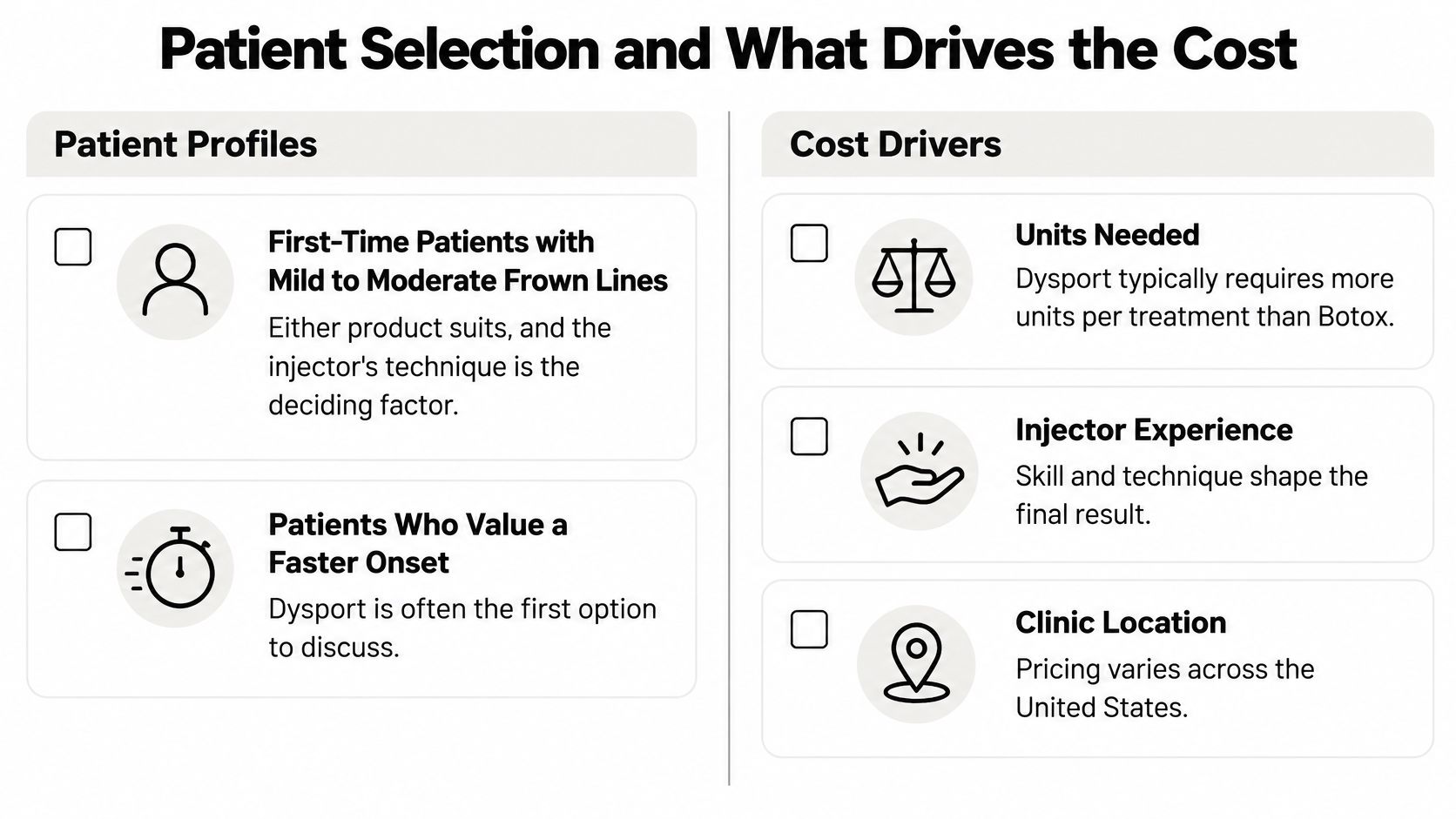
Profiles That Change the Discussion
- Early response is the priority: Dysport is a reasonable first option to discuss because its trial program documents an early median response.
- Durability is the priority: Botox deserves discussion because one direct comparison favored it later in follow-up, though that result isn't guaranteed for an individual.
- Low brows or heavy lids: Placement, conservative dosing, and follow-up access should drive the decision before brand preference.
- Prior good response: A documented result with one product is stronger personal evidence than a generic online ranking.
Neither product is advised during pregnancy or breastfeeding, with active infection at an injection site, or in certain neuromuscular conditions. Your provider also needs your medication history, prior toxin treatments, allergies, and previous reactions before deciding.
Build the Annual Figure, Not the Unit Price
Per-unit pricing can't rank these products because the unit scales differ. For a purely hypothetical example, say a clinic used $12 per unit for both. A 20-unit Botox session would be $240 in product arithmetic, while a 50-unit Dysport session would be $600, before any provider fee. That gap demonstrates the pricing trap, not a real market quote.
Request an itemized total for the full session, then multiply by expected sessions per year using at least three-month spacing, up to four sessions, and add provider fees and travel. The comparison of Botox vs Dysport cost is most useful when you apply that total-cost method to written quotes. Compare annual cost for a similar result, not the advertised price attached to incompatible units.
Choose Your Toxin and Confirm the Protocol
A useful treatment decision depends on records that allow you and your provider to assess the result, not memory alone. Standardized baseline photos, a documented dose, and follow-up at planned intervals make comparisons more meaningful.
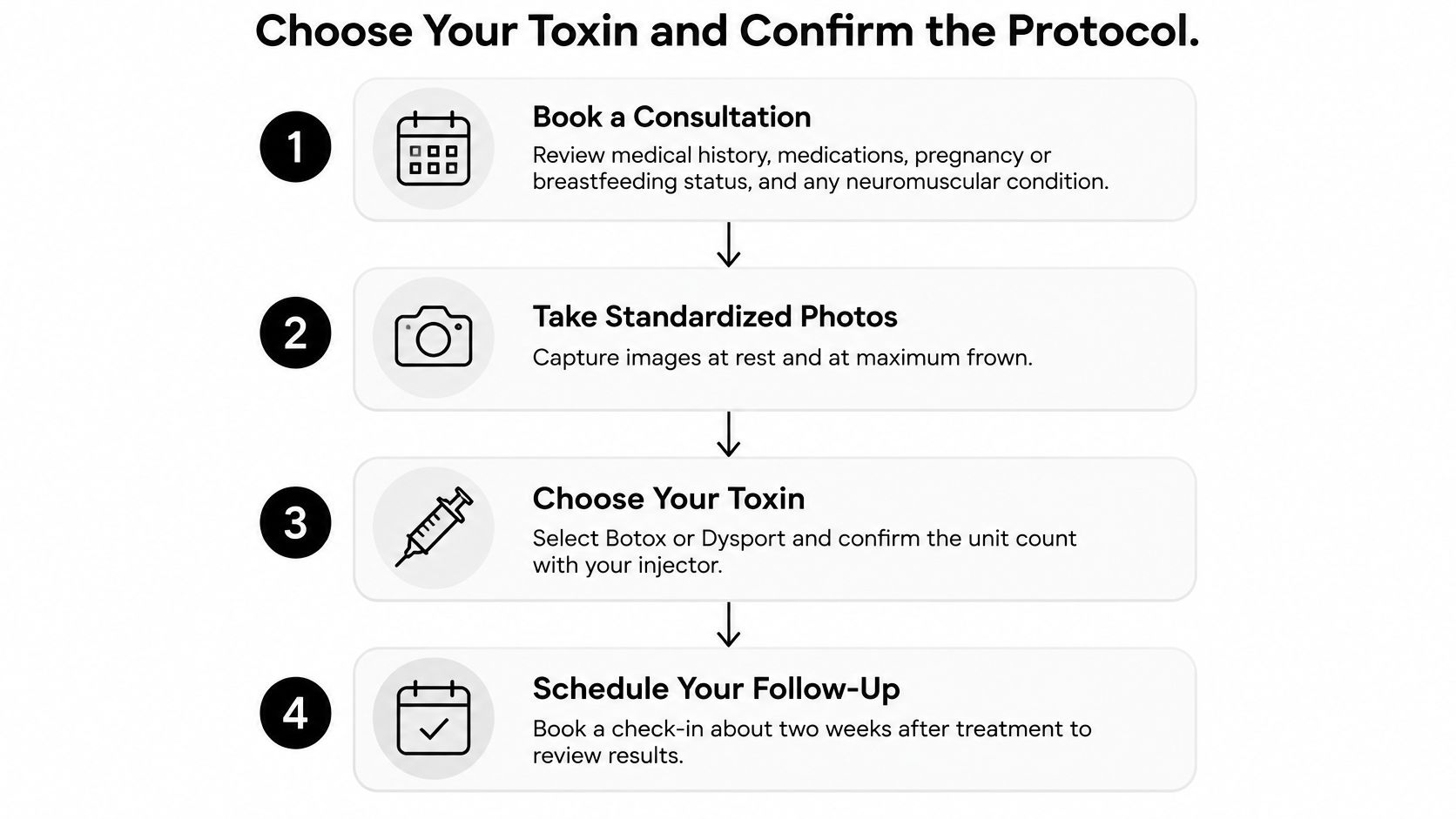
The Seven-Part Protocol
- Book a consultation: Review your medical history, medications, pregnancy or breastfeeding status, neuromuscular conditions, previous toxin response, and treatment goals.
- Take standardized photographs: Photograph your brow at rest and at maximum frown before treatment, using consistent lighting.
- Agree on the product and labeled dose: Confirm the product, total units, number of injection sites, units per site, and any adjustment for muscle strength or brow position. Botox and Dysport units use different scales, so their labeled unit counts are not directly comparable.
- Inject and document: Record the product, total units, sites, dilution, and any immediate reaction in the treatment note.
- Review at about day 14: Assess brow height, eyelid position, symmetry, remaining movement, and whether a touch-up is appropriate.
- Reassess at about day 30: Repeat maximum-frown photographs and compare them with baseline images taken under the same conditions.
- Reassess near months 3 to 4: Review durability, adverse effects, and satisfaction before planning another treatment. Follow the interval allowed by the product label.
The Dysport FDA label reports that 55% of Dysport-treated subjects met a composite Day 30 success criterion in one labeled analysis. Success required none-or-mild severity and at least a two-grade improvement at maximum frown. The label also reports benefit maintained for up to four months. Botox labeling reports reduced severity for up to 120 days and an overall effect of approximately 3 to 4 months. These findings support checking the result at day 30 and again around months 3 to 4. They do not establish that one product is superior: the populations, endpoints, doses, and follow-up designs differ.
A good protocol also depends on assessment, documentation, and recognizing complications, not just injection speed. Clinicians considering adding Botox to your clinic should look for training that gives anatomy and follow-up the same attention as product handling.
Verdict by Situation
There is no universal winner for glabellar lines. A documented, balanced result with one product is a reasonable basis for continuing it and refining the treatment record. If a faster reported response is the priority, discuss Dysport. If later durability in the direct trial matters more, discuss Botox while recognizing that individual results vary. With low brows or heavy lids, settle placement and dose conservatively before choosing by brand.
Supportive skincare addresses skin concerns that toxin injections do not. BotoxBarb offers a curated skincare selection that may complement a routine; ask your provider which products suit your skin. Botox and Dysport consultations are available by appointment through BotoxBarb. Confirm the product against your photos, anatomy, and prior response, rather than comparing per-unit prices or unit counts across different products.
Book a Botox or Dysport consultation to review the labeled 20-unit Botox and 50-unit Dysport protocols in relation to your brow position, muscle strength, and previous response. Ask for standardized photos and a timed follow-up plan. Visit BotoxBarb to schedule an appointment and choose a treatment using results you can measure.