
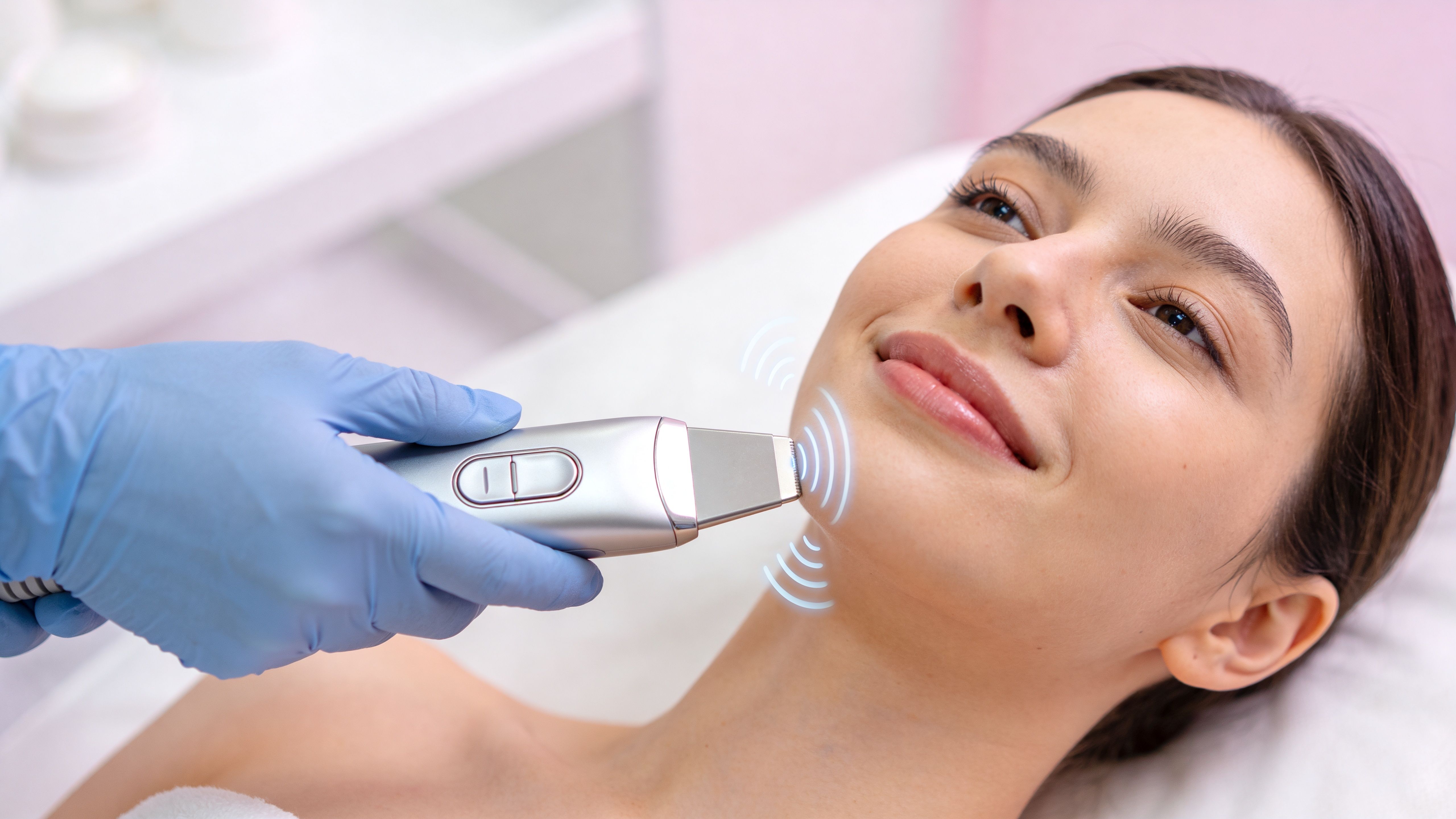
What Is Ultherapy? A Guide to the Non-Surgical Facelift
You catch it in the mirror first. Your jawline looks a little softer. The skin under your chin doesn’t sit the way it used to. Your brows feel heavier, even when you’re well rested. You still look like yourself, but the structure looks less supported.
That’s usually when people start searching for a middle-ground option. They’re not ready for surgery. They don’t want a dramatic change. They want something that helps the face look firmer, fresher, and more awake without weeks of downtime or a result that looks “done.”
That’s where Ultherapy enters the conversation. If you’ve been wondering what is Ultherapy, the simplest answer is this: it’s a non-invasive treatment that uses focused ultrasound energy to stimulate your own collagen deep under the skin, with the goal of gradually lifting and firming areas like the brow, neck, and under the chin.
The Search for a Lift Without the Surgery
A common patient story sounds like this: Botox still softens forehead lines nicely, skincare keeps the skin looking healthy, but something deeper has changed. Makeup settles differently along the jaw. The neck starts to look less crisp in photos. Fillers may help in the right person, but volume alone doesn’t fix laxity.
That’s an important distinction. Many people aren’t really asking for “more volume” or “fewer wrinkles.” They’re asking for support.
Ultherapy appeals to that person because it sits between topical care and surgery. It isn’t a facelift, and it shouldn’t be sold that way. But it also isn’t just another glow treatment. It addresses tissue at depth, which is why it’s often part of the conversation for people exploring non-invasive cosmetic procedures that can improve early sagging without the commitment of surgery.
Why this option gets attention
Patients usually come in with a few very practical goals:
- They want natural change. They don’t want to look inflated, frozen, or overtreated.
- They want little to no downtime. Many can’t take a week off to recover.
- They want treatment that matches early aging. Mild to moderate laxity often needs a different approach than lines, pigment, or volume loss.
- They want a plan, not hype. Patients are tired of hearing that every device is “the best.”
Ultherapy makes the most sense when the problem is structural softening, not when someone needs major lifting or instant volume.
That’s the honest middle ground. In practice, Ultherapy works best as a foundational treatment for skin support. It’s often not the only treatment someone will ever need, but for the right candidate, it can be the treatment that addresses the layer other non-surgical options don’t reach.
How Ultherapy Rebuilds Your Skin from the Inside Out
To understand what Ultherapy does, you have to look below the surface.
Ultherapy uses focused ultrasound energy to treat deeper layers of tissue that help hold the skin in place. The skin surface stays intact, but controlled heat is delivered at specific depths under the skin to trigger a wound-healing response. That response is what starts new collagen formation over time.

The layer that matters
One reason Ultherapy stands apart from many skin-tightening treatments is depth. According to the American Board of Cosmetic Surgery's overview of ultrasound skin tightening, ultrasound can reach structural layers below the skin surface, including tissue associated with facial support.
In practice, treatment is typically delivered at different depths so the provider can address more than one layer in a single session:
- Superficial dermis, where collagen contributes to firmness
- Deeper dermis, where laxity starts to show more clearly
- Deeper supportive tissue, including the layer commonly called the SMAS
That last layer matters because it is part of the facial support system. Surgeons work with it during facelift surgery. Ultherapy does not recreate a surgical lift, but it does target a depth that is relevant when the concern is early descent rather than just surface texture.
What the ultrasound energy actually does
Ultherapy uses micro-focused ultrasound with visualization. The visualization matters because it lets the provider see the tissue planes during treatment instead of placing energy blindly. From a clinical standpoint, that improves precision and helps match the treatment depth to the anatomy in front of you.
The energy creates small thermal injury points under the skin. Those points stimulate collagen remodeling as the tissue repairs itself. Patients usually do not walk out looking dramatically tighter that day, because collagen rebuilding is a biologic process, not an instant fill.
That distinction matters in consultation. If someone wants immediate cheek support or correction of deeper folds, I usually discuss filler or biostimulatory injectables as a better match for that goal. If the bigger issue is that the lower face, jawline, or neck is starting to lose structural firmness, Ultherapy can be a strong foundation.
Why this is part of a bigger treatment plan
Ultherapy is one of the treatments I use to address the support layer first. Then I decide what else, if anything, needs to be added. Some patients also benefit from conservative filler to restore proportion, neuromodulator to reduce pull from overactive muscles, or at-home LED therapy to support recovery and overall skin quality.
That is the practical value. It helps build the base.
Skin also responds better when home care supports collagen health instead of working against it. Consistent sun protection, barrier repair, and well-chosen skin renewal products can support the skin after in-office treatment, even though they do not replace what ultrasound does at depth.
Where Ultherapy tends to work best
Results are usually strongest in patients who still have enough natural structure for collagen remodeling to make a visible difference. In the treatment room, that often looks like:
- early jowling
- mild softening under the chin
- neck skin that looks looser or more crepey
- a brow that appears slightly heavier
- skin that feels less firm, even without major wrinkling
It tends to be less satisfying when the tissue is very heavy, the laxity is advanced, or the main concern is volume loss. It also will not do much for pigment, redness, or acne scarring.
That is the trade-off patients deserve to hear clearly. Ultherapy is not a catch-all anti-aging treatment. It is a structural collagen treatment, and in the right person, that makes it a very useful starting point for long-term support.
Determining if You Are an Ideal Candidate for Ultherapy
A common consultation starts the same way. Someone points to early jowls, a softer jawline, or a heavier brow and says, “I still look like me. I just look more tired.” That is often the stage where Ultherapy makes the most sense.
The strongest candidates usually have mild to moderate skin laxity and want gradual, natural-looking improvement rather than a dramatic change. In practice, I look less at age and more at tissue quality, facial structure, skin thickness, and the underlying cause of the concern. A patient in their late 30s with early descent can be a better candidate than someone in their 60s with heavier tissue and more advanced laxity.
Ultherapy fits best when the goal is structural support. It works well for patients who want to strengthen the foundation first, then decide whether they also need a small amount of filler, neuromodulator, or another treatment to refine the result. That approach usually gives the most balanced outcome.
Signs you may be a good fit
You may be a strong candidate if the changes you see are subtle but persistent:
- Your jawline looks a little less defined.
- The skin under your chin or along your neck feels looser than it used to.
- Your brows sit slightly lower, which can make the eyes look tired.
- You want improvement that still looks like you.
- You want little to no downtime and prefer to avoid surgery for now.
Expectations matter as much as anatomy.
Patients tend to be happiest when they understand what Ultherapy can and cannot do. It can improve firmness and create a modest lift in the right patient. It does not replace a facelift, restore lost facial volume, or correct pigment and texture issues.
Published clinical research on microfocused ultrasound with visualization has shown improvement in lifting and skin tightening in selected patients, and the treatment has a long track record in aesthetic practice. If you want to review the original clinical literature, the Journal of Cosmetic and Laser Therapy published one of the early prospective studies on eyebrow lifting after microfocused ultrasound treatment: A pilot study of intense ultrasound therapy to rejuvenate aging facial skin. For patient-reported satisfaction, RealSelf maintains its own live review data on the procedure here: Ultherapy reviews on RealSelf.
Those sources are useful, but they do not replace a proper assessment. Results depend heavily on candidate selection and treatment planning.
The practical question is simple: are you trying to tighten tissue that has started to loosen, or are you trying to correct volume loss, deeper folds, or heavier sagging that usually needs a different approach?
When Ultherapy probably isn’t the right first move
Ultherapy is often not the best starting point in these situations:
| Situation | Better conversation to have |
|---|---|
| Significant skin sagging | Surgical consultation |
| Hollow cheeks, temples, or volume loss around the mouth | Filler or biostimulatory volume support |
| Deep lines caused mainly by facial movement | Neurotoxin, resurfacing, or both |
| Pigment, rough texture, or acne scarring | Laser, peel, or other texture-focused treatment |
| Expectations centered on dramatic lifting | Reassess goals and treatment options |
I also screen for patience. Collagen remodeling takes time, so the right candidate is comfortable with results that build over months.
That does not make the outcome less meaningful. In the right patient, it makes the result more believable, easier to maintain, and easier to build on with other treatments later.
What to Expect During Your Ultherapy Treatment
A well-run Ultherapy appointment feels methodical. It should never feel rushed or generic. The treatment plan depends on your anatomy, the areas being treated, and how much support your skin needs.
The visit starts with consultation and assessment. Your provider looks at movement, tissue quality, skin laxity, and balance across the face and neck. This part matters because ultrasound energy needs a plan. A patient with early brow descent is different from someone whose main issue is submental softness or neck laxity.

The mapping and prep
Once the treatment areas are confirmed, the skin is cleansed and marked. Those markings guide placement and help keep the treatment organized and symmetrical. Then ultrasound gel is applied so the handpiece can couple properly with the skin.
This is not a “stamp and go” device. Placement matters. Angle matters. Depth matters.
The imaging step that sets Ultherapy apart
One of the most important features of Ultherapy is that the provider can see tissue layers in real time during treatment. Ultherapy's B-Mode ultrasound imaging allows clinicians to visualize tissue layers up to 8mm deep in real time, ensuring energy is delivered precisely to the target depth while avoiding non-target structures like bone, according to the Ultherapy IFU.
That real-time visualization is a major reason experienced providers value the platform. It adds precision. It also helps guide safer treatment by confirming where energy is going before it is delivered.
The best Ultherapy treatments aren’t aggressive for the sake of being aggressive. They’re precise.
What the treatment feels like
Patients usually describe Ultherapy as brief pulses of heat, tingling, zaps, or deep pressure. Some areas are easier than others. Areas over bone or along the jawline can feel sharper. The neck can be sensitive in a different way.
Comfort management matters, and so does honest counseling. This isn’t usually described as a spa facial. It’s tolerable for many patients, but it’s still an energy-based structural treatment.
A typical experience includes:
- Short bursts of sensation. The feeling comes with each line of energy, then passes.
- More sensitivity in certain zones. Bony areas often feel stronger than fleshy ones.
- Provider feedback during treatment. A good clinician adjusts pacing and communicates throughout.
- A quick return to normal. Individuals typically resume normal activity right after the appointment.
What you may notice right after
Most patients leave looking fairly normal. You can see some temporary redness, mild swelling, tenderness, or tingling. Those effects are generally mild and transient based on the safety data described in the device materials and physician information already noted earlier.
What you usually won’t see is a dramatic instant lift. Some people notice a subtle early tightness, but that’s not the endpoint. Ultherapy is building toward a delayed collagen response.
What makes a treatment session worth it
From a practitioner standpoint, the session quality depends on three things:
- Appropriate candidate selection
- Accurate depth targeting
- A realistic treatment plan that matches your goals
If any of those pieces are off, the experience can still be technically “successful” but disappointing to the patient. Good aesthetic medicine is not just about doing a treatment. It’s about choosing the right treatment for the right problem.
Your Results Timeline From Subtle Glow to Full Lift
Ultherapy rewards patience. If you go into it expecting next-day transformation, you’ll likely feel underwhelmed. If you understand that this is a collagen remodeling treatment, the timeline makes much more sense.
The first days and weeks
Right after treatment, the skin may feel a bit tighter or mildly swollen. Some patients notice an early “fresh” look, but this isn’t the final result. That early effect can come from temporary tissue response rather than long-term collagen remodeling.
The more meaningful change happens later, when your body starts building and reorganizing support fibers beneath the surface.
When visible improvement tends to show up
The typical rhythm looks like this:
- Early phase. A subtle change may appear as the skin settles.
- Around 2 to 3 months. Many patients start seeing clearer lifting and firming.
- At about 6 months. Results often look most complete.
- Beyond that. The improvement gradually ages with you rather than disappearing all at once.
This gradual pattern is one reason Ultherapy can look natural. People often notice that you look fresher or better rested without being able to point to a single dramatic change.
If you want a treatment that whispers instead of shouts, Ultherapy fits that profile well.
How long results usually last
Long-term expectations matter just as much as short-term ones. While most clinical literature highlights peak results at 6 months, practitioner reports and long-term studies indicate that 70-80% of patients maintain satisfaction at 12 months, with many opting for maintenance sessions every 1-2 years, as summarized by WebMD’s Ultherapy overview.
That doesn’t mean every patient keeps the exact same degree of lift for the entire period. Aging continues. Collagen continues to change. Sun exposure, smoking, weight changes, and genetics all influence how long a result holds.
What helps results look better longer
The people who tend to like their results the longest usually do a few things well:
- They protect collagen daily. The importance of sun protection is often underestimated.
- They keep expectations realistic. A maintenance mindset is healthier than chasing permanence.
- They treat aging in layers. Structural support may need to be paired with volume, wrinkle, or texture treatments over time.
Ultherapy is best thought of as a long-game investment in support. It can create visible improvement, but the value is often in slowing the slide and helping the face age more gracefully.
How Ultherapy Compares to Other Anti-Aging Treatments
Ultherapy is often discussed as if it competes with every other anti-aging treatment. It doesn’t. It occupies one lane. The confusion happens when patients use one word, “lift,” to describe several different problems.
A forehead line from muscle movement is not the same as cheek deflation. A rough skin surface is not the same as neck laxity. The treatment has to match the mechanism.
Explore key differences between popular aesthetic treatments.

Where Ultherapy fits
Ultherapy is best understood as a deep support treatment. It’s for laxity. It’s not primarily for motion lines, volume replacement, or resurfacing. That’s why it often complements other procedures instead of replacing them.
If you’re comparing broader options for facial treatments for aging skin, it helps to sort treatments by what they do rather than by marketing language.
Side-by-side treatment logic
| Treatment | Main job | Best for | What it does not do well |
|---|---|---|---|
| Ultherapy | Builds deeper structural support | Mild to moderate laxity of brow, neck, under chin, lower face | Instant volume, major skin resurfacing, severe sagging |
| Botox or Dysport | Relaxes targeted muscles | Forehead lines, frown lines, crow’s feet | Lift loose skin or replace lost volume |
| Dermal fillers | Restore or shape volume | Cheeks, lips, folds, contour support | Tighten lax skin in a meaningful structural way |
| Laser resurfacing | Improve surface quality | Texture, pigment concerns, fine lines, photodamage | Lift deeper tissue support |
| RF microneedling | Stimulate collagen with a texture-tightening effect | Pores, texture, mild laxity, acne scarring | Replace significant lift or volume restoration |
The real trade-offs
Ultherapy has a clear advantage when the issue is structural descent without downtime. That’s the lane. It doesn’t require surgery, and it doesn’t rely on adding product volume. For the right person, that makes it appealing.
Its trade-off is equally clear. The result is gradual and usually moderate, not dramatic.
Botox and Dysport work faster for expression lines. Fillers work faster for hollowing and contour. Lasers can do far more for pigment and surface refinement. RF microneedling may be a better fit when skin texture and mild tightening are the main goals.
A strong aesthetic plan rarely asks one treatment to do everything.
Combination treatment usually makes more sense than either-or thinking
In practice, many people need a layered approach:
- movement control with neurotoxin
- support with Ultherapy
- volume correction where true deflation exists
- texture and tone treatment separately
- home care that protects the gains
If you’re weighing options more broadly, this guide to the best anti-aging treatments can help frame the decision in a more practical way.
The key is not to ask, “Which treatment is best?” The better question is, “What is my main aging pattern, and which tool addresses that pattern most directly?”
Enhancing and Extending Your Ultherapy Investment
Ultherapy creates a signal. Your body does the rebuilding. What you do afterward influences how well that investment holds up.
That’s why I view Ultherapy as a foundation, not a standalone miracle. It can create structural improvement, but collagen still has to live in your real life. That means sunlight, stress, inconsistent skincare, dehydration, and normal aging all keep exerting pressure on the result.

What supports your result
The most useful post-Ultherapy strategy is usually boring in the best way. It’s consistent skin protection and collagen-friendly habits.
Focus on:
- Daily sun protection. UV exposure breaks down the very collagen you’re trying to preserve.
- Medical-grade skincare. Antioxidants and barrier-supportive products help keep skin healthier overall.
- A realistic maintenance mindset. You’re preserving progress, not freezing time.
For people who want to support skin health between office visits, a thoughtful home routine matters. If collagen support is part of your goal, this article on how to boost collagen production naturally is a useful place to start.
Where LED fits in
At-home LED can be a smart companion to a professional treatment plan because it supports skin wellness without adding downtime. It does not replace Ultherapy. It serves a different purpose.
A device worth considering is the Barb N.P. LED Facial Mask. Its appeal is practical:
- Wireless design makes it easier to use consistently instead of leaving it in a drawer
- Comfortable fit matters because a mask that feels awkward rarely becomes part of a real routine
- Three light settings allow more than one use case, including red light for collagen support, blue light for breakout-prone skin, and amber for calming and recovery support
Home devices work best when they remove friction. If it’s easy to wear, comfortable on the face, and simple to charge, you’re more likely to keep using it.
What won’t extend your results
Some patients undermine good treatments by expecting one session to compensate for everything else. Ultherapy won’t outwork chronic sun exposure. It won’t replace sunscreen. It won’t fix poor skin habits by itself.
The strongest long-term outcomes usually come from layered care. Good treatment selection. Good skincare. Sensible maintenance. That’s what keeps structural improvement looking intentional instead of temporary.
Your Ultherapy Questions Answered
Is Ultherapy painful?
It can be uncomfortable, but most patients find it manageable. The sensation is usually brief and happens as each line of ultrasound energy is delivered. Some parts of the face and neck are more sensitive than others, especially areas over bone.
A good provider prepares you realistically instead of pretending you won’t feel anything. Clear expectations and thoughtful comfort support make a big difference.
Is there downtime?
Individuals typically return to normal activities the same day. You may have temporary redness, mild swelling, tenderness, bruising, or tingling. These effects are typically short-lived and mild.
Ultherapy appeals to busy patients for exactly that reason. It’s an in-office treatment that usually doesn’t require hiding out afterward.
Is Ultherapy safe?
When performed by a qualified provider using proper technique, Ultherapy has a strong safety profile. The ability to visualize tissue in real time is one of the major reasons it stands apart from less precise energy-based treatments.
That said, provider skill matters. A well-selected patient and a well-executed treatment plan are part of safety, not separate from it.
How much does Ultherapy cost?
Pricing varies by provider, treatment area, and how much tissue is being treated. Smaller areas such as the brow will generally be priced differently than a full lower face and neck treatment. The most accurate way to understand cost is through an in-person consultation where your provider can map the actual treatment plan.
If someone gives you a generic price without evaluating the area, that’s not very useful.
How do I know if it’s worth it for me?
It’s worth it when your main issue is mild to moderate laxity and you want gradual, natural-looking improvement without surgery. It’s less worth it if you want instant volume, dramatic repositioning, or major resurfacing.
The right question isn’t “Does Ultherapy work?” It’s “Does Ultherapy fit my anatomy, my timeline, and my goals?”
If you’re ready to build a thoughtful treatment plan, BotoxBarb offers expert aesthetic care, curated skincare, and at-home tools that support long-term results. You can explore injectables, LED therapy, PRP, and medical-grade products in one place, with guidance designed to help you look refreshed, not overdone.


