
What to Expect After Allergy Testing: Results Timeline
The nurse has finished your allergy test, and you're looking at the marks on your arm or waiting for a blood-test notification. You may already be wondering whether dinner needs to change, whether your pet is a problem, or whether that itchy bump means something serious.
Knowing what to expect after allergy testing means separating three things: the test-site reaction, the laboratory or skin-test finding, and the clinician's interpretation. They're related, but they aren't interchangeable. Your next step should be a clear plan, not a list of foods or medicines you've decided to stop on your own.
Allergy Test Types and How Long Results Take
You might receive an initial explanation before leaving the clinic, or you might need a follow-up appointment after laboratory processing. The test you had determines the timetable, so check its name on your appointment paperwork rather than assuming every allergy test works alike.
Allergy test types, reading times and typical result waits
| Test | What It Checks | When It Is Read | Typical Wait for Result |
|---|---|---|---|
| Skin-prick test | Reaction to common allergens placed on the skin | About 15 to 20 minutes | Same appointment |
| Intradermal test | Reaction to a small amount of allergen injected under the skin | About 20 minutes | Same appointment |
| Blood specific-IgE test | Allergen-specific antibodies in a blood sample | After laboratory processing | About 3 to 10 days; uncommon send-out tests 4 to 6 weeks |
| Patch test | Delayed contact-allergy reactions | Patches removed at 48 hours, reread at 72 to 96 hours | About 3 to 4 days |
| Oral food challenge | Reaction to increasing doses of a suspected food under supervision | Two to three hours of dosing plus at least one hour of observation | Same visit |
For skin-prick and intradermal testing, the same-appointment readings and approximate 15-to-20-minute interpretation window are described in Manchester University NHS Foundation Trust's allergy investigations guide. Blood testing follows a different schedule: the ACAAI allergy-testing information describes waits ranging from 3 or more days to about 7 to 10 days, with uncommon send-out tests taking 4 to 6 weeks.
Patch testing requires return visits because contact reactions may develop after the initial application. An oral food challenge, by contrast, involves active monitoring while you eat the tested food, not just waiting for a laboratory number.
A reading isn't always the completed answer
A skin finding can start the discussion immediately, but your clinician may still need your symptom history, another test, or a specialist opinion before making recommendations. If medications interfere with skin testing or the findings aren't clear, a blood test may help answer a more specific question.
Our comparison of allergy blood testing versus skin testing can help you understand why a clinician might choose one approach over another.
Before you leave, confirm which test you had, when the written report will arrive, and who will explain it. If you're still preparing for testing, ask those questions when scheduling, especially if return visits will be necessary.
What Happens During a Skin-Prick Appointment
Skin-prick testing follows a controlled sequence so the clinician can distinguish an allergen response from ordinary skin reactivity. Before the appointment, ask whether antihistamines or other medicines need to be paused. Never stop a prescribed medicine without the clinician's instructions.
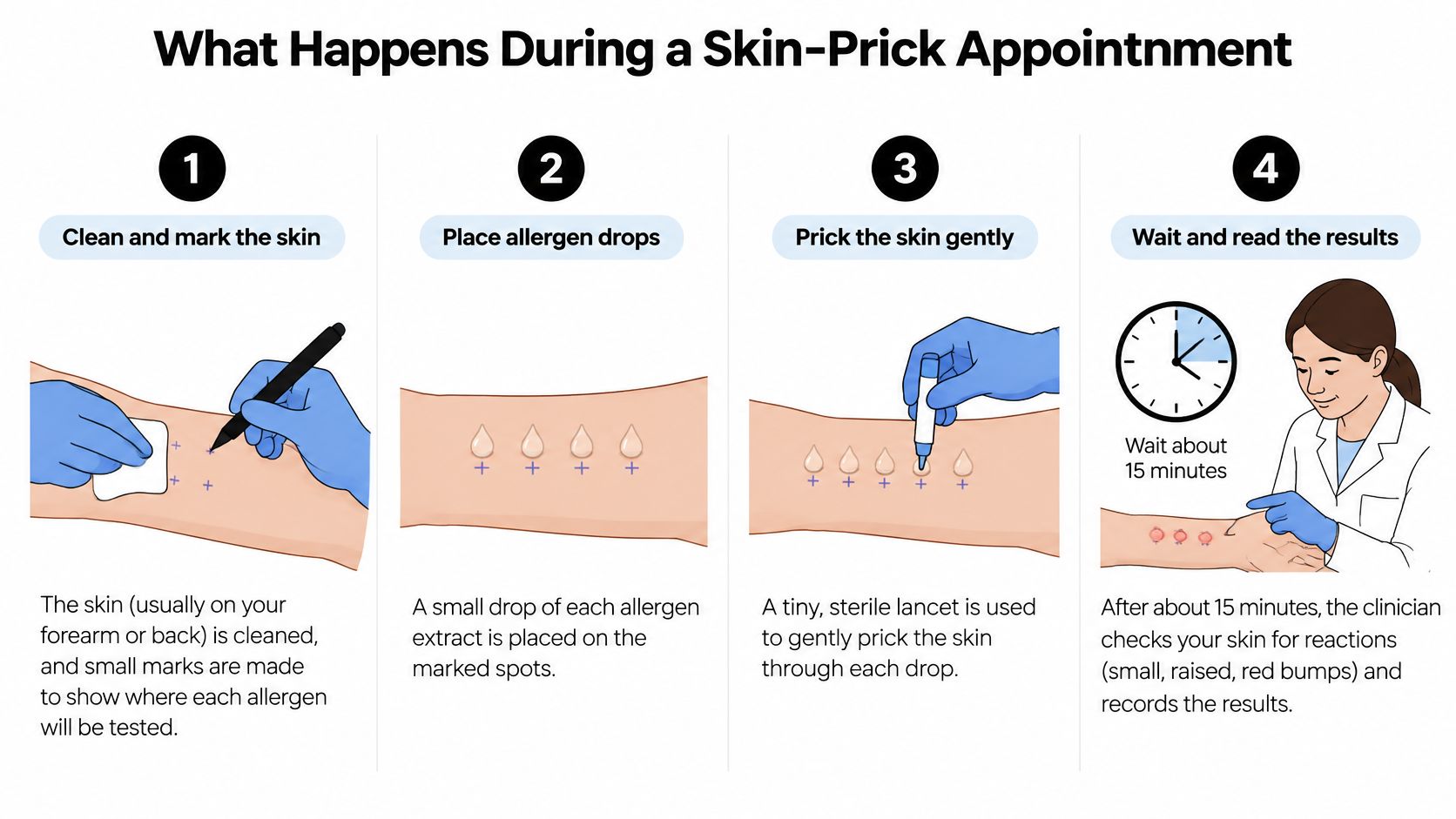
- The clinician cleans and marks your skin. The forearm or back is prepared, and pen marks identify the test sites. Avoid rubbing the markings away, because the clinician needs to match each response to the correct extract.
- Allergen drops are placed and the skin is gently pricked. A small testing device introduces each extract through the skin's surface. Stay still and tell the clinician if you need a pause rather than moving suddenly.
- You wait without scratching. The waiting period lets the response develop. Scratching or rubbing can irritate neighboring skin and make the outline harder to assess.
- The clinician measures the raised wheals. Measurements are compared with positive and negative controls, which help show whether your skin responded appropriately to the testing process. Don't interpret the largest-looking spot yourself; the controls matter.
- You remain for observation and review. Staff check how you're feeling and discuss the findings alongside your symptoms. Don't leave because the drops have been wiped away.
Why some patients stay longer
For patients with multiple positive results plus asthma or previous anaphylaxis, the Australasian Society of Clinical Immunology and Allergy skin-prick testing guide recommends observation totaling about 40 minutes from the start, approximately 20 minutes after completion. That full period is particularly important in higher-risk circumstances, including food, latex or medication testing, severe asthma, beta-blocker use, pregnancy and intradermal testing.
Use this allergy-testing preparation guide to organize medication questions and your history before attending.
A typical local response feels itchy and looks like a small raised bump. Tell staff immediately if you develop breathing trouble, feel faint, or notice swelling away from the test sites.
Normal Skin Reactions and When to Get Urgent Care
Your arm or back may itch where the drops were placed. That is expected. According to Cleveland Clinic's allergy skin-test guide, itching commonly subsides within approximately 15 minutes, although redness or swelling may persist for hours or occasionally days; temporary sneezing, congestion or watery eyes can also occur.
The key is that different changes run on different clocks. Itching tends to ease first. Localized redness or swelling commonly resolves within 24 to 48 hours, and delayed changes can appear several hours later. The American College of Allergy, Asthma and Immunology's patient testing guide also describes patch removal at 48 hours and another reading around 72 to 96 hours, because some contact reactions appear later.
Post-test reactions: what is normal and what to do
| What You Notice | Usually Normal? | What to Do |
|---|---|---|
| Itching, redness or swelling at test sites | Yes; itching often fades within about 15 minutes, while redness or swelling usually settles within 24 to 48 hours | Leave the sites alone and monitor them |
| Sneezing, congestion or watery eyes | Can be temporary | Use only symptom relief your clinic has approved and note the timing |
| Delayed bumps or redness appearing hours later | Possible; usually resolves within about 48 hours | Photograph the area and contact the testing clinic |
| Widespread hives or a rash spreading across the body | Not expected | Seek urgent same-day medical review; tell the clinic |
| Breathing difficulty, throat or tongue swelling, or faintness | No | Call emergency services now |
Report changes without interpreting them yourself
A delayed bump doesn't reliably establish that you have a true allergy, and a dramatic-looking wheal says nothing on its own about how severe a real-world reaction would be. Photograph the area, record when it appeared, and contact the testing clinic that day for advice rather than trying to score the reaction yourself. Until your clinician interprets the results alongside your history, keep eating and taking your usual medications as directed unless the clinic tells you otherwise.
Systemic reactions are uncommon with appropriately supervised testing, but rapidly worsening symptoms require emergency care. Don't wait for a clinic callback if breathing, throat swelling or faintness is involved.
Safety rule: Don't deliberately eat a suspected food or take a suspected medication at home to confirm a result. A diagnostic challenge needs a qualified clinician's plan and supervision.
What a Positive or Negative Result Really Means
A positive allergy test works like a smoke alarm: it tells you to investigate, but it does not establish the cause or predict how serious a future reaction could be. The key distinction is sensitization versus clinical allergy.
Sensitization means your immune system recognizes the tested substance. Clinical allergy means exposure produces a compatible allergic reaction. According to the AAAAI allergy diagnostic testing practice parameters, a skin-prick wheal is commonly considered positive when it is at least 3 mm larger than the negative control, and that finding still has to be read alongside symptoms, timing and controls.
What each test result means and what it does not prove
| Result | What It Tells You | What It Does Not Tell You |
|---|---|---|
| Positive skin-prick test, meeting the wheal threshold | Sensitization to that allergen | Whether exposure will cause symptoms or how severe a reaction would be |
| Negative skin-prick test | Lowers the probability of allergy | Absolute certainty, because medications, extract quality and skin reactivity can affect results |
| Positive blood specific-IgE test | Allergen-specific antibodies are present | Clinical relevance without matching symptoms and exposure history |
| Inconclusive pattern | Further assessment may be needed, such as blood testing or a supervised challenge | A final diagnosis |
Why food-test positives need context
Food skin-prick testing is designed to catch most true sensitizations, so a negative result can be reassuring when the history also fits. The tradeoff is that it also flags many people who tolerate the food in real life, which is why a positive result alone is not a diagnosis.
In plain language, a sensitive test is good at finding possible allergy, but some positives are false alarms in everyday life. A larger bump also does not forecast a more severe future reaction.
For more detail, see how allergy test accuracy differs from a personal diagnosis.
The decisive conversation connects the result with what happened during an actual exposure: what you encountered, how soon symptoms began, and whether the same pattern occurred again. If those pieces do not fit, the next step is clarification, such as history review, blood testing or a supervised challenge, instead of an automatic food or medication restriction.
Next Steps After a Positive Result
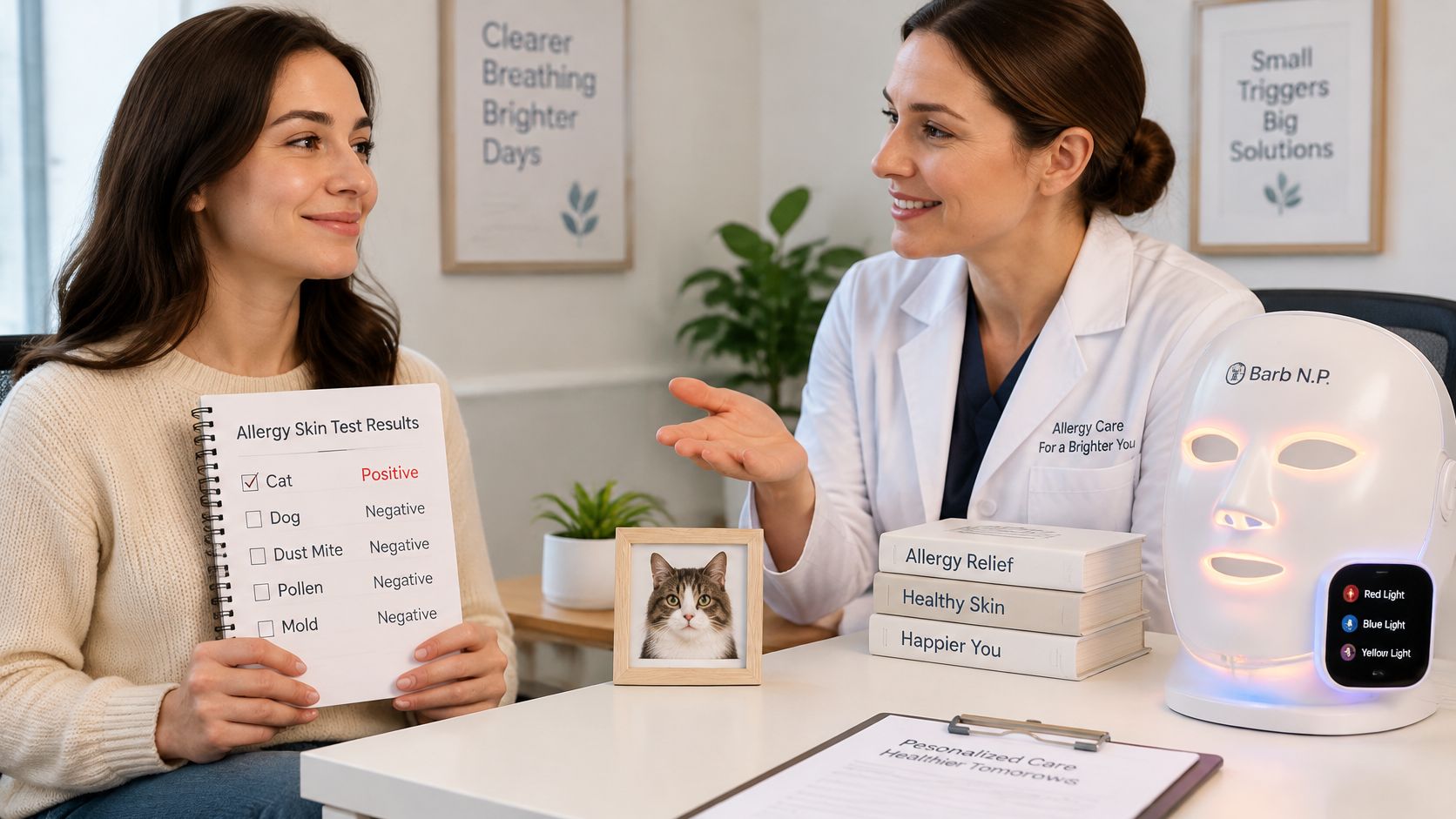
Say your cat skin test is positive, but you've never had symptoms around cats. Your clinician may recommend keeping your current routine, watching for a consistent symptom pattern, and agreeing on a treatment plan if symptoms develop, rather than immediately removing your pet.
Now consider a positive peanut result in someone who has regularly eaten peanuts without symptoms. That history matters, but it isn't an invitation to make an independent decision about the next serving. Ask the clinician specifically whether you should continue eating peanuts while the result is being clarified.
Turn the result into specific decisions
The follow-up plan should tell you what to do, not just name substances.
- Personalized avoidance: Clarify which exposures need avoiding and whether that advice is temporary or ongoing.
- Medication planning: Confirm what to use for symptoms, when to restart medicines held for testing, and whether any prescription needs review.
- Emergency preparation: If your history includes severe reactions, ask for a written emergency action plan and instructions for any prescribed rescue medicine.
- Further evaluation: Request referral or targeted testing when the history and initial findings don't agree.
Broad food panels can produce unexpected positives and unnecessary restrictions. Removing foods without a clinically relevant reason can create nutritional gaps, increase anxiety, and make daily meals harder than they need to be.
A useful question is: Which changes are necessary now, and which should wait until you've interpreted my history and results together?
When a supervised challenge helps
A medically supervised oral food challenge is the diagnostic reference standard when history and initial testing are inconclusive. The ACAAI food-allergy diagnosis guide describes gradually increasing doses, usually over two to three hours, followed by at least one hour of observation.
Don't stop a prescribed medication because its name appears on a report. Contact the prescribing clinician and testing service to establish whether the finding applies to that medicine and what alternatives, if any, are appropriate.
For a confirmed airborne trigger, environmental measures may become part of the plan. If your clinician recommends room filtration, you can compare specifications when you shop allergy-focused air purifiers from EcoQuest Purifiers; treat a purifier as an environmental product to assess, not proof that a test result requires a purchase or a replacement for treatment.
When Symptoms Continue After a Negative Test
A negative report can feel frustrating when you still have congestion, rashes or symptoms after meals. It doesn't mean your symptoms aren't real, and it doesn't automatically explain their cause.
The clinician may need to reconsider exposure timing, medication effects, a condition that doesn't involve IgE antibodies, or a different diagnosis. Cleveland Clinic's allergy-testing overview emphasizes interpreting testing alongside the clinical picture rather than relying on the result alone.
Start a usable symptom diary
Beginning the day after testing, record ordinary exposures without deliberately recreating a suspected reaction:
- Date and time: Note when the exposure occurred and when symptoms began.
- Food or medication: Record the specific item, relevant ingredients and amount taken when known.
- Symptoms: Describe what happened, such as itchy eyes, raised hives or abdominal discomfort.
- Severity and duration: Explain how symptoms affected you, how long they lasted, and whether they changed.
- Treatment and response: Write down what you used and whether it helped.
Keep entries factual rather than labeling every episode an allergy. For example, recording that your eyes became itchy while cleaning a bedroom gives the clinician more useful information than writing that you reacted to dust.
Bring the pattern, not just the conclusion. Your clinician needs the sequence of exposure, symptoms and recovery.
Arrange a focused follow-up
Book a review if symptoms persist beyond what the testing clinic described or keep recurring after a particular exposure. Bring your written test report, diary, current medication list and any photographs of skin changes.
Emergency symptoms still require emergency care, regardless of a negative result. For ongoing nonurgent symptoms, ask when reassessment should happen and whether repeat testing, a different test or a supervised challenge would answer a specific unresolved question.
Confirm Your Plan With Your Clinician
A positive mark on a printout is not a diagnosis. It works more like a smoke alarm, signaling that something deserves a closer look without telling you what caused it or what to change. Before leaving the clinic, or while arranging your follow-up, make sure you can explain the plan in your own words. If you only know which boxes were marked positive, you still need the practical interpretation.
Your follow-up checklist
- Identify the tests: Confirm exactly what was performed, which findings are complete, and which results remain pending.
- Set a result date: Ask when each outstanding result is expected and whom to contact if it has not arrived.
- Request the written report: Get a copy and a plain-language explanation of what each relevant finding means for daily life.
- Define restrictions: Write down which foods, medicines, products or activities to avoid, which can continue, and what needs clarification. A positive result alone does not prove a restriction is necessary, so ask your clinician to separate genuine avoidance from findings that only need watching.
- Confirm treatment: Check the medication plan, including when to restart anything paused before testing.
- Review emergency instructions: Know which symptoms require immediate help and whether you need a personalized action plan.
- Schedule reassessment: Establish when follow-up should occur and what question any repeat test or challenge would answer.
Keep unrelated skincare decisions separate
A food or environmental panel does not evaluate every possible contact trigger, so do not assume a clear panel clears your cosmetics. Avoid applying new skincare products to irritated test sites while you are monitoring them, and bring ingredient lists for anything you suspect so your clinician can judge whether a different type of testing is needed.
BotoxBarb offers allergy tests, and a consultation with Barb N.P. can help you organize your questions and decide which follow-up fits your situation.
Diet, medication and further-testing decisions belong with a qualified clinician. A result read in isolation pushes people toward restrictions they never needed, and the written plan is what turns findings into safe instructions. Leave with instructions you understand and a named person to contact.
BotoxBarb offers allergy testing and consultations where you can organize your questions and plan next steps, plus a curated skincare selection including SkinCeuticals sun protection. Visit BotoxBarb to arrange a consultation with Barb N.P., and bring your test report, medication list and questions about what you can safely continue.