Which Lasts Longer Botox or Dysport A Definitive Guide
When it comes to neurotoxins, the million-dollar question is always the same: “Which one lasts longer, Botox or Dysport?”
Here’s the straight answer from years of clinical experience: both treatments offer a very similar duration. Most of my clients see beautiful, smooth results for about three to four months. While you might hear stories online about one outlasting the other, the clinical evidence just doesn't show a significant difference in how long they stick around.
A Head-to-Head Comparison of Neurotoxin Duration
So, if they last about the same amount of time, what's the real difference? It all comes down to the subtle nuances—things like how quickly you see results, how the product settles into the muscle, and which areas it’s best suited for.
Understanding these details is what helps us choose the perfect treatment for your goals, whether we’re meticulously targeting fine crow’s feet or aiming for a softer, broader effect on the forehead.
The infographic below gives you a clean visual of what to expect.
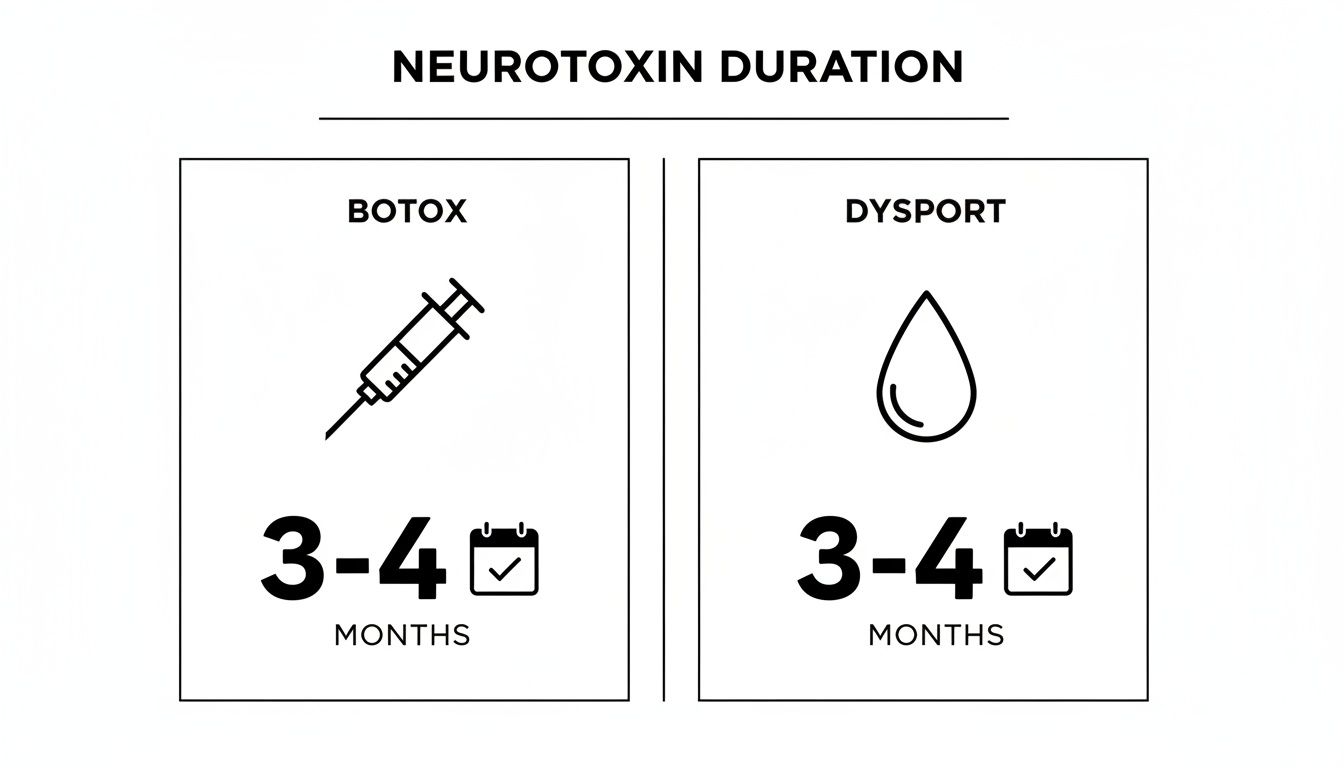
As you can see, both Botox and Dysport reliably deliver results within that 3-4 month window. From a pure longevity standpoint, they are equally fantastic choices.
Key Differences at a Glance
Before we get into the science, let’s break down the most important distinctions between these two powerhouse products. I've put together a quick comparison table to summarize what truly sets them apart.
Botox vs Dysport Quick Comparison
| Feature | Botox | Dysport |
|---|---|---|
| Average Duration | 3-4 months | 3-4 months |
| Onset Time | 4-7 days | 2-3 days |
| Primary Use Cases | Precise, targeted areas like glabellar lines | Larger areas like the forehead or crow's feet |
| Diffusion | Lower spread, remains localized | Higher spread, feathers out for a softer look |
This table makes it clear: while how long they last is nearly identical, the real differentiators are how fast you'll see the magic happen and how the product spreads once injected. These are the details that matter most when customizing a treatment plan.
Clinical Data on Longevity
Don't just take my word for it—the science backs this up. Study after study confirms that Botox and Dysport have remarkably similar longevity profiles.
One key double-blind, randomized study found no statistically significant difference between the two. Botox showed a mean duration of 260 days (ranging from 90-360 days), while Dysport came in at a mean duration of 290 days (also ranging from 90-360 days).
This reinforces what we see in the clinic every day. A patient’s unique metabolism, the dose we use, and my injection technique often have a much bigger impact on results than the brand name on the vial. You can dig deeper into the research and get more insights into how long Dysport typically lasts.
Understanding the Science Behind Neurotoxins
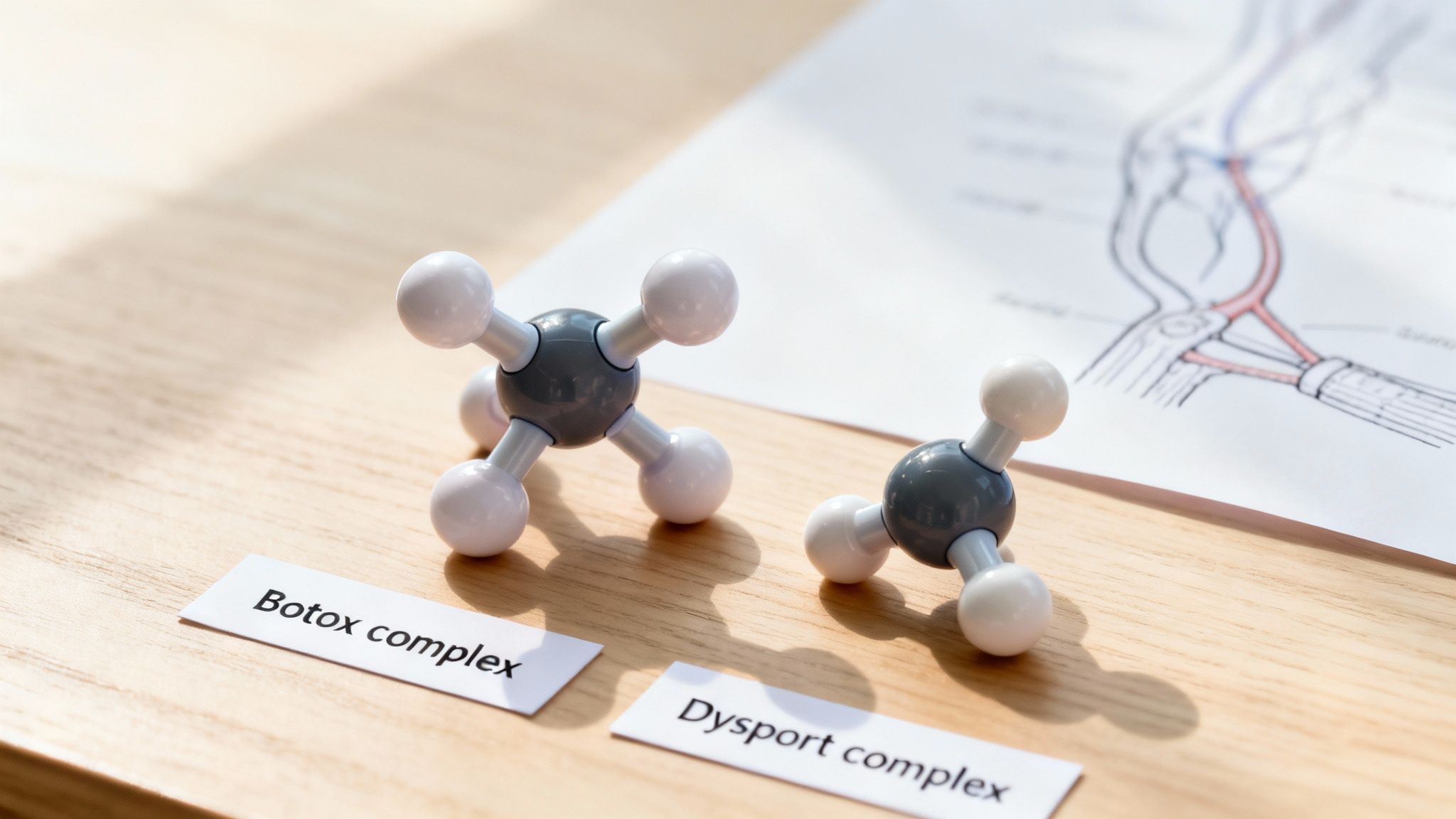
To really get to the bottom of the Botox vs. Dysport debate—and why an injector might choose one over the other for you—we have to look at what’s happening on a molecular level. Both are incredible products, and both are derived from botulinum toxin type A. Their core job is the same: to temporarily interrupt the nerve signals telling your muscles to contract, which is what smooths out wrinkles caused by expression.
Think of it like this: your brain sends a message down a nerve to a muscle, telling it to move. That nerve ending is like a switch that turns on the muscle. Neurotoxins work by temporarily placing a block on that switch. The muscle can't get the "on" signal, so it stays relaxed. That’s how we see those forehead lines, frown lines, and crow's feet soften and fade away.
Unpacking the Molecular Differences
While they start from the same place, the real difference is in the protein structure that surrounds the active toxin molecule. Imagine the active ingredient is a diamond. Botox encases that diamond in a heavier, more complex set of protective proteins, giving it a higher molecular weight.
Dysport, on the other hand, uses a much smaller and less complex protein structure. It’s this seemingly minor detail that creates all the practical differences we see in the clinic, from how the product behaves in the tissue to the way we calculate the units for your treatment.
The Role of Diffusion and Spread
That difference in molecular weight has a direct impact on how each product spreads, or diffuses, after it's been injected.
- Botox: With its larger protein complex, it tends to stay put. It has a more localized effect, which makes it perfect for targeting small, powerful muscles with precision—like the ones between your brows that create those "11" lines.
- Dysport: Because it's a smaller molecule, it spreads out a bit more from the injection site. This is a huge advantage when treating larger areas like the forehead. It allows us to create a soft, feathered, and incredibly natural-looking result with fewer injection points.
This isn't a case of one being "better." It's about choosing the right tool for the right job. The real artistry of an experienced injector is knowing which product’s diffusion pattern will best deliver the patient's specific aesthetic goals.
Dosing Units and What They Mean
The molecular differences also explain why we can't just swap one for the other, unit for unit. You’ll often hear injectors talk about a dose conversion ratio, which is typically 2.5:1 or 3:1 (Dysport to Botox). This doesn’t mean Dysport is "weaker." It's just a different measurement system based on its unique formulation.
Knowing this science is key to answering the big question: "Which one lasts longer?" While their core mechanism and longevity are very similar, these molecular nuances change how they perform in different parts of the face, which ultimately affects how long you perceive your beautiful results to last.
Analyzing the Clinical Studies on Longevity
While most people get a solid 3-4 months from both Botox and Dysport, the clinical research tells a more nuanced story. This is where we can start to understand why some patients swear one lasts longer than the other. These studies go beyond just looking in the mirror; they use precise tools to measure exactly how these neurotoxins perform over time, giving us a much clearer picture of their subtle differences.
This level of detail matters because "longevity" isn't just about the total time until your next appointment. It’s also about how well the treatment holds its peak effect and how gradually muscle movement comes back.
What Electromyography Studies Reveal
One of the most objective ways to measure a neurotoxin’s effect is with electromyography (EMG), a technique that records the electrical activity in muscles. Instead of just assessing wrinkles visually, EMG shows us exactly how much a muscle's ability to contract has been blocked.
Some of this highly specific research has found slight advantages for Dysport at certain points in the treatment cycle. For instance, one study using EMG showed Dysport had statistically significant longer-lasting effects on both muscle activity and forehead wrinkles starting 10 weeks after injection. This advantage continued for the rest of the study. You can read more about these neuromodulator study findings.
This data suggests that while both products have a similar overall duration, Dysport might maintain its peak muscle-relaxing power a bit longer in the later stages of the treatment window.
Key Takeaway: Even if the results for both fade around the same time, some evidence suggests Dysport may hold its maximum wrinkle-smoothing effect for slightly longer before it begins to wear off. This could be why some patients anecdotally report that Dysport "feels stronger for longer."
Patient-Reported Outcomes and Relapse Rates
Beyond objective muscle data, what patients see and feel is crucial. Patient-reported outcomes are a cornerstone of understanding which product delivers the most satisfying, real-world results.
In many head-to-head trials, patient satisfaction is remarkably similar for both Botox and Dysport. Where we sometimes see a slight difference is in when patients feel they need a touch-up. These variations often come down to individual factors, which is why it's so important to understand what affects your personal results. For more on this, check out our guide on understanding Botox longevity.
Studies looking at relapse rates—the point where muscle function returns to a certain level—also hint at subtle differences. A few findings suggest full muscle activity might return a week or two later with Dysport in specific areas, but these differences are rarely significant enough to officially change the standard 3-4 month retreatment schedule.
Combining Treatments for Extended Results
To get the absolute most out of your injectables, you have to support your skin's health from the outside, too. Neurotoxins relax the muscle, but high-quality skincare is what makes the canvas glow. This is where at-home devices can play a huge role.
I often recommend the Barb N.P. Facial Mask to my clients to complement their in-office treatments. This innovative device is completely wireless, making it incredibly comfortable and easy to use while you relax or move around the house. It offers three light settings to target different skin concerns:
- Red Light: This is fantastic for stimulating collagen, which helps improve skin firmness and can amplify the smooth look you get from Botox or Dysport.
- Blue Light: If you're prone to breakouts, this setting targets and helps eliminate acne-causing bacteria for a clearer complexion.
- Amber Light: This light works to reduce redness and even out your skin tone, giving you a brighter, more radiant finish.
Using an LED mask regularly helps maintain excellent skin quality, ensuring the surface looks just as smooth and youthful as the relaxed muscle beneath.
Key Factors That Influence Your Treatment Duration
When you’re asking, “which lasts longer, Botox or Dysport,” the answer isn’t really in the bottle. The truth is, how long you’ll enjoy those smooth, refreshed results comes down to your unique body and the specifics of your treatment. Getting a handle on these variables is the key to setting the right expectations.
Think of it this way: just like some people burn through calories faster, some bodies process medications like Botox or Dysport more quickly. It’s not something you can control, but it explains why one person might get a full four months from their treatment while a friend is ready for a touch-up at the three-month mark.
Patient-Specific Factors
Your own physiology is the biggest piece of the puzzle. A few personal traits and lifestyle habits can really change the game when it comes to longevity.
- Your Metabolic Rate: If you have a high metabolism—maybe you’re a dedicated athlete or love intense, frequent workouts—your body will likely break down the neurotoxin faster. Your system is just naturally efficient at processing everything, including your injectable treatments.
- Muscle Mass and Strength: Stronger, more prominent facial muscles often need more product to achieve that smooth, relaxed look. These powerful muscles can also work through the product more quickly, which might shorten how long your results last.
- Your Treatment History: If it's your first time, you might notice the effects seem to fade a bit sooner. But with consistent treatments over time, those targeted muscles actually get "trained" to stay relaxed, which can help extend the time between your appointments.
Your first treatment is like the initial training session for your muscles. With regular follow-ups, they learn to hold that relaxed state for longer, potentially stretching the time between visits.
Treatment-Specific Variables
Beyond your body’s biology, the details of the treatment itself are critical. Every choice your injector makes, from the dosage to the exact placement, directly impacts your outcome. A skilled provider like Barb N.P. carefully maps out these factors to give you the best, longest-lasting results.
- Dosage: This is a big one. A dose that’s too low—sometimes called "baby Botox"—is naturally going to wear off faster. Your injector needs to administer the precise number of units required to effectively relax the target muscles for that standard 3-4 month period.
- Injection Precision: The skill and anatomical knowledge of your injector are everything. Placing the product in the exact right spot at the correct depth ensures the muscle is treated properly, leading to a much more predictable and sustained result.
- Treatment Area: Where you get treated matters, too. Smaller muscles with less frequent movement, like the ones that cause crow’s feet, may hold onto the results longer than larger, more active muscles like the frontalis in your forehead.
To complement the muscle-relaxing effects of your treatment and keep your skin healthy and glowing, think about adding an at-home therapy device to your routine. The Barb N.P. Facial Mask is a perfect choice. It’s completely wireless, making it super comfortable and easy to wear while you unwind. It has three light settings for different skin needs: red light for boosting collagen, blue light for targeting acne, and amber light for calming redness. Using it consistently can seriously upgrade your overall skin quality, making your injectable results look even more amazing.
Planning Your Treatment Schedule and Aftercare
Knowing the clinical data is one thing, but translating it into a real-world treatment plan is what creates those gorgeous, lasting results. When clients ask, “which lasts longer, Botox or Dysport?” my answer often circles back to one key principle: consistency. A smart treatment schedule and diligent aftercare are your best tools for getting the most out of every appointment.
Most experienced injectors, myself included, will recommend booking your follow-up appointments every 3-4 months. This isn’t a random number. We time it this way to retreat the muscles just as they start to regain movement, long before the lines have a chance to etch back into your skin.
This proactive approach keeps you ahead of the game, preventing that frustrating "rollercoaster" of watching wrinkles fully return before you come back in. Sticking to a schedule is how you maintain seamless, predictable results.
Establishing Your Retreatment Cycle
While that 3-4 month window is a solid guideline, your personal cycle might look a little different. Clinical studies give us a great baseline—for instance, one study on Dysport found the average time before retreatment was 3.9 months, with many patients coming back around 3.3 months. This lines up almost perfectly with what we see in Botox users, who also tend to rebook within that same timeframe. You can read more on the research behind neurotoxin retreatment schedules.
Over time, you and your injector will figure out your unique rhythm. If you have a faster metabolism, you might find yourself closer to the 3-month mark. Others, especially after a few consistent treatments, might be able to stretch it to four months or even a bit longer.
A consistent treatment schedule does more than just maintain your look—it can actually train your facial muscles to stay relaxed. Over several sessions, you may find that you can gradually extend the time between your appointments without sacrificing results.
Critical Aftercare for Maximum Longevity
What you do in the first 24-48 hours after you leave the clinic has a huge impact on how well your treatment settles and how long it lasts. Think of these simple rules as non-negotiable for protecting your investment.
- Avoid Strenuous Activity: For at least 24 hours, hold off on high-intensity workouts, hot yoga, or anything that really gets your heart pumping. Increased blood flow can encourage the product to spread away from the muscles we so carefully targeted.
- Stay Upright: Don't lie down flat for at least four hours after your injections. It’s a simple but crucial step to ensure the product stays exactly where it needs to be.
- Hands Off: This one can be tough, but resist the urge to rub, massage, or put any pressure on the treated areas for the first day. That means no facials, no facial massage tools, and no tight hats or headbands pressing on your forehead.
Because both Botox and Dysport generally require a similar number of treatments per year, the financial commitment ends up being pretty comparable. This frees us up to choose the best product for you—based on your anatomy and aesthetic goals—rather than getting bogged down in minor cost differences. It’s all about picking the right tool for the best possible outcome.
How to Enhance and Extend Your Results at Home
So much of the conversation around Botox and Dysport is about what happens in the clinic. But what you do at home? That plays a massive role in protecting your investment and keeping that smooth, refreshed look.
Think of it this way: your neurotoxin treatment is the foundation. Your daily skincare and wellness routines are what build a beautiful, lasting structure right on top of it. Healthy, vibrant skin will always showcase your results better.
Complement Your Treatment with Advanced Skincare
To really support your Botox or Dysport, you need to think beyond a simple cleanser and moisturizer. Integrating powerful, targeted treatments can seriously improve your skin’s texture and resilience. This is where advanced tools like LED therapy come in, working to rejuvenate your skin from the inside out.
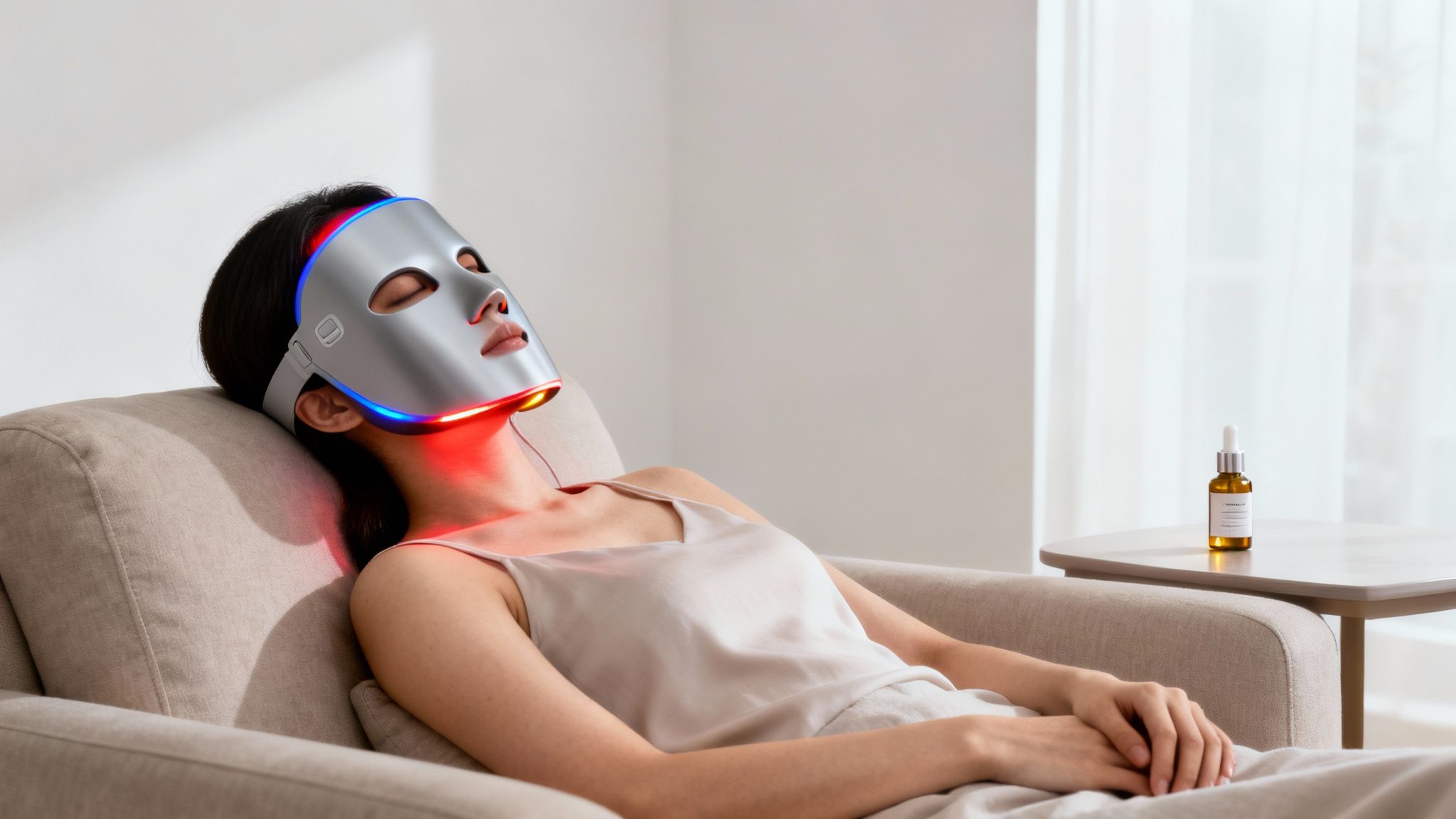
One of the most effective at-home devices I recommend to my clients is the Barb N.P. LED Facial Mask. It’s designed for real life—its wireless construction means you can wear it while you relax, read, or walk around the house. You're not stuck tethered to a wall, which makes using it consistently a breeze.
The mask has three different light settings, and each one offers a specific benefit that perfectly complements your injectable treatments:
- Red Light: This is a powerhouse for stimulating collagen. More collagen means firmer, plumper skin, which beautifully amplifies the wrinkle-smoothing effects of your neurotoxin. It’s also fantastic for reducing inflammation.
- Blue Light: If you’re prone to the occasional breakout, blue light is your best friend. It targets and neutralizes acne-causing bacteria, giving you a clearer, more even complexion.
- Amber Light: This light is all about calming the skin. It works to reduce redness and improve your overall skin tone, leaving you with that healthy, even glow.
When you regularly use an LED mask, you’re actively improving the very canvas your injector works on. Healthier, more resilient skin doesn’t just look better on its own—it creates the ideal environment for your neurotoxin results to truly shine.
For those looking to build out a complete maintenance routine, we've outlined even more strategies. You can dive into our detailed guide on how to make your Botox last longer to find more tips and product recommendations.
Using the Barb N.P. Facial Mask consistently creates a powerful synergistic effect. While your neurotoxin is handling the dynamic wrinkles from muscle movement, the mask is busy refining your skin’s surface, tackling pigmentation, and boosting collagen. It’s a dual approach that ensures your results look flawless from every angle.
Your Questions, Answered
Even after comparing all the details, it's totally normal to have a few more questions pop up. We get it. To make sure you feel completely confident, here are the answers to some of the most common things we discuss with our clients about Botox and Dysport.
Can I Switch Between Botox and Dysport?
Absolutely. It’s actually quite common for patients to switch between the two. You might try one and then the other to see which one your body responds to best, or even use different products for different treatment areas.
Since both are derived from botulinum toxin type A, there's no medical reason you can't try one after the other. The most important thing is to keep your injector in the loop about your full treatment history.
When you're choosing a provider, look for transparency. Understanding their approach to patient care, like their med spa review generation strategies, can tell you a lot about their commitment to patient satisfaction. A great provider will always be happy to discuss your past treatments and future goals.
Is One More Painful Than the Other?
Nope, the injection experience for Botox and Dysport is practically identical. Any minor discomfort you might feel comes from the tiny needle prick itself, not the product being injected. We use extremely fine needles to make the whole process as quick and comfortable as possible.
Does Building a Tolerance Affect How Long It Lasts?
This is a great question. While it’s technically possible for your body to develop antibodies to the proteins in neurotoxins, it's incredibly rare in a cosmetic setting.
More often than not, what feels like "tolerance" is really just a sign that you might need a small dose adjustment. Over years of consistent treatment, your muscle patterns can change, and your treatment plan should evolve with you.
Key Insight: If you notice your results aren't lasting quite as long as they used to, it's far more likely that your dosage or injection pattern needs a tweak. It’s rarely a sign of true resistance.
How Can I Keep My Results Looking Great Between Appointments?
This is where smart at-home care makes all the difference. Keeping your skin healthy and radiant is the best way to complement your neurotoxin treatments and make them look even better.
Investing in a quality skincare routine and targeted at-home devices can significantly elevate your overall results.
The Barb N.P. LED Facial Mask is a perfect addition to your maintenance plan. It’s designed to be completely effortless with a comfortable, wireless fit, so you can treat your skin while you relax. The mask features 3 lighting settings to target specific concerns:
- Red Light: To help boost collagen production for firmer, plumper skin.
- Blue Light: To target and reduce acne-causing bacteria.
- Amber Light: To soothe redness and promote a more even skin tone.
Using it regularly helps keep your skin’s surface smooth and glowing, which beautifully enhances the effects of your Botox or Dysport and helps you feel amazing between visits.
At BotoxBarb, our entire philosophy is built on empowering you with the knowledge to make the best decisions for your aesthetic journey. Whether you’re leaning toward Botox, Dysport, or just want to level up your skincare, we invite you to book a consultation to create a plan that’s all about you. Explore our curated selection of medical-grade products at barbnp.shop and take the next step.