Allergy Testing Kit Guide: Types, Accuracy, and Next Steps
Many start with the wrong question. They ask which allergy testing kit is the most accurate, when the issue is whether the kit is measuring a true allergy at all, or just producing a list of foods and substances that may never have caused a reaction. That distinction matters because consumer tests can look scientific while still falling short of a clinical diagnosis.
The demand is real, though. Allergy UK says the UK has over 20% of the population affected, 44% of British adults report at least one allergy, and 50% of people under 35 say they have one, while hospital admissions for anaphylaxis rose 615% between 1992 and 2012. In the broader market, one report valued allergy test kits at about $2.0 billion+ in 2023 and projected $2.932 billion in 2025 at a 3.7% CAGR, which tells you this category isn't a fad, it's a response to persistent need. Those numbers help explain why home testing has become so tempting, but they don't prove every kit is worth your trust. See the clinical critique from the British Dental Association's summary of home testing concerns in the context of this market pressure: BDA discussion of home allergy testing kits.
What Allergy Testing Kits Actually Measure
The first question I ask clients is whether the allergy testing kit measures a true allergy at all. That matters because marketing often blurs immune sensitization and a symptom-producing allergy, and those are not the same thing. A kit may detect antibodies, but antibodies alone do not tell you whether your body reacts in a way that is clinically meaningful.

IgE is the meaningful signal
The antibody that matters in allergy workups is IgE, especially when the test is validated for a specific suspected allergen. In the FDA-reviewed example, a solid-phase chemiluminescent immunoassay reported a working range of 0.1 to 100 kU/L, a limit of blank of 0.1 kU/L, and lot-to-lot variability within ≤20% (FDA review PDF). That range matters because borderline reactivity and stronger positivity do not carry the same clinical weight.
A validated IgE result can help a clinician connect symptoms to a plausible trigger. It still does not prove that a person will react every time they encounter that trigger. In practice, history, timing, and symptom pattern do most of the work when a result is being interpreted.
IgG is where consumers get misled
IgG is the common trap. A positive IgG result often reflects exposure, not danger, and it can push people into unnecessary avoidance without a real diagnosis. Specialist guidance says many at-home food allergy and sensitivity tests are unproven, nonstandardized, or not recommended for diagnosing food allergy, and patients sometimes spend heavily only to find that removing the flagged foods does not improve symptoms (CU Anschutz guidance).
Practical rule: if a kit promises to tell you your “sensitivities” without tying results to a validated clinical condition, treat it as a conversation starter, not a diagnosis.
A direct comparison of the two antibody approaches is useful here, especially for clients deciding whether to trust a home result or escalate to formal testing. See IgG vs IgE allergy testing for a closer look at why the distinction changes the meaning of the result. That is why I stay cautious with broad panels. They can generate data, but data is not the same thing as a diagnosis.
IgE vs IgG Testing and Why the Difference Matters
The divide between IgE testing and IgG testing is the divide between clinical use and marketing language. IgE belongs in formal allergy evaluation because it measures an immune response linked to immediate-type allergy. IgG is often sold as a shortcut for “food sensitivity,” but that claim does not hold up well in mainstream allergy practice.
| Feature | IgE Testing | IgG Testing |
|---|---|---|
| Clinical role | Used in allergy workups for suspected immediate reactions | Often marketed for sensitivity or tolerance claims |
| What it measures | Allergen-specific immune sensitization | Antibody presence that may reflect exposure |
| Result meaning | Can support diagnosis when matched to history | Usually not enough to diagnose a food allergy |
| Validation | Available in clinical and laboratory formats | Commonly controversial in consumer testing |
| Best use | Targeted evaluation of specific suspected allergens | Limited practical value for diagnosing allergy |
Modern allergen-specific IgE kits are usually quantitative immunoassays, not simple yes-no screens. One FDA-reviewed example used a two-step chemiluminescent assay with a 0.1 to 100 kU/L range, while an ELISA-based panel used only 50 µL of serum or plasma per allergen and reported a detection threshold starting at 0.35 kU/L, with intra- and inter-assay precision around 4.47%/4.61% CV. That kind of repeatability matters because clinicians need results they can compare with the symptom history and, if needed, with repeat testing over time.
For a consumer-facing contrast between these two testing philosophies, the internal discussion here is worth a look: IgG vs IgE allergy testing
Rapid screening versus lab quantitation
Format matters too. Rapid lateral-flow food allergen kits can return results in about 11 minutes including extraction, which is useful for on-site screening and quick checks (Romer Labs food allergen kits). Lab-based ELISA systems trade speed for concentration data, including low-level quantitation such as 2.5 ppm gliadin for gluten-related testing and other ranges like 2.5 to 25 ppm for specific allergens. Those ppm-level limits are operationally important when cleaning validation or supplier QA requires defensible numbers, not just a visible line on a strip.
That is the basic trade-off. IgE can support a validated allergic mechanism, while IgG often tells you little about what belongs on an avoidance list. If a product leans heavily on IgG and speaks vaguely about “sensitivities,” I would treat it with caution.
How to Use an Allergy Testing Kit Correctly
Using an allergy testing kit is only straightforward if you respect the small details. I've seen people sabotage otherwise decent kits by collecting samples at the wrong time, skipping instructions, or shipping specimens in poor condition. The kit can't rescue bad collection technique.

Start with the right kit and the right target
Choose a kit for the specific suspected problem, not the broadest panel on the shelf. A food-focused IgE panel is not the same thing as a contact dermatitis workup, and an environmental panel won't solve a reaction that only happens with ingestion. If you're trying to understand how home testing fits into a broader setting, the BotoxBarb article on allergy testing at home gives a helpful consumer-oriented frame.
For a useful outside resource on indoor exposure context, I also like the practical framing in Can Do Duct Cleaning air quality kit, especially for people trying to sort symptoms that seem tied to dust, HVAC, or seasonal buildup rather than one food.
Collect carefully and ship promptly
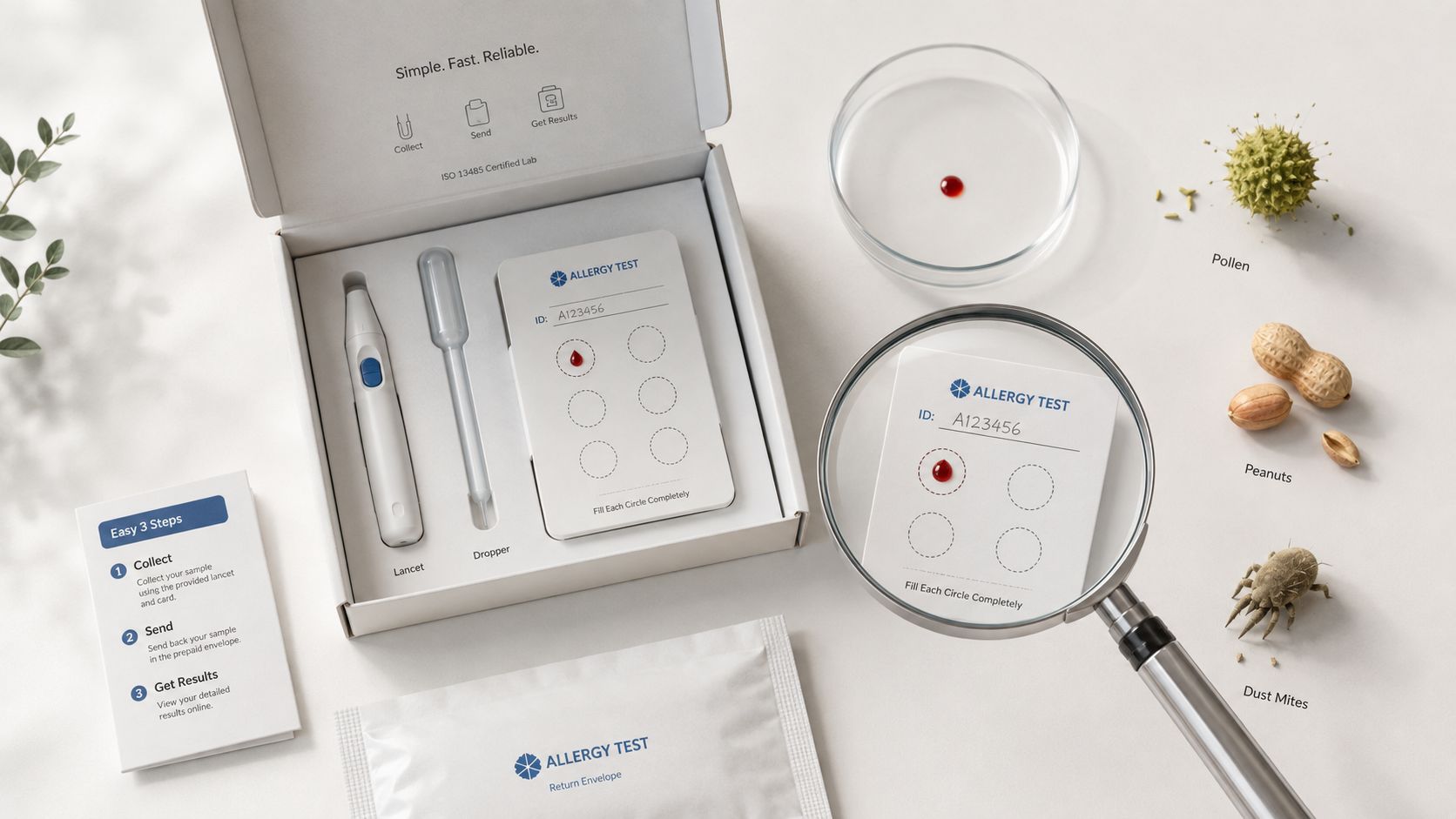
Finger-prick blood collection should be clean and deliberate. Wash and dry your hands, warm the finger if the instructions allow it, and collect the sample as directed so you don't contaminate it or underfill the card. Hemolysis, poor drying, or incomplete spots can make the lab's job harder, even if the sample still gets processed.
Follow the timing instructions exactly. A kit that asks for a specific drying window or shipping method is depending on sample stability, not convenience.
A common mistake is testing while taking medications that suppress symptoms or alter skin reactivity. Another is letting a sample sit in heat or cold long enough to degrade it. Those errors don't just create inconvenience, they can turn a readable specimen into a questionable one.
Match the result delivery to your expectations
Most mail-in kits send results through a portal or report, sometimes with trend charts or panels grouped by category. That's helpful only if you know what the numbers mean, and what they don't. A numerical result without symptom context can tempt you into overreacting to a borderline finding.
The safest habit is simple, document what you ate, what you touched, what happened, and when it happened. The kit is the measurement tool, not the final interpretation.
Understanding Accuracy and Limitations
Accuracy is where home marketing claims run into clinical reality. A consumer allergy blood test can look precise on a report, but its usefulness depends on the allergen, the symptom history, and what question you are trying to answer. In practice, a positive result may reflect true sensitization, while a negative result does not always settle the issue.

Why false positives and false negatives matter
A false positive tells you the test detected reactivity that may not show up in real life. That can push people into food fear, unnecessary shopping, and a more restrictive diet than they need. A false negative is more concerning, because it can give false reassurance to someone who still has a real allergy.
The gap between a lab marker and a real reaction is where interpretation matters most. Even an accurate-looking number can mislead if it is read without symptoms, exposure history, and timing. Skin prick testing shows why this matters. For food allergy screening, it has about 90% sensitivity but only about 50% specificity, which is why it should not be used by itself as a screening tool (StatPearls). It catches many true cases, but it also flags many people who would not react in daily life.
Home kits can't replace challenge testing
The diagnostic gold standard for suspected food allergy is supervised oral food challenge combined with history and targeted testing (AAAAI). That is the point where home kits stop, no matter how polished the report looks. Food Allergy Research & Education also notes that unproven diagnostic tests are not recommended in U.S. food allergy guidelines and may even increase the risk of an allergic reaction.
Clinical takeaway: if the kit result does not match the symptom story, the symptom story deserves the heavier weight and professional confirmation.
Rapid food allergen screening still has a place, especially when someone needs a quick go or no-go check in a food setting. The limit is clear. The moment a result starts driving long-term dietary changes, you need more than a colored strip or a mail-in panel. You need the finding interpreted against actual exposure and actual symptoms, and a practical guide to that interpretation process is available in how to read an allergy test.
Interpreting Your Results and Avoiding Common Pitfalls
A result report can be either useful or misleading, depending on how you read it. The main trap is treating a positive test as proof of disease. In allergy medicine, sensitization and clinical allergy are related, but they're not the same thing.
Read numbers as part of a story
Quantitative IgE values matter most when they match a believable history. If someone gets hives within minutes of eating a specific food and the targeted IgE result is positive, the test is supporting the story. If someone has vague fatigue and a panel flags twelve foods, that doesn't automatically justify elimination.
That's why broad restriction often backfires. People cut out more and more foods, then end up with less flexibility, more anxiety, and no clear symptom improvement. If you want a practical guide to that interpretation process, the internal post on how to read an allergy test is a useful companion.
Watch for the three common errors
The first error is overreacting to borderline values. Borderline doesn't mean harmless, but it also doesn't mean clinically meaningful without symptoms. The second is ignoring timing, because immediate-type allergy behaves differently from delayed or nonspecific symptoms.
The third error is assuming one panel can settle every question. It can't. If the history points to food, skin, or environmental exposures that don't align with the result, the result needs a second look, not automatic obedience.
If the food disappears from your meals and nothing changes, the test may have described exposure, not the cause of your symptoms.
A better approach is to compare the result with your real-life pattern, then decide whether the next step is observation, targeted re-testing, or formal clinical evaluation. That keeps you from turning a lab report into a diet prison.
When to Seek Professional Allergy Testing
Some cases call for an allergist, not another home kit. If you have severe reactions, if you suspect multiple allergens, or if your symptoms do not match the result from a home test, professional evaluation is the safer route. Home kits can be convenient, but convenience does not help when the result misses the true trigger.
A clinic can sort out problems a mail-in panel cannot. Skin prick testing uses allergen extracts on the skin with positive and negative controls spaced apart, and it gives a quick read on immediate reactions. Patch testing stays on the skin for a longer period and is used for delayed contact reactions, which is a different mechanism from classic IgE allergy. That distinction matters because a person with hives after food exposure needs a different workup than someone with a rash that builds slowly after touching something.
Blood testing is still useful when medications or skin conditions make skin testing harder to interpret. The limitation of home kits is not that they are useless, it is that they do not adapt to the clinical context. Real patients rarely present with one neat explanation.
For people who also suspect indoor exposure issues, Phoenix air duct allergy solutions is a useful reminder that symptoms can overlap with environmental buildup, not just food or skin triggers.
When the cost favors the clinic
Buying several home kits can turn into a false economy. If you keep paying for panels to answer overlapping questions, a clinician can often choose the right test for the right mechanism and interpret it against your history. That usually gives you a clearer answer with less guesswork.
Practical rule: escalate when the question is safety, not curiosity.
No home product can replace supervised challenge testing when food allergy is being considered. If the stakes include breathing problems, swelling, or a history that raises concern for anaphylaxis, professional care should take priority.
Your Next Steps with BotoxBarb
A home result only helps if it leads to the right next move. For some people, that means narrowing exposure, then discussing the findings with a clinician. For others, it means confirming the result before changing a diet, skin routine, or household plan.
BotoxBarb offers an at-home Food and Environmental Allergy Panel that uses a finger-prick blood sample and lab analysis for IgE antibody responses. That makes it a practical starting point when you want focused information instead of a broad consumer sensitivity screen. It works best as data to discuss in context, not as a way to self-diagnose every symptom under the sun. For indoor comfort alongside symptom management, the allergy air purifier shop is another resource some clients use when environmental triggers are part of the picture.
The broader wellness side still matters. LED light therapy can support skin care routines while you sort out allergy questions, and the Barb N.P. Facial Mask is described as wireless, comfortable on the face, and equipped with 3 lighting settings for different treatments. That kind of supportive device does not diagnose anything, but it can fit into a skin-focused plan while the clinical question is being worked through.

The strongest next step is straightforward. If your kit suggests a trigger, bring the result, your symptom log, and your questions into a real consultation so the finding gets interpreted properly. If you are ready to compare home testing with professional guidance, visit BotoxBarb to review the available allergy panels and choose the follow-up that matches your symptoms instead of chasing a stack of conflicting reports.