Allergy Testing Near Me: A Practical Local Guide
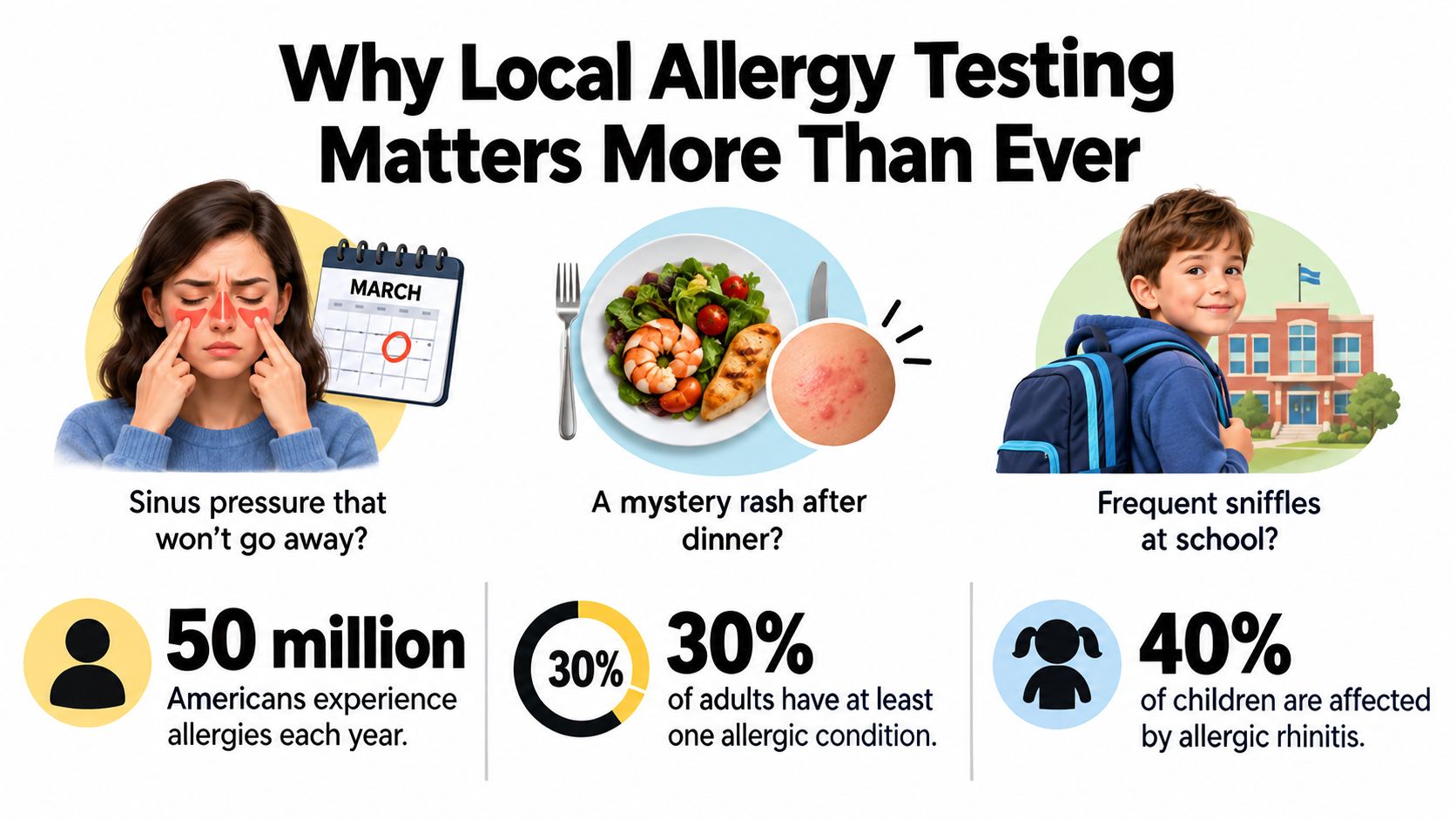
You've searched “allergy testing near me” after another episode you can't quite explain. Maybe it's sinus pressure that returns every spring, a rash that appears after dinner, or a child who develops symptoms at school and feels fine at home. The difficult part isn't finding a test. It's finding a clinician who can connect the result to your actual symptoms instead of handing you a long list of substances to avoid.
Allergy testing can be useful, but only when the question is specific and the interpretation is careful. A positive result may show sensitization, not a proven clinical allergy. The right local appointment should give you more than convenience. It should give you a reasoned testing plan, safe preparation, and a results review that leads to practical next steps.
Why Local Allergy Testing Matters More Than Ever
A recurring symptom often feels too minor for a medical visit until it starts shaping your routine. You stop opening the windows because your nose blocks up. You avoid a restaurant after a mysterious rash. You check every school snack because your child once developed hives after eating something unfamiliar. Those patterns deserve more than guesswork.
CDC National Center for Health Statistics data from 2021 found that 25.7% of U.S. adults reported a seasonal allergy, 7.3% reported eczema, and 6.2% reported a food allergy. Among children younger than 18, 18.9% reported a seasonal allergy, with eczema and food allergy also affecting a substantial share of children. Taken together, nearly one in three U.S. adults and more than one in four U.S. children reported at least one of these conditions, according to the CDC allergy prevalence summary.
Convenience should not replace clinical judgment
A nearby clinic matters because testing works best when the clinician can ask detailed questions and respond to what they find. Timing, dose, exposure route, repeatability, medication use, eczema, asthma, and the exact symptoms all influence which test makes sense.
Environmental triggers can also hide in ordinary places. If symptoms worsen overnight or after waking, reviewing practical information about dust mite symptoms in bedding may help you identify an exposure pattern to discuss during your appointment.
Retail screening kits and elimination diets can feel efficient, but they often remove the clinical context. A local clinician can decide whether your symptoms suggest an IgE-mediated allergy, irritation, intolerance, contact dermatitis, or another condition that needs a different evaluation.
Practical rule: Choose the provider who explains what the test can and cannot answer, not the provider who promises the longest allergen list.
The Core Concepts Behind Allergy Testing
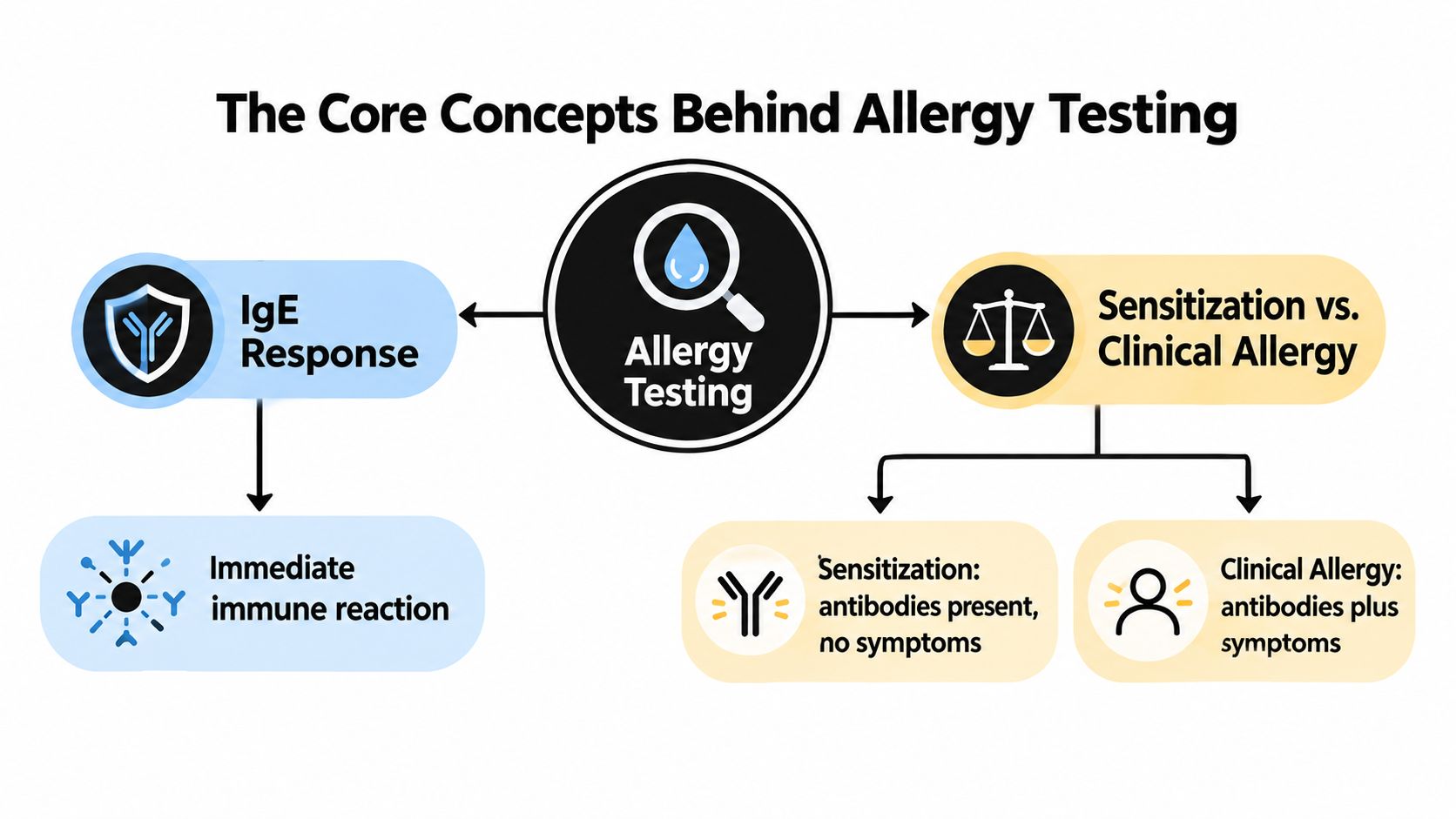
The central question is simple: what is the test measuring? Many allergy tests look for immunoglobulin E, or IgE, an antibody involved in certain immediate immune reactions. Skin-prick testing and serum-specific IgE blood testing can detect IgE directed toward selected allergens.
A positive result means your immune system has recognized that substance. It doesn't automatically mean you'll develop symptoms every time you encounter it. Think of the result like a smoke detector that responds to a signal. The alarm matters, but you still need to determine whether there's a fire in the room.
Sensitization is not the same as clinical allergy
Sensitization means antibodies are present. Clinical allergy means the exposure is associated with a reproducible symptom pattern that fits the test result and the person's history. Someone may have a positive food-specific IgE result and still tolerate that food. Broad testing can uncover irrelevant sensitization and create unnecessary restrictions.
The National Institute of Allergy and Infectious Diseases states that skin and blood tests alone cannot diagnose food allergy. Results must be interpreted alongside the patient's history and examination, as explained in its diagnostic guidance for food allergy.
Different reactions need different questions
IgE-mediated allergy often involves symptoms that occur relatively soon after exposure, such as hives, swelling, wheezing, vomiting, or other immediate reactions. Food intolerance may involve a different mechanism and may not be identified by IgE testing. Contact dermatitis is evaluated through a different pathway, often involving delayed skin reactions to substances that touch the skin.
That distinction matters because a food panel can't answer every digestive complaint, and an environmental allergy test won't diagnose every rash. The best appointment begins with your story, not with a preselected panel.
Comparing the Main Allergy Test Types
Local providers may offer several testing approaches, but they don't all answer the same clinical question. The appropriate choice depends on the suspected trigger, the timing of symptoms, your skin condition, medications, and whether a clinician needs to observe a reaction directly.
| Test Type | What It Measures | Best For | Typical Time |
|---|---|---|---|
| Skin-prick testing | Skin response to selected allergen extracts | Common environmental or suspected food triggers | Results are usually read after about 15 minutes |
| Intradermal testing | Response after a small amount of allergen is placed just beneath the skin | Selected situations, often involving certain inhalant or medication questions | Timing depends on the protocol |
| Specific IgE blood testing | IgE antibodies to specified allergens in a blood sample | When skin testing is impractical, unreliable, or affected by medication or skin disease | Timing depends on the laboratory |
| Patch testing | Delayed skin response to substances applied under patches | Suspected contact dermatitis | Requires scheduled interpretation according to the clinic's protocol |
| Oral food challenge | Direct observation of symptoms after supervised ingestion | When history and testing remain uncertain and a clinician needs to assess tolerance | Requires medical supervision and a clinic-specific protocol |
During a skin-prick test, the clinician places small drops of allergen extract on the skin and lightly pricks each site. AAAAI guidance defines a positive result as a wheal at least 3 mm larger than the negative control with surrounding erythema, with results usually read after about 15 minutes, according to its office procedure guidance.
Match the test to the problem
If you already know which food or environmental exposure concerns you, targeted testing may be more useful than an indiscriminate panel. Readers comparing options can also review this explanation of private food allergy tests while remembering that any result still needs clinical interpretation.
For a practical discussion of allergy blood test versus skin test, ask which option fits your medication list and skin condition. Blood testing can be useful when antihistamines cannot be paused under medical direction or when eczema and other skin conditions make a skin response difficult to interpret.
What to Expect During a Local Allergy Testing Appointment
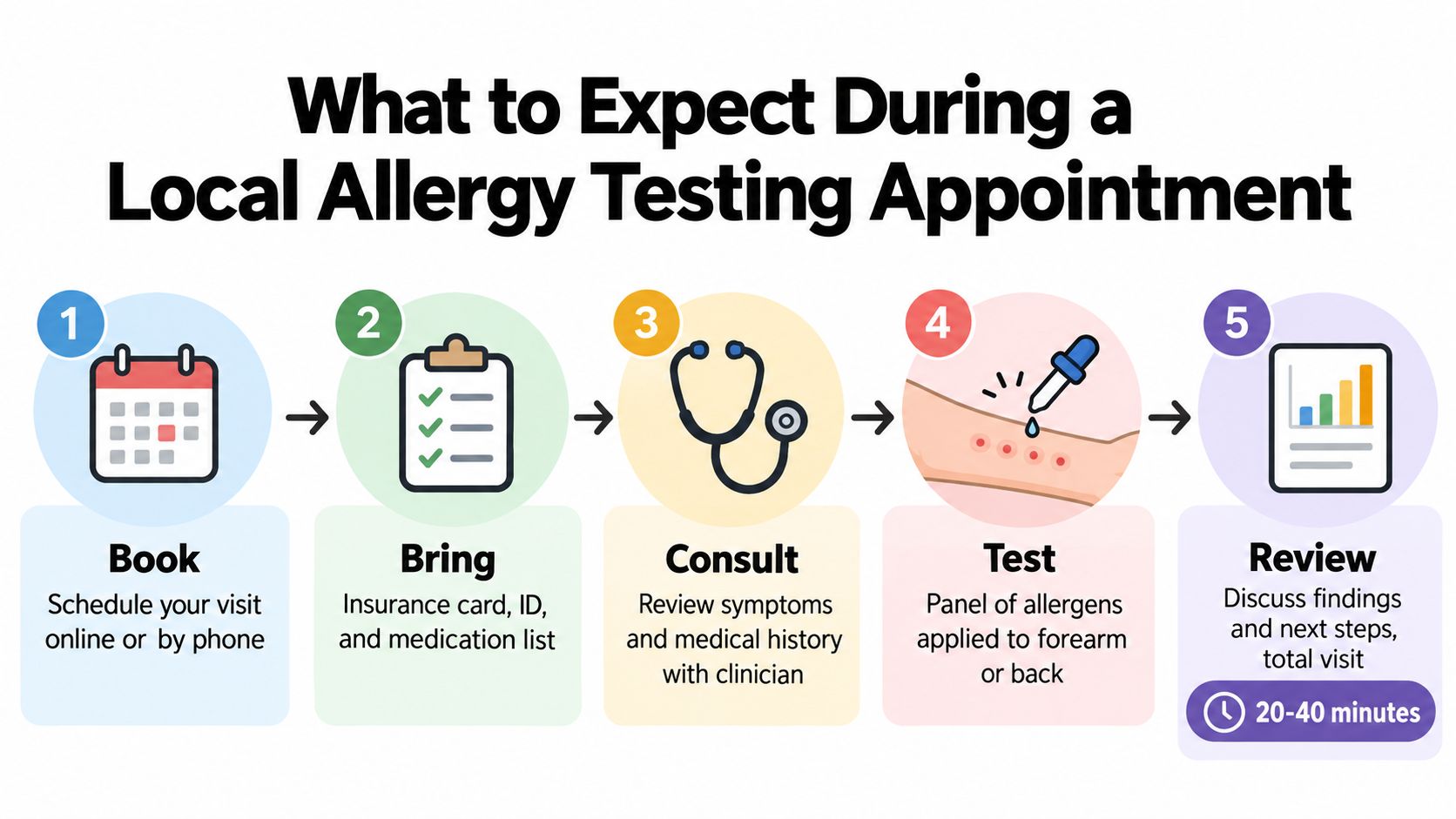
A well-run appointment starts before you arrive. When booking, describe the symptom you want evaluated, the suspected exposure, how quickly symptoms appear, and whether you've had breathing difficulty, swelling, faintness, or a rapidly progressing reaction. Bring your medication and supplement list, identification, insurance information if relevant, and any photographs of a rash or swelling.
Preparation affects the result
Some medications, particularly antihistamines, can affect skin testing. Don't stop a medication on your own. Ask the clinician whether anything needs to be paused, for how long, and whether blood testing would be more appropriate.
For skin-prick testing, the clinician commonly marks the forearm or back, applies selected allergen drops, and makes a light prick at each site. Mayo Clinic reports that the overall appointment commonly takes about 20 to 40 minutes, with the skin observed for approximately 15 minutes before the wheals are measured and recorded, as described in its allergy test overview.
The small raised areas and surrounding redness usually settle after the reading. AAAAI notes that skin testing performed by an allergist is generally safe and effective for adults and children, with small hives commonly resolving within about 30 minutes. A clinic should obtain consent, monitor you during the test, and have appropriate emergency procedures in place.
Seek urgent medical care rather than waiting for a routine appointment if you develop breathing difficulty, throat or tongue swelling, fainting, or a rapidly progressive reaction. Document what you were exposed to, when symptoms started, what symptoms occurred, and what treatment you used.
How to Choose a Trustworthy Allergy Testing Provider Nearby
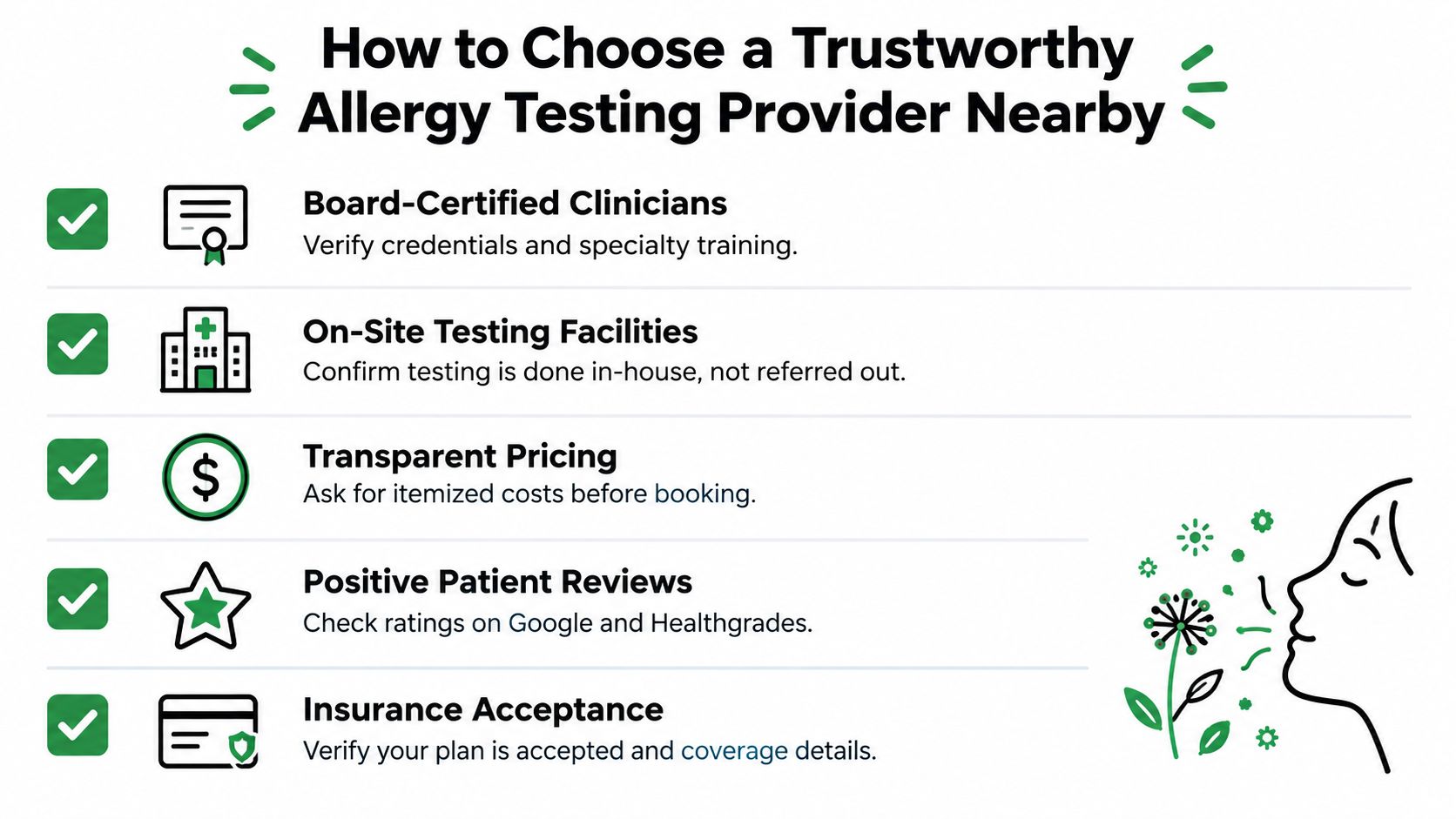
The most useful local provider isn't necessarily the one advertising the largest panel. Look for a practice that can explain why each allergen is being tested, who will interpret the results, and what happens after the report arrives.
Questions to ask before booking
- Who interprets the result? Confirm that a qualified clinician reviews the findings with your history and examination.
- Which allergens are included? Ask whether the panel is targeted to your exposures or a broad screen.
- What preparation is required? Ask about antihistamines and other medications, and follow medical directions rather than guessing.
- What happens after testing? A results-review pathway matters because the report alone isn't a diagnosis.
- What will the visit involve? Clarify whether testing occurs on site, how long the appointment takes, and whether follow-up is included.
Transparent pricing and clear logistics are useful, but they shouldn't distract from clinical quality. A provider should explain whether skin testing, blood testing, patch testing, or referral is the better route for your concern. If the practice can't tell you who will interpret the results, treat that as a meaningful warning.
Red flags deserve attention
AAAI specifically cautions against supermarket or drug-store screening tests, home testing, applied kinesiology, cytotoxic food testing, and IgG food-allergy testing, because these approaches may produce inappropriate diagnoses or treatment, as outlined in its public guidance on allergy testing.
IgG "food sensitivity" panels are especially problematic when they encourage people to remove multiple foods without a compatible history. Unnecessary restriction can increase anxiety, complicate nutrition, and make it harder to identify the cause of symptoms.
The quality of an allergy evaluation depends on the question, the method, and the interpretation. A long report can't compensate for a weak clinical assessment.
Understanding Your Results and Planning Next Steps
A results appointment should answer three questions: what was detected, does it fit your symptoms, and what should you do now? The clinician should compare the report with the timing of exposure, the amount involved, the route of exposure, the symptoms, and whether the same pattern has happened more than once.
A larger wheal can indicate greater sensitivity to the tested substance, but it doesn't establish the severity of a real-world reaction. A positive blood result also doesn't prove that you need to remove the food from your diet. Your clinician may recommend targeted avoidance, symptom treatment, additional evaluation, or referral to an allergist.
When the history and test disagree
If a food produces no symptoms despite a positive test, don't assume the result overrides your experience. If your history strongly suggests a reaction but testing is negative or unclear, ask what other explanations should be considered and whether additional evaluation is appropriate.
A supervised oral food challenge may sometimes help resolve uncertainty, but it must be planned and monitored by a qualified clinician. Never test a suspected trigger at home after a serious reaction.
For symptom patterns involving nuts, swelling, or hives, a practical resource on how to identify nut allergy reactions can help you organize observations before your review appointment. It should support, not replace, medical assessment.
Use this guide to read an allergy test as preparation for a clinician conversation, not as a way to diagnose yourself. A responsible plan may include environmental changes, medication guidance, skin care for eczema, asthma evaluation, food-allergy precautions, or specialist referral.
Booking Through BotoxBarb and Supporting Your Skin at Home
For people who want a convenient starting point, BotoxBarb offers food and environmental allergy testing options that use an at-home finger-prick blood sample mailed to a laboratory for analysis. The practical advantage is convenience, but the same clinical rule applies: a report should be reviewed in the context of your symptoms and exposure history.
Reactive skin also needs a thoughtful routine. Seasonal irritation, eczema flares, frequent cleansing, and unnecessary product changes can weaken the skin barrier. A simple medical-grade skincare plan may be more helpful than adding several new products at once.
A separate role for LED facial care
The Barb N.P. Facial Mask is a complementary skincare device, not an allergy test and not a substitute for clinician-directed evaluation. It offers wireless operation, a comfortable fit against the face, and three lighting settings intended for different skincare treatments.
A systematic review reported that carefully designed at-home LED devices appear safe and effective for improving facial-aging parameters such as wrinkles, skin texture, and overall skin quality. Reported adverse events were infrequent, mild, and transient, according to the systematic review of at-home LED devices.
Use an LED mask only as directed, and don't apply it over skin that is acutely inflamed, broken, or reacting unless a qualified clinician has advised you to do so. The device can complement a recovery-focused routine, but it can't identify pollen, food, medication, or contact triggers.
For readers comparing convenience with clinical oversight, this discussion of allergy testing at home can help frame the decision. The important question remains who explains the result and what happens afterward.
Common Misconceptions and Smart Next Steps
More allergens tested doesn't mean better care. Broad panels can identify sensitization that has nothing to do with your symptoms and may lead to unnecessary food restrictions or lifestyle changes.
A positive IgE result isn't a diagnosis. It becomes meaningful only when it fits your history, examination, and exposure pattern. That's why a results-review conversation matters as much as the sample collection.
An elimination diet shouldn't begin with a single unexplained positive result. Removing foods without guidance can create anxiety and nutritional problems while leaving the actual trigger unaddressed.
Your next step should be focused: write down the suspected exposure, timing, symptoms, treatment, and any photographs, then ask a qualified local provider which test answers your question. Choose interpretation over test count, and treat the report as a starting point for a safe plan.
BotoxBarb offers food and environmental allergy testing options alongside skincare and wellness support, including guidance for maintaining reactive skin and the Barb N.P. Facial Mask for complementary LED care. Visit BotoxBarb to review the available options and choose the next step that fits your symptoms.