Article: Under Eye Filler Before and After: Real Results
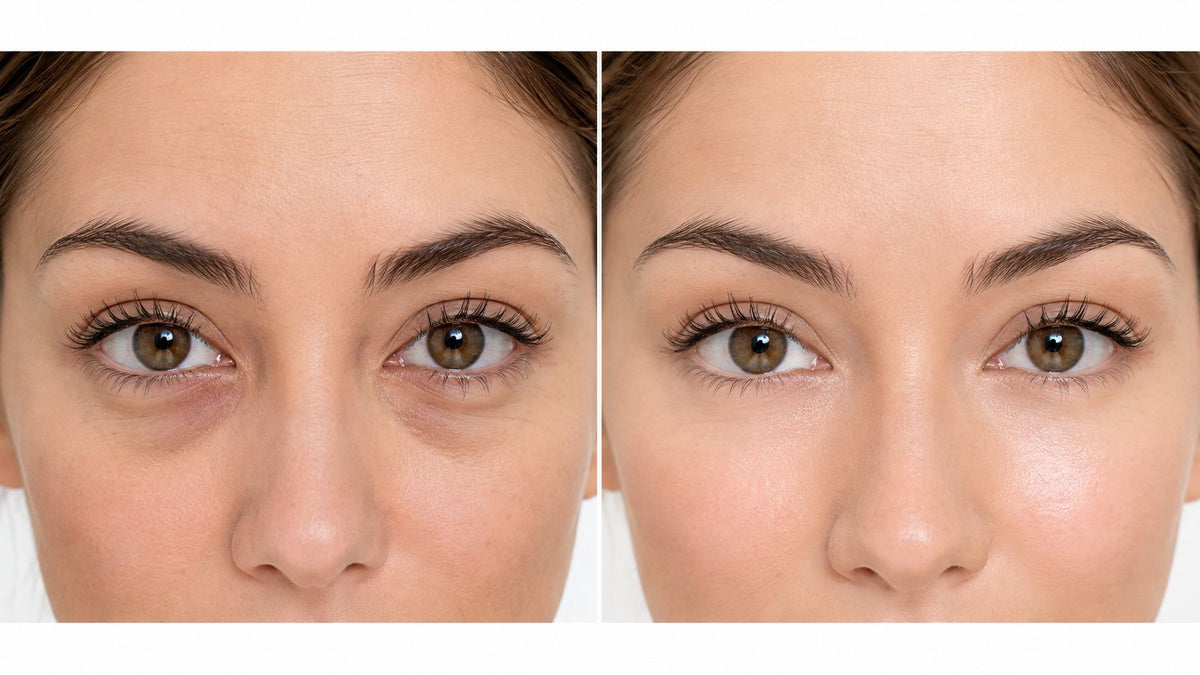
Under Eye Filler Before and After: Real Results
You're probably here because the under-eye area has started doing something photographs make worse. In the bathroom mirror it looks like tiredness. In overhead light it looks hollow. In a front-facing camera with flash, it suddenly looks like you haven't slept in weeks. That's usually the moment people search for under eye filler before and after photos and try to decide whether filler is the fix, or whether they're about to pay for a result that only looks good under perfect lighting.
The problem is that most galleries show the easiest version of the story. They show a “before,” then a polished “after,” but they skip the anatomy, the healing window, and the reasons one person gets a soft refreshed result while another gets puffiness, bruising, or very little change. Under-eye concerns are rarely just one issue. A hollow can create shadow. Pigment can mimic a hollow. Eyelid bags, malar edema, and thin skin can all confuse the picture.
A good consultation should make this simpler, not more mysterious. The right way to judge tear-trough filler is to look beyond the final photo and ask what changed, what didn't, how the result evolved over time, and whether filler was the right treatment category in the first place.
When the Mirror First Tells You Something
A common scenario goes like this. You catch your reflection while brushing your teeth and the under-eye area looks deeper than it did a year ago. Then someone takes a candid photo and the hollow under the inner eye looks darker than the rest of your face, even though your skin is otherwise fine. You start wondering whether you need concealer, better sleep, treatment for puffiness, or filler.

That confusion matters because the under-eye area can look “dark” for different reasons. A true tear trough hollow creates a valley that casts a shadow. Pigment creates discoloration without a volume deficit. Eyelid bags and cheek swelling create fullness above or below the groove, which can make the hollow seem worse. If you treat the wrong problem, the before and after won't look like the one you had in mind.
The search usually starts with fatigue, not vanity
Most patients don't describe this as wanting dramatic change. They say they look tired, drawn, or older than they feel. They've often already tried eye creams, concealer, better sleep, and cooling products. If puffiness is part of the picture, a simple comfort measure like a soothing eye mask for dry eyes can help you tell the difference between temporary irritation and a structural hollow that stays put.
Another reason people hesitate is that under-eye concerns blur together. Puffy lower lids aren't the same problem as hollow tear troughs. If bags are part of what you're seeing, it helps to understand what causes under-eye bags before assuming filler will smooth everything.
A good under-eye treatment plan starts with naming the main problem correctly. Shadow from volume loss behaves differently than pigment, skin laxity, or fluid retention.
What you actually want from this decision
You don't need a fantasy result. You need a realistic answer to four practical questions:
- Will filler soften the hollow enough to reduce that tired shadow?
- Will early swelling make it look worse first, even if the final result is good?
- Are you a poor candidate because the issue is really puffiness, pigment, or laxity?
- What should a trustworthy before and after show besides one flattering final image?
That's the standard worth using. Not whether someone looked perfect in a clinic photo, but whether the treatment matched the anatomy and healed the way it should.
What Tear Trough Filler Does
Tear trough filler treats volume loss in the infraorbital hollow, where the lower eyelid blends into the upper cheek. The lid-cheek junction is a slope; when the cushion thins, the slope becomes a groove that catches shadow. That is why some people look tired in certain lighting even when they feel fine.
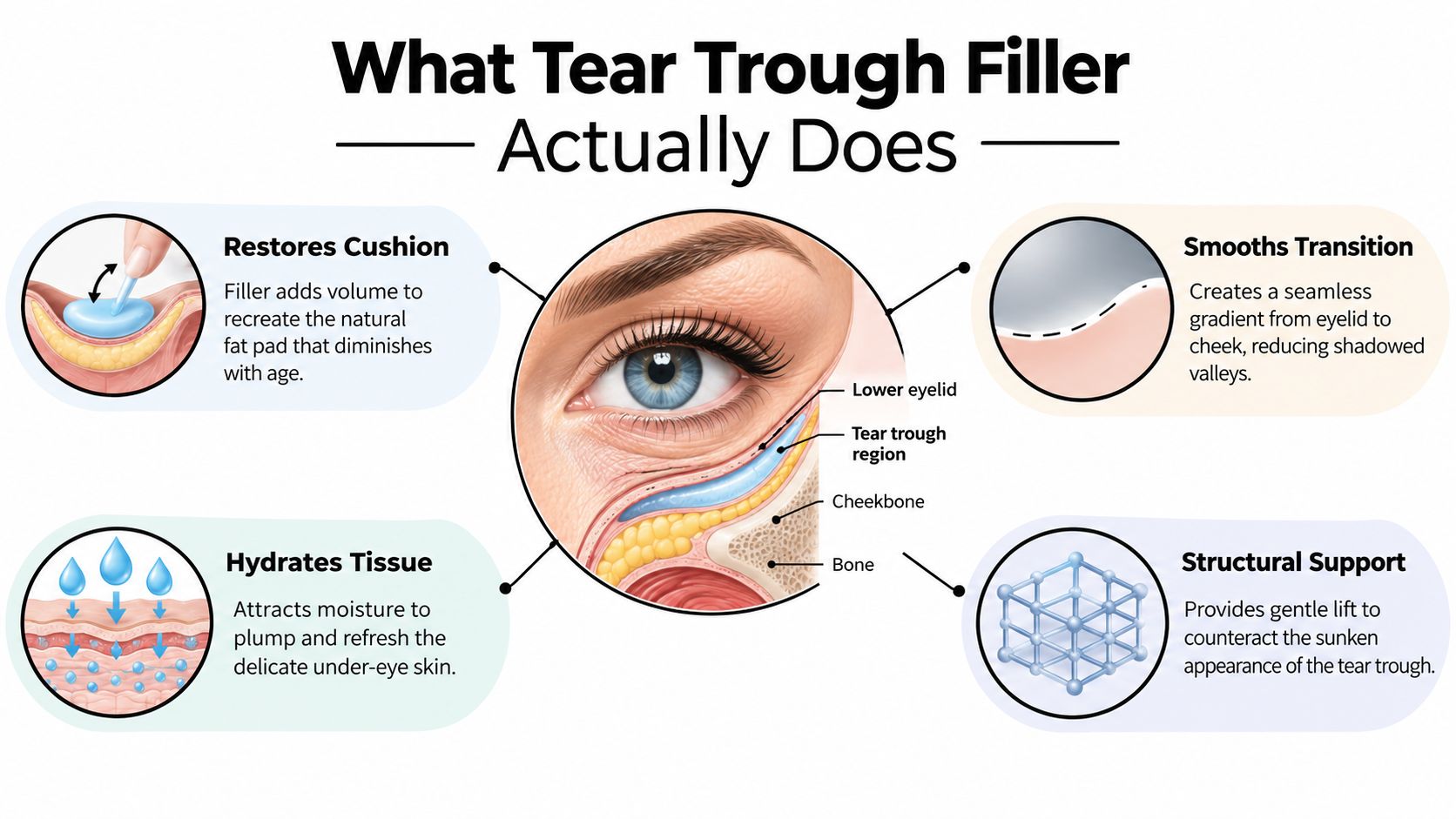
What filler changes
Hyaluronic-acid filler can soften that hollow by replacing a small amount of lost support and smoothing the transition from lid to cheek. In practice, the goal is rarely to “fill the under-eye.” The goal is to reduce the shadow without making the area look puffy, stiff, or obvious.
That distinction matters in real consultations. Patients often point to “dark circles,” but the mirror may be showing a mix of hollowing, thin skin, pigment, and lower-lid fat. Filler helps the hollow component. It does not correct every cause of under-eye darkness.
Published outcomes support that narrower expectation. In a clinical series of tear-trough treatment, 25 patients were treated and independent evaluators judged 22 patients, or 88%, to have cosmetic improvement, while 3 showed no improvement. The authors also reported post-treatment improvement across the group and high patient satisfaction, while noting that results were not uniform and that more severe starting anatomy did not guarantee a better cosmetic change (Aesthetic Surgery Journal tear-trough study).
For anyone comparing under eye filler before and after photos, that is the right frame. A good result usually looks rested, not transformed.
What filler cannot fix
Disappointment usually starts with the wrong target, not bad product.
- Pigment-driven darkness stays visible if color, not hollowing, is the main issue.
- Skin laxity or crepiness does not tighten just because volume was placed underneath.
- Malar edema or baseline puffiness can look heavier after filler.
- Prominent lower-lid fat pads often need a different approach.
A meta-analysis of 31 reports and 2,556 participants reached the same broad conclusion. Tear-trough HA filler works best when the problem is true hollowing, and benefit may be limited when the dominant issue is edema, fat pad prominence, pigmentation, or marked skin laxity.
One practical clue is morning variability. If the area looks fuller when you wake up, shifts with allergies, or changes after salt, fluid is part of the picture. Filler does not fix that pattern and can make it more noticeable.
Why restraint matters here
This area is unforgiving. The skin is thin, soft-tissue cover is limited, and the region contains a dense network of vessels and lymphatics.
That is why subtle placement matters so much. Small amounts can blend a hollow well. Too much product, or product placed too close to the surface, can show through, create contour irregularity, or hold water and prolong swelling. In the best tear-trough work, less is often what looks best.
Reading Before and After Photos Like a Practitioner
A gallery photo is a claim, and most claims in this space are made with a camera. Harsh overhead light in the "before", softer diffused light in the "after", a slight head tilt, a touch of concealer. Once those variables move, you are no longer looking at what the filler did. You are looking at what the photographer did.
What a trustworthy gallery includes
Consistency is the whole game. A clinic that controls its photography is showing you treatment effect. One that does not is showing you staging.
- Lighting stays identical, because shadows can fake improvement or deepen a hollow that filler corrected.
- Camera angle and distance match, since looking slightly up or down reshapes the lower-lid contour on its own.
- Facial expression stays neutral, because a smile changes the lid-cheek junction.
- Time points are disclosed, so you know whether the image is immediate, two weeks, or months out.
Same-day images deserve special suspicion. Nearly one in five patients in the pooled data swells visibly, and a similar share bruises. That is exactly why an immediate post-treatment photo is close to meaningless as evidence of outcome. Swelling, injection-point redness, and the temporary fullness before product settles can all masquerade as correction, or as a bad result, depending on the day.
What the complication rates mean for photo timelines
The meta-analysis cited earlier found pooled patient satisfaction of 91.0%, with swelling in 19.2% and bruising in 18.4%. The satisfaction figure tells you the treatment tends to please people. The complication figures tell you something more useful here: a polished "after" image can still represent a treatment that had a messy first week. Swelling and bruising do not mean the treatment went wrong. They mean the timeline of the image is doing quiet work in your judgment.
Don't judge a tear-trough result from an immediate photo. Judge it from a matched photo taken after the early recovery effects have resolved.
Questions worth asking when you see a gallery
When I review under-eye photos critically, I look for what they are not showing. A patient should ask the same questions.
- When was the after photo taken? Same-day, one-week, one-month, and long-term images tell four different stories.
- Is the anatomy similar to yours? A mild hollow without bags is not the same case as pigment plus puffiness, and the results will not transfer.
- Were both sides equally improved? Tiny asymmetries are normal. Large mismatches deserve an explanation.
- What happened during healing? A good injector should be comfortable discussing bruising, swelling, and whether touch-up or dissolving was ever needed.
If you want a feel for how filler results are typically presented across the face, this gallery of dermal fillers before and after is a useful reference point for comparing style and photo consistency. Hold the under-eye area to a stricter standard than anything else you see there. Thin skin and minimal soft-tissue cover make this zone the least forgiving place to hide a mediocre technique or an uncontrolled photograph.
A Realistic Day by Day Recovery Timeline
The missing piece in most under eye filler before and after content is time. Patients usually see the start and the finish, but not the middle. The middle is where most of the anxiety happens.
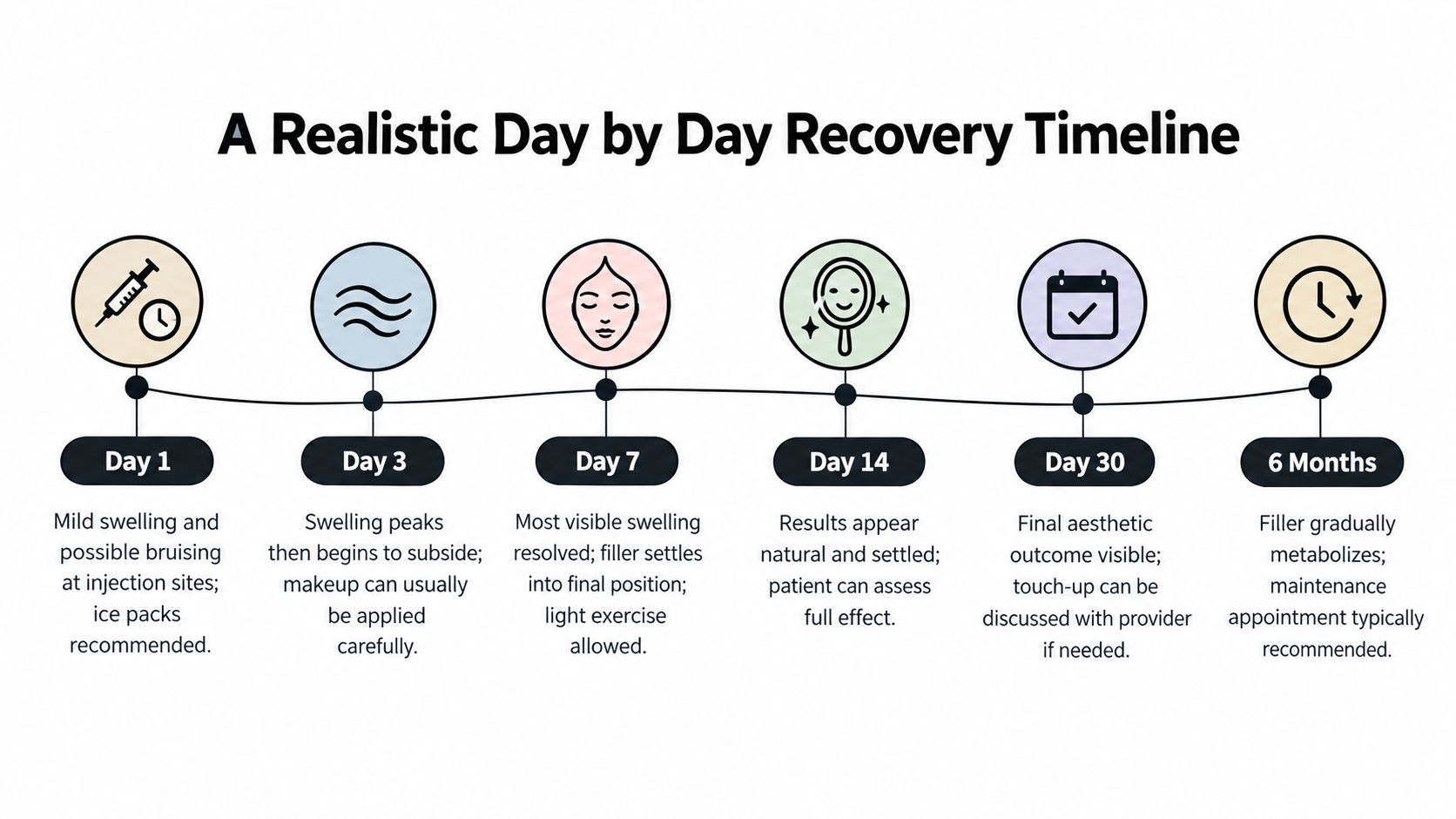
What the calendar often looks like
Day 1
Expect the area to feel recently treated. Some people see mild puffiness right away. Tiny entry-point marks, tenderness, and early asymmetry can happen.
Day 3
This is often the day people second-guess everything. Swelling can peak early, and bruising may look more obvious as it settles. The mirror can make the result look worse before it looks better.
Day 7
By now, you can often assess the direction of the result, though the final refinement may not be clear yet. Bruising often fades ahead of any puffiness. If one side still appears slightly fuller, that can still fall within the normal healing curve.
Day 14
This is a more honest checkpoint for judging the shape. If the treatment was well chosen and conservatively placed, the under-eye should look smoother, not “filled.”
What longer follow-up can reveal
A large systematic review of 1,956 tear-trough patients found overall satisfaction of 84.4%, while long-term satisfaction fell to 76.7% at six months or more. Reported complications included bruising in 12.9%, edema in 9.2%, and lumpiness in 6.5% (systematic review summary from the American Academy of Ophthalmology).
That decline in long-term satisfaction is important. It doesn't mean filler usually “goes wrong.” It means a result that looked good early may evolve as the product integrates, water balance changes, or the patient notices something photos didn't show.
How to use the timeline without overreacting
- At one month, you can usually judge whether the intended correction happened and whether a touch-up conversation makes sense.
- At six months, some people still like the effect. Others feel the value has faded or subtle trade-offs have become more noticeable.
- At twelve to eighteen months, what you see depends on the product used, metabolism, anatomy, and whether delayed issues such as swelling or migration have appeared. That's why longevity should never be sold as a simple promise.
Early bruising or puffiness doesn't tell you the final cosmetic story. Persistent swelling, increasing lumpiness, or late discoloration deserves a fresh exam rather than a wait-and-see mindset.
The goal isn't to panic over every change. It's to know the difference between a healing phase and a result that needs re-evaluation.
Who Makes a Good Candidate and Which Products Suit Them
Good tear-trough results depend on anatomy more than on the brand of filler. Treatment is most suitable when a true hollow is present at the lid-cheek junction and the surrounding tissue is relatively stable. Filler is less likely to help when the main issue is puffiness, loose skin, prominent fat, or pigmentation rather than a depression.
The anatomy-led candidate screen
A stronger candidate has a groove that remains visible across different lighting and times of day. It may create a shadow, but the area does not become markedly fuller in the morning or form a distinct bulge above the groove.
Look carefully for patterns that filler cannot correct well:
- Malar edema or fluid retention, where puffiness is already part of the lower cheek.
- Prominent fat pads, where a bag creates fullness and the groove is only one part of the appearance.
- Pigment-first concerns, where darkness remains even after the cheek is supported.
- Substantial skin laxity, where looseness and texture matter more than lost volume.
A consultation should separate these findings rather than treating every dark under-eye as a hollow. Sometimes the best recommendation is less filler, a different treatment, or no injection.
Product families and what the conversation should cover
The modern category developed from the broader history of hyaluronic-acid dermal fillers. The FDA approved Restylane in December 2003 as the first U.S.-approved HA filler, followed by Hylaform in April 2004. The Juvederm family first gained FDA approval in 2006. FDA materials state that absorbable dermal-filler effects generally last about 6 to 12 months, with variation by product, injection site, metabolism, and technique (FDA dermal filler history and duration overview).
For the under-eye area, the useful questions are practical. How much water does the product tend to attract? How thin is the skin? How softly will it integrate? How conservative is the injection plan? A product that looks smooth in another facial area may still be a poor choice for a thin, easily swollen lower eyelid.
| Product Family | Integration Tendency | Swelling Considerations |
|---|---|---|
| Restylane family | Often selected for a controlled correction, with lower water attraction often preferred in thin skin | Can suit delicate tissue when placed conservatively, but anatomy and depth still determine swelling risk |
| Juvederm family | Often provides smooth correction, with higher water attraction requiring careful depth control | May be less forgiving in patients prone to puffiness, depending on the specific product and placement |
The product family does not determine the result by itself. Injection depth, volume, tissue behavior, and the patient's baseline fluid retention can matter just as much.
Needle or cannula is not the whole story
Patients commonly ask whether a cannula is automatically safer or better. Evidence does not support treating the instrument as the deciding factor. A systematic review found no statistically significant difference in outcomes or safety sufficient to establish a preference between needle and cannula for this area (ASJ Open Forum review of infraorbital filler swelling and technique considerations).
The injector still needs to understand the lower eyelid-cheek junction, distinguish edema from volume loss, and use restraint. Tool choice supports that judgment. It does not replace it.
Side Effects and Risks You Should Plan Around
The under-eye area deserves more risk counseling than it usually gets. One reason is regulatory. The FDA states that injection in the periorbital area, including around the eyes, is not an FDA-approved use for dermal fillers. That doesn't mean treatment is never performed. It means the area requires clear informed consent and a medical injector who treats it with the seriousness it deserves (FDA dermal filler safety communication).
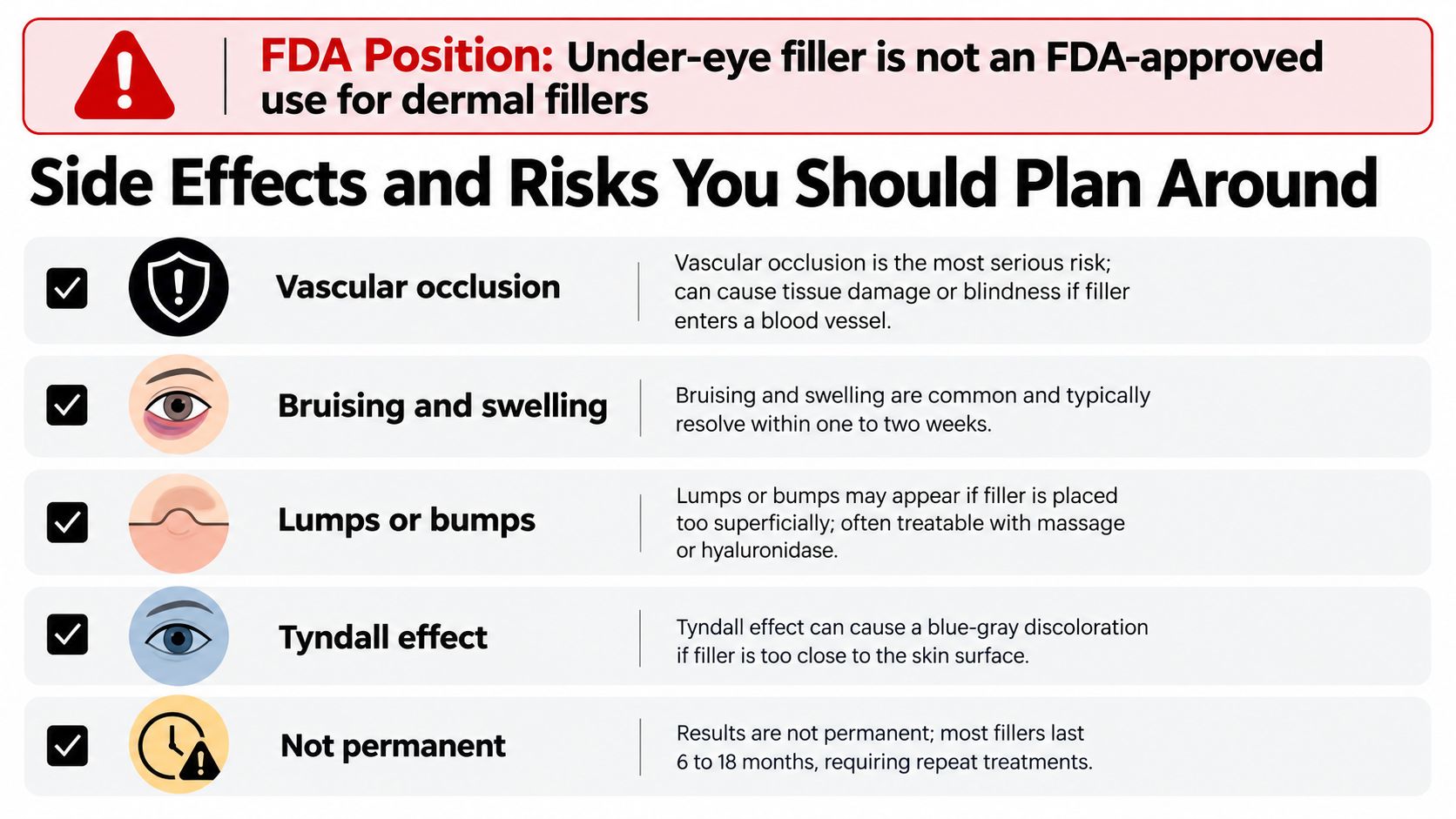
The common risks patients should expect to discuss
Short-term effects like swelling and bruising are common soon after injection and often resolve within days to weeks, according to the FDA safety guidance linked above. Under-eye tissue is thin, and hyaluronic acid is hydrophilic, which means it can bind water. That's one reason the area can look temporarily puffy even after a technically careful treatment.
Other cosmetic complications include:
- Contour irregularity, where the surface doesn't look smooth.
- Tyndall discoloration, a blue-gray cast when filler sits too close to the skin.
- Delayed swelling, which can appear later and confuse patients who thought healing was complete.
The risk that matters most
The same FDA safety communication identifies unintended injection into a blood vessel as the most serious dermal-filler risk. Although uncommon, it can block blood flow and cause tissue death, visual abnormalities including blindness, or stroke.
That's why injector selection isn't a branding question. It's a safety question.
If a practice can't explain emergency recognition, reversal planning, and follow-up access in plain language, that's a reason to keep looking.
What needs same-day contact
Normal healing can include tenderness, swelling, and bruising. Concerning symptoms are different. Contact the treating clinician urgently if you develop vision changes, severe pain, unusual skin discoloration, worsening asymmetry that appears ischemic rather than swollen, or symptoms that escalate instead of gradually settling.
It also helps to review a dedicated overview of tear trough filler risks before treatment so you know which problems are common nuisances and which are true red flags. The goal isn't fear. It's informed consent and quick action if something doesn't look right.
Choosing a Qualified Injector and What to Ask
A good consultation should feel like a facial assessment, not a sales script. In the tear trough, the injector is deciding whether your under-eye concern comes mainly from hollowing, fat-pad prominence, pigment, skin quality, or a mix of those. That distinction shapes the result more than the brand of filler. If someone reaches for filler before explaining what they see anatomically, pause there.
This area punishes overconfidence. A clinician with good judgment will sometimes advise less filler, staged treatment, or no filler at all.
What you want is clear reasoning, delivered in plain language. Ask questions that show how they think:
- What makes me a good or bad candidate?
- What result should I realistically expect to see in normal room light, not just photos?
- If I swell more than expected, what is your plan and how long do you usually watch before changing course?
- If the filler looks wrong or holds water, are you comfortable dissolving it?
- Can I see before-and-after images of patients with anatomy like mine, photographed at the same stage of healing?
Those questions matter because under-eye filler is often judged too early and sold too simply. The polished photo is rarely the hard part. The harder part is predicting whether product in this area will sit cleanly, attract fluid, or make pre-existing puffiness look more obvious in everyday light.
Earlier in the article, the ASJ Open Forum seven-year infraorbital review was cited because it found both short-term and delayed swelling after treatment. In practice, that means a consultation should cover trade-offs, not just technique. If you already wake up puffy, have poor lymphatic drainage, or shift between hollow and swollen depending on sleep, salt, or allergies, filler may improve one problem while exaggerating another.
A careful practice also explains logistics. You should hear how they take a medical history, what normal recovery tends to look like, what aftercare they recommend, and how to reach the clinic if the area changes after hours.
One more sign of quality is restraint. The best injectors do not need filler to be the answer every time. They are comfortable telling you when another approach, or no treatment, is more likely to leave you pleased with what you see in the mirror.
Alternatives and How LED Light Therapy Fits In
Not every under-eye concern is a filler problem. If the dominant issue is pigment, skincare and brightening strategies make more sense than volume. If the issue is fat-pad prominence or significant laxity, surgery may be the more honest option. If there's mild skin-quality change around the eyes, supportive treatments can complement, but not replace, volume correction.
One option worth understanding is at-home LED support. A randomized, double-blind clinical trial evaluated facial photobiomodulation using an LED mask with red light at 660 nm, 6.4 mW/cm² irradiance, and 21-minute sessions, and found measurable skin-tone benefits over four weeks (LED mask clinical trial). That doesn't mean LED replaces tear-trough filler. It doesn't restore lost volume. It does support the idea that light therapy can play a role in overall skin-quality care.
For patients who want a home device in that category, the Barb N.P. Facial Mask fits as a supportive option rather than a substitute for injectables. Its wireless design makes it easier to wear comfortably, the mask sits with good facial comfort, and the three lighting settings allow different treatment modes depending on the skin goal. If you run a busy aesthetic practice and want to understand how clinics streamline communication around treatments and follow-up, Virtual Assistants for Med Spas and Aesthetics Clinics is a useful operational resource.
If you're weighing under-eye filler, Botox, LED light therapy, or a more complete facial plan, BotoxBarb offers medically guided treatment and curated at-home support with a conservative, anatomy-led mindset. You can explore services, skincare, and self-care essentials, then book or shop directly through BotoxBarb if you want a plan built around what your under-eye area needs, not just what looks good in a before-and-after photo.