Article: Best Filler for Cheekbones: Expert Guide
Best Filler for Cheekbones: Expert Guide
The most popular advice about the best filler for cheekbones is also the least useful: choose the brand with the strongest marketing. Cheek augmentation isn't a product-ranking exercise. The right material depends on whether your face needs deep structural projection, replacement of lost soft-tissue volume, or gradual collagen support.
The American Academy of Dermatology recognizes restoring cheek fullness as a purpose of dermal fillers, while also emphasizing that the result depends on your anatomy, the selected filler, and the amount injected. The AAD's filler overview reflects the point I make in consultations: a technically excellent product can still look wrong when it's placed in the wrong layer, region, or volume.
Rethinking the Search for the Perfect Cheek Filler
Cheek filler selection starts with anatomy. A flat malar eminence, age-related midface hollowing, and lax skin with tear-trough shadowing each point toward a different treatment plan. The key question is whether the face needs deep structural projection, replacement of lost soft-tissue volume, or gradual collagen support.
The FDA recognizes dermal fillers for cheek augmentation in adults, but approval applies to specific products, injection locations, and patient populations. A filler marketed for facial enhancement is not automatically approved for every cheek application. Product labeling may also state limitations, including situations where safety has not been established in people with very thin midface skin. The regulatory framework is outlined in the FDA's guidance on dermal fillers and soft-tissue fillers.
Start with the problem, not the syringe
I assess the face in layers. First, I examine the zygomatic and malar structure. I then evaluate fat compartments, skin thickness, facial movement, asymmetry, and signs of descent. The final step is to clarify the desired result: sharper projection, restored softness, a younger-looking transition beneath the eyes, or a subtle reduction in tiredness.
Those goals require different strategies:
- Structural projection usually needs a product with sufficient lift and cohesion, placed accurately and conservatively.
- Soft-tissue restoration may call for a smooth transition across the midface rather than a concentrated bolus over the cheekbone.
- Biostimulatory support develops gradually and may suit patients who prefer progressive change instead of immediate sculpting.
The injection plane matters as much as the product. A firm filler placed too superficially can show or feel irregular, while excessive volume can widen the face or exaggerate heaviness beneath the eyes.
Practical rule: If a provider recommends a product before examining your facial proportions, ask how it addresses your specific anatomical problem.
A sound consultation should cover previous filler, medical history, skin quality, vascular anatomy, and whether you prefer a temporary or potentially dissolvable option. For a patient-focused discussion of risk and provider selection, Wakefield cheek filler safety provides further guidance.
The Clinical Evidence Behind Midface Augmentation
Hyaluronic acid, or HA, remains the foundational material for cheek enhancement because it has the broadest comparative evidence and can be adjusted when clinically necessary. A systematic review identified 14 randomized controlled trials involving 1,091 patients. In the pooled analysis of five trials, HA produced a significantly higher Global Aesthetic Improvement Scale responder rate than control treatment, with a relative risk of 3.27 and a 95% confidence interval of 2.26–4.75. The findings are reported in the systematic review of HA for midface volume deficiency.
That evidence supports HA as an evidence-based option, but it doesn't make every HA product identical. The review reported very high heterogeneity, meaning results varied substantially among studies and products. Lift capacity, cohesivity, injection plane, facial anatomy, treatment volume, and injector training all influence the final appearance.
What the cheek-specific trials tell us
Evidence has also moved beyond general facial filler studies toward products evaluated specifically for the midface. In the key U.S. Phase 3 trial supporting FDA clearance of Restylane Contour in 2021, 270 patients were evaluated across 15 American centers over 48 weeks. The cheek-augmentation comparison included 142 patients treated with the HA filler and 68 assigned to a comparator. Across the reported FACE-Q cheek-satisfaction questions through week 48, at least 76% of Restylane Contour patients reported satisfaction, compared with at least 73% in the comparator group, according to Galderma's FDA approval announcement.
Those results are meaningful, but they describe one product, protocol, population, and follow-up period. They don't prove that Restylane Contour, or any other brand, is universally superior. The data are best used to establish that specific HA products can perform well in controlled cheek-augmentation settings.
Why calcium hydroxylapatite remains relevant
Calcium hydroxylapatite, or CaHA, has a smaller cheek-specific evidence base than HA, but it can be appropriate when structural support and biostimulatory remodeling are central goals. In a prospective randomized multicenter study of 116 patients, CaHA was assessed across malar, submalar, zygomatic, preauricular, and infraorbital regions using MRI, physician assessment, patient satisfaction, and blinded aesthetic ratings. At three months, MRI-measured cheek volume and aesthetic improvement were significantly better in the immediately treated group than in controls, with p < 0.05, and physician satisfaction reached 92% at 12 months. A newer study involving 15 participants reported sustained improvement through week 24. These findings are discussed in the clinical review of CaHA for facial contouring.
CaHA can offer immediate structure plus possible collagen stimulation, but it has less reversibility than HA. That makes technique, depth, dilution, and anatomy especially important. A filler with strong clinical data still needs the right clinical indication.
For patients trying to understand how cheek volume may or may not influence perceived facial lift, cheek filler face lift expectations offers helpful context. Added cheek volume can improve contour, but it isn't a substitute for treating every form of skin laxity or descent.
Comparing Filler Materials for Cheek Contouring
The practical comparison is less about which material sounds most advanced and more about how it behaves in tissue. Cross-linked HA is adaptable and potentially reversible. CaHA offers structural support with a biostimulatory component but requires more caution if the result needs modification. Poly-L-lactic acid, commonly known as Sculptra, works gradually and diffusely, making it less suited to patients seeking a sharply defined cheekbone immediately.
| Material | Primary Benefit | Longevity | Reversibility |
|---|---|---|---|
| Cross-linked hyaluronic acid | Adjustable volume, contour, and midface support | Commonly 12 to 18 months in reported studies | Can be adjusted or reversed with hyaluronidase when clinically appropriate |
| Calcium hydroxylapatite | Structural projection with possible collagen stimulation | Effects can persist through later follow-up, depending on treatment and anatomy | No comparable instant dissolving agent |
| Poly-L-lactic acid | Gradual, diffuse collagen-supported improvement | Develops progressively and varies by patient and treatment plan | Not immediately reversible with an enzyme |
Cross-linked HA
HA is usually my starting point when the patient wants a controlled, staged plan. It can provide immediate volume, and a clinician may refine the contour later rather than committing to a permanent or difficult-to-modify result. In a multicenter controlled study of a high-G' HA filler for midface volume loss, 85.6% of treated subjects achieved at least a 1-point improvement on the Mid-Face Volume Deficit Scale at six months, with effects commonly lasting 12 to 18 months, as reported in this systematic review of HA midface augmentation.
The most important HA properties aren't the nominal concentration on the box. I pay closer attention to G-prime, cohesivity, flexibility, and the intended placement. A firm, cohesive gel may suit deep malar projection, while a more flexible product may blend better where the tissue moves.
CaHA
CaHA is useful when the goal includes defined projection and possible collagen remodeling. It can be selected for deeper structural work or broader support, but it's less forgiving if too much is placed or if the patient later dislikes the contour. I'm particularly cautious when the skin is thin, the anatomy is asymmetrical, or the patient has a history of multiple filler treatments.
Poly-L-lactic acid
Sculptra doesn't behave like a traditional volumizing HA gel. It's designed for gradual improvement through collagen stimulation, so it's better suited to a patient who wants progressive, diffuse restoration rather than a sharply sculpted cheekbone immediately. It also requires a clinician who understands where diffuse volume is appropriate and where it could blur definition.
Product names can help start a conversation, but they shouldn't replace an anatomy-based plan. Patients comparing facial filler options in Bel Air may also benefit from reviewing the broader distinctions between filler categories in this guide to types of dermal fillers.
Matching Filler Properties to Facial Anatomy
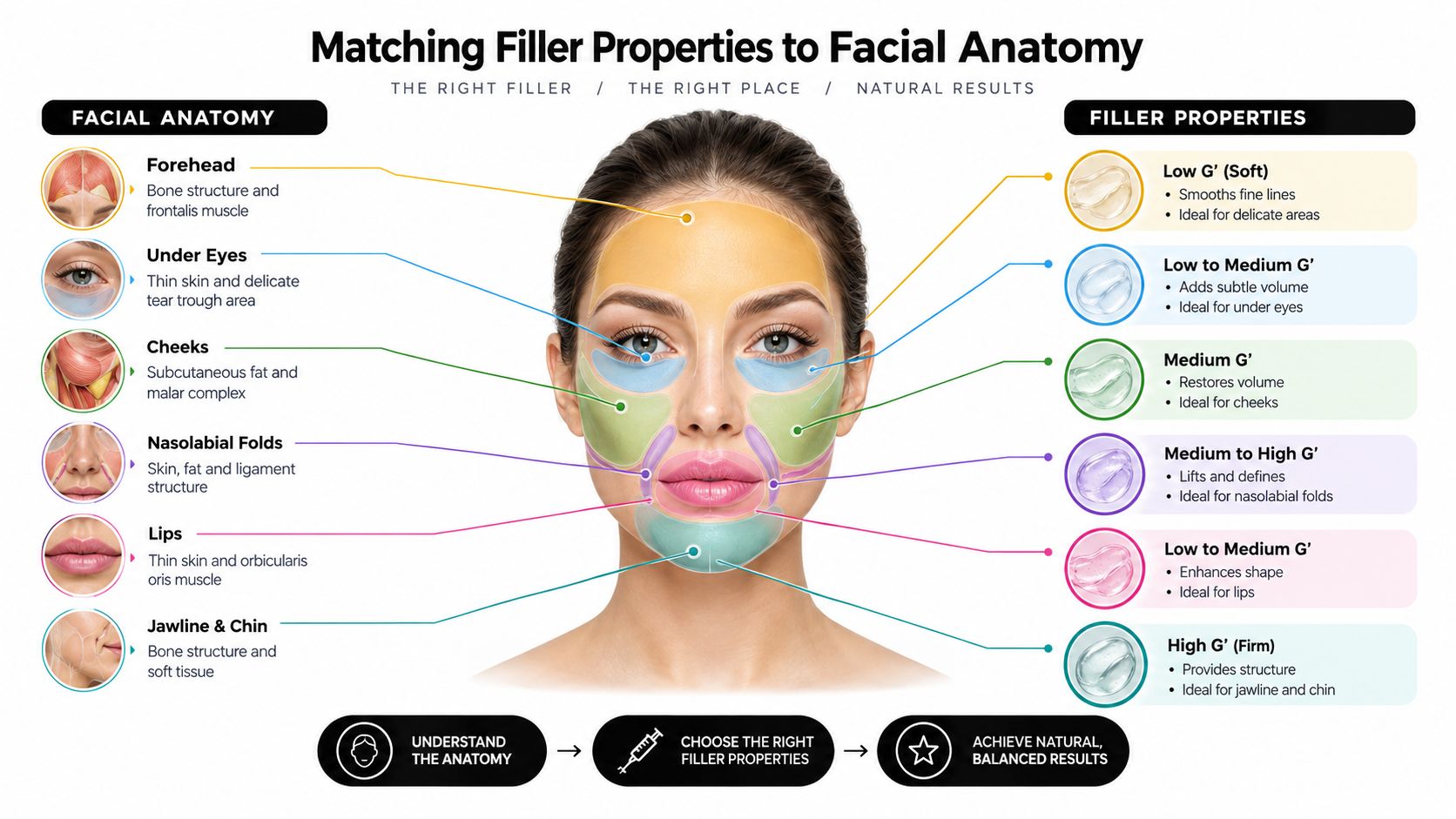
The right cheek filler is determined by the tissue problem, not by a product ranking. The malar region is the upper cheekbone area, while the submalar region lies lower and may look hollow or flattened. The lateral cheek affects width and contour along the outer midface. Each area may require a different balance of projection, flexibility, and spread.
Three questions clarify the treatment target
Is the concern structural? If the cheekbone lacks projection, a cohesive, high-lift HA or CaHA may suit carefully controlled deep placement. The goal is to reinforce existing anatomy, not create a prominent mound above the facial plane.
Is the concern volume loss? Age-related midface flattening may call for broader restoration across the cheek. Placing all the product at the highest point can exaggerate projection instead of recreating a natural transition from cheek to surrounding tissue.
Is the concern descent or shadowing? Soft-tissue descent, laxity, and under-eye hollowing can mimic a deficient cheekbone. Filler may soften selected transitions, but it cannot correct every cause of shadow or laxity. Another treatment plan may be more appropriate.
Why placement matters as much as material
Deep supraperiosteal placement and superficial blending demand different gel behavior. A firm filler may provide controlled projection over the malar structure, while a softer, more flexible product may blend better through mobile or delicate tissue. The same material can look balanced in one plane and too prominent in another.
For thin tissue, I palpate midface skin thickness, assess asymmetry and vascular anatomy, and review previous filler before choosing depth. Very thin skin often calls for a flexible HA used conservatively rather than a firm bolus. Product labeling may also define patient groups or treatment situations where safety evidence is limited, as described in FDA dermal filler labeling. A careful plan should account for the patient's anatomy, treatment history, and whether the aim is projection, restoration, or gradual collagen support.
Elevating Skin Quality with LED Light Therapy
Filler changes the deeper contour. It doesn't automatically improve the quality of the skin covering that contour. If the surface is dull, irritated, uneven, or poorly supported, a beautifully placed cheekbone can still look less polished than expected.
That's where a non-invasive adjunct such as the Barb N.P. Facial Mask can fit into a broader skincare routine. The device is designed for convenient home use with a wireless format, a comfortable fit over the face, and three lighting settings intended for different treatment goals. Red light is commonly selected for a collagen-supportive skincare routine, while blue light may be used when clarity is the priority. The appropriate setting and frequency should follow the device guidance and your clinician's advice.

Treat the skin as the finishing layer
A wireless mask is practical because you aren't tethered to a power source while wearing it. Comfort matters too. If the mask sits securely without creating distracting pressure, it's easier to incorporate into a consistent routine rather than treating it as an occasional device.
LED therapy shouldn't be presented as a replacement for filler, and it shouldn't be used to promise that an injectable result will last longer. Its role is different. It supports the surface appearance while the filler addresses deeper contour, and it can be considered alongside sunscreen, a well-tolerated retinoid when appropriate, barrier support, and clinician-directed skincare.
Clinical perspective: A filler can restore contour, but healthy-looking skin helps that contour read as natural.
After injections, timing matters. I'd wait until your injector confirms that the skin has settled and that using the mask is appropriate. Avoid applying pressure over freshly treated areas, and don't use any device on skin with an active reaction unless your clinician specifically advises it. For more background on integrating LED into skincare, see this guide to LED light therapy for skin.
Navigating Safety and Long-Term Risk Management
Cheek filler is a medical procedure performed near important vessels. Common short-term effects include bruising, swelling, redness, tenderness, firmness, itching, and lumps or nodules. These effects often improve as the tissue settles, but your injector should explain what is expected and what requires urgent assessment.
The more serious concern is unintended vascular injection. FDA materials identify potential complications including tissue necrosis and injection into a blood vessel, which can damage facial tissue and cause vision impairment or blindness. The FDA describes this as an uncommon event with potentially permanent consequences, which is why injector training and emergency preparedness matter. Review the FDA safety information for dermal fillers before treatment.
Reversibility is a safety advantage, not a guarantee
HA can often be adjusted or dissolved with hyaluronidase when clinically appropriate. That's a meaningful advantage, particularly for a first treatment or a staged contour plan. It doesn't mean correction is instant, complete, or risk-free, and dissolving should be performed by a qualified clinician who understands the product, anatomy, and reason for treatment.
Long-term management also deserves honest discussion. Imaging literature has described early problems such as swelling, infection, overcorrection, discoloration, and skin necrosis, as well as delayed concerns including migration, delayed hypersensitivity, granuloma, and scarring. CT or MRI may be needed to evaluate selected complications.
Preliminary FDA materials also describe reports of bone resorption after supraperiosteal HA injections in the midface identified through imaging. The reported patients were asymptomatic, and the evidence remains preliminary. The sensible response isn't panic. It's conservative reassessment, accurate documentation of product and placement, and avoiding automatic retreatment every time volume appears to fade.
Choose the injector before the brand
A qualified injector should be able to explain:
- Vascular safety: How they reduce risk and what their urgent complication protocol involves.
- Product history: Which filler was used previously, where it was placed, and whether imaging or examination is needed.
- Treatment restraint: Why the proposed volume is appropriate and what they'll do if the result looks excessive.
- Follow-up access: Who evaluates persistent swelling, pain, skin changes, or asymmetry after treatment.
You can also review dermal filler side effects before your consultation, then use that information to have a specific discussion with your clinician.
Planning Your Consultation and Treatment Timeline
A good consultation feels less like ordering a product and more like solving a three-dimensional problem. Your provider should examine your face at rest and in motion, assess the malar, submalar, and lateral cheek regions, and ask whether your priority is projection, restored volume, skin quality, or a gradual change.
Bring a record of previous injections if you have one. Tell the clinician about medications, allergies, medical conditions, prior reactions, and any upcoming event that affects your preferred timing. Ask which product they're considering, why it fits your tissue, what alternatives exist, and how they would manage an unwanted result.

A realistic treatment pathway
Step one is assessment. The clinician identifies whether you have skeletal underprojection, soft-tissue volume loss, descent, asymmetry, or a combination. Photos and facial mapping can help document the starting point.
Step two is product selection. HA is often considered when adjustability and staged refinement matter. CaHA may be discussed when structural support and collagen stimulation are priorities. Poly-L-lactic acid may suit a patient who prefers gradual, diffuse change.
Step three is conservative treatment. The injector places product according to the agreed anatomical plan, not according to a preset number of syringes. Immediate swelling can make the cheeks appear larger than the settled result, so early judgments should be cautious.
Step four is recovery. Follow the provider's instructions regarding pressure, heat, exercise, skincare, and device use. Ask specifically when it's appropriate to resume an LED mask, including the Barb N.P. Facial Mask if it's part of your routine.
Step five is review. A follow-up around the two-to-four-week mark allows the clinician to assess tissue integration, symmetry, and whether any staged refinement is needed. Don't chase every small difference while swelling is still changing.
The safest plan may be smaller than the one you imagined. Natural cheek enhancement usually comes from respecting the relationship between bone, fat, skin, and movement, not from maximizing volume.
BotoxBarb offers consultations and in-clinic aesthetic services including dermal fillers, Botox, Dysport, LED light therapy, and PRP, alongside a curated online boutique of skincare and wellness products. Visit BotoxBarb to explore cheek contouring options and arrange a personalized consultation focused on your anatomy, goals, and safety.