Best Sunscreen for Daily Use: A Practical 2026 Guide
You've washed your face, applied a carefully chosen serum, and then paused over the sunscreen shelf. One bottle promises an invisible finish, another leaves a pale cast, and a third has an impressive SPF number that doesn't explain how well it protects against UVA. In practice, the best sunscreen for daily use is rarely the most glamorous product. It's the formula that protects broadly, feels comfortable, works with your routine, and gets applied consistently.
As an aesthetic nurse practitioner, I look at sunscreen as part of treatment planning, not as a final cosmetic step. The right product supports pigment control, post-treatment recovery, and long-term skin quality. The wrong one may sit unused in a drawer because it pills, stings, shines, dries the skin, or disrupts makeup.
Why Daily Sunscreen Is the Highest-Return Habit in Your Routine
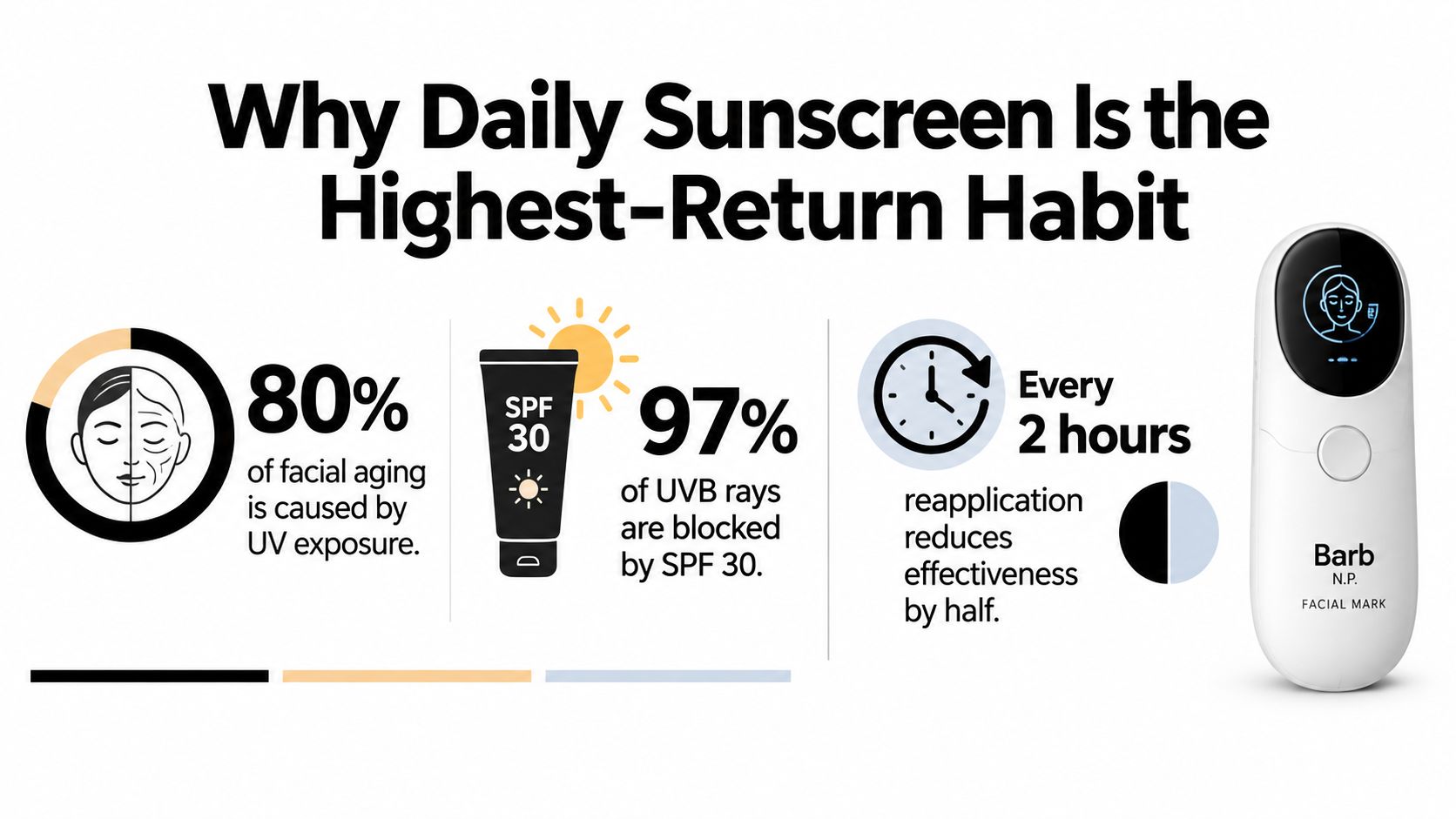
In the treatment room, cumulative ultraviolet exposure often shows up as uneven tone, persistent pigmentation, fine lines, loss of firmness, and slower-looking recovery after aesthetic treatments. UVA contributes substantially to premature skin aging, while UVB is the principal cause of sunburn, according to the U.S. Food and Drug Administration's sunscreen guidance. Both types matter, and visible sun damage is only one part of the concern. Broad-spectrum protection also supports a routine designed to reduce the appearance of pigment and preserve collagen.
The question, then, isn't just “Which sunscreen has the highest SPF?” A more useful clinical question is: What will this product deliver every morning without creating a reason to skip it?
What I look for before the finish
I start with two label requirements:
- Broad spectrum: The formula is designed to address both UVA and UVB exposure.
- SPF 30 or higher: The product offers a practical level of routine UVB protection when applied correctly.
Then I assess the factors that determine whether a patient will keep using it:
- Filter tolerance. Sensitive or recently treated skin may prefer a mineral formula, while many patients choose a lightweight chemical or hybrid formula for easier blending.
- Texture. A fluid can suit oily skin and makeup, while a lotion-cream may be more comfortable on dry or mature skin.
- Finish. Matte, satin, dewy, and tinted formulas each solve different cosmetic problems.
- Routine compatibility. A sunscreen should layer over antioxidant serums and moisturizer without pilling or disturbing the barrier.
- Exposure demands. Water, sweat, swimming, friction, and towel drying all change how often protection needs attention.
Practical rule: The best sunscreen is the one that gives you verified UVA and UVB coverage, then feels good enough to apply generously every day.
Sunscreen also shouldn't stand alone. Shade, protective clothing, hats, sunglasses, and avoiding intense midday exposure add protection that a topical product can't replace. For patients using pigment-focused serums or recovering from procedures, daily sunscreen is what helps prevent environmental exposure from working against the rest of the routine.
What SPF and Broad-Spectrum Labels Really Mean
A high SPF number can still leave a patient underprotected if the formula lacks verified UVA coverage or is applied too sparingly. SPF has a specific regulatory meaning, not a general score for every type of ultraviolet protection.
The FDA determines SPF through an in-vivo comparison of the UV exposure required to produce sunburn on protected skin versus unprotected skin. SPF therefore reflects UVB-related erythema, rather than complete protection across every ultraviolet wavelength.
The numerical difference between familiar SPF levels is also smaller than many consumers expect. SPF 15 filters approximately 93% of UVB, while SPF 30 filters approximately 97%, according to the FDA's consumer explanation of how sunscreen helps protect your skin. A higher SPF has value, but it cannot replace broad-spectrum coverage, an adequate amount, or consistent reapplication.
Reading the broad-spectrum claim
In the United States, the FDA broad-spectrum claim requires in-vitro testing of UVA and UVB transmission. The formula must reach a mean critical wavelength of at least 370 nanometers, showing that protection extends sufficiently into the UVA range. That distinction matters in aesthetic practice, particularly for patients concerned about photoaging, persistent pigmentary change, or collagen degradation.
A strong SPF can still require closer review of its UVA performance. When I assess a sunscreen for a patient using pigment-focused serums or recovering from a procedure, the label is only the starting point. The product also needs to suit the patient's tolerance and routine so it does not interfere with barrier care or discourage generous application.
International labels communicate UVA protection differently. Japan uses the PA system, while European products follow their own UVA labeling conventions. A product purchased abroad may be well formulated, but regional claims do not always correspond directly to the American broad-spectrum designation.
Filter availability also differs by market. Rather than relying on unsupported comparisons of authorized filter counts, evaluate the product's stated UVA and UVB protection, formulation, and tolerability. Country of origin alone does not establish superior performance.
| Claim | What It Measures | What It Misses | Daily Use Takeaway |
|---|---|---|---|
| SPF | Primarily UVB-related sunburn protection | Full UVA performance and application errors | Choose SPF 30 or higher |
| Broad spectrum | UVA and UVB transmission performance under the relevant labeling system | Whether you apply enough or reapply after removal | Treat it as a required label feature |
| High SPF number | Greater labeled UVB protection | Proper dose, UVA quality, and real-world wear | Do not use it to justify skipping reapplication |
For a broader consumer explanation of sunscreen and tanning products, the lo la beauty sun care blog offers useful context. My practitioner rule is simple: select SPF 30 to 50 with an explicit broad-spectrum designation, then choose the texture you'll wear every day. In the morning, sunscreen follows serum and moisturizer when tolerated. In the evening, the Barb N.P. LED Facial Mask can support a separate recovery routine, but it does not replace daytime UV protection.
Chemical vs Physical Filters and How to Choose
The chemical-versus-mineral debate becomes more useful when treated as a matching exercise. No filter family wins for every face, every procedure, or every lifestyle. The correct starting point depends on sensitivity, desired finish, skin tone, activity level, and whether you need to reapply over makeup.
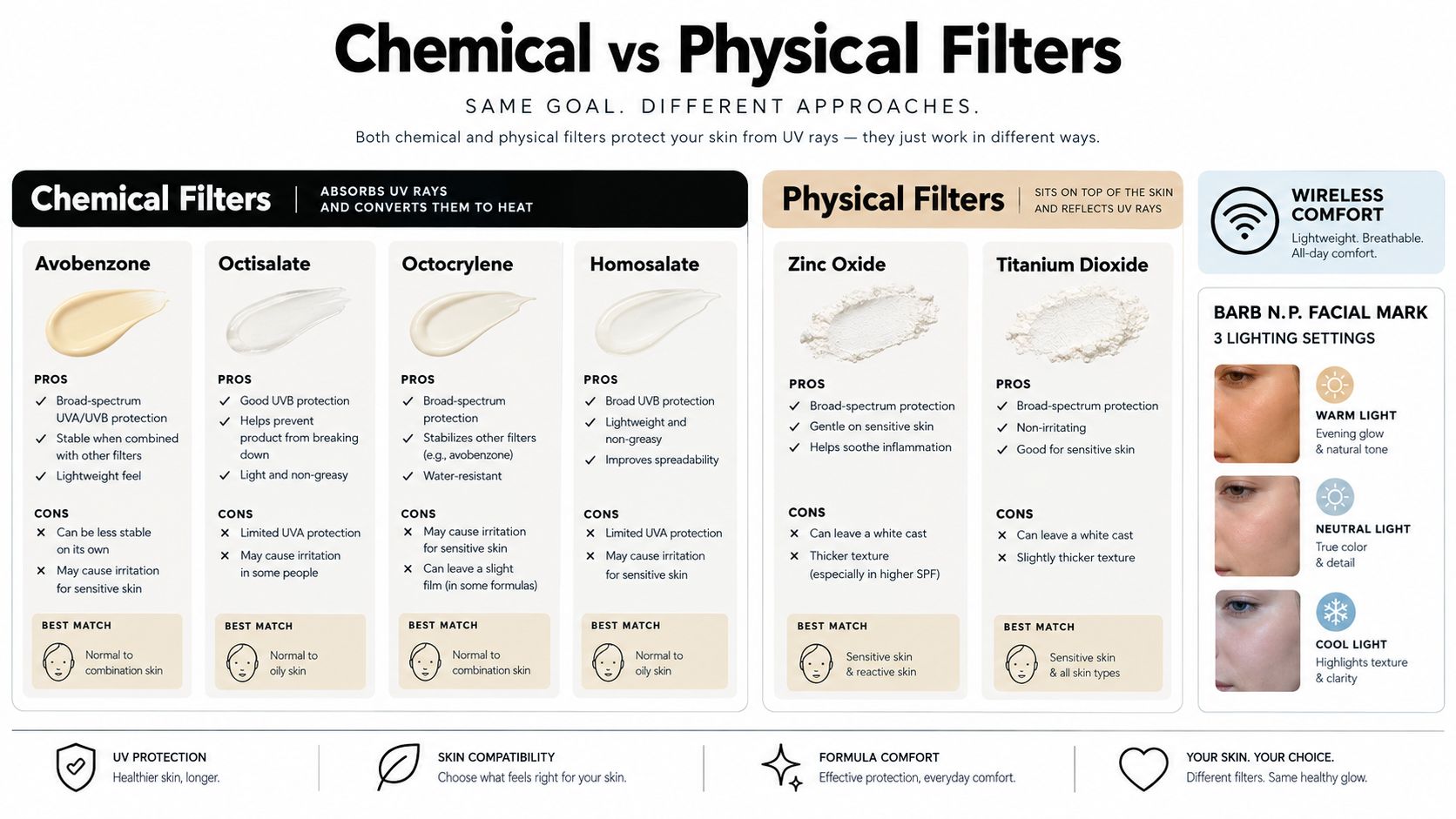
Chemical formulas may include filters such as avobenzone, octisalate, octocrylene, and homosalate. Newer large-molecule filters such as Tinosorb S and Uvinul A Plus are used in some international formulas. Their advantages often include a thinner application, easier blending, and less visible residue. Avobenzone contributes UVA coverage, while other filters may support UVB coverage, formula stability, or a more cosmetically elegant finish depending on the complete system.
Mineral formulas use zinc oxide, titanium dioxide, or both. They're often a sensible starting point for reactive, recently treated, or sting-prone skin. Zinc oxide can provide broad protection across the ultraviolet range, while titanium dioxide contributes primarily to UVB and shorter UVA wavelengths. The trade-off is familiar: mineral products may feel drier, require more blending, or leave a visible cast, especially when the formula isn't tinted.
Start with the problem you need to solve
- For oily or active patients: A chemical or hybrid fluid may be easier to spread and less likely to feel heavy during the day.
- For sensitive or post-procedure skin: Begin with a fragrance-free mineral formula and introduce other options only when the skin barrier is comfortable.
- For deeper skin tones: Look for a well-tinted mineral formula or an elegant hybrid that doesn't leave a gray or purple cast.
- For makeup users: A thin chemical or hybrid lotion often layers more smoothly, although a well-formulated mineral product can also perform beautifully.
- For swimming or heavy sweating: Choose a water-resistant product when needed, but remember that water resistance doesn't remove the need for reapplication.
The distinction between “chemical” and “physical” also shouldn't replace a patch test. A patient can react to the vehicle, fragrance, preservatives, or the overall formula rather than to the filter family itself. My mineral sunscreen versus chemical sunscreen guide provides another way to compare the two approaches before choosing a daily formula.
Matching Formulation to Your Skin Type and Concern
A sunscreen can meet every label requirement and still be a poor daily choice if the texture conflicts with your skin. I ask patients what happens by midday. Does the face become shiny, tight, flaky, irritated, or uneven under makeup? That answer often tells us more than the product's marketing language.
Use the finish as a diagnostic clue
Oily or acne-prone skin usually does best with an oil-free fluid, lotion, or gel-cream that dries to a true matte or soft-satin finish. Look for non-comedogenic labeling where available. Avoid heavy creams with rich butters or coconut derivatives if they consistently trap sebum or make breakouts harder to manage.
Dry or mature skin benefits from a lotion-cream that cushions the barrier. Squalane, ceramides, and hyaluronic acid can make sunscreen feel more comfortable over a hydrating serum or cream. A dedicated skin hydration cream may be useful beneath sunscreen when the formula itself doesn't provide enough comfort.
Sensitive or post-procedure skin needs simplicity. I generally favor a fragrance-free, 100% mineral SPF with zinc oxide as the active filter when the skin is reactive, peeling, or newly treated. Avoid unnecessary fragrance, strong actives, and formulas that sting on application.
Melanin-rich or hyperpigmentation-prone skin often benefits from a tinted mineral formula. Tint can improve cosmetic tone while helping address the visible-light component of pigment concerns. The shade should disappear into the complexion rather than create an ashy veil.
Combination skin often responds well to a balancing gel-cream. Apply a lighter layer through oilier zones and make sure the cheeks, ears, and neck receive full coverage rather than using a different SPF product on each area.
| Skin Type / Concern | Recommended Texture & Finish | Look For | Avoid |
|---|---|---|---|
| Oily or acne-prone | Fluid, gel, matte, or soft satin | Oil-free and non-comedogenic labeling | Heavy, occlusive-feeling creams |
| Dry or mature | Lotion-cream with a cushioned finish | Squalane, ceramides, or hyaluronic acid | Drying, quick-setting formulas |
| Sensitive or post-procedure | Minimal, fragrance-free mineral lotion | Zinc oxide and a short ingredient list | Fragrance and formulas that sting |
| Melanin-rich or pigment-prone | Tinted mineral or elegant hybrid | A natural tint and broad-spectrum claim | Gray or visibly pale residue |
| Combination | Lightweight gel-cream | Balanced hydration without excess shine | Thick layers in the T-zone |
The ultimate guide to choosing a face cream with SPF can help you decide whether your sunscreen should replace moisturizer or sit over it. In clinic, I prefer fewer layers when the skin is congested and more barrier support when the skin feels tight or compromised.
How to Apply, Layer, and Reapply the Right Way
Even an excellent sunscreen underperforms when the film is too thin or uneven. SPF testing uses a standardized sunscreen layer, while real users often apply less product, touch the face, sweat, swim, or remove the product with a towel. Application technique is therefore part of the product selection.
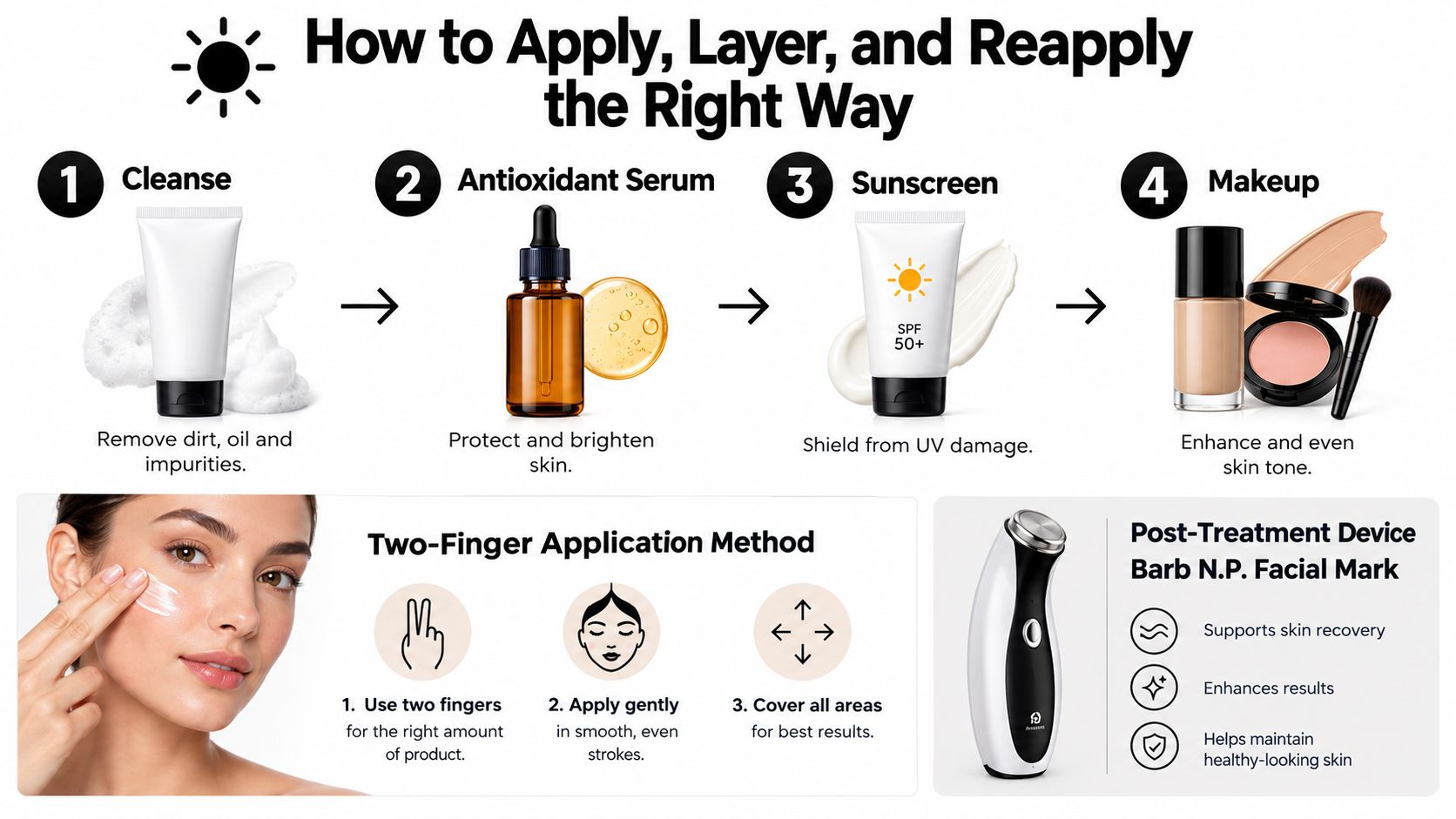
Start with the morning routine in this order:
- Cleanse. Remove overnight oil and residue without leaving the skin stripped.
- Apply an antioxidant serum. Vitamin C is one example, provided your skin tolerates it.
- Moisturize if needed. Dry or mature skin may need a separate barrier-supporting layer.
- Apply broad-spectrum sunscreen last. It should form the final skincare layer before makeup.
Use enough, then protect the areas people miss
For the face and neck, the two-finger method is a practical benchmark. Dispense sunscreen along the length of the index and middle fingers, then spread it over the face, ears, neck, and exposed hairline. Exact volume varies with finger size and coverage area, but this approach is more reliable than applying a tiny dot and hoping it spreads far enough.
For exposed body skin, a practical benchmark is about 1 fluid ounce, as described in dermatology guidance from the American Academy of Dermatology. Reapply approximately every two hours when outdoors, immediately after swimming or sweating, and after towel drying. Water-resistant formulas are useful for water or heavy perspiration, but they still need to be reapplied.
Indoor exposure requires judgment rather than a rigid rule. A skincare science review describes a controlled trial in which desk-based workers away from windows retained effective coverage after one morning application across a simulated six-hour workday. The same review notes that standard window glass blocks nearly all UVB but only about 25% of UVA. Because the trial was limited and indoor settings vary, I recommend a morning application for routine days, with midday reapplication driven by sunlight, windows, commuting, exercise, sweating, or friction rather than by the clock alone.
Around the eyes, pat instead of rubbing. Let layers settle before makeup, and use a makeup strategy that doesn't disturb the base. The Buy Me Japan makeup routine guide offers useful ideas for sunscreen under cosmetics. Powder SPF or a sunscreen mist can help with touch-ups, but they shouldn't replace a generous initial lotion application.
For a practical exposure-based explanation, see this guide on how often to reapply sunscreen.
Clinic-Grade Picks From BotoxBarb and How to Use Them
I reach for different formulas depending on whether the priority is pigment support, weightless wear, or visible-light coverage. These products aren't interchangeable, and the right choice depends on how the skin behaves under treatment products, makeup, and daily exposure.
SkinCeuticals Advanced Brightening UV Defense SPF 50 is my lead recommendation when tone evenness is part of the plan. It combines chemical and mineral protection with 1% tranexamic acid and niacinamide, making it a logical option for patients who want daily UV protection alongside a brightening-focused routine. I use it after serum and moisturizer, before makeup, with reapplication tied to direct exposure, sweating, or product removal.
EltaMD UV Clear Broad-Spectrum SPF 46 suits acne-prone skin and patients who dislike a heavy sunscreen layer. Its lightweight, niacinamide-forward fluid is designed for a more weightless daily feel. I favor it when a patient wants a simple morning product that can sit over treatment serums without making the face feel coated.
For melanin-rich skin or persistent hyperpigmentation concerns, SkinCeuticals Physical Fusion UV Defense SPF 50 offers a tinted mineral format. The tint provides a more natural skin-tone finish and supports a routine where visible-light exposure is part of the pigmentation conversation.
| Product | Filter Type & SPF | Best For | How I Use It |
|---|---|---|---|
| SkinCeuticals Advanced Brightening UV Defense SPF 50 | Chemical-mineral hybrid, SPF 50 | Uneven tone and brightening-focused routines | Apply after skincare in the morning, then reapply with meaningful exposure |
| EltaMD UV Clear Broad-Spectrum SPF 46 | Lightweight fluid, SPF 46 | Acne-prone or post-treatment skin | Use as the final morning skincare step when a thin finish matters |
| SkinCeuticals Physical Fusion UV Defense SPF 50 | Tinted mineral, SPF 50 | Melanin-rich or pigment-prone skin | Apply generously for mineral coverage and a natural tint |
| BARB N.P. Tinted Mineral SPF 40 | Tinted mineral, SPF 40 | Patients seeking a daily mineral tint | Use when a cosmetic mineral finish and simple morning application fit the routine |
In the evening, the Barb N.P. Facial Mask can complement, rather than replace, daytime sunscreen. BotoxBarb's published product material describes it as a wireless mask with three light modes: red light for anti-inflammatory support, near-infrared light for healing-oriented treatment, and blue light for rejuvenation or complexion-focused care. The hands-free format is convenient during an evening routine, and the mask is intended to rest directly over the face during treatment. Sunscreen handles daytime UVA and UVB defense. The LED device belongs in the separate evening treatment category.
Your Daily Sunscreen Decision Checklist and Next Steps
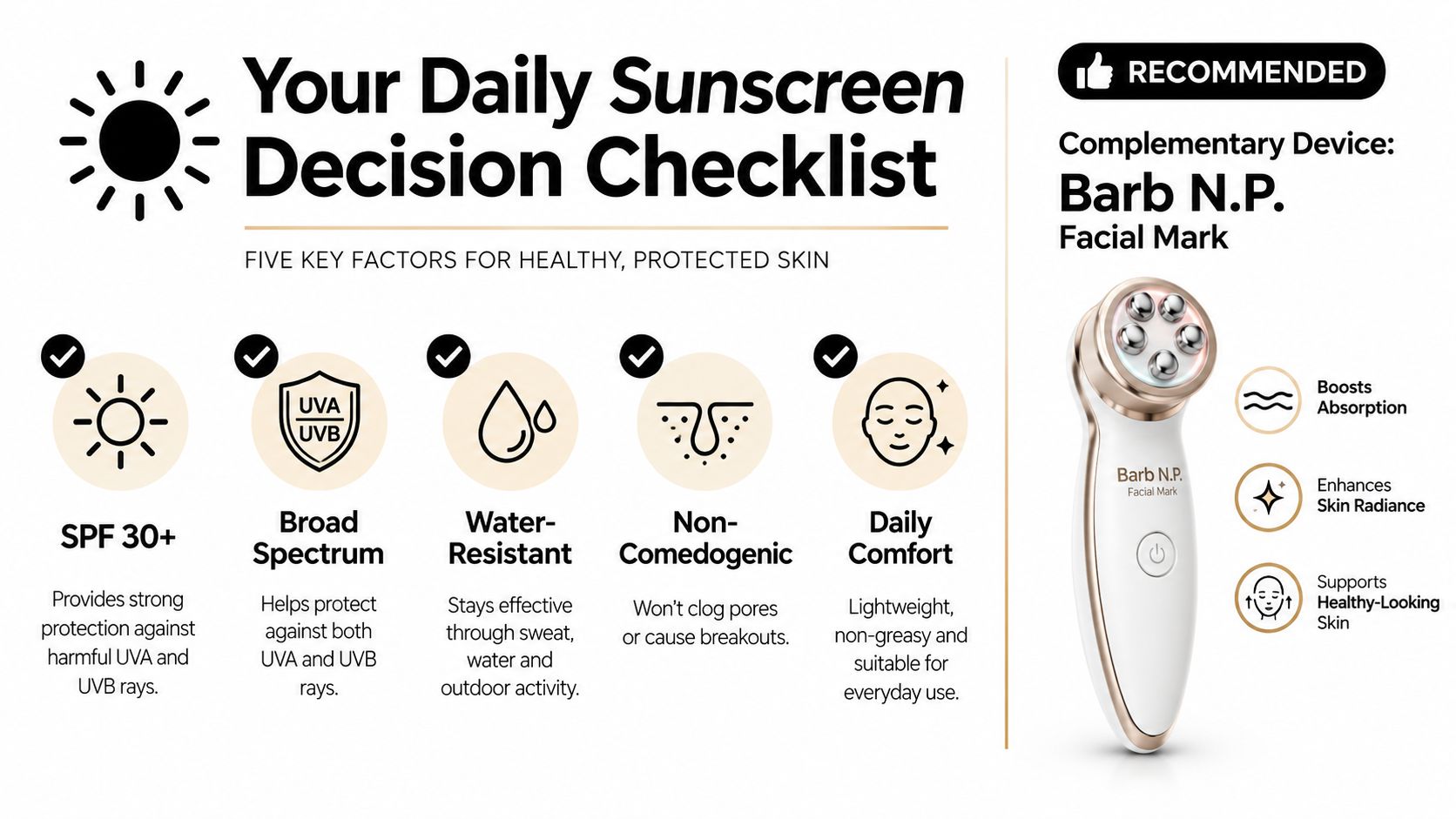
Choose your product in this order, not by packaging or the highest number on the front label:
- SPF 30 or higher: Use it as the practical baseline for routine facial protection.
- Broad spectrum: Confirm that the label addresses both UVA and UVB.
- Skin-matched filters: Start with mineral protection when sensitivity or recent treatment makes sting a concern.
- Comfortable finish: Select matte, satin, dewy, or tinted based on how your skin behaves under makeup.
- Appropriate wear claims: Choose water resistance when swimming or sweating is part of the day, and look for fragrance-free or non-comedogenic options when relevant.
Adjust the routine to the day
For a low-exposure indoor day, apply a comfortable broad-spectrum SPF in the morning. If you're seated beside bright windows, commuting, driving, exercising, or spending time outside, treat that as a higher-exposure day and plan for reapplication based on sunlight, sweat, and friction.
Travel and outdoor plans call for a formula that you can apply generously and refresh without hesitation. Pack a water-resistant option when water or heavy perspiration is expected, plus protective clothing and shade strategies. An impressive label won't compensate for missed areas or a thin layer.
After microneedling, peels, laser treatments, or other procedures, follow the treating clinician's instructions before restarting active products. Once sunscreen is appropriate, a gentle mineral formula may be easier to tolerate, and reapplication should be careful rather than aggressive. After injectables, avoid rubbing treated areas and follow the specific aftercare guidance provided by your practitioner.
The decision is simple enough to remember: broad spectrum, SPF 30 or higher, generous application, and a finish you'll wear consistently. Choose the formula that fits your skin, then protect the rest of the routine with shade, clothing, and sensible exposure habits.
I offer curated medical-grade skincare, daily sunscreen options, LED light therapy, injectables, and personalized aesthetic guidance for patients building a practical long-term routine. Visit BotoxBarb to shop the daily lineup or book a consultation so we can match your sunscreen and treatment plan to your skin's needs.