Best Skincare for Hyperpigmentation: An Expert Guide
You've bought the brightening serum, tried the “dark spot corrector,” maybe even rotated through acids and retinol, yet the spots are still there. In some cases they look lighter for a few weeks, then come right back after one breakout, one beach day, or one stretch of inconsistent sunscreen. That cycle is frustrating, and it often makes people think their skin is stubborn or untreatable.
It usually isn't. Hyperpigmentation is a treatable pattern of excess melanin production, not a personal failure and not something you have to blindly experiment with forever. The problem is that most routines target only one piece of the process. They exfoliate but don't suppress pigment. They brighten but don't control inflammation. They use SPF but miss visible light protection.
A practical plan works better than product hopping. If you're interested in brightening skin with gentle care, the most useful starting point is understanding that dark spots fade fastest when your routine matches the reason they formed in the first place.
Your Path to Even-Toned Skin Starts Here
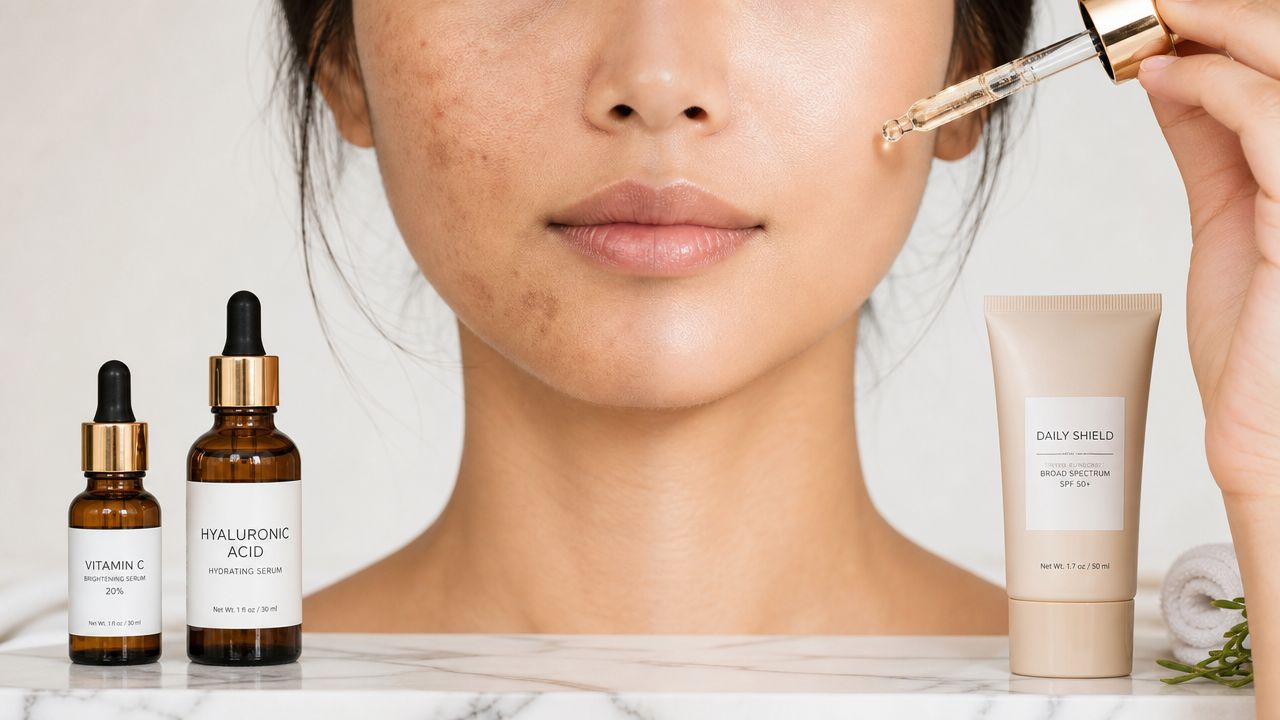
Hyperpigmentation shows up as patches, marks, or spots that are darker than your natural skin tone. I tell patients to think of it as the skin's memory system. When skin is irritated, inflamed, hormonally triggered, or repeatedly exposed to light, it responds by making more pigment.
That's why random routines often disappoint. A cleanser, one serum, and a basic moisturizer may feel productive, but the best skincare for hyperpigmentation usually combines home care, light protection, and sometimes in-office treatment. If your routine ignores one of those pillars, progress slows down.
What improvement usually looks like
A realistic timeline matters. A 12-week single-center study found that a targeted pigment-correcting dark spot treatment gel suspension cream improved overall hyperpigmentation, skin tone evenness, and dark spot intensity and contrast as early as Week 2, with continued improvement through Week 12 (study details).
That kind of timeline is why I encourage patients to stop judging a routine after a handful of uses. Skin needs repetition and consistency.
Practical rule: If a product is causing stinging, peeling, or chronic irritation, it can work against your pigment goals even if the ingredient itself is evidence-based.
What helps most people move forward
Instead of asking “What's the strongest thing I can use?”, ask these questions:
- What kind of pigmentation is this? Acne marks behave differently than melasma.
- Am I preventing new pigment every day? Treatment fails when new darkening keeps getting triggered.
- Is my routine doing too much? Over-exfoliation is one of the most common reasons spots linger.
- Do I need professional help now? Some pigment responds better when at-home care is paired with in-clinic support.
If your skin tone looks blotchy overall, this guide on how to fix uneven skin tone can help you connect discoloration with broader skin barrier and treatment habits.
Understanding the Cause of Your Dark Spots
Before choosing ingredients, identify the pattern. Hyperpigmentation isn't one diagnosis. It's a category.

Post-inflammatory hyperpigmentation
Post-inflammatory hyperpigmentation, or PIH, happens after the skin gets injured or inflamed. Acne, picking, burns, eczema, aggressive exfoliation, and even friction can leave behind a flat dark mark after the original issue is gone.
This is one reason acne patients feel like they're fighting two battles at once. The breakout fades, but the mark remains.
For this type, calming inflammation matters just as much as fading pigment. Research also supports N-Acetyl Glucosamine as part of the toolkit. Multiple double-blind, controlled clinical trials found that N-Acetyl Glucosamine, alone or paired with niacinamide, significantly lightened hyperpigmentation related to solar radiation, and 2% NAG reduced facial hyperpigmentation after 8 weeks of application (review summary).
Melasma
Melasma usually appears as broader, patchier discoloration, often on the cheeks, forehead, upper lip, or jawline. Hormones often play a role. Pregnancy, birth control, and heat or light exposure can all be part of the picture.
Melasma tends to be the condition that humbles people. It can improve nicely, then flare again if the trigger isn't controlled. That's why one “dark spot serum” rarely solves it on its own.
Melasma often behaves less like a stain and more like a condition that needs maintenance.
Solar lentigines
These are the classic sun spots. They develop after cumulative sun exposure and tend to show up in areas that get regular light, such as the cheeks, temples, nose, chest, and hands.
They're often more defined than melasma and less directly tied to inflammation than PIH. In-clinic options can be especially helpful for these when home care reaches a plateau.
If you're comparing patterns, this overview of best treatments for hyperpigmentation is a useful companion because it frames treatment around the underlying cause rather than treating every spot the same way.
A quick way to think about it
A simple analogy helps:
| Type | Common trigger | Typical look | Main treatment focus |
|---|---|---|---|
| PIH | Acne, irritation, injury | Flat marks after inflammation | Calm inflammation and fade existing pigment |
| Melasma | Hormonal shifts plus light exposure | Patchy, symmetrical areas | Ongoing suppression and strict light protection |
| Sun spots | Cumulative sun exposure | More distinct, localized spots | Brighteners, turnover, and procedural options |
The Best Active Ingredients for Hyperpigmentation
Ingredient lists make more sense when you group them by job. Some ingredients slow pigment formation. Others speed removal of pigmented cells. A third group helps reduce inflammation and oxidative stress, which lowers the chance of new discoloration.

Inhibitors that slow melanin production
Hydroquinone remains the benchmark. Topical hydroquinone at 4% is the gold standard first-line therapy for facial hyperpigmentation, and clinical guidance recommends a maximum treatment duration of 6 months (clinical review). This is one of the most effective ways to directly suppress pigment production, but it isn't a forever ingredient and should be used thoughtfully.
Azelaic acid is a strong option for people who want a gentler profile, including sensitive or pregnancy-safe routines. Verified guidance supports 15% to 20% prescription strengths or 10% over-the-counter for pigment management, with the added benefit of helping texture and redness.
Kojic acid and arbutin also fit this category. They're common in non-hydroquinone routines and can be useful for patients who want a more gradual path.
Tranexamic acid deserves a separate mention. In practice, it's especially relevant for melasma and stubborn, inflammation-linked pigment patterns. It's increasingly used in combination formulas because it addresses pathways that classic “brighteners” don't fully cover.
Accelerators that increase cell turnover
These ingredients don't stop pigment at the source as directly as hydroquinone does. Instead, they help remove pigmented surface cells more efficiently.
Retinoids are central here. Verified dermatology reviews support that retinoids such as retinol, tretinoin, and adapalene can produce visible fading within 6 to 8 weeks of consistent use, and combination regimens work faster and more durably than single-agent approaches.
AHAs, including glycolic, lactic, and mandelic acid, can help lift superficial pigment. They're useful, but many people tend to overdo the treatment. More peeling doesn't always mean better fading. If the skin barrier gets inflamed, pigment can worsen instead of improve.
If glycolic acid is already in your lineup or you're thinking about adding it, this guide on what is glycolic acid helps clarify where it fits and who should use it cautiously.
The right exfoliant helps pigment. The wrong frequency creates more of it.
Protectors that support a brighter, steadier routine
Vitamin C, specifically ascorbic acid, is one of the most practical antioxidant choices. Verified data supports up to 30% reduction in pigmentation severity after 12 weeks of daily application at 10% to 15% concentration in clinical use. It's useful in the morning because it supports defense and brightening at the same time.
Niacinamide is one of my favorite ingredients for people who irritate easily. Verified data supports that 5% niacinamide reduced melanin dispersion by 20% to 25% after 8 weeks, and separate evidence also supports 2% niacinamide improving hyperpigmentation area and skin lightness within 4 weeks when used with sunscreen.
Licorice extract and N-Acetyl Glucosamine can be smart supporting ingredients, especially in formulas built for uneven tone rather than aggressive exfoliation.
A practical comparison
| Ingredient | Main role | Helpful concentration or use note | Main trade-off |
|---|---|---|---|
| Hydroquinone | Suppresses pigment production | 4% is the established first-line standard; limit use to 6 months | Can irritate, not ideal for indefinite use |
| Azelaic acid | Reduces excess pigment and smooths skin | 15% to 20% prescription or 10% OTC | Slower than hydroquinone for some cases |
| Retinoids | Speed turnover and help fade pigment | Consistent nightly or alternate-night use | Dryness, peeling, adjustment period |
| Vitamin C | Antioxidant support and brightening | 10% to 15% daily use supported | Some formulas sting sensitive skin |
| Niacinamide | Reduces melanin transfer and supports barrier | 2% to 5% has supportive data | Usually well tolerated, but not dramatic overnight |
| Kojic acid | Helps inhibit tyrosinase | Often used in combination formulas | Can be irritating in sensitive skin |
Building Your AM and PM Skincare Routines
A good routine should feel repeatable on an ordinary Tuesday, not just on your most disciplined day. That means fewer products, better layering, and enough restraint that your skin doesn't stay irritated.

Morning routine for protection and prevention
Morning care should defend your skin and stop new pigment signals from building.
For most skin types, this sequence works well:
- Gentle cleanse if you wake up oily, or rinse with water if your skin is dry and reactive.
- Antioxidant or brightening serum such as a Vitamin C or niacinamide formula.
- Moisturizer if your skin needs barrier support.
- Tinted sunscreen with iron oxide as the final step.
For oily or acne-prone skin, keep textures light. A niacinamide serum or azelaic acid product usually fits better than heavy creams.
For dry or sensitive skin, reduce the number of active products in the morning. A bland moisturizer under sunscreen is often smarter than layering too many treatment serums.
Evening routine for correction and repair
Night is where your stronger treatment step usually belongs.
A basic PM framework looks like this:
- Cleanser to remove sunscreen, makeup, and debris.
- Treatment step such as a retinoid, azelaic acid, tranexamic-acid-based serum, or hydroquinone if prescribed and appropriate.
- Moisturizer to reduce irritation and support consistency.
If you're using a retinoid and an exfoliating acid, don't assume they belong on the same night. Many patients do better alternating. The best skincare for hyperpigmentation is often the routine you can tolerate for months, not the one with the longest ingredient list.
If your skin burns every night, your routine isn't “working through it.” It's asking for a reset.
How I simplify this for different skin patterns
| Skin pattern | AM focus | PM focus |
|---|---|---|
| Acne-prone with PIH | Niacinamide or lightweight antioxidant, then sunscreen | Adapalene or other retinoid on a tolerable schedule |
| Dry with uneven tone | Gentle antioxidant, moisturizer, then sunscreen | Azelaic acid or low-irritation brightener plus barrier cream |
| Melasma-prone | Minimal irritation, strict tinted SPF | Pigment suppressor and a calm, non-stripping routine |
Device support and one practical product option
For patients who want an at-home device, the BARB N.P. LED Facial Mask is one option that can fit into an evening routine. It's wireless, sits comfortably on the face, and includes 3 light settings for different treatments. LED isn't a replacement for pigment-suppressing topicals or sunscreen, but it can support a routine aimed at calming inflammation and improving recovery, which matters when your skin tends to mark easily.
If you're building a product wardrobe, medical-grade lines such as SkinCeuticals for antioxidant support and barrier care can make sense alongside prescription or targeted pigment formulas. The key is matching each product to a job instead of stacking overlapping actives.
The Critical Role of Sun Protection
If your dark spots keep returning, sunscreen may not be failing. Your sunscreen choice may be incomplete.

Why regular SPF isn't always enough
Many assume that only UV light matters. For hyperpigmentation, especially melasma and post-inflammatory marks, that's too narrow.
The American Academy of Dermatology explicitly recommends tinted sunscreen containing iron oxide to block visible light, and without addressing visible light, even strong treatment plans may fail in people dealing with melasma or PIH (AAD guidance). This point gets missed constantly.
Visible light matters most in the patients who often struggle the longest with recurrent pigment. If you're diligent with sunscreen but still seeing darkening, this is one of the first things I reassess.
What to look for in a daily sunscreen
A useful sunscreen for hyperpigmentation should do more than carry an SPF number.
- Broad-spectrum protection helps cover UV exposure.
- Tint with iron oxide helps with visible light.
- A texture you'll wear daily matters more than a formula you avoid.
- Reliable reapplication habits matter if you're outside, driving often, or near windows for long stretches.
If you're sorting through options, this guide on how to choose sunscreen can help narrow your decision based on finish, skin type, and daily use habits.
The non-negotiable truth
Patients often ask whether strong actives can make sunscreen less important. They can't. Hydroquinone, vitamin C, niacinamide, retinoids, peels, and tranexamic-acid-based routines all work better when you stop re-triggering pigment every day.
The fastest way to waste a good pigment routine is to treat diligently at night and skip light protection in the morning.
For melasma-prone patients, I often treat tinted sunscreen almost like a daily medication. Not because it sounds dramatic, but because that's how consistently it needs to be used if you want the rest of your regimen to hold.
When to Seek Professional In-Clinic Treatments
At-home care can take you far, but not every case should stay at home. Some pigment sits deeper, some has multiple triggers, and some keeps recurring despite a thoughtful routine.
Signs it's time to escalate
Professional help makes sense when any of these are true:
- You've been consistent without meaningful progress and the spots still look unchanged.
- The discoloration is patchy and recurrent, which often points to melasma.
- You're getting frequent acne or irritation, so new PIH keeps replacing the old marks.
- Your routine is becoming too aggressive, with burning, peeling, or rebound darkening.
- You want a diagnosis before investing further, especially if the pattern is unusual.
This isn't a failure of skin care. It's just good triage.
What in-clinic options actually do
Prescription combination therapy is often the next step before devices. Verified data supports the triple combination approach of hydroquinone, tretinoin, and a mild corticosteroid because it targets pigment production, turnover, and inflammation at the same time, and it works significantly faster than hydroquinone alone (treatment overview).
Chemical peels can help lift superficial pigment when chosen carefully. In practice, they're most useful when the peel type, strength, and spacing match the patient's skin tone, sensitivity, and diagnosis.
IPL and pigment-targeting laser treatments can be helpful for selected sun spots and certain localized pigment patterns. They're not interchangeable with at-home exfoliation. Devices work by targeting pigment with light energy, so candidacy matters.
PRP-based treatment plans can support healing and improve overall skin quality in patients who also have textural issues, inflammation, or a longer recovery pattern.
For readers comparing procedural approaches, Inlet Plastic Surgery's dark spot treatment gives a useful patient-facing view of how lasers fit into dark spot management.
How this works in a practice setting
In clinic, the first job isn't to sell a procedure. It's to answer a few practical questions:
| Question | Why it matters |
|---|---|
| Is this PIH, melasma, or sun damage? | Treatment success depends on diagnosis |
| Is the skin barrier stable? | Irritated skin marks more easily |
| Is visible light part of the relapse pattern? | Pigment can rebound if this is ignored |
| Do we need prescription support? | Some cases won't respond adequately to cosmetic products alone |
At BotoxBarb, that's the bridge between shelf products and treatment planning. Some patients need a stronger topical strategy. Others need peels, light-based therapy, or a staged plan that combines both.
Your Long-Term Strategy for Clear Radiant Skin
Clearer skin usually comes from a calm, boring level of consistency. That's less exciting than a miracle serum, but it's the truth.
The four pillars that matter
The long-term strategy is straightforward:
- Identify the pattern so you aren't treating melasma like acne marks.
- Use the right actives based on mechanism, not hype.
- Protect against light every day, especially visible light if you're melasma- or PIH-prone.
- Escalate when needed instead of repeating ineffective routines for months.
Patients do best when they stop chasing instant brightness and start managing pigment as a process.
What usually slows progress
The biggest setbacks aren't mysterious.
- Switching products too often makes it hard to know what's helping.
- Over-exfoliating increases irritation and can deepen discoloration.
- Skipping protection on “indoor days” leaves a major trigger unaddressed.
- Expecting old pigment to fade overnight leads to unnecessary routine changes.
Good pigment care is less about intensity and more about control.
What I'd want a new patient to remember
If your dark spots have lasted longer than expected, that doesn't mean your skin can't improve. It usually means the treatment plan hasn't fully matched the cause yet.
The best skincare for hyperpigmentation is rarely one hero product. It's the combination of accurate diagnosis, disciplined home care, proper sunscreen use, and timely in-clinic intervention when the marks are too stubborn, too deep, or too recurrent for over-the-counter care alone.
Patience matters here. So does support. When people have the right ingredients, a realistic timeline, and a plan that respects both skin biology and daily life, their complexion usually becomes much more predictable.
If you're ready to build a smarter pigment routine or explore treatment options that go beyond trial and error, BotoxBarb offers medical-grade skincare, sun protection, and in-clinic aesthetic services that can support each stage of hyperpigmentation care.