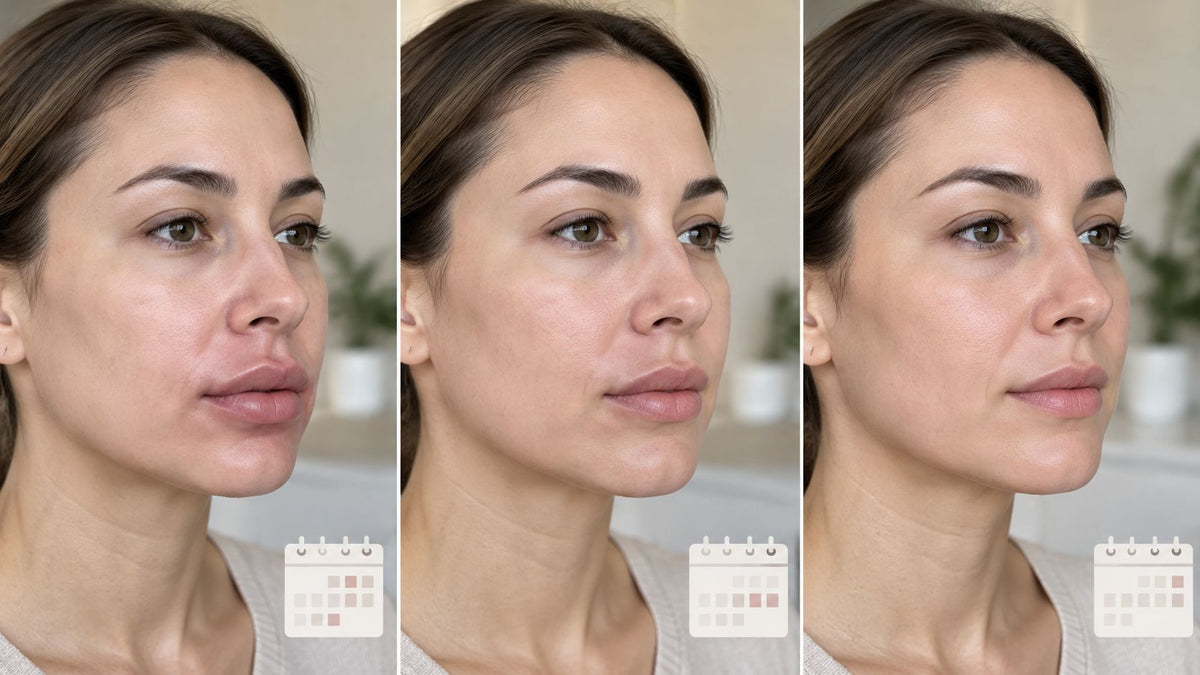
Botox Injections Units Per Area: Chart and Dosing Guide
Botox dosing by area comes down to three FDA-labelled benchmarks: 20 units for glabellar frown lines, 24 units for crow's feet, and 40 units when forehead lines are treated together with the glabella. Add all three upper-face areas into one plan and the labelled total lands at 64 units.
Those numbers are the closest thing this field has to a public price list, and they get misread constantly. A unit count only means something when it's attached to a named muscle and a set number of injection points. Five tiny points between the eyebrows carry the entire 20-unit glabellar benchmark, while a jaw muscle can take 50 units on one side. Area of skin has almost nothing to do with it.
I plan doses by feeling how hard a muscle fires under my fingers and watching how the brow sits at rest, not by measuring square inches of forehead. What follows is the reference framework I'd want any patient to have before a consult: a lookup chart, the exact labelled site maps behind the upper-face numbers, realistic ranges for the lower face, jaw and neck, and the patient variables that push a real dose above or below the chart. None of it is a self-dosing guide. Every figure is a starting reference to be assessed and adjusted by a qualified clinician, and cosmetic results are temporary no matter how well the plan is built.
Why Botox Dosing Is Measured in Units per Area
A Botox plan is two things stapled together: a total number of units and a map of where those units go. Patients talk in the first. Injectors plan in the second. That gap is why a conversation about "how much" so often ends with a shrug and a chart.
Units per area became the shared language because the FDA-approved labeling is itself organized that way. Regulators never published a formula per square inch of skin. They published muscle targets and the dose delivered to each one. That's why the upper face has hard numbers while the lower face has wide ranges that shift with the size and function of the muscle involved.
The organizing idea: a unit count means nothing until you know which muscle it's aimed at and how many points receive it.
Use this guide in two passes. Scan the quick-reference chart first to calibrate what a normal plan looks like, then read the entry for the area you care about, whether that's the glabella, the forehead, crow's feet, or something off-label like the masseter or the neck. If you're comparing quotes, the chart tells you when a number is unusual. If you're comparing injectors, the sections on how doses get adjusted matter more than any row.
What none of it replaces is the in-person assessment. No table can feel how strongly your corrugator fires when you frown, and no chart knows that one brow sits higher than the other before anyone touches it.
Botox Units per Area Quick-Reference Chart
Read these as common starting totals, the kind reported in clinical references and used in everyday practice, not as guarantees. Rows run from the top of the face down.
| Treatment area | Typical total units | Common injection points | Notes |
|---|---|---|---|
| Glabellar (frown) lines | 20 | 5 points between the brows | FDA benchmark; strongest evidence |
| Forehead lines | 10-20 | 4-6 points across the forehead | Usually treated with the glabella (about 40 combined) |
| Crow's feet | 12-24 (6-12 per side) | 3 points per side | FDA benchmark 24 total |
| Brow lift | 2-6 | Upper outer forehead | Small doses; asymmetry risk |
| Bunny lines | 4-10 | 2-4 points on the nose sides | Off-label |
| Lip flip | 4-8 | 2-4 points along the upper lip | Off-label; subtle effect |
| Chin (mentalis) | 4-10 | 1-2 points on the chin | Softens chin dimpling |
| Mouth corners (DAO) | 2-4 per side | 1 point per side | Small doses; smile asymmetry risk |
| Masseter (jaw) | 20-50 per side | 2-3 points per side | Much larger totals; clenching or jaw slimming |
| Neck bands (platysma) | 20-50 total | Along each visible band | Off-label; advanced injector |
How to Read the Upper-Face Rows
The upper three rows carry the most weight because they're the only ones with regulatory backing. The FDA labeling for Botox Cosmetic sets the glabellar protocol at 20 Units total, delivered as 4 Units at each of 5 injection sites, and the crow's feet protocol at 24 Units total, which works out to 4 Units at each of 3 sites on each side of the face. Forehead lines are labelled at 20 Units across 5 sites, but with a condition attached: the labeling specifies forehead treatment should be performed together with glabellar treatment, producing a recommended combined total of 40 Units.
That's the single most useful line in the table. A forehead plan quoted at 20 units on its own isn't wrong, it's incomplete, and the injector should be able to explain why the glabella is or isn't in the plan.
What the Mid and Lower Rows Tell You
Bunny lines, lip flips, chin dimpling and mouth corners all sit in single digits or low double digits because the muscles involved are small and precision matters more than volume. The two big rows are the masseter and the neck, where totals climb into the tens per side or across the whole band. Those rows also carry the widest spread, because a slim jaw being softened for clenching and a heavy jaw being narrowed are two different dosing problems.
Notice what the table doesn't do. It doesn't scale units to the size of your face. A small woman with a fierce scowl can out-dose a large man with a quiet brow, and frequently does.
For a visual of where each of these points lands, this Botox injection sites face diagram is worth five minutes before any consultation, so you can follow along when your injector points at muscles rather than patches of skin.
Using the Chart to Check a Quote
Run any plan against these ranges before you book.
- A forehead-only quote of 60 units deserves questions. That's well above the labelled 20 for the frontalis and above most clinical ranges, and it raises the risk of a heavy brow.
- A full upper-face quote of 25 units is suspiciously low. The three labelled areas together total 64, and a plan that treats all three with a fraction of that often underperforms and disappoints at the two-week mark.
- A jaw quote of 10 units per side rarely does much. Masseter work starts higher for a reason.
- Any quote that names no muscles at all is the weakest kind. Units without a site map aren't a plan.
What a Botox Unit Actually Measures
A Botox unit is a biological potency measure specific to onabotulinumtoxinA. It isn't a milligram and it isn't a milliliter. It describes how much of a standardized biological effect a defined quantity of the product produces, which is why the number stays constant while the fluid around it changes.
The FDA approval documents for Botox Cosmetic trace the product back to its April 12, 2002 clearance for temporary improvement of moderate-to-severe glabellar lines in adults aged 65 or younger, covering the corrugator and procerus muscles and supplied as a 100-Unit lyophilized vial. The powder gets reconstituted with saline in the clinic. Dilute that vial with 1 mL and each unit travels in a small volume. Dilute it with 4 mL and each unit travels in four times as much fluid.
The unit count never moves. A 2-unit injection stays 2 units at either dilution, and that's where a lot of confusion starts.
Volume Is Not Dose
Patients sometimes assume a bigger syringe means a bigger treatment. The current prescribing information for Botox Cosmetic describes each glabellar injection as 0.1 mL containing 4 units, five times over. That's a tiny volume per point and a meaningful dose overall. A clinic that dilutes more heavily can deliver the same 20 units across the glabella in a noticeably larger total volume with no difference in effect.
Practical rule: when you compare price per unit between two clinics, ask what the dilution is, who mixed it, and how many points the plan uses. Price per unit without those three answers is a marketing number, not a clinical one.
Units Do Not Convert Across Brands
Botox, Dysport (abobotulinumtoxinA) and Xeomin (incobotulinumtoxinA) are each scored on their own scale, and the FDA labeling is explicit that Botox Units must not be converted directly to Dysport or any other botulinum toxin product. This trips people up constantly, because a Dysport plan that sounds like a much bigger number than a Botox plan may be delivering a comparable biological effect rather than triple the dose.
The same caution applies inside a single brand family. The number printed on the chart is a Botox number. If you're being treated with something else, the total will look different and that difference isn't a red flag by itself.
The mechanics of that comparison are worth understanding in detail, and this breakdown of how Dysport and Botox units differ explains why a straight ratio between the two products can be riskier than expected. What matters at the consult is simple: confirm the exact product name, the total units, the dilution, and the mapped areas before you agree to anything.
FDA-Labeled Botox Doses for the Upper Face
Each labelled area follows the same anatomy: a total dose, a fixed number of sites, a per-site amount, and a caution that shapes how the whole protocol is applied. The FDA product labeling for Botox Cosmetic gives the figures.
Glabellar Lines at 20 Units Across Five Sites
The glabellar complex is dosed at 20 Units total, injected as 4 Units into each of five sites, typically two sites in each corrugator and one in the procerus. Those are the muscles that pull your brows together and create the vertical "11" lines when you concentrate or squint.
Two practical notes. First, five points is the labelled pattern, not a universal one; a broad, strong glabellar complex sometimes gets the same 20 units spread across six points so the dose reaches the whole muscle belly rather than pooling centrally. Second, this is the area where underdosing shows up fastest. Come in too light and you'll still be able to furrow at two weeks, which is why so many injectors treat the glabella at the labelled dose rather than trimming it.
Forehead Lines at 20 Units, Treated With the Glabella
The labelled forehead regimen is 20 Units total, delivered as 4 Units at each of five frontalis sites. The critical part is the pairing: the labeling recommends this in conjunction with the 20-Unit glabellar treatment, for a combined 40 Units.
The reason is mechanical. The frontalis is the muscle that lifts your brow. Weaken it too aggressively, especially on its own, and you lose brow support, which can leave the brow feeling heavy or the eyelid sitting lower than it should. Before treating a forehead at all, an injector should be looking at forehead height, baseline brow position, how much the frontalis is compensating for something else, any asymmetry, muscle strength, and how readily you recruit the frontalis when you raise your brows. A patient with a high forehead and a naturally low brow is a different dosing problem from a patient with a short forehead and a brow that already sits high.
What I'd ask: "Are you treating my forehead alone, or with the glabella, and why?" The answer tells you whether your injector is thinking about brow support or just about horizontal lines.
If you want to see how those variables stack up across different faces, this overview of the factors that change your Botox dose from ProMD Health Tysons Corner walks through the same assessment in clinical terms and is a useful second read before a consult.
Crow's Feet at 24 Units
Lateral canthal lines are labelled at 24 Units total, given as 4 Units at each of three sites on each side, so 12 Units per side. The skin here is thin and the muscle is a sphincter, so placement matters as much as volume. Shots set too close to the lower lid can affect the muscle that supports the cheek, and shots set too far laterally miss the lines entirely.
Adding crow's feet to a forehead-plus-glabella plan brings the three-area labelled total to 64 Units. That's a practical ceiling for a full upper-face treatment done to label.
Brow Lift as a Small Add-On
A brow lift isn't a labelled indication, and it isn't a big-dose treatment. It's typically 2 to 6 units placed at the upper outer forehead, targeting the fibers that hold the tail of the brow down so the brow can rise slightly.
Keep it small and matched on both sides. Uneven placement here reads as brow asymmetry, which is far more visible than the lines you were trying to soften, and it takes months to wear off.
Typical Units for the Lower Face, Jaw and Neck
Below the eyes, most cosmetic Botox use is off-label, which means the doses come from clinical experience and published practice patterns rather than from a regulatory protocol. Ranges are wider. Injector skill matters more. The clinical dosing literature reviewed in PMC describes conventional patterns of approximately 20 units for the glabella, 20 for the forehead when treated with the glabella, and 24 for crow's feet, while lower-face muscles such as the depressor anguli oris and mentalis generally need only a few units and masseter treatment can require substantially larger totals.
That gap is the whole story of the lower face. Muscle size and function set the dose, not the visible area of skin.
Masseter at 20 to 50 Units per Side
The masseter is the largest dosing number on the face, commonly 20 to 50 units per side, spread across two or three points per side depending on how far the muscle bulges when you clench. Two reasons to treat it: bruxism and clenching, where the goal is to reduce force, and jaw slimming, where the goal is to soften a square lower face.
Chewing fatigue in the first couple of weeks is the signal you've dosed generously. It usually settles. If a patient can't chew comfortably at all, the dose was too high for that muscle and the plan should come down next time.
Chin and Mouth Corners at Low Doses
The mentalis gets 4 to 10 units across one or two points on the chin to soften the pebbled, dimpled look that appears when you pull your lower lip up. The depressor anguli oris gets 2 to 4 units per side, one point each, to stop the muscle dragging the mouth corner down.
The DAO is where I'm most conservative. Overdose it or place it too close to the depressors that work with the smile and you get an uneven smile, which is a hard thing to hide for three months.
Lip Flip and Bunny Lines
A lip flip uses 4 to 8 units in the orbicularis oris along the upper lip to encourage a subtle roll outward. It's a small effect by design, and patients who expect filler-level volume from it are always disappointed. Bunny lines take 4 to 10 units across two to four points on the nasalis, and they're a nice finishing touch on a full upper-face plan because scrunching the nose recruits that muscle hard.
Neck Bands at 20 to 50 Units
Platysmal bands take 20 to 50 units distributed along each visible band, and this is an advanced area. The platysma is a large, thin sheet that runs down the neck, and dosing it imprecisely can affect swallowing. It belongs with an injector who treats necks regularly, not with whoever is cheapest that week.
Across every one of these areas, book the review before you book the touch-up. Two weeks is when the full effect is visible, and judging a dose at day four leads to overcorrection.
Why Your Dose May Differ From the Chart
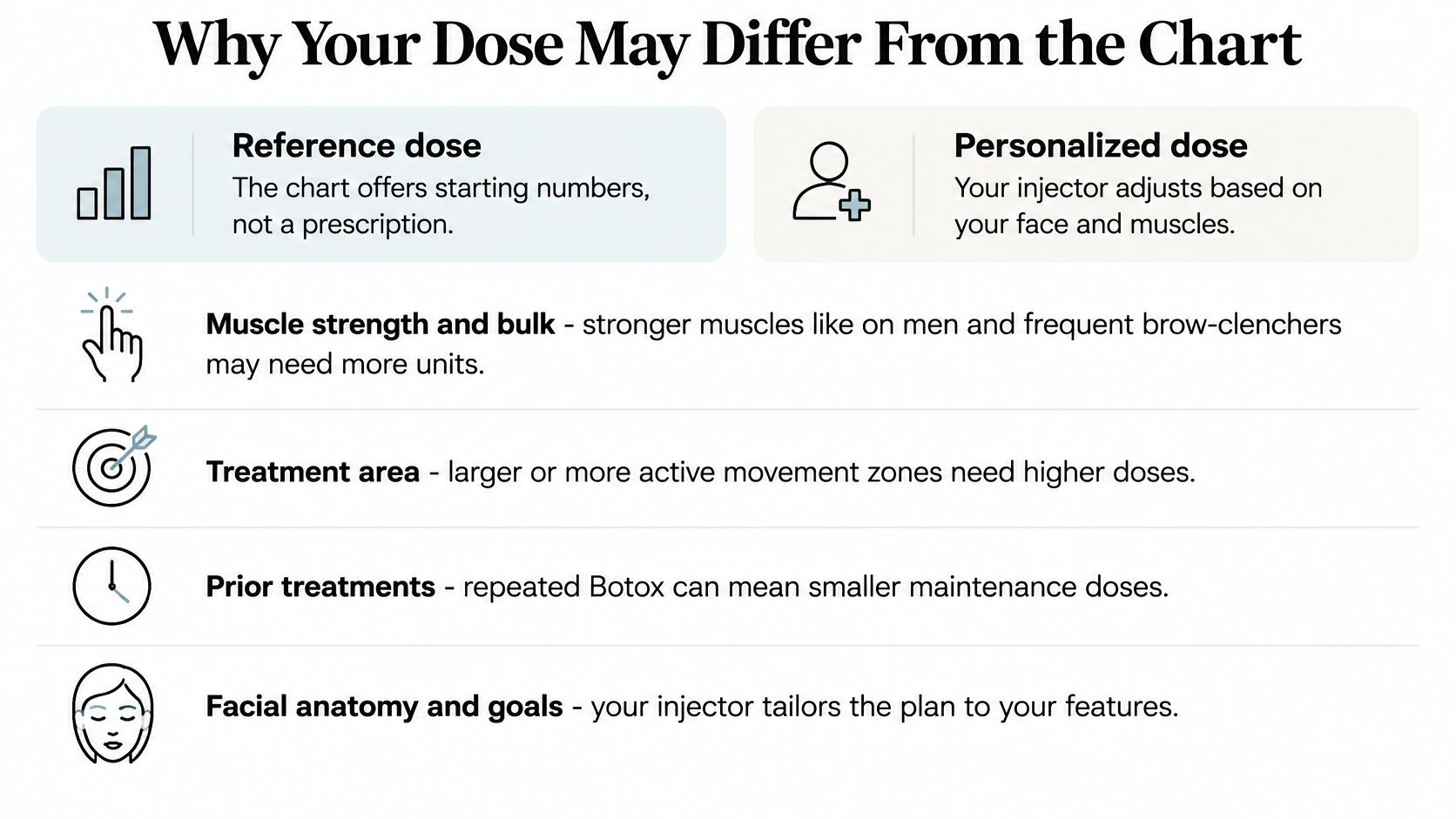
Here's the distinction that matters most in this whole subject: the chart gives a reference dose, and your injector builds a personalized dose. The FDA's own DailyMed entry for Botox Cosmetic makes the point directly, describing standardized dosing for specific upper-face indications while noting that these figures describe labeled injection patterns rather than a universal prescription for every face.
The Variables, Strongest First
Muscle strength and bulk move the number more than anything else. A man with a heavy glabellar complex, or anyone who has spent twenty years squinting into a screen, often needs more than the labelled 20 to get full relaxation. A strong masseter sits at the top of its range.
Baseline brow position and frontalis compensation decide whether the forehead gets treated at all and how much. This is the check that prevents a heavy brow.
Facial asymmetry means doses get split unevenly. One side might take 12 units and the other 8, and that's a better plan than a symmetrical 10 and 10 that leaves one brow higher.
Age and skin laxity change what's achievable. Toxin relaxes muscle. It doesn't tighten skin, and a plan that ignores that will underdeliver no matter how the units are counted.
Goals set the ceiling. A patient who wants soft movement and a patient who wants full smoothness can receive the same product on the same day at very different totals.
Prior treatment history shifts things in both directions. Muscles that have been quiet for years often hold with less, while a patient whose treatments consistently fade early may need a different dose or interval.
Two Patients, Same 20 Units
Say two people come in with identical frown lines. Both get 20 units in the glabella. The first receives the labelled five points, 4 units each. The second gets six points, with the extra dose placed laterally because her corrugator extends further toward the temple. Same total, different map, and the second plan fits her face better.
That's why comparing total units between friends tells you almost nothing.
More units never guarantee a better result. Past a point, they buy heaviness, droop or a look that reads as frozen, and the only fix is waiting it out. Many of us start conservative and add at the two-week review, because you can always add and you can never subtract.
What to Bring to a Consult
- Your history. Prior treatments, which product, how many units, and how long the result lasted.
- Photos from before. Old photos show your baseline brow position better than a mirror does.
- Your goal in plain words. "I want to look less tired" and "I want my forehead completely smooth" are different briefs.
- The areas that bother you most, ranked, so a limited budget goes to the right place.
- Questions about the plan. Product name, units per area, number of points, dilution, and the review policy.
Keeping Skin Quality High Between Treatments
Daily sunscreen is the habit that protects a unit plan between visits. Botox softens lines that muscle movement creates. How the skin looks at rest comes from sun protection, barrier care, and what you put on it at night, not from the syringe.
I treat those as two separate jobs. Units decide how quiet a muscle gets. Texture, tone, and moisture are what make that quieter face look healthy rather than less lined. A patient who is consistent with sun protection usually shows a cleaner result at the same dose than someone who skips it.
SkinCeuticals is what I recommend for the skin around injectable treatments. The basics still do most of the work: daily broad-spectrum sunscreen, a gentle cleanser, an antioxidant serum in the morning, and consistent hydration. Miss the sunscreen and UV keeps breaking collagen down while the muscle is resting, so the lines you paid to soften can look etched again by the next visit.
LED facial masks sit in a different category. They work on a pathway injectables do not touch. Red light supports collagen and calms visible redness. Blue light targets the bacteria involved in breakouts. At-home masks let you run short sessions on your own schedule and match the light to anti-aging, blemish control, or calming instead of buying a separate device for each goal.
Short sessions several times a week are plenty. Once your provider clears you, usually after the initial post-injection settling period, LED fits the recovery window because it uses no needles and asks for no downtime. It complements injectables. No light setting will relax a corrugator.
If you are rebuilding a routine at the same time, this guide to comparing night cream ingredients from Sleep All Nite is a sensible primer on what earns a place in your evening step, so you are not layering actives that fight each other while your skin is recovering.
Get a Personalized Unit Plan
Carry these chart figures into the consult: about 20 units for the glabella, 24 for crow's feet, 40 for forehead plus glabella, and 64 for all three upper-face areas. Lower-face work runs from a couple of units at the mouth corners to 50 or more per side in the masseter. Each total belongs to a specific muscle group on an FDA-style site map. Treat the list as the opening bid. A face that is stronger, weaker, or asymmetric will land above or below those rows once it is assessed in motion.
A good consultation covers six things before anyone opens a vial. The exact product brand, and the reason for choosing it. The units planned per area, written down. The dilution. The injection map, meaning which muscles and how many points. A brow position assessment, since that is what governs forehead safety. And the review or touch-up policy, including when it happens and what it costs. I recommend you leave with those six items on paper, not as a verbal estimate you try to remember in the car.
In Northern California, BotoxBarb in Cameron Park is set up for that conversation. The practice is run by Barb N.P., a board-certified nurse practitioner, and offers injectable services including Botox, Dysport and Restylane, with online booking at BotoxBarb. Prices can change, so ask the practice for current per-unit and per-area pricing when you book, and use the Botox cost breakdown as general background before you sit down.
Outside the area, take the same six-point checklist to a licensed, experienced injector near you. Topical care still matters between visits, and ALODERMA's fresh aloe anti-aging guide is a reasonable place to start on what a cream can and cannot do for a line a muscle is causing.
Bring the chart, your history, and your goals. The in-person assessment, with your face moving, sets the dose. A qualified clinician maps the areas that move rather than quoting one generic total.