Pros and Cons of a Chemical Peel: Risks, Results, Costs
You're under bathroom light, thumb over a booking link, trying to decide if a few days of flaking is worth clearer skin. Acne marks have hung on, or sun spots look darker than last summer. One peel is sold as a lunch break. Another can leave you red for months. Both get called the same treatment.
The trade-off that matters isn't ordinary peeling or a day of pink skin. It's whether pigment shifts, how your skin tone handles inflammation, and whether recovery stays on the expected path. Depth sets both the payoff and the risk. A light pass can brighten dull skin. A deep one can resurface severe sun damage and asks much more afterward.
The pros and cons of a chemical peel only make sense once you sort them by depth, then match a goal to a recovery window before any acid touches your face.
Chemical Peel Pros and Cons at a Glance
Superficial peels often offer a good balance of benefit and downtime. Medium and deep peels buy stronger change with longer recovery and a higher chance of pigment shifts that outlast the flaking.
| Depth | Main pros | Main cons | Typical downtime | Typical results |
|---|---|---|---|---|
| Superficial (glycolic, salicylic) | Gentle, quick, repeatable; suits mild acne and dullness | Stinging, redness, dryness, short-term darkening | A few days of flaking | Subtle brightening and smoother texture; needs repeat sessions |
| Medium (Jessner's solution, TCA) | Visible change in fine lines, pigment and texture | Crusting, redness, higher risk of pigment change and scarring | 1 to 2 weeks or longer | Noticeable change that can last months with sun protection |
| Deep (phenol) | Strongest resurfacing for severe photoaging | Long recovery, prolonged redness, hypopigmentation, systemic safety concerns | Several weeks; redness can last months | Dramatic change, longest-lasting but not permanent |
Discomfort is common even when the peel is considered safe. In a comparative study within a systematic review of peels for acne, burning or stinging occurred in 65% of patients treated with salicylic acid and 45% treated with Jessner's solution. The difference wasn't statistically significant. Post-peel erythema occurred in 20% of the salicylic-acid group and 30% of the Jessner's group, also without a significant difference, per that systematic review of chemical peels. Scaling and peeling were among the most frequent events. Glycolic and salicylic treatments were still described as generally safe and well tolerated.
How to use the rows
- Match the concern. Dullness and mild acne sit on the superficial row. Fine lines and patchy pigment often need the medium row. Severe photoaging is the usual reason anyone discusses phenol.
- Match the calendar. A few days of flakes is a different plan from crusting that lasts one to two weeks, or redness that can run for months.
- Read the cons before the price. If pigment change or scarring is in that cell and your skin is melanin-rich, depth choice matters more than the acid printed on the menu.
Practical rule: Choose the shallowest row that can reach your main concern, then confirm you can live with that downtime.
Superficial options are often called lunchtime peels because glycolic or salicylic acid stays near the surface and sessions can be repeated. Medium peels typically use Jessner's solution or trichloroacetic acid (TCA). Deep peels use phenol. A light peel usually costs less per visit. A deep peel isn't something you repeat every month.
How Peel Depth Controls Results and Risk
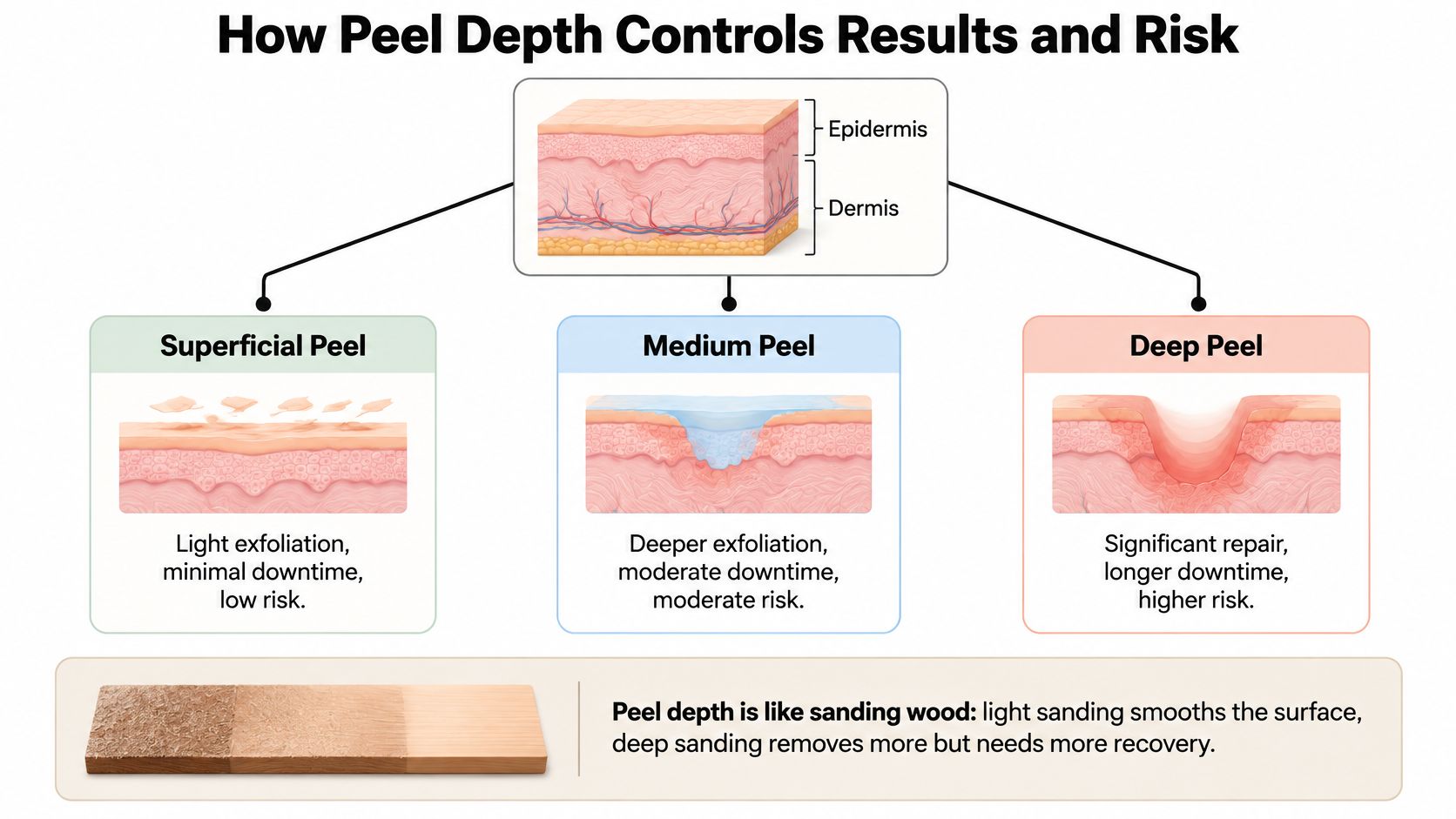
Think of peel depth like sandpaper grit on a tabletop. Fine grit polishes the finish. Coarse grit removes more wood and leaves a surface that needs longer before you can use it. A chemical peel is a planned injury. Acid loosens outer skin, that skin sheds, and repair builds a smoother surface while you protect it.
From the surface inward
Superficial peels act on the epidermis only. Glycolic and salicylic acids in this range usually give the best mix of effect, comfort, and flexibility. They still commonly cause short-term stinging, burning, erythema, dryness, scaling, and transient darkening, as a review of peel injury and healing describes. Those signs reflect a temporary barrier break and inflammatory signaling. Book the next peel too soon, or pile on home scrubs and acids, and expected irritation becomes cumulative injury.
Medium peels reach the upper dermis. More tissue is injured, so lines, pigment, and texture can change more, and healing takes longer.
Deep peels reach deeper dermal layers. Resurfacing potential is the highest. So is the chance of a long, complicated recovery.
The bottle name doesn't lock the result. Concentration, contact time, number of coats, and how the skin was prepared all change how far the acid goes. Depth and spacing should be set for you, not copied from a label. For pigment disorders, a peel works best as an adjunct. Lasting control still needs treatment of the inflammation or ultraviolet trigger underneath, plus strict photoprotection while the barrier is open.
This isn't an experimental trick. Multiple peeling agents, including salicylic acid, resorcinol, and phenol, were already in dermatologic use by 1941, according to the Mayo Clinic overview of chemical peels. That same guidance separates temporary surface effects from medium and deep peels, which can leave redness for months and raise the chance of pigment change and scarring. Phenol can affect heart rhythm and can harm the kidneys and liver, which is why a deep peel stays in a monitored medical setting.
Depth is the first decision. Acid name and brand come after it.
The Real Benefits and How Long Results Last
A peel can improve fine lines and wrinkles, uneven pigmentation, dullness, acne, age spots, freckles, melasma, and some acne-related scarring. The American Academy of Dermatology notes that treatment may produce fewer lines and wrinkles, more even skin color, a brighter complexion, and smoother skin. Those benefits depend on depth and on the condition being treated. A superficial peel generally produces less dramatic change than a medium or deep peel. If you booked a light series, expect a polish, not a new face.
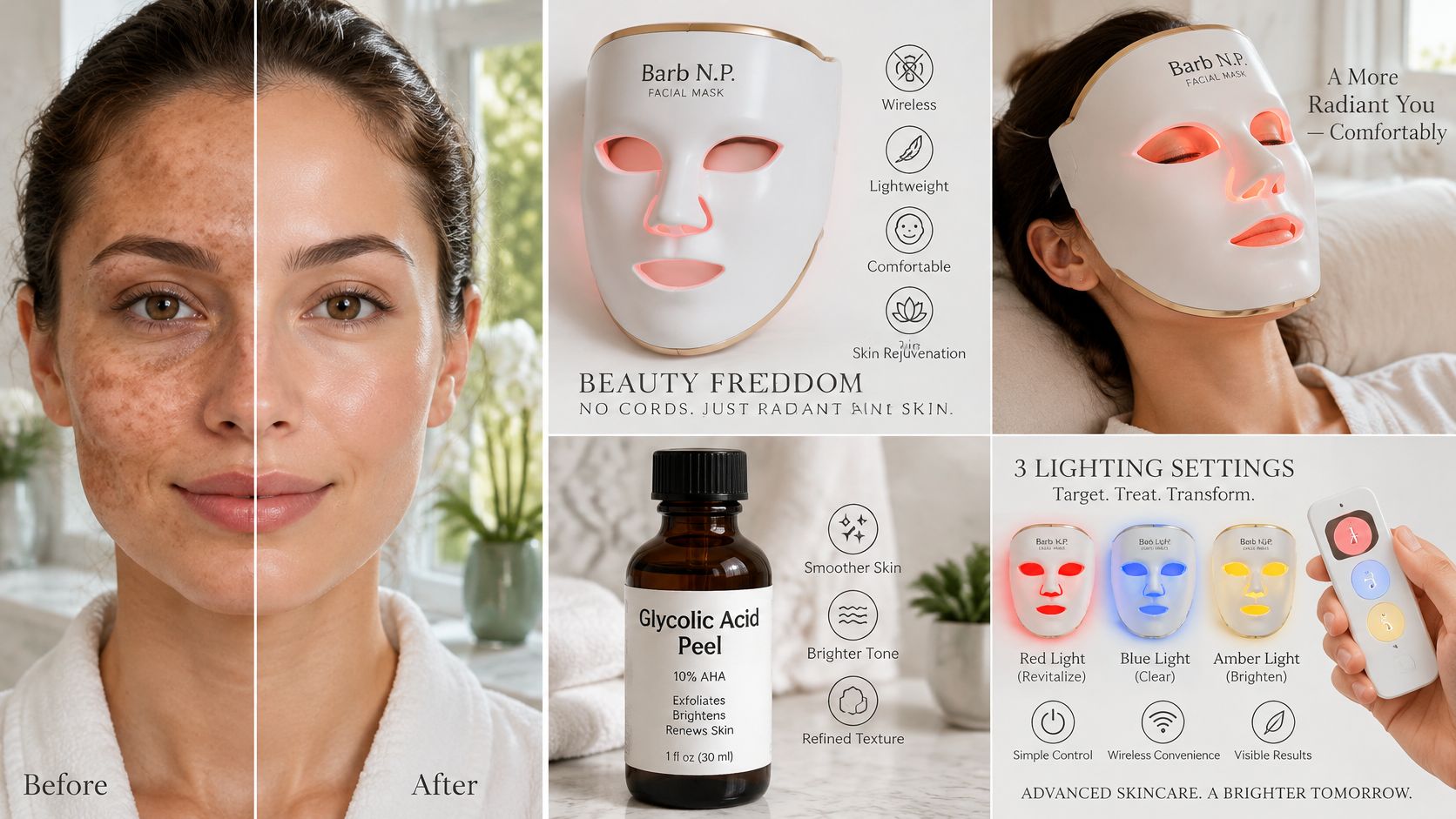
What tends to move, and in what order
Say your goal is dull winter skin plus flat brown marks left after old breakouts, and you start a superficial series spaced over several weeks.
- Brightness and texture usually arrive first. Makeup sits more evenly. Skin looks less ashy in daylight.
- Pigment such as freckles, age spots, or melasma often needs several sessions before the tone looks steadier. One visit rarely finishes the job.
- Acne-related texture and marks can improve when the peel sits inside a wider plan for breakouts. It isn't a cure you use instead of acne care.
- Deep scars soften slowly. Superficial peels rarely flatten them completely. If the scar is punched in, a light peel will disappoint you if you expected it gone.
Medium and deep peels move lines and photoaging further because they injure more tissue. That stronger change is still not a freeze-frame. Skin keeps turning over. New sun keeps writing pigment. Superficial results need maintenance sessions or a consistent home routine. Medium and deep results last longer, and they aren't permanent. Daily sun protection is what protects the money and the downtime you already spent.
Three signs the result is actually good
- Tone looks more even, without fresh dark patches where the peel sat.
- Texture feels smoother, bare or under makeup.
- The face looks brighter without redness that is still the main thing other people notice.
If pink skin is the headline, you're still in recovery. Judge the peel after that pink has settled, not on day three when flakes make everything look "more treated."
The Downsides, Risks and Who Should Skip a Peel
The common assumption is that a peel is broadly safe and the downside is a week of flakes. The downside that changes lives is pigment and scarring, and both climb as the peel goes deeper. Medium and deep peels create greater dermal injury. A review of peel complications links that injury to higher risks of prolonged erythema, delayed healing, infection, post-inflammatory hyperpigmentation (PIH), hypopigmentation, textural change, and scarring. The same review reports scarring in less than 1% of medium-depth peels such as Jessner's solution or 35% glycolic-acid plus trichloroacetic-acid protocols. Severe scarring is uncommon. It is still a result you can't moisturize away. The American Academy of Dermatology, cited in that review, notes that infection and scarring risks rise substantially when people pick crusts, expose healing skin to sunlight or tanning beds, put makeup on before the surface has re-covered, or ignore aftercare.
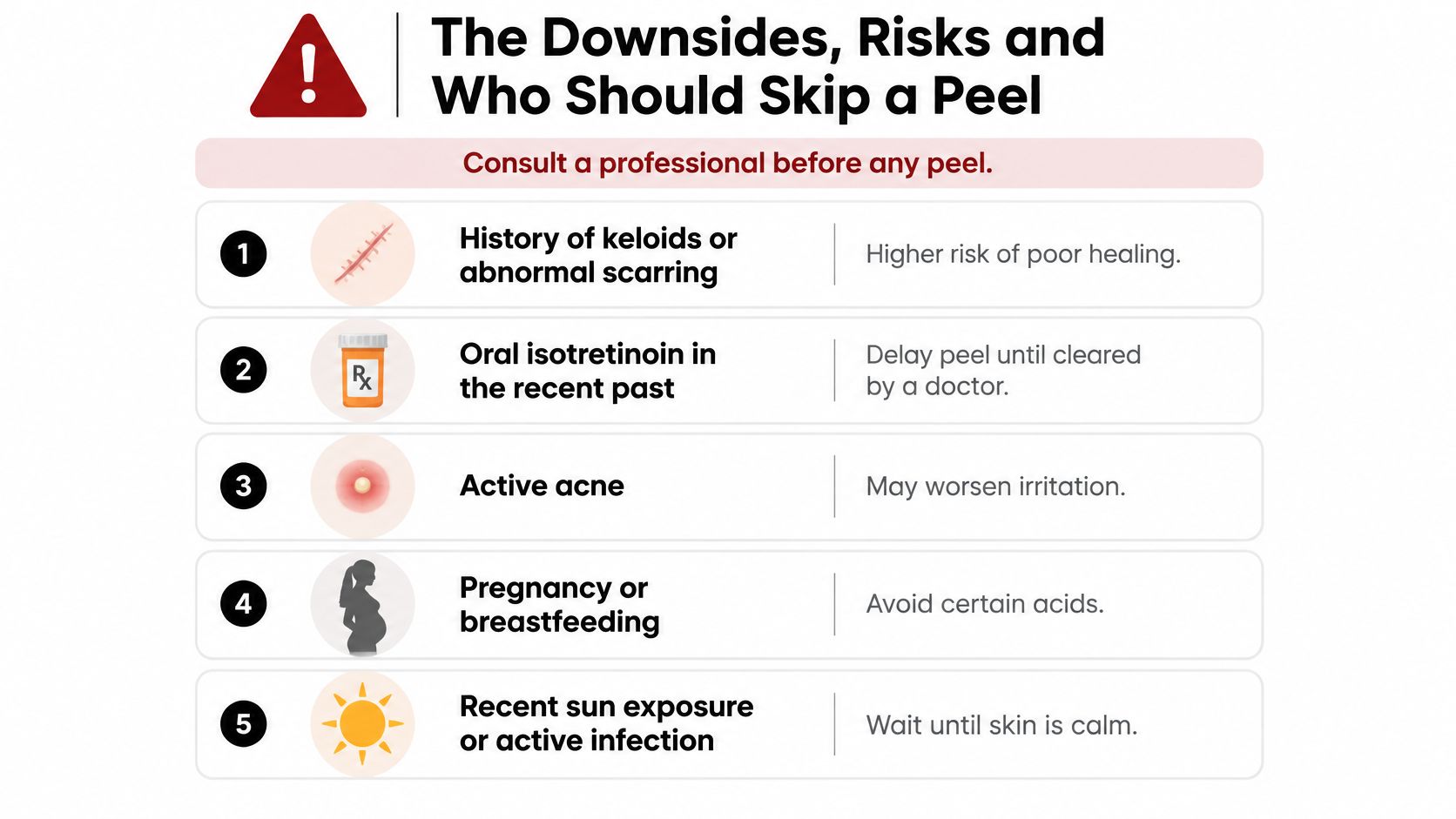
A screening list before you book
- History of keloids or abnormal scarring. Healing that overshoots once can overshoot again.
- Oral isotretinoin in the recent past. Timing should be cleared by the clinician who knows your course, not guessed from a forum.
- Active acne, dermatitis, or eczema on the treatment area. Inflamed skin doesn't peel in a neat sheet.
- A history of cold sores. Facial peels can trigger a herpes flare. Say so before the appointment.
- Recent sun exposure or tanning. Fresh ultraviolet injury plus acid is how a "brightening" visit leaves a darker patch.
- Current retinoids, scrubs, or strong acids. A barrier that's already thin burns faster.
- Darker skin types. Aggressive treatment can leave persistent PIH. Conservative depth, careful screening, and rigorous sun avoidance are the practical safeguards.
Pigment alteration, not the flake itself, is the trade-off many articles skip. A scoping review of peels in skin of color found positive outcomes for acne, acne scarring, and dyspigmentation, with mostly minor reported effects. It also stressed limited evidence from small samples, short follow-up, and underrepresentation of Fitzpatrick types IV–VI. In that setting, clinicians favor low-concentration superficial peels, gradual titration, longer intervals, pretreatment when it fits, and strict sun protection. Medium depth needs substantial caution. Deep peels are generally avoided in darker skin because pigmentary and textural complications are too likely.
Numbers from superficial work are reassuring and still not zero. A retrospective study of superficial peels on darker skin reviewed 473 procedures and tied complications to 18 of them, 3.8%, counting events within two weeks and after two weeks.
If any checklist item applies, the next step is a clinical consultation, not a peel you direct yourself.
High-strength acids used without dose control can injure skin because concentration, number of applications, contact time, and penetration depth decide the burn. That decision belongs with a licensed, trained provider.
Downtime, Aftercare and When Recovery Becomes a Problem
Expected recovery has a shape. Injury doesn't stay inside it. For a superficial peel, use this timeline, then draw a hard line under it.
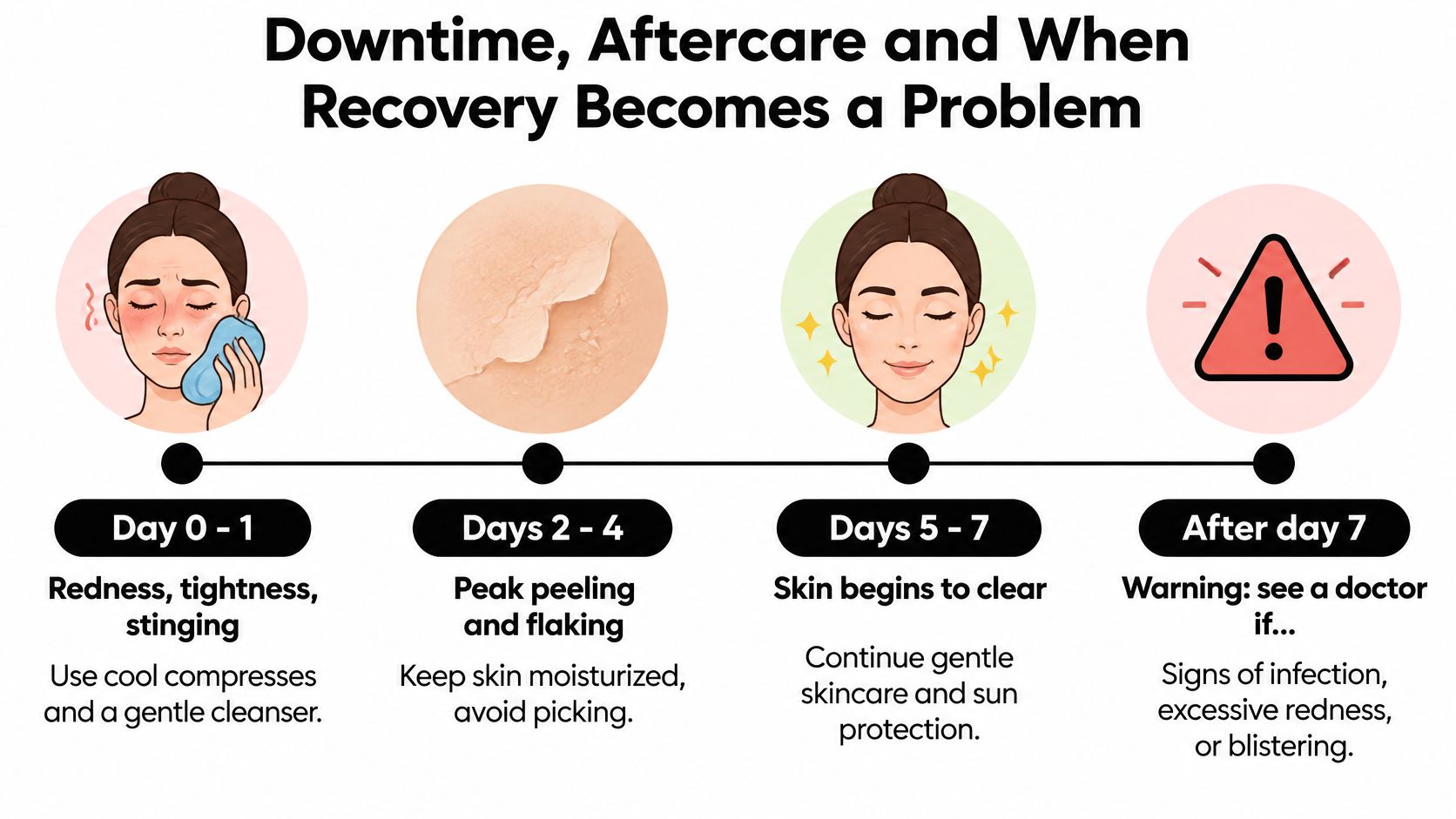
| Phase | Typical timing | What the skin does | What to do |
|---|---|---|---|
| Day 0 to 1 | Hours to 1 day | Redness, tightness, stinging | Cool compresses and a gentle cleanser |
| Days 2 to 4 | Peak peeling | Flaking, dryness, visible scaling | Moisturize; never pick or pull flakes |
| Days 5 to 7 | Tapering | Pink, sensitive new skin | Daily broad-spectrum SPF; no makeup until skin re-covers |
| Weeks 2 to 4 | Normalizing | Even tone emerges, some residual pinkness | Reintroduce retinoids and acids slowly, with clinician approval |
| Month 1 onward | Results settle | Full effect of the peel becomes visible | Plan maintenance sessions and keep sun protection |
Medium peels usually run longer, with crusting and redness over one to two weeks or more. Deep peels take weeks of downtime, and redness can last months. Don't compare your day-four face to a friend's phenol recovery, or the other way around.
Daily care while the barrier is open
- Moisturize gently. A bland moisturizer beats a "repair" serum full of acids.
- Wear broad-spectrum sunscreen every day. New skin burns and pigments faster.
- Skip tanning beds and deliberate sun. Both undo the visit.
- Hold makeup until the surface has fully re-covered.
- Pause retinoids, scrubs, and acids until you're cleared to restart. Our post-procedure skin care notes walk through that handoff without rushing actives back on.
Short-lived stinging, redness, dryness, and scaling can be normal. Get urgent professional assessment for escalating pain, marked swelling, blistering, gray or white skin, spreading redness, drainage, or persistent pigment change. The FDA warning on unsupervised peel products is blunt about high-strength trichloroacetic, glycolic, salicylic, or lactic acid used without professional supervision. Those products can cause chemical burns, pain, swelling, infection, permanent color changes, and disfiguring scars.
More peeling is not a better result. Extra depth and stacked irritation can worsen the outcome, especially with retinoids, scrubs, acids, or early sun. If home acids have already left you breaking out, how too many acids worsen breakouts is a useful reset before you add another peel on top.
Peel Alternatives, Costs and Where an LED Mask Fits
A peel isn't the only way to chase tone and texture. Put the other options on the same yardstick, goal, downtime, result, and cost, before you assume acid is the default.
| Option | Best for | Downtime | Typical results | Cost tier |
|---|---|---|---|---|
| Laser resurfacing | Scarring, deep wrinkles, stubborn pigment | Days to weeks, depending on setting | Strong and device-dependent | High per session |
| Microneedling | Texture, fine lines, acne scarring | A few days of redness | Gradual, builds over sessions | Moderate per session |
| Topical regimen (retinoids, azelaic acid, sunscreen) | Mild aging and pigment maintenance | None | Slow, takes months | Low, ongoing |
| LED light therapy at home | Gentle support for tone and texture | None | Mild, cumulative with consistent use | Low upfront device cost |
What the bill actually includes
Fees follow depth, how many sessions the plan needs, your region, and who performs the treatment. A cheap single superficial visit can cost more than it looks once you count a series. A single laser visit often costs more and may need fewer appointments. Ask for a per-session price and a full-course price, including aftercare products and follow-up, before you compare one peel sticker to one laser sticker.
A non-peeling add-on, not a substitute
LED phototherapy doesn't shed skin. Parameters still matter. A 2025 home-use study used red light at 630 nm and infrared light at 850 nm. Among 60 participants, 4 people, or 6.67%, reported adverse events, and one developed dry skin and withdrew without lasting effects, as reported in that home LED phototherapy study.
The Barb N.P. Facial Mask fits as a convenient complement after professional guidance, not as a replacement for a peel or a medical visit. It's a wireless, face-contouring LED mask built for comfortable wear, with three lighting settings for different treatment goals and hands-free use. If you want the wavelength logic before you buy a device, the benefits of LED light therapy spell out what light can and can't do. LED is gentler and non-peeling. It can't stand in for chemical resurfacing or for an exam when something on your skin needs a diagnosis.
Decide Whether a Chemical Peel Fits Your Skin
You have a work event in ten days, a dark patch makeup never quite covers, and a retinoid still on the counter. Those details decide more than a before-and-after photo. Sort the choice into one of three paths instead of settling on a vague maybe.
Delay the peel and book a medical visit first if any screening item fits you. That includes pregnancy or breastfeeding, an active skin infection, or skin that is already irritated. Acid on angry skin turns a cosmetic plan into a wound-care plan. The risk worth pausing for is a color shift or slow healing, not a few days of ordinary flaking.
A superficial peel fits dullness, mild texture, or early sun damage when you can accept several days of flaking. That depth matches a surface problem. It does not borrow weeks of redness, or a higher chance of light or dark patches you do not need.
Ask whether a medium or deep peel is even appropriate when the goal is severe photoaging, deep scarring, or stubborn pigment, and only if you can clear weeks on the calendar. The clinician should weigh your skin tone before naming a depth. A smooth result that leaves hypopigmentation or a new dark patch is not a win. Deeper acid reaches more of the pigment pathway, so the same goal that tempts you toward depth is also the one most likely to change color.
A useful consultation covers health history, skin type, skin tone, a depth recommendation, and a written aftercare plan. At BotoxBarb, that visit can set a peel you are considering next to treatments the practice performs: microneedling with PRP, microneedling, PRP for hair regrowth, and Neogen plasma skin resurfacing laser. Booking a consultation with Barb also gets a product recommendation matched to your skin type and goals. If you are torn between needles and acid, start with whether a chemical peel or microneedling comes first so the questions you bring are specific.
Bring your current product list, including retinoids and acne creams. Ask three things out loud. What depth are you recommending, and why not the one above it? What will downtime look like on my calendar? What is my pigment risk with my skin tone, and what will we do if color shifts?
BotoxBarb offers in-clinic microneedling, PRP, and Neogen plasma skin resurfacing laser, alongside medical-grade home care. If you are weighing a chemical peel against a gentler plan, bring your product list and your calendar to a visit. Book through BotoxBarb and ask for a depth, a downtime window, and a pigment plan before you commit.