Article: SPF 30 vs SPF 50: Which Sunscreen Protects Better?
SPF 30 vs SPF 50: Which Sunscreen Protects Better?
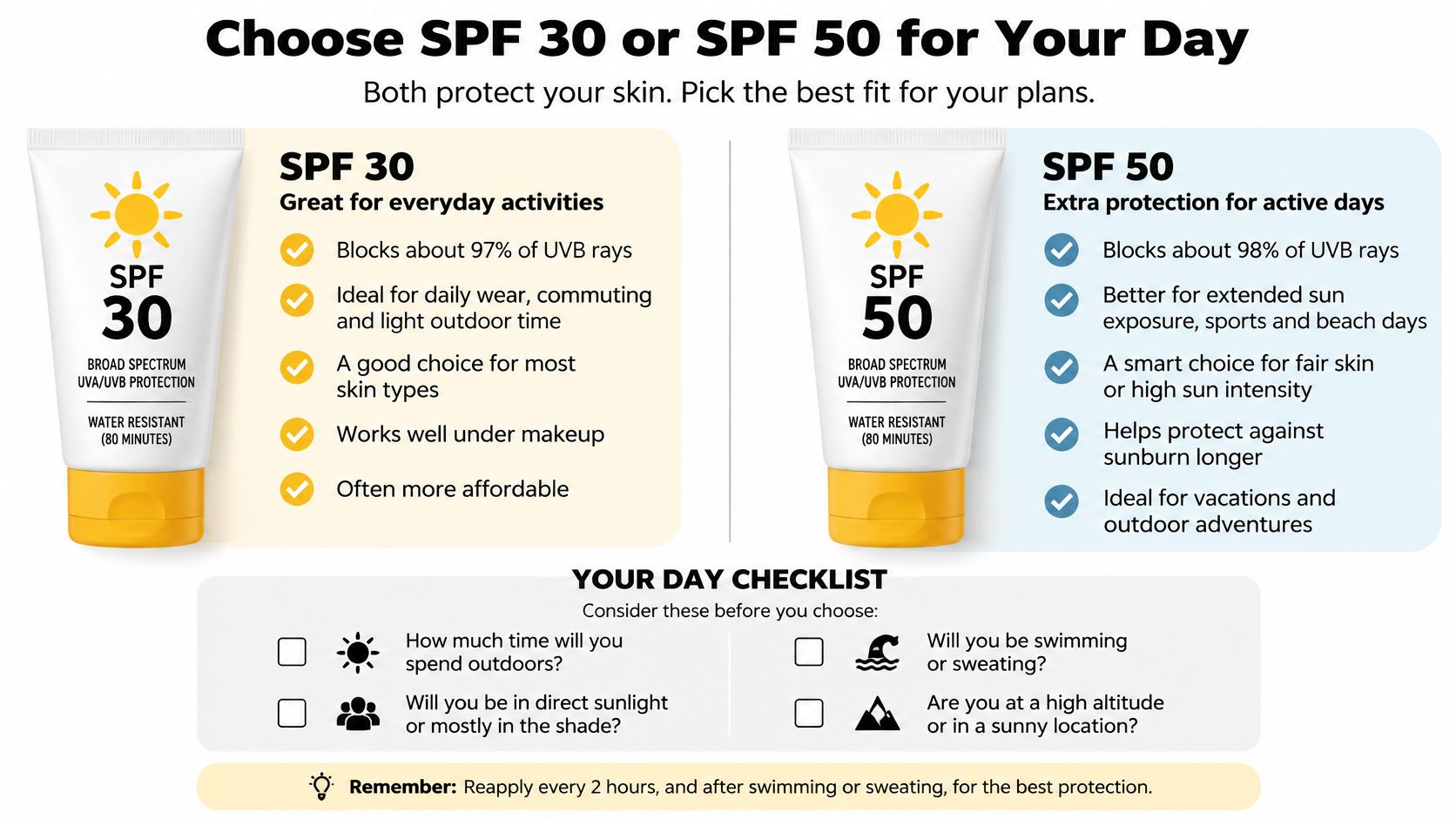
SPF 50 filters about 98% of UVB, compared with about 97% for SPF 30, according to dermatologist recommendations reported by NBC Los Angeles. That small difference is the starting point, not the whole decision. A sunscreen's tested performance and the protection you get from a hurried morning application aren't necessarily the same.
The useful question in SPF 30 vs SPF 50 isn't whether the higher number wins in a laboratory. It does. The question is whether that extra margin suits your skin, your application habits, and the day you're planning, without distracting you from coverage and reapplication.
SPF 30 and SPF 50 Side by Side
SPF 30 and SPF 50 provide similar, but not identical, UVB protection when applied at the tested amount. Neither is a complete sun-protection plan, and neither number tells you everything you need to know about the formula.
The test-thickness and UV-photon comparisons below follow The Medical Letter's sunscreen review. The baseline check assumes that each product also carries the required broad-spectrum and water-resistant claims, not merely an SPF number.
SPF 30 vs SPF 50 at the tested application amount
| Measure | SPF 30 | SPF 50 |
|---|---|---|
| UVB filtered at the tested amount | About 97% | About 98% |
| UVB reaching the skin | About 3% | About 2% |
| Share of UVB passing through | Baseline | About one third less |
| UV photons reaching skin at 2 mg/cm² | About 1 in 30 | About 1 in 50 |
| Meets AAD baseline (broad spectrum, water resistant) | Yes | Yes |
| Best fit | Everyday use with generous, consistent application | An additional margin for intense exposure or sun-sensitive skin |
Why the same comparison can sound small or substantial
The filtration percentages describe how much UVB the sunscreen keeps out. The relative comparison describes how much gets through. Both are legitimate ways to describe the same difference, but neither should be used alone to make the product sound dramatically stronger or practically useless.
The rounded percentages also aren't exact enough for elaborate calculations. About one third less transmitted UVB is a useful interpretation of the rounded figures, not a promise that every real-world application reduces your exposure by that amount.
Buying rule: Check for broad-spectrum protection and water resistance before comparing the SPF numbers.
A higher SPF doesn't automatically mean a more comfortable texture, better coverage around your hairline, or greater willingness to reapply. Those are separate purchasing decisions. Choose a formula you can spread generously rather than one you feel compelled to ration because it looks or feels unpleasant.
The verdict is straightforward: the difference is real but modest. SPF 50 offers a higher labeled UVB rating, while SPF 30 remains a reasonable daily starting point when the rest of the label and your application habits are appropriate. Your exposure and behavior determine how useful that extra margin becomes.
What the SPF Number Really Measures
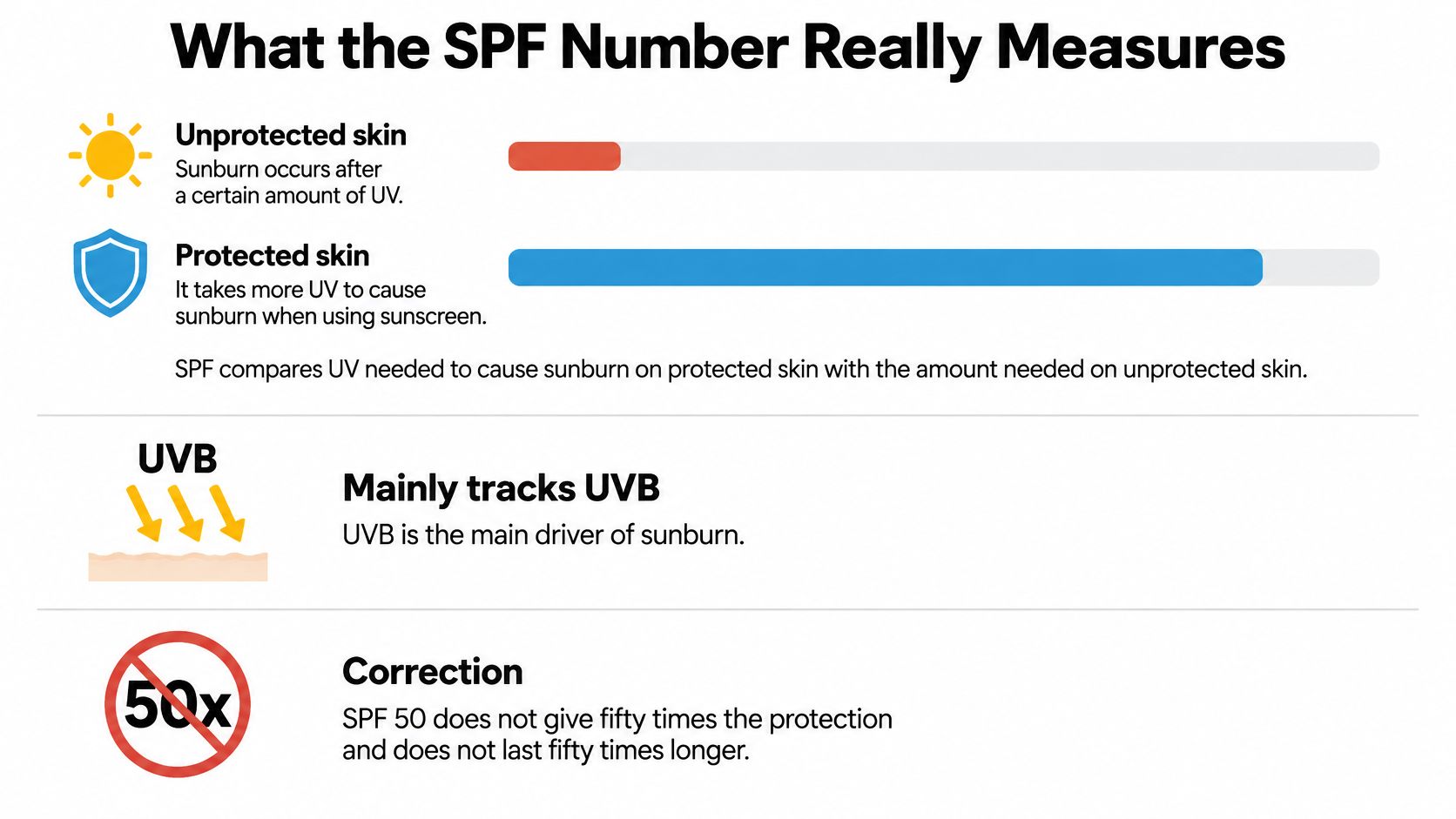
SPF measures a ratio of sunburn-producing UV exposure, not an all-purpose multiplier of protection. It compares the amount of solar energy required to cause sunburn on sunscreen-protected skin with the amount required on unprotected skin, as explained in PBS NewsHour's dermatologist-led sunscreen guide.
That distinction corrects a common misconception. SPF 50 doesn't mean fifty times more protection in every meaningful sense, and it certainly doesn't mean the product lasts fifty times longer. The number describes performance under standardized conditions, primarily against UVB-driven sunburn.
Exposure equivalence isn't a timer
The American Cancer Society's exposure comparison, described in the PBS guide, makes the ratio easier to understand:
With correctly applied SPF 30, 30 minutes of sun exposure is approximately comparable to 1 unprotected minute in sunburn-producing exposure; one hour is comparable to about 2 unprotected minutes. This arithmetic isn't permission to remain outside longer.
The important term is exposure, not time. Sunscreen doesn't create a fixed period during which your skin is protected regardless of conditions. An uneven layer, perspiration, swimming, or rubbing changes what remains on your skin.
That makes stopwatch reasoning unreliable. You can't establish a personal burn time, multiply it by the bottle's number, and treat the result as a safe outdoor allowance. The test compares controlled doses, while an ordinary day involves changing exposure and a sunscreen film that you may disturb.
UVA protection requires another label claim
SPF doesn't independently establish how well a product protects against UVA. Look for broad spectrum, the label claim indicating protection across UVA and UVB wavelengths, rather than assuming that a higher SPF settles both questions.
For someone managing melasma, a tendency toward discoloration, or skin recovering from a cosmetic procedure, that distinction changes the shopping priority. Start with broad-spectrum protection, then consider whether a higher UVB rating makes sense for the exposure you're expecting. Don't interpret the higher number as a proportionate improvement in every pigmentation concern.
Water sports make the limits of SPF arithmetic particularly relevant. If surfing is part of your routine, Blitz Surf Shop's sun safety tips for Kiwi surfers provide activity-specific context for planning protection around time in the water.
What you gain from the higher SPF is an additional UVB margin under the tested conditions. What you still need from the label is evidence of broader coverage and suitability for the way you'll use the product.
How Under-Application Narrows the Gap
Under-application narrows the protection you receive compared with the protection printed on the bottle. It doesn't necessarily erase the advantage of the higher rating. In practice, both products can fall well below their labels while SPF 50 retains a useful, limited advantage.
Labeled SPF assumes approximately 2 mg of sunscreen per cm² of skin, and Stanford Medicine's sunscreen-science overview discusses estimates associated with applying three to four times less, including effective protection near 9 for SPF 30 and 14 for SPF 50. These are illustrative estimates, not a formula that predicts the protection of every sunscreen on every face.
Build the layer before debating the number
A practical application routine should make missed areas and skimpy coverage less likely:
- Measure before spreading. Use approximately an ounce for a full adult body as a practical guide. For the face, dispense enough to create a visible, even layer before working it across the skin, rather than stretching a small dab until it disappears.
- Apply sunscreen after serums and moisturizer, before makeup. Treat it as the final skincare layer, not an ingredient to dilute into another product.
- Cover the edges deliberately. Include exposed ears, the neck, the hairline, and the backs of the hands. Check around clothing edges rather than stopping exactly where fabric begins.
- Give the layer a few minutes to settle before clothing or makeup. Respect any longer pre-exposure waiting period stated on the product's directions.
The body quantity is a practical guide, not a reason to ignore differences in body size or how much skin is exposed. Likewise, a visible facial layer is a coverage aid, not proof that you've reproduced laboratory conditions.
Effective protection when application falls short
| Application level | SPF 30 effective protection | SPF 50 effective protection |
|---|---|---|
| Tested amount, 2 mg per cm² | About 30 | About 50 |
| Typical under-application, about three to four times less | About 9 | About 14 |
The estimates discussed by Stanford Medicine illustrate possible losses with under-application. They aren't guaranteed outcomes for a particular formula.
What the estimates actually justify
The sensible conclusion isn't that you should buy a stronger sunscreen and deliberately use less. It's that the higher label may provide some insurance against an imperfect layer, while still leaving you substantially short of the protection you intended to apply.
A higher SPF can help where sunscreen is present. It can't protect an area you left uncovered.
That distinction matters for sweating and rubbing, too. A higher starting rating doesn't prevent physical removal, and the under-application estimates shouldn't be treated as a precise model of what happens after exercise.
Compare two separate decisions: which product you choose and how completely you apply it. Upgrading the number addresses the first; using enough product, checking coverage, and adding protective clothing address the second. Improving quantity and coverage can matter as much as switching between these ratings, particularly if your current routine involves a thin, hurried application.
Reapplication Rules Are the Same for Both
SPF 50 doesn't buy a longer reapplication interval. The American Academy of Dermatology's application guidance recommends reapplying approximately every two hours while outdoors, and immediately after swimming or sweating; towel drying also calls for a fresh application.
Water resistance doesn't change that basic responsibility. The FDA's sunscreen guidance identifies water-resistance claims of 40 or 80 minutes, not indefinite protection in wet conditions.
Plan around events, not just elapsed time
For a hypothetical four-hour beach afternoon, apply before going outside and plan fresh applications around the midpoint and again if you're remaining outside at the end. Swimming, heavy sweating, or toweling off can require additional applications before those planned breaks.
A commuter has a different problem. If you apply before leaving home and then eat lunch outside much later, refresh your protection before the lunch break rather than assuming the morning layer is unchanged. The useful trigger is your next period of exposure, not whether you still feel sunscreen on your face.
- Set a reminder. Use a phone alert based on the outdoor interval, then reset it when you reapply.
- Keep the product accessible. Put it in your everyday bag or somewhere visible at work, within its labeled storage conditions.
- Plan for makeup. A sunscreen stick can be convenient, but it still needs thorough coverage. Don't assume a quick dusting of SPF powder recreates a full sunscreen application.
- Replace disturbed coverage. Refresh areas rubbed by towels, hands, straps, or clothing rather than waiting for a scheduled alarm.
Make the routine repeatable
Our guide to how often to reapply sunscreen can help you organize applications around commuting, outdoor breaks, and activities.
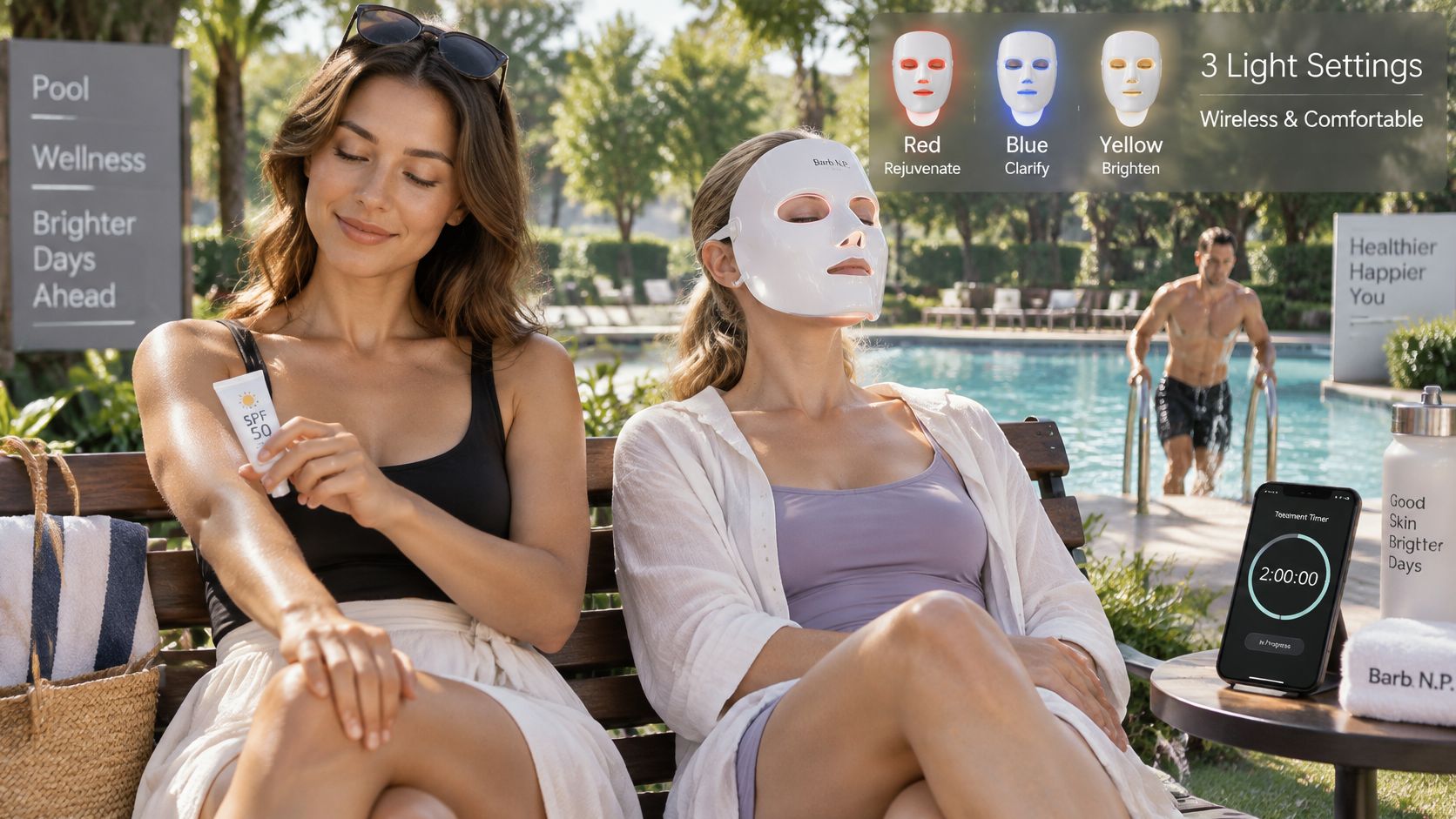
An LED mask in a skincare routine, including the one pictured, has a different purpose. It doesn't replace sunscreen or make outdoor exposure safer.
The actionable rule stays simple: the number changes the margin, but the schedule is the same. Choose the rating that suits your exposure, then make the replacement layer easy to apply when you need it.
How to Read the Label Before You Buy
The front of a sunscreen bottle should answer different questions, not repeat the same promise in different words. Broad spectrum addresses UVA and UVB coverage, water resistant addresses tested performance during wet conditions, and SPF primarily describes sunburn protection.
The American Academy of Dermatology's sunscreen-label guide supports choosing broad-spectrum, water-resistant SPF 30 or higher. A high number alone doesn't establish that the product meets that combined standard.
Use a label checklist
- Find broad spectrum. Look for the actual statement, not a general promise of sun defense or daily protection.
- Check the water-resistance claim and its stated duration, especially for swimming, exercise, or humid outdoor days.
- Confirm the SPF rating meets the baseline. Only then compare the available ratings.
- Consider texture in a realistic quantity. Test how the product spreads and settles when used generously, not just how a tiny sample feels on your hand.
Skip a product without the broad-spectrum claim when choosing daily sun protection, even if its SPF looks impressive. The higher number alone doesn't establish additional UVA coverage.
Practical distinction: Water resistance is a performance claim for skin protection, not proof of environmental compatibility.
For an ocean holiday, keep those decisions separate. Diving Escapades' eco-friendly diving practices for travelers offer a broader conservation resource alongside your sunscreen-label checks.
Our guide to how to choose sunscreen can help you compare formats and daily-use priorities. The final test is whether you'll use the formula properly: a label can describe tested performance, but it can't show how much you'll apply or whether you'll carry it for another layer.
Choose SPF 30 or SPF 50 for Your Day
A commute with ten minutes outside each way calls for a different margin than a midday boat session. Use the table as a starting point, then adjust for how much you actually apply and how often you can reapply.
Which SPF fits which situation
| Situation | Better starting point | Why |
|---|---|---|
| Daily commute and office work | SPF 30 broad spectrum | Meets the baseline; reapply if you spend lunch outdoors |
| Beach or boat day | SPF 50 broad spectrum | Higher buffer for long, intense exposure |
| Outdoor exercise | SPF 50 broad spectrum | Sweat and rubbing remove film, so the margin helps |
| Fair or burn-prone skin | SPF 50 broad spectrum | More tolerance for imperfect application |
| Recent cosmetic procedure or pigment-prone skin | SPF 30 or SPF 50 broad spectrum, tinted if possible | Tinted formulas with iron oxides add visible-light protection |
These starting points apply the American Academy of Dermatology's selection guidance, which recommends broad-spectrum, water-resistant protection and identifies tinted formulas containing iron oxides as useful for additional visible-light protection. Treat SPF 50 as a small buffer for the days that stress sunscreen film: long exposure, sweat, rubbing, burn-prone skin, photosensitivity, or recovery after a procedure. For ordinary indoor-heavy days, a broad-spectrum SPF 30 used generously and reapplied when needed usually covers the routine. The rating cannot compensate for a skipped second layer.
Match the product to the routine
BotoxBarb's sunscreen choices let you compare texture, tint, and rating against the kind of exposure you expect:
- Lira SPF Solar Shield 30 Classic Tint, sale price $46.00. An option to compare when you prefer a tinted daily sunscreen. Confirm the ingredient list before assuming its tint provides the iron-oxide protection relevant to pigmentation concerns.
- SkinCeuticals Daily Brightening UV Defense Sunscreen SPF 30, sale price $60.00. A daily-use candidate for someone choosing within the baseline rating and assessing how the formula fits their morning routine.
- SkinCeuticals Clear Daily UV Defense SPF 50, Mineral Sunscreen, sale price $54.00. A higher-rated mineral option to consider for days when you want the additional UVB margin.
Match the format to the day: tint for visible-light concerns, mineral for a higher UVB margin, and a lighter daily texture for consistent morning use. Our guide to the best sunscreen for daily use narrows that comparison by format and routine fit.
For paddling days, PADL's sun protection tips for kayakers provide activity-specific planning context. Choose sunscreen alongside protective clothing and shade opportunities.
Keep treatment and protection separate
For a complementary at-home cosmetic device, the BARB N.P. LED Light Therapy Face Mask, sale price $250.00, combines red, blue, and purple light therapy with adjustable settings for hands-free use at home. Red light is offered for collagen-support and skin-healing goals, blue light targets blemish-related concerns, and purple blends red and blue benefits for dark-circle appearance, brightness, and anti-aging support.
Use the mask according to its directions as a separate cosmetic step. Keep it outside the sun-protection step; it adds no UV margin. SPF 50 is a buffer for imperfect conditions, and before a cosmetic procedure ask your treating provider which sunscreen and exposure limits fit recovery.
BotoxBarb offers daily sunscreens, skincare essentials, and the BARB N.P. LED facial mask so protection and treatment stay distinct. Visit BotoxBarb to compare the listed sunscreen options, choose a formula for everyday exposure, and arrange guidance before planning a cosmetic procedure.