Article: Sweat Under Arms Treatment: What Works and When

Sweat Under Arms Treatment: What Works and When
What if the treatment that failed your underarms had little to do with the product itself, and more to do with the night you applied it, the condition of your skin, or the starting point your severity required?
Underarm sweating is one of the most treatable complaints in primary care. It is also one where the first attempt often collapses for reasons that have nothing to do with the ingredient. Two decisions come before brand, strength or price. First, is this primary underarm sweating, or a signal a clinician needs to check? Second, how severe is it? Mild and severe sweating start in different places, and layering a strong product onto already irritated skin is a reliable way to manufacture a "failure" that never really was one.
A sweat under arms treatment plan holds up when it is matched to a grade and applied correctly. Grabbing the strongest product on the shelf skips both steps. Many people have already tried two or three products without ever being asked how they applied them.
Treatment Options Compared at a Glance
| Option | Typical use | Application | Duration of effect or study length | Main trade-off |
|---|---|---|---|---|
| Standard antiperspirant | Mild, occasional sweating | Once daily, as labeled | Lasts while used daily | Limited effect on heavy sweating |
| Prescription aluminum chloride (about 20%) | Mild to severe, first line | Applied at night to dry skin, about twice weekly at first | Maintenance once or twice weekly after control | Irritation, stinging and rash |
| Prescription sofpironium or glycopyrronium topical | Localized underarm sweating | Daily on dry skin, as prescribed | Clinical studies ran 4 to 16 weeks | Skin dryness or irritation |
| OnabotulinumtoxinA (Botox) injections | Severe, persistent sweating | Clinic injections, 50 units per underarm | Commonly 2 to 6 months; median 175 to 238 days in one study | Injection discomfort, bruising, temporary localized weakness |
| miraDry energy procedure | Patients wanting a longer-lasting procedure | Clinic treatment | 84% of 139 patients treated with one procedure in a 2025 study | 16% needed a second intervention |
Read that table as a map, not a leaderboard.
Each route works by a different mechanism. An antiperspirant forms temporary plugs inside the sweat ducts, which is why it needs steady reapplying. Botox blocks the nerve signal that tells the gland to secrete, leaving the gland itself intact. miraDry uses thermal energy to destroy sweat glands in the treated patch of skin, which is why its results are described as long-lasting rather than temporary.
Two numbers in those rows deserve a closer look. A 2024 systematic review found that glycopyrronium tosylate reduced sweat production by 107.6 mg, against 92.1 mg for placebo (Discover Medicine). On the procedural side, a 2025 study of 139 patients treated for excessive underarm sweating found 84% were effectively treated with one miraDry procedure, while 16% required a second intervention (Aesthetic Plastic Surgery).
What the table can't tell you is which of these wins outright, because nobody has run that study. A 2025 review of FDA-approved options found no direct comparative trials establishing which is most effective or safest, so use the columns to compare how each option fits your life rather than to crown a champion.
If you want to see how the in-office routes are delivered, Medical Aesthetics And Lasers hyperhidrosis walks through the clinic-side options, which is useful preparation before you decide what to ask for.
Your real starting point is severity, cost, access, and how you feel about repeated application versus repeated appointments. Not which option sounds strongest.
When Sweating Needs a Clinician First
Focal treatment, whether that's a stronger antiperspirant, an injection or an energy device, is designed for primary underarm sweating. Before anyone matches a treatment to severity, the reasons sweating might not be primary need to be ruled out. These four patterns earn a medical visit first.
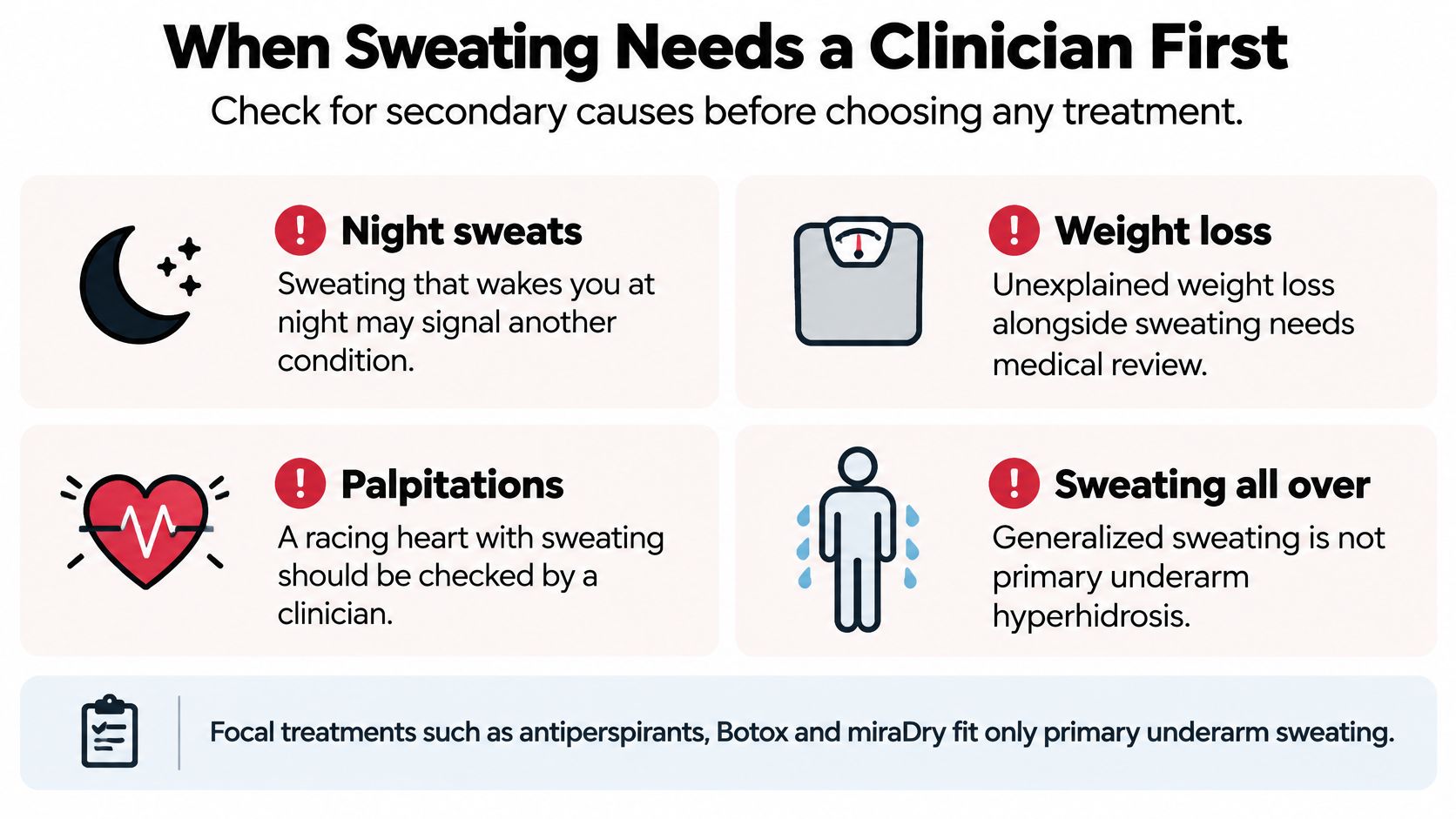
- Sweating that is new, sudden or spreading. Sweating that appears in months rather than years, or that has moved beyond the underarms to the whole body, isn't the familiar patterned kind.
- Sweating during sleep. Waking up damp, especially with the sheets soaked, is the single most common reason I'd pause and look for another explanation.
- Sweating that started after a medication change. Antidepressants, opioid analgesics, hormone therapies and many other drugs change sweat output. The timeline is the clue.
- Sweating with other symptoms. Fever, unplanned weight change, palpitations, or low-blood-sugar signs such as shakiness, confusion or night sweats with hunger all point away from a focal problem.
What a clinician will check
The usual secondary causes are medication effects, thyroid disease, infection, hypoglycemia and generalized systemic illness. The evaluation is rarely dramatic: a full medication review, a conversation about what has changed recently, and basic tests chosen by the clinician if the history points somewhere.
A 2025 medication class review makes the practical stakes clear. It flags new-onset or generalized sweating, medication changes and associated illness as reasons for medical evaluation rather than cosmetic treatment, and it notes that treatment selection turns on severity, access, cost, tolerance for repeated applications or injections, and whether sweating is localized or generalized (2025 hyperhidrosis medication class review).
Anyone heading toward injectables should also read the contraindications for Botox before booking, since a history of certain neuromuscular conditions changes the plan entirely.
Bring these three things to the visit: when the sweating started, what makes it worse, and a written list of every medication and supplement you take. That's usually enough to sort primary from secondary.
If none of those red flags applies, move on to grading severity. If any of them does, book a medical evaluation before any cosmetic or injectable appointment.
Match the Treatment to Your Sweat Severity
Severity isn't how much you dislike it. It's how often the sweating shows up and how much it takes out of your day. The Hyperhidrosis Disease Severity Scale (HDSS) grades that from 1 to 4, and clinicians use the grade to decide where treatment starts.
The four grades differ mainly in interference, not in volume.
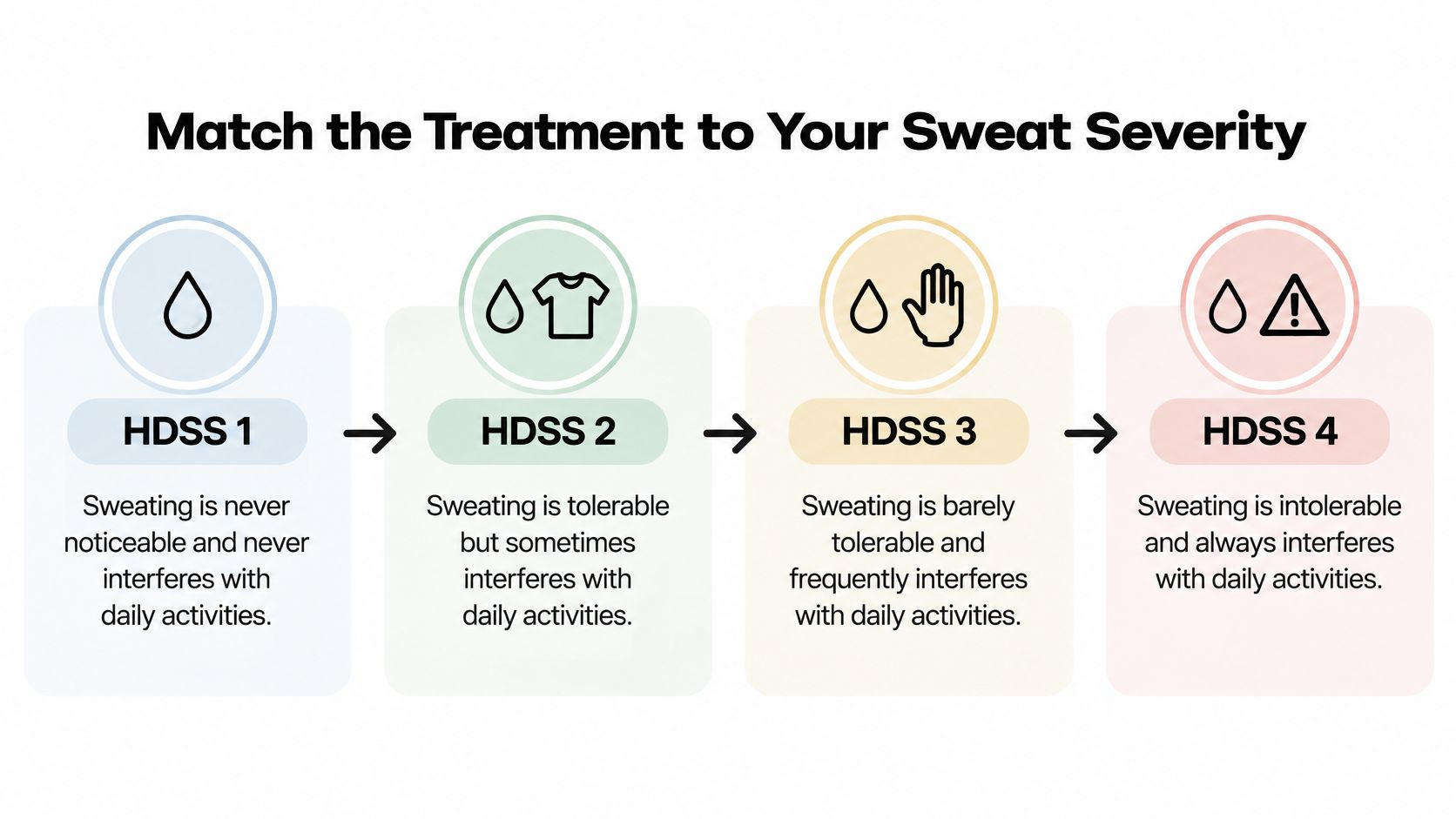
| HDSS grade | What sweating is like | Usual first treatment |
|---|---|---|
| HDSS 1 | Never noticeable, never interferes with daily life | No treatment needed; reassess if it changes |
| HDSS 2 | Tolerable, sometimes interferes | Topical aluminum chloride antiperspirant |
| HDSS 3 | Barely tolerable, frequently interferes | Aluminum chloride or onabotulinumtoxinA |
| HDSS 4 | Intolerable, always interferes with daily activities | Aluminum chloride or onabotulinumtoxinA |
Mild disease (HDSS 2) generally starts with a topical aluminum chloride antiperspirant, while severe disease (HDSS 3 to 4) may reasonably begin with aluminum chloride or onabotulinumtoxinA (American Family Physician).
Escalation is about tolerance as much as response. If topical therapy fails, or the skin can't take it, onabotulinumtoxinA is an evidence-supported next step rather than a cosmetic upgrade. The two aren't rivals; they sit at different points on the same ladder.
Why dry skin at night matters
Aluminum chloride reduces sweating by forming functional plugs within the sweat ducts. Applying it to completely dry skin at night improves both tolerability and efficacy, because moisture increases hydrochloric acid formation and irritant dermatitis. Clinical guidance commonly uses about 20% aluminum chloride for axillary disease, with repeated initial applications followed by maintenance once or twice weekly once control is achieved.
There's a gate on all of this. None of it applies if the sweating isn't primary, so run the red-flag checklist above first. Focal treatment alone is the wrong tool when the sweating is a symptom of something else.
Do a two-minute self-check
Count the days per week you notice the sweating. Then list what it stops you from doing: the shirt you won't wear, the arm you keep pinned to your side, the jacket you keep on in July.
Those two answers usually place you on the scale without much argument. Rate your grade before your appointment and bring the number with you.
Using Antiperspirants Without Irritation
Start with the distinction rarely taught clearly. Antiperspirants reduce sweat. Deodorants mainly control odor. A deodorant alone will not keep a shirt dry, no matter how strong it smells, and confusing the two is the most common mismatch in the drugstore aisle.
If your skin has reacted badly to a clinical-strength product, this is the image worth holding in mind: the difference between a product that works and one that "doesn't" is often a routine, not a formula.
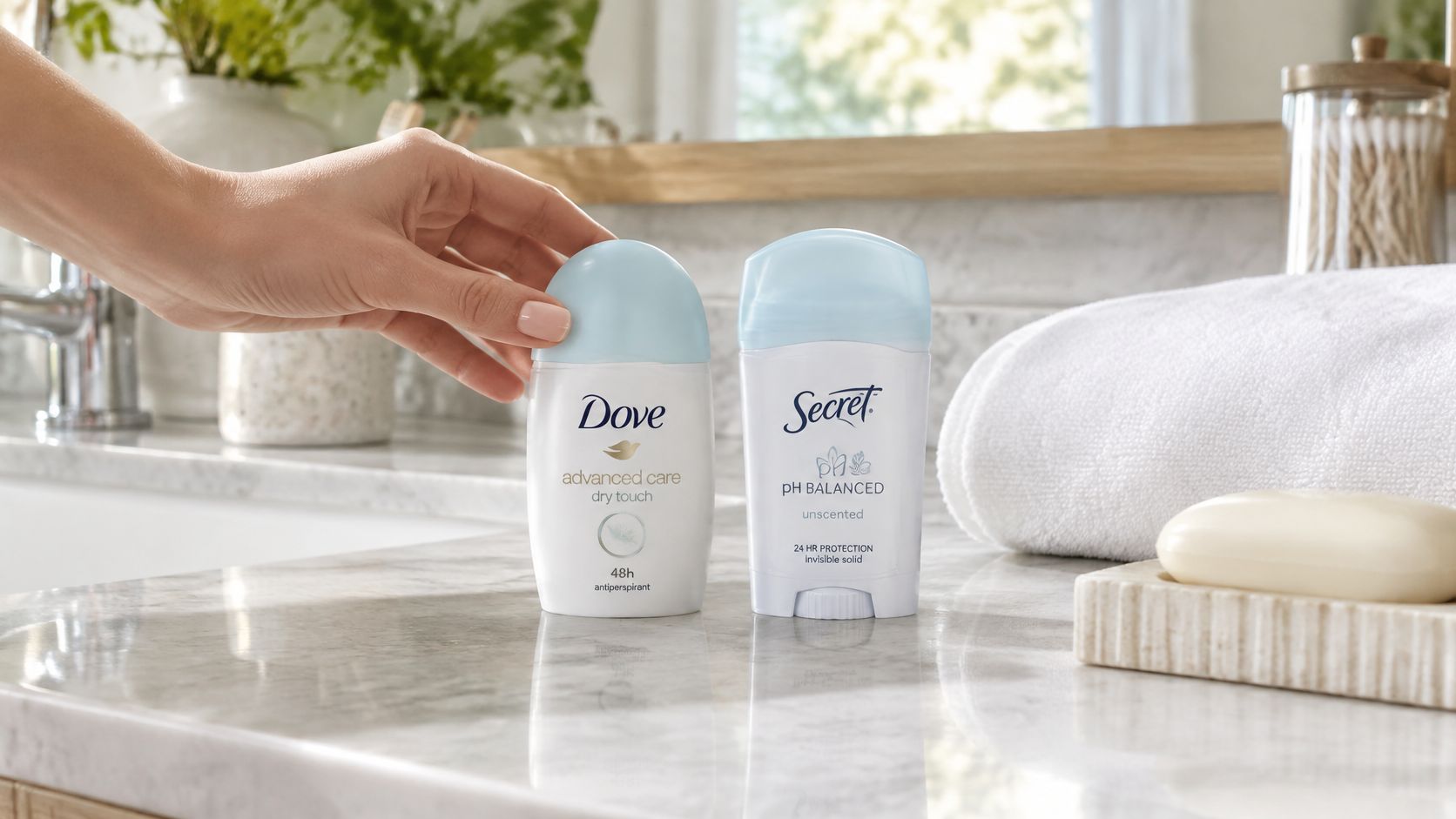
The routine that keeps aluminum chloride tolerable
- Wash and dry before bed. Clean skin absorbs predictably, and any residue of lotion or deodorant traps the product against the surface. Wait until the underarm feels completely dry to the touch, not just towel-dried.
- Apply a thin layer at night. Night application is deliberate: sweat glands are less active while you sleep, so the product stays where you put it instead of sliding off.
- Wash it off the next morning. Rinsing removes the residue that would otherwise sit against your skin all day and turn into a rash.
- Start about twice a week. Neutral clinical guidance is consistent on this: apply at night to completely dry skin, wash off in the morning, begin about twice weekly and increase frequency gradually (International Hyperhidrosis Society axillary guideline). That technique matters more than many expect, because evidence-based reviews report response rates as high as 98% for axillary hyperhidrosis when topical therapy is used properly.
- Increase only when the skin stays calm. Add a night, live with it for a week, then add another. Jumping straight to nightly use is how people end up with a chemical burn instead of dry underarms.
- Drop back to maintenance once control arrives. Many settle at once or twice weekly and stay there. More frequent use doesn't add benefit once the ducts are plugged.
When it burns, stings or rashes
Stop for two or three nights and let the skin settle. Then restart at a lower frequency, on completely dry skin, and skip the night after shaving. Shaving right before application, broken or freshly waxed skin, and fragrance-heavy products layered on top all raise the irritation risk, and none of them are necessary.
If it burns, you're not allergic to aluminum. You're almost certainly applying it to damp skin, too often, or onto skin that hasn't healed. Fix the technique before you give up on the ingredient.
That distinction matters because "treatment failure" is often just dermatitis wearing a disguise. A rash looks like a product that doesn't work, and it gets abandoned at exactly the point where the routine needed adjusting.
Track two weeks before you decide
Keep a simple log: the date of each application, how many nights that week, and any stinging, redness or peeling the next morning. Two weeks of that record tells you more than six months of guessing, and it gives a clinician something concrete to work from.
When Botox Makes Sense for Underarms
BOTOX carries an FDA indication for severe primary axillary hyperhidrosis when topical treatments have not worked adequately. That phrasing matters. This is a medical treatment for a diagnosed condition, not a cosmetic upgrade for someone who prefers to be drier (DailyMed BOTOX labeling).
The appointment is short and the technique is precise. The steps unfold as follows.
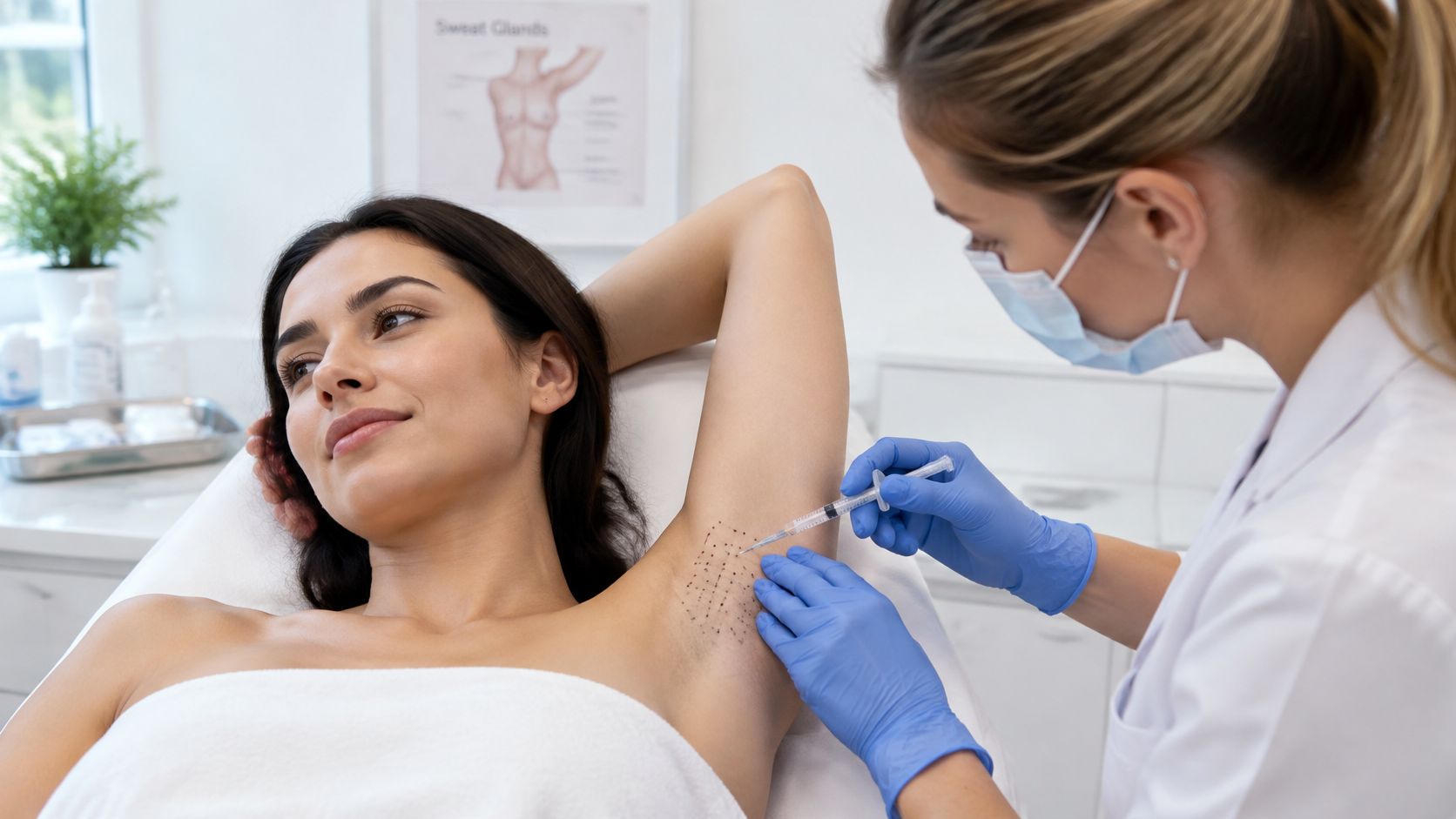
Mapping comes before injecting
Before a needle goes in, the sweating area gets identified with a standard staining method such as the Minor iodine-starch test. Iodine solution is painted across the underarm, starch powder is dusted over it, and the spots that turn dark blue-black are the ones actively producing sweat.
That map does two jobs. It shows where to inject and where not to. Treating skin that isn't sweating adds nothing but bruising.
The labeled dose and pattern
The labeled dose is 50 Units per underarm, injected intradermally. The label describes dividing that dose into 0.1 to 0.2 mL injections across 10 to 15 sites, with injection points spaced approximately 1 to 2 cm apart.
Botox works here by blocking acetylcholine release at the sympathetic nerve terminal, which suppresses secretion from the eccrine glands in the treated field. The glands themselves survive. That's why the effect fades rather than lasts forever, and why repeat treatment is only intended once the clinical effect of the previous injection diminishes.
Who actually qualifies
You're a reasonable candidate if the sweating is severe and persistent, if a properly applied topical antiperspirant hasn't controlled it, or if your skin can't tolerate aluminum chloride at any useful strength. Access and cost belong in that conversation too, because this is a repeating treatment rather than a one-off, and the appointment count adds up over a year.
The benefits of Botox injections for sweating go beyond dryness: fewer shirt changes, less planning around color, and a lower background hum of self-consciousness.
Ask your clinician one direct question at the consult: is iodine-starch mapping part of my plan? If the answer is no, ask why.
Side Effects and Retreatment Timing
The counseling after underarm Botox is short but specific, and knowing it in advance removes most of the surprises.
- Injection discomfort. Brief, needle-level, and over in seconds per site. No numbing is typically needed in the underarm.
- Bruising. Common and harmless. Skip anti-inflammatories and alcohol for a couple of days beforehand if you bruise easily.
- Temporary localized weakness. A known effect in the treated area. In the underarm it's usually subtle, and it resolves.
- Recurrence. Expected, not a failure. As nerve terminals recover, sweating returns gradually rather than all at once.
On timing, the evidence is more encouraging than often assumed. In a clinical study summarized in the medical literature, patients who received 50 units per axilla and reached at least a two-grade HDSS improvement had a median treatment-effect duration of approximately 175 to 238 days across repeated sessions, roughly 6 to 8 months, though individual response varies (American Family Physician). Earlier randomized-trial evidence found reductions of about 50% or greater in axillary sweat production at 16 weeks, with a number-needed-to-treat of about 2.
Retreatment belongs on symptom return, not on a calendar. Someone who gets eight months shouldn't be booked at four.
The record that helps most: the date of each treatment, the first week you notice sweating returning, and whether it returned to your old HDSS grade or a milder one. Three data points, and your clinician can time the next session properly.
Side effects worth reporting rather than tolerating are covered in more detail in this guide to Botox side effects. Anything that doesn't resolve on its own belongs in that conversation.
Book a Consultation to Choose Your Next Step
Three branches cover almost everyone, and only one of them needs an appointment this month.
If your sweating is mild and occasional, start with a correctly applied standard or prescription antiperspirant using the routine above, and give it several weeks of honest tracking before you judge it. Most failures at this stage come from application, not the product, so the log matters more than the brand. If your sweating is moderate to severe, or topicals failed or irritated your skin, book a consultation to talk through onabotulinumtoxinA and whether mapping, dosing and timing fit your schedule. And if anything from the red-flag checklist applies, arrange a medical evaluation before anything else. Cosmetic treatment can wait a few weeks; an unexplained night sweat shouldn't.
Bring four things to that visit: your HDSS self-rating, the two-week log of application nights and symptoms, a full medication list including supplements, and any recent change in your health or prescriptions.
The choice depends on your history rather than a table. Booking a consultation with Barb gets a product recommendation matched to your skin type and goals, and injectable services include Botox, Dysport, Restylane, biostimulators such as Sculptra and Radiesse, PRP injections, Revanesse, body contouring, and Hylenex.
For the at-home side of the routine, BotoxBarb's LED light therapy face mask is the device worth knowing about. The lightweight, ergonomic fit stays comfortable across a full hands-free session, and adjustable settings let you personalize each treatment. Its blue light targets acne-causing bacteria, which suits blemish-prone skin, and the routine itself is gentle and painless rather than another chore.
BotoxBarb offers in-clinic injectables alongside curated medical-grade skincare and at-home devices hand-picked by Barb N.P., so the treatment plan and the routine that supports it come from the same place. If underarm sweating has outgrown every antiperspirant you've tried, bring your severity rating and your two-week log to a consultation and get a plan matched to your grade. Visit BotoxBarb to book your appointment.