Contraindications for Botox: A Provider's Safety Guide
You're in the consultation chair for forehead or glabellar Botox, ready to smooth the lines that bother you, when your provider asks about medications, allergies, medical conditions, and recent changes in your health. You nearly forget to mention the antibiotic you started yesterday, a reaction to another botulinum toxin product, or a procedure scheduled soon. That small detail can change the plan.
Contraindications for Botox aren't meant to make treatment intimidating. They help a qualified injector decide whether treatment is appropriate today, whether it should be delayed, or whether another clinician should be involved. A responsible screening conversation protects your health before the syringe is opened. If you're preparing for an appointment, review this practical guide to preparing for Botox, then bring every medication, reaction, and concern into the room.
The Moment You Should Speak Up Before Botox
A patient once arrived for glabellar treatment with a detail she almost left out. She'd recently been prescribed an antibiotic and assumed it had nothing to do with cosmetic injections. During the medication review, the provider paused. Certain antibiotics, particularly aminoglycosides, can be a concern with botulinum toxin because they may intensify neuromuscular effects or affect how the treatment performs, as described in a clinical review of botulinum toxin safety and drug interactions.
The appointment didn't automatically become a disaster. It became a decision point. The provider needed to understand the medication, why it had been prescribed, whether the patient felt unwell, and whether postponing treatment was safer than proceeding. That's the purpose of screening. It turns a hidden risk into information the clinician can manage.
The same pause may happen if you mention a previous reaction to Dysport, Xeomin, Jeuveau, Daxxify, Letybo, or another botulinum toxin product. A past reaction doesn't always mean every future treatment is impossible, but it does mean the product ingredients, symptoms, timing, and severity need careful review. Facial swelling, widespread hives, breathing difficulty, or symptoms affecting swallowing require a much more cautious response than expected tenderness or a small bruise at an injection point.
Practical rule: If you're wondering whether a detail matters, tell your injector before treatment. Let the clinician decide its significance.
Patients also sometimes hold back information about pregnancy, breastfeeding, an upcoming surgery, an active cold sore, recent illness, or a chronic condition they feel is unrelated to aesthetics. Those details can affect timing, infection risk, bleeding, healing, medication interactions, or the risk of excessive weakness.
A responsible provider won't treat your disclosure as an inconvenience. The appointment can be rescheduled. A treatment plan can be modified. A referral can be arranged. The unsafe choice is allowing embarrassment, haste, or the desire not to lose a booking to replace medical judgment.
What Counts as a Botox Contraindication
A contraindication is a factor that makes Botox inadvisable or unsafe for a particular patient, indication, or moment. It can be medical, pharmacological, or situational. The word doesn't always mean “never.” Sometimes it means “not today,” “not without specialist input,” or “only after the risk has been addressed.”
Clinically, I separate contraindications into two broad categories:
- Absolute contraindications: Treatment shouldn't proceed because the risk is unacceptable. Known hypersensitivity to botulinum toxin or a formulation component, and infection at the proposed injection site, are the clearest labeled examples in FDA materials, including FDA BOTOX labeling.
- Relative contraindications: Treatment may be possible after additional evaluation, altered timing, conservative planning, or input from another clinician. Neuromuscular disease, medication interactions, bleeding risk, and uncertain prior reactions often fit this more individualized category, although the final decision depends on the patient and indication.
A traffic-light analogy helps. A red light means stop. A flashing yellow light means proceed only after slowing down, checking the road, and deciding whether the conditions are safe. An injector who treats every concern as a red light may deny appropriate care. An injector who treats every concern as a yellow light may overlook a serious contraindication.
The distinction matters because botulinum toxin weakens targeted muscles. If a patient already has impaired neuromuscular function, the treatment may add to weakness and contribute to problems such as dysphagia or respiratory compromise. If the skin is infected, inserting a needle can introduce organisms deeper into tissue. If a patient has a true hypersensitivity, exposure may trigger an immune-mediated reaction.

The same framework applies when comparing Botox with other anti-wrinkle treatment options. A different product or procedure doesn't remove the need for medical screening. It may change the ingredients, mechanism, treatment area, or risk profile, but candidacy still starts with an accurate history.
The Universal Red Flags Providers Always Screen For
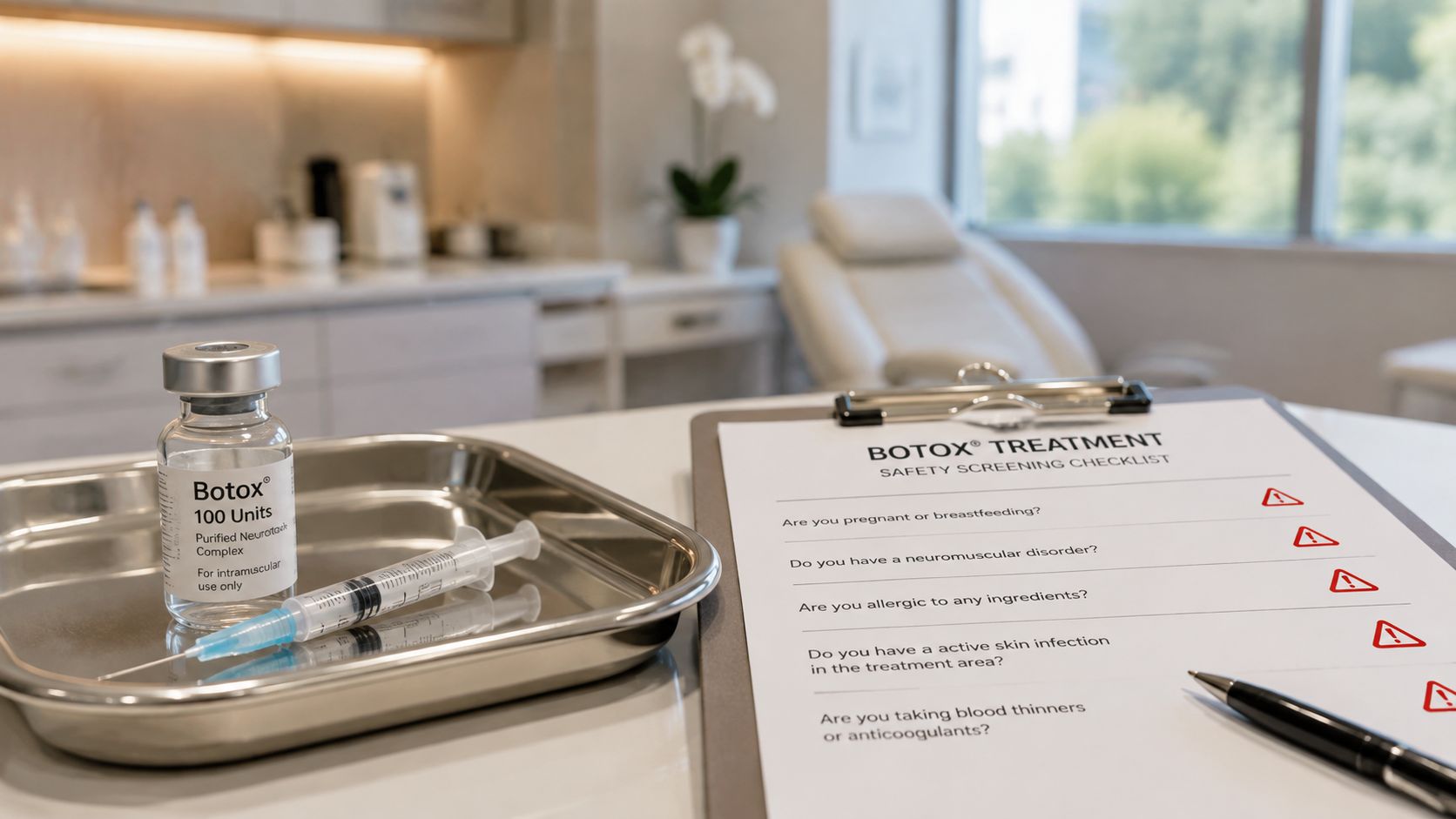
Some screening questions belong in every cosmetic botulinum toxin consultation, regardless of whether the planned treatment involves the forehead, glabella, crow's feet, or another area. FDA labeling identifies known hypersensitivity to botulinum toxin or any formulation component as a contraindication, along with infection at the proposed injection site. These aren't optional questions or paperwork details. They're the baseline safety screen.
Hypersensitivity requires product-level review
A patient may react to the toxin itself or to an ingredient in a specific formulation. The history should include reactions to BOTOX, BOTOX Cosmetic, Dysport, Xeomin, Jeuveau, Daxxify, Letybo, or related products. FDA materials also warn patients who've previously reacted to other botulinum toxin products to avoid BOTOX or BOTOX Cosmetic unless a qualified clinician determines an appropriate path forward.
The provider needs more than the word “allergy.” Ask yourself what happened. Was there localized redness, generalized hives, facial swelling, wheezing, faintness, or difficulty breathing? Did symptoms start immediately or later? Was emergency treatment required? A mild expected injection-site response isn't equivalent to a systemic allergic reaction.
An infected site needs time to recover
The proposed injection area should be free from active infection or significant inflammation. Acne lesions, herpes outbreaks, cellulitis, open skin, or draining areas can change the decision. A needle can carry organisms through tissue, and compromised skin may not heal predictably.
That doesn't mean every blemish permanently rules out treatment. It means the provider should inspect the exact injection points and decide whether treatment can be safely moved, postponed, or avoided until the skin has settled.
Neuromuscular disease changes the risk calculation
Conditions such as myasthenia gravis, Lambert-Eaton syndrome, and ALS deserve separate attention because baseline weakness can increase the risk of generalized weakness, swallowing difficulty, or breathing problems. The concern isn't limited to the injection site. Botulinum toxin's muscle-weakening mechanism can become clinically important when the neuromuscular system is already impaired.

A thorough provider will also ask about unexplained fatigue, drooping eyelids, difficulty swallowing, changes in speech, or previous episodes of generalized weakness. Those symptoms don't establish a diagnosis, but they're reasons to stop and evaluate rather than inject on autopilot.
Medical Conditions That Require Extra Evaluation
Medical history rarely fits neatly into “safe” or “unsafe.” A person with a bleeding tendency may still be a candidate, while someone with a neuromuscular disorder may need specialist input or should avoid treatment altogether. The provider's job is to identify the category, assess the level of risk, and choose the least risky next step.
Neuromuscular and respiratory concerns
Myasthenia gravis, Lambert-Eaton syndrome, and ALS are high-alert conditions. A patient with baseline weakness, dysphagia, ptosis, or unexplained fatigue may be more vulnerable to additional muscle impairment. Cervical injections deserve particular caution when swallowing or respiratory function is already compromised.
The practical response may be deferral and a neurology consultation, not just a lower dose. Reducing exposure doesn't automatically remove the underlying concern, and an aesthetic appointment shouldn't replace disease management.
Bleeding, skin, and structural factors
Anticoagulants and clotting disorders can increase bruising or bleeding during needle-based treatment. They don't necessarily make Botox absolutely contraindicated, and patients shouldn't stop prescribed anticoagulants without the prescribing clinician's direction. A provider may adjust technique, injection depth, pressure, and timing, while explaining that bruising can still occur.
Active dermatologic disease at the injection site is a different issue. A history of keloids, facial surgery, altered anatomy, or connective tissue disease may call for more detailed examination and conservative planning. Previous surgery can change landmarks and muscle movement, so an injector shouldn't rely on a standard map alone.
| Condition Category | Risk Level | Recommended Action |
|---|---|---|
| Neuromuscular disorder or unexplained weakness | High and potentially serious | Defer treatment and seek neurologic evaluation |
| Active infection or significant inflammation at the planned site | Contraindication at that site | Treat or allow the condition to resolve before reassessment |
| Anticoagulant use or bleeding tendency | Individualized | Review the medication with the prescriber, modify technique, and discuss bruising |
| Autoimmune or connective tissue disease | Variable | Review disease activity, medications, healing history, and specialist advice |
| Prior facial surgery or altered anatomy | Moderate and anatomy-dependent | Examine movement and landmarks, then plan conservatively |
| Respiratory or swallowing concerns | High for relevant treatment areas | Avoid or refer for medical assessment before considering treatment |
Cardiopulmonary symptoms, active systemic illness, and substantial immune suppression also deserve honest discussion. The correct plan may be consultation, modified dosing, or avoidance. A good screening process doesn't force every patient into the same pathway.
For patients who suspect environmental or medication-related reactions, structured comprehensive allergy testing may help organize the history, but testing should complement, not replace, a clinician's assessment of a prior botulinum toxin reaction.
Pregnancy, Medications, and Other Situational Risks
A patient can be medically healthy and still need to postpone Botox because the timing creates avoidable uncertainty. Pregnancy and breastfeeding are the clearest examples. FDA labeling states that it is not known whether onabotulinumtoxinA passes into breast milk, and safety data during pregnancy remain limited. For that reason, clinical guidance commonly recommends avoiding elective cosmetic injections during pregnancy and breastfeeding, as discussed in clinical guidance on Botox during pregnancy.
The timing question
If you are pregnant, the practical choice is usually to defer elective cosmetic injections until after delivery. If you are breastfeeding, many clinicians take the same conservative approach because published information about transfer into milk is limited or absent. Cosmetic treatment should be separated from medically necessary care, which belongs in a discussion with the clinician managing that condition.
Resources covering pregnancy development milestones may help with scheduling and changing appointments, but they cannot provide individualized advice about injections.
Medication reconciliation matters
Bring the medication names and doses when possible, rather than saying only “an antibiotic” or “a blood thinner.” Aminoglycoside antibiotics and neuromuscular blocking agents can raise concern because they may affect neuromuscular transmission. A provider may delay treatment, coordinate with the prescriber, or proceed only after deciding that the medication can be managed with added caution.
Anticoagulants, antiplatelet drugs, and aspirin products can increase bruising. That generally calls for a risk discussion and careful injection technique, not independent discontinuation of a prescribed medicine. Supplements and herbal products also belong in the medication review, especially when they may affect bleeding or interact with other medicines.
Other reasons to pause
Recent vaccination, an active infection, feeling systemically unwell, planned surgery, heavy alcohol use near the appointment, or a major life event can affect timing. These circumstances do not all carry the same level of risk, and they are not automatic permanent exclusions. The provider should ask what occurred, when it occurred, how severe it was, and what else is planned.
Bring this information to intake:
- Current prescriptions: Include antibiotics, muscle relaxants, anticoagulants, antiplatelet medicines, and sleep or allergy medications.
- Supplements and herbs: List every product, including those marketed as natural.
- Upcoming procedures: Mention surgery, dental work, laser treatments, facials, and other injections.
- Recent health changes: Report fever, respiratory symptoms, active skin lesions, or a new diagnosis.
- Reproductive status: State pregnancy, plans for pregnancy, or breastfeeding plainly.
The provider then distinguishes a concern that requires avoidance from one that can be managed. The outcome may be treatment, rescheduling, dose modification, or referral.

How a Responsible Screening Conversation Should Work
A safe consultation should feel like a medical appointment, not a sales conversation compressed into a few minutes. The provider reviews your health history, asks about current changes, reconciles medications, examines the planned injection area, and gives you room to mention information you're unsure is relevant.
Open-ended questions work better than a rushed checklist. “What has changed in your health recently?” may reveal an antibiotic, a new diagnosis, a planned operation, or breastfeeding that a patient wouldn't think to mention after being asked only whether they have allergies.
What the clinician should clarify
The conversation should cover:
- Previous toxin exposure: Product name, treatment area, response, side effects, and any suspected allergy.
- Medical conditions: Neuromuscular, respiratory, autoimmune, connective tissue, bleeding, and swallowing concerns.
- Medication use: Prescriptions, over-the-counter products, supplements, and recent antibiotics.
- Skin examination: Infection, inflammation, herpes lesions, open areas, or active acne at intended injection points.
- Expectations: What Botox can address, what it won't correct, and how the provider will assess the result.
Questions about pregnancy, HIV status, chronic illness, or sexual health can feel personal, but they're standard in a complete medical history. A professional should ask respectfully, explain why the information matters, and protect confidentiality.
A screening appointment is a safety appointment. A good provider welcomes the questions that make treatment slower and safer.
When the history is ambiguous, responsible clinicians don't guess. They may defer treatment while obtaining records, contact the prescribing clinician, request dermatology input for a skin condition, or refer to neurology for symptoms suggesting impaired neuromuscular function. Documentation should record the concern, the decision, the consent discussion, and the follow-up plan.
Patients can also evaluate the provider's preparation. Training resources such as aesthetic service line expansion advice may support professional development, but hands-on competence, appropriate licensing, product knowledge, and honest communication remain essential. You should understand why the provider recommends proceeding or postponing before you agree.
Treatment Failure, Allergies, and How BotoxBarb Handles Safety
A poor response to a previous botulinum toxin treatment deserves investigation, not an automatic assumption that you're “not a candidate.” Treatment failure can reflect product choice, injection planning, muscle anatomy, expectations, or antibody-related nonresponse. Older clinical literature has identified blocking antibodies as one possible reason for reduced response, and FDA product information reinforces the importance of reviewing prior reactions and related products.
A true component allergy is different from expected soreness, a small bruise, or temporary localized swelling. The clinician should document reactions to the toxin and formulation ingredients, which can include components such as human albumin, lactose, or sodium depending on the product. Switching brands isn't automatically a solution because related botulinum toxin products may share clinically relevant concerns, and cross-reactivity requires individualized assessment.
A safety-focused workflow
At BotoxBarb, the practical safety sequence is straightforward:
- History first: Review diagnoses, medications, pregnancy or breastfeeding status, previous toxin exposure, and allergic reactions.
- Consent with context: Explain likely effects, limitations, risks, alternatives, and the reason for any delay.
- Conservative planning: Use careful assessment and appropriately conservative dosing for first-time patients rather than chasing an aggressive result.
- Follow-up: Reassess the response at a planned 30-day follow-up, particularly when evaluating suspected primary failure.
- Referral when needed: Seek allergy or neurology input when the history suggests a true reaction, neuromuscular disease, or unexplained nonresponse.
The Botox not working guide can help patients prepare better questions for that review. Staying with one trusted provider also has a practical advantage. Longitudinal records can reveal patterns in product response, timing, side effects, and changing medical circumstances.
The practice also offers non-injectable options, including the Barb N.P. Facial Mark, an LED facial mask designed for convenient home use. Its wireless design, comfortable fit on the face, and three lighting settings support different skincare routines without replacing medical evaluation or Botox when an injectable is appropriate.
BotoxBarb offers individualized Botox, Dysport, filler, LED light therapy, and skincare guidance with safety screening at the center of every plan. Visit BotoxBarb to book a consultation, review your contraindications, and find the right next step for your skin and wellness goals.