Comprehensive Allergy Testing: Get Your Clear 2026 Diagnosis
Some people live with allergy symptoms for years without ever feeling sure what's driving them. It might be the congestion that shows up every morning, the itching that flares after being outdoors, the rash that appears without warning, or the stomach upset that makes meals feel unpredictable. When symptoms move between your nose, skin, gut, and eyes, it's easy to start guessing, a common tendency.
That's where thorough allergy testing helps. Not because one test magically reveals everything, but because a structured workup can turn scattered symptoms into a clear plan. When testing is done thoughtfully, it helps separate likely triggers from false leads, and it gives you something better than internet advice. It gives you direction.
Decoding the Mystery of Your Symptoms
A lot of patients arrive at allergy testing already exhausted by trial and error. They've changed detergents, stopped eating certain foods, bought air purifiers, switched skincare, and still don't know what matters. That uncertainty is often worse than the symptoms themselves.
Allergy symptoms also overlap with other common problems. Hives can be confused with irritation. Nasal symptoms can come from non-allergic causes. A skin reaction may be eczema, contact dermatitis, bites, or a true allergic response. If you're trying to identify bedbug bites or allergies, that kind of side-by-side comparison can be useful before you assume every bump is an allergy.
Why guessing usually fails
The challenge is that allergies rarely present as one neat pattern. Environmental allergies can show up as sneezing, itchy eyes, postnasal drip, sinus pressure, and irritated skin. Food-related reactions may be immediate and obvious, or they may seem inconsistent until a proper history is taken.
If your symptoms lean seasonal or indoor, this guide on symptoms of environmental allergies can help you recognize common patterns before testing.
A good allergy workup doesn't start with a giant panel. It starts with your story.
That history matters more than is commonly understood. When symptoms happen, how fast they start, where you were, what you ate, what touched your skin, and what medications you take all shape which tests make sense. Without that context, even a technically accurate test can be clinically misleading.
What a clearer path looks like
Thorough allergy testing is best understood as a diagnostic journey. It's a way to move from, “Something is wrong,” to, “Here's what's most likely, here's what to avoid, and here's how to protect your skin and overall wellness.”
That process usually helps answer questions like:
- What's the most likely trigger based on timing, environment, and symptoms
- Which test fits best for inhalant, food, skin contact, venom, or medication concerns
- What to ignore so you don't overreact to irrelevant findings
- How to build a plan that supports breathing, digestion, sleep, and skin comfort
For many people, relief starts when the mystery starts to narrow.
What Comprehensive Allergy Testing Really Means
Thorough allergy testing sounds like one big test. In practice, it works better as a sequence of decisions. The strongest workups begin with a targeted clinical history, because both skin testing and serum IgE testing detect sensitization, not disease on their own, and the presence of allergen-specific IgE without symptoms doesn't confirm clinical allergy. The most accurate confirmatory method is an allergen provocation or challenge test performed under controlled conditions, as outlined in this clinical review of allergy diagnosis.

Sensitization versus actual allergy
This is one of the most important distinctions in allergy medicine.
Think of sensitization as your immune system recognizing a substance. Think of clinical allergy as your body reacting in a meaningful way when real exposure happens. You can have a positive test and still not have symptoms when you encounter that allergen in daily life. That's why a lab result alone shouldn't define your diet, your home routine, or your skincare.
A positive result is a clue. It isn't the whole diagnosis.
Practical rule: Test results should match the story. If they don't, the next step is interpretation, not panic.
Why history comes first
The full scope isn't about ordering the broadest panel possible. It's about using history to decide what deserves investigation.
A focused history usually covers:
-
Symptom pattern
Are symptoms immediate, delayed, seasonal, year-round, meal-related, or triggered by skin contact? -
Exposure details
Did symptoms start around pets, pollen, dust, mold, new cosmetics, a workplace exposure, or a specific food? -
Medication and skin factors
Antihistamines, eczema, dermatographism, and skin condition all influence which test type is practical. -
Severity and safety
Reactions that involve breathing changes, widespread hives, swelling, or prior severe reactions need a more careful path.
Why broad screening can mislead
Untargeted testing often creates noise. The more unrelated items you test without a clear reason, the more likely you are to end up with findings that don't explain your real symptoms. That can lead to unnecessary avoidance, over-restriction, and a lot of anxiety around foods or environments that may not be causing harm.
A true thorough allergy testing process asks better questions:
- What are we trying to explain?
- Which triggers are plausible?
- Which test best answers that question?
- What action would we take if the result is positive, negative, or unclear?
That's how testing becomes useful. It doesn't just generate data. It guides decisions.
Your Guide to The Different Types of Allergy Tests
Different tests answer different clinical questions. Some are quick and office-based. Others are better when skin testing isn't practical. A few are used to clarify edge cases rather than to start the workup.
For many immediate allergy concerns, skin-prick testing is the common first-line option. According to the Mayo Clinic, skin-prick tests can evaluate up to about 50 substances in one visit and usually produce results in 20–40 minutes, while specific-IgE blood tests can measure reactivity to hundreds of triggers from one sample. The same guidance notes that blood testing is preferred when antihistamines or other factors make skin testing unreliable, and that blood test interpretation must stay anchored to clinical history in this Mayo Clinic overview of allergy testing.
Skin-prick testing
Skin-prick testing places small amounts of suspected allergens on the skin, usually the forearm or back, and then gently introduces them to the surface. If you're sensitized, a raised itchy bump may develop at that spot.
This method is especially useful for airborne allergens such as pollen, pet dander, and dust mites. In practice, it's also appealing because results come back during the same visit. That immediacy helps patients understand patterns quickly.
Skin-prick testing is less ideal when:
- You can't stop antihistamines
- Your skin is very inflamed or affected by eczema
- Dermatographism makes your skin overly reactive
- You need a blood-based option for practical or safety reasons
Specific-IgE blood testing
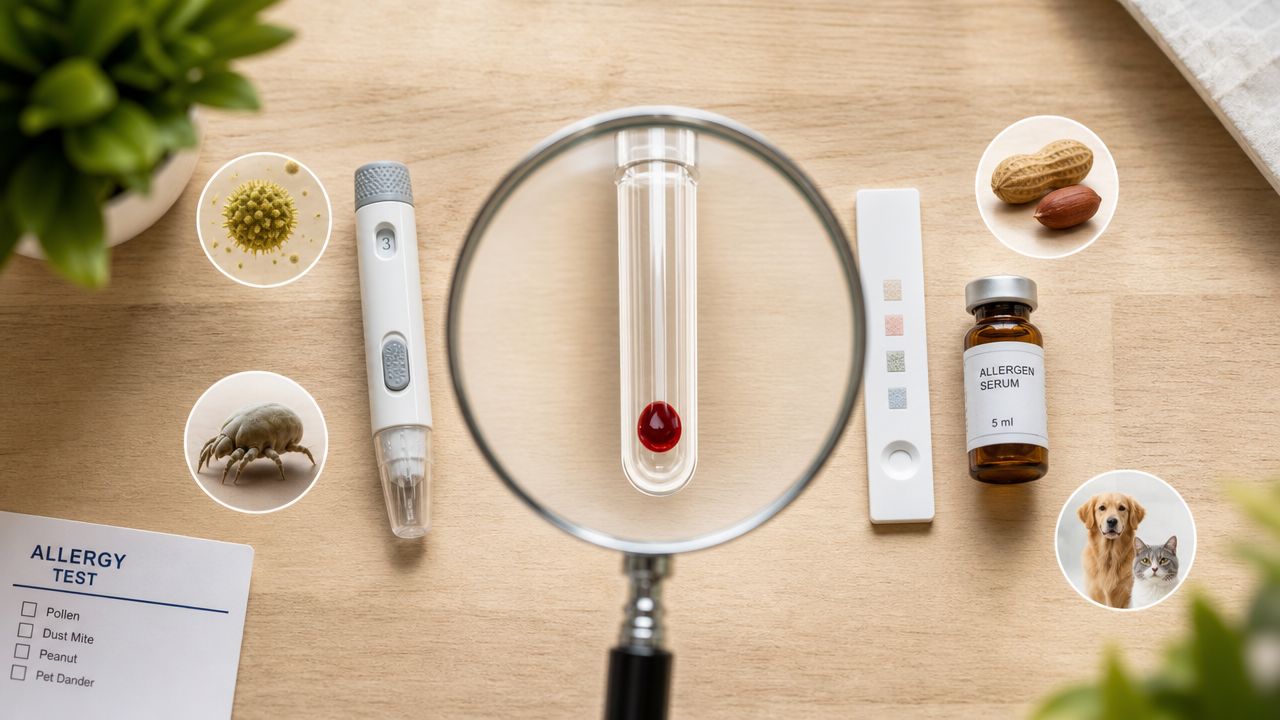
Serum specific-IgE testing uses a blood sample to look for reactivity to selected allergens. This can be helpful when skin testing isn't feasible or when a provider wants a broader look from one collection.
Its convenience is real, but the biggest misconception is also here. A positive blood result shows sensitization, not automatic clinical disease. It also doesn't predict reaction severity based on the number alone. That's why blood testing works best when the panel is chosen carefully and interpreted against symptom timing, exposure, and history.
For some patients, blood testing is the most practical route. For others, it's one piece of a larger puzzle.
Patch testing and intradermal testing
Not every “allergy” is the same kind of immune reaction.
Patch testing is typically used for contact dermatitis. If a rash appears where products, metals, adhesives, fragrances, or topical ingredients touch your skin, patch testing may be more relevant than IgE testing. This is especially important in people who think they have a food or environmental allergy when the underlying issue is repeated skin contact.
Intradermal testing places a small amount of allergen just under the skin. It's more specialized and usually selected for specific situations rather than routine first-line screening. Whether it's appropriate depends on what reaction type a clinician is trying to investigate.
Not all rash problems are food problems. Not all sneezing problems are seasonal allergies. The test has to fit the question.
Advanced tools and confirmatory testing
Some workups require more than a first-pass skin or blood result. In selected food allergy evaluations, clinicians may use component-resolved diagnostics or other higher-specificity methods to refine the picture. And when the diagnosis remains uncertain, a medically supervised challenge may be the clearest way to confirm whether exposure causes true symptoms.
That's where a thorough process earns its name. It doesn't stop at the first positive result.
Comparing Common Allergy Test Methods
| Test Type | What It Detects | Procedure | Best For |
|---|---|---|---|
| Skin-prick testing | Immediate sensitization to selected allergens | Small amounts placed on skin with quick reading during visit | Environmental triggers and many first-line IgE-mediated questions |
| Specific-IgE blood testing | Allergen-specific IgE in blood | Blood draw with lab analysis | When antihistamines, eczema, skin reactivity, or logistics limit skin testing |
| Patch testing | Delayed contact reactions | Allergens applied to skin and reviewed over time | Suspected contact dermatitis from products, metals, or topical exposures |
| Intradermal testing | Skin reactivity in selected cases | Small amount injected under the skin | More specialized situations based on clinician judgment |
| Provocation or challenge testing | Whether exposure causes clinical symptoms | Controlled exposure under supervision | Confirming true allergy when history and earlier testing don't fully align |
If you want a direct side-by-side discussion of first-line choices, this comparison of allergy blood test vs skin test is a useful next read.
In Clinic vs At Home Allergy Testing Panels
Convenience matters. People want answers without taking time off work, sitting in a waiting room, or arranging multiple appointments. That's why at-home allergy testing panels get so much attention. The appeal is obvious. Collect a sample, ship it, and wait for results.
The problem isn't convenience. The problem is unguided interpretation and, in some cases, the wrong kind of test.

What in-clinic testing does better
In a clinic, the biggest advantage is context. A qualified provider can look at your symptoms, timing, medications, skin condition, and risk profile before choosing a test. That lowers the chance of ordering something broad but clinically unhelpful.
In-clinic care also helps when results are mixed. A provider can tell you whether a positive finding fits your story, whether more testing is needed, or whether the result is likely incidental.
Where at-home testing can go wrong
At-home testing isn't automatically inferior. The issue is that some panels include methods that major guidance doesn't support for diagnosing allergy. CMS guidance distinguishes between validated tests such as skin-prick testing and serum specific-IgE testing, while noting that IgG food panels and several alternative methods are not supported by sufficient evidence. The same guidance also makes an important practical point. More panels don't automatically mean more accuracy, and the most inclusive package is often the one that is narrower but better targeted to the suspected trigger, as described in this CMS coverage guidance on allergy testing methods.
That's the core trade-off with many mail-in kits. They can look thorough while instead making the picture messier.
What makes an at-home option worth considering
A better at-home model keeps the convenience but removes the guesswork. Look for:
- Validated methodology such as serum specific-IgE rather than unsupported food sensitivity claims
- Targeted panel design based on likely exposures, not just maximum volume
- Clinical review so results are interpreted in context
- Clear next steps for avoidance, follow-up, and referral if needed
If you're weighing convenience against accuracy, this guide to allergy testing at home can help you sort out what's useful and what deserves skepticism.
For many people, the best setup is simple. Use at-home testing when it's clinically appropriate, but don't separate the sample from professional interpretation. Testing should answer a real question, not just generate a long list.
Turning Your Results Into a Wellness Plan
Results only matter if they change what you do next. A thorough allergy workup should leave you with a plan that fits daily life, not just a report with highlighted items.
That plan often touches your home, your meals, your medications, and your skin. It should also account for what's realistic. The perfect avoidance strategy on paper isn't helpful if you can't maintain it.

Environmental changes that actually help
When environmental triggers are part of the picture, your provider should help you focus on the exposures most likely to affect symptoms. That may mean changes to bedding habits, indoor cleaning routines, pet exposure, ventilation, or product selection.
The key is specificity. If testing and history suggest indoor allergens are the issue, your plan should prioritize the rooms and surfaces where exposure is highest. If your skin flares after fragranced products or dusty cleaning sessions, your routine should reflect that.
For practical home support, a list of recommended cleaning supplies for allergy relief can help you choose products that are less likely to add irritation while you clean.
Food changes without over-restriction
Food-related concerns create the most anxiety because people often jump from “possible trigger” to “I can never eat this again.” That's not always the right move.
A useful food plan usually includes:
- Confirmed avoidance for foods that clearly match symptoms and testing
- Caution with interpretation when a result is positive but your history is weak or inconsistent
- Structured follow-up when a challenge or specialist evaluation is needed
- Nutrition awareness so you don't create unnecessary dietary gaps
In this context, professional guidance protects patients from both directions. It helps prevent accidental exposure to true triggers, and it helps prevent needless elimination of foods that aren't causing disease.
Treatment and monitoring
Treatment may include symptom-relief medication, a referral for immunotherapy, changes to skin care products, or a safety plan for more serious reactions. The right plan depends on what kind of allergy pattern you have and how severe the reactions are.
Skin-prick testing is the most common allergy test, and one reason it remains so widely used is that clinicians can assess likely triggers efficiently while keeping the evaluation structured. In a large cohort of 31,000 patients, systemic reactions after skin-prick testing were recorded at 77 per 100,000 patients, which is about 0.077%, showing that serious reactions are rare but real and that testing is best overseen by a professional who can build a safe treatment plan, as reviewed in the Cleveland Clinic Journal of Medicine article on allergy testing.
The test is only the midpoint. The real outcome is a plan you can follow when you wake up congested, eat out, travel, or have a skin flare.
Where skin health fits in
Allergies and skin health are tightly connected. Even when the trigger begins in the air or diet, the visible result may be inflammation, itching, redness, hives, dryness, or a disrupted barrier. That's why many patients don't just want fewer reactions. They want calmer skin.
When skin is reactive, keep the routine simple. Use gentle cleansing, avoid unnecessary fragrance, and pause actives that sting or strip the barrier. Supportive tools can also help with comfort. In practice, some patients like using an LED facial mask as part of a broader skin-calming routine because it's easy to use at home and fits into consistency-based care. Features that matter most are usually practical ones: wireless wearability, a comfortable fit on the face, and 3 lighting settings so the device can be adapted to different treatment goals.
That kind of device doesn't replace allergy diagnosis or treatment. It can, however, complement a plan built around reducing skin stress while the underlying triggers are being managed.
Navigating Your Next Steps After Testing
Once results are back, the next move depends on how clean the picture is. Some people get a very clear answer. Others get a mixed result that needs context, follow-up, or specialist input.
That doesn't mean the testing failed. It usually means allergy diagnosis is doing what it often does best. Narrowing possibilities in a stepwise way.
When primary care or an NP can guide the process
A Nurse Practitioner can often help with the early and middle parts of the journey. That includes reviewing symptoms, choosing appropriate initial testing, identifying obvious mismatches, and building practical plans around avoidance, symptom control, and skin support.
This is especially helpful when the main goal is to answer focused questions such as whether symptoms look environmental, whether blood testing is more practical than skin testing, or whether a rash pattern suggests contact irritation rather than IgE-mediated allergy.
When an allergist should step in
Some situations deserve referral to a board-certified allergist. Examples include:
- Severe reactions involving breathing changes, facial swelling, or widespread hives
- Unclear food reactions where confirmation may require advanced interpretation or challenge testing
- Need for immunotherapy or more specialized planning
- Conflicting results that don't line up with the clinical story
According to an NIH-reviewed article, an estimated 10% to 30% of the global population has an allergic disease, and modern diagnosis is often sequential. That review notes that skin prick tests and serum specific IgE have high sensitivity, while other methods can add high specificity, which is why a thorough workup may involve multiple steps and may help guide decisions such as whether to proceed to an oral food challenge in this NIH review on food allergy diagnostics.
How to handle ambiguous results
If your results feel confusing, ask these questions at follow-up:
- Does this result fit my symptom pattern?
- Does the exposure happen often enough to explain my symptoms?
- Is this finding actionable, or just interesting?
- Do I need confirmation before avoiding something long term?
Those questions keep you from overreacting to noise.
A good provider doesn't just hand over results. They help you rank what matters now, what needs monitoring, and what can be set aside. That's how testing becomes useful in real life.
Frequently Asked Questions About Allergy Testing
Can allergy tests be wrong
They can be misleading if they're interpreted without history. Skin and blood IgE tests can detect sensitization without proving that the allergen is causing real-world symptoms. That's why a positive result doesn't always equal a true clinical allergy, and why the full picture matters.
What's the difference between a food allergy and a food intolerance
A food allergy involves the immune system. A food intolerance doesn't necessarily involve the same allergic mechanism and may present very differently. If reactions are delayed, inconsistent, or mostly digestive without a clear allergy pattern, the evaluation may need to widen beyond classic allergy testing.
Do I need to stop antihistamines before testing
Sometimes, yes. Antihistamines can interfere with skin-prick testing, which is one reason blood testing may be chosen when stopping medication isn't practical. Your provider should review your medication list before deciding which test to use and when to schedule it.
Is a bigger panel always better
No. A larger panel can produce more irrelevant findings. The most useful allergy testing is often targeted to your likely triggers, symptom timing, and exposure pattern rather than built around testing everything possible.
If you're ready to move from symptom guessing to a clearer plan, BotoxBarb offers wellness-focused support, including curated allergy testing options and self-care tools that fit into everyday life. You'll also find skin-focused products and devices designed to support comfort, routine, and confidence while you work on the bigger picture of trigger control and overall skin health.