Article: How Long Does Filler Swelling Last? a Day-by-Day Guide
How Long Does Filler Swelling Last? a Day-by-Day Guide
Routine filler swelling usually peaks in the first 24 to 48 hours and is mostly gone within about one to two weeks, with the American Academy of Dermatology putting temporary filler side effects, swelling included, at 7 to 14 days or sooner. Lips and the under-eye hollows run on a slower clock, and swelling that keeps growing, hurts more each day, turns the skin pale or dusky, or arrives with any change in vision is a reason to call your injector right away.
You're in the parking lot or at the bathroom mirror, twenty minutes after you left the clinic, and your lips look bigger than the plan you agreed to. One side is fuller. There's a small bruise near the border. You're already drafting a message you're not sure you should send.
Nothing here is meant to talk you out of sending it. It's meant to give you a ruler: what's expected hour by hour, which areas heal on a different schedule, how a cold or a dental cleaning can wake up old filler, and the specific symptoms that move you from watch-and-wait to call-now.
Typical Filler Swelling Timeline Day by Day
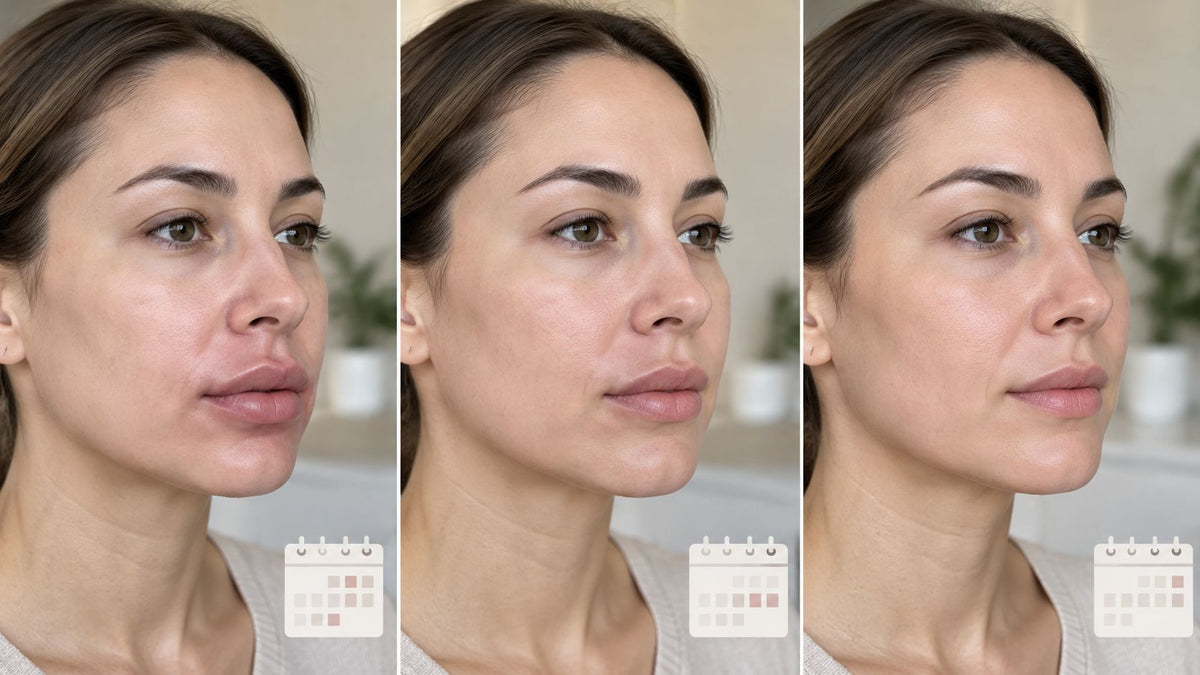
Swelling after a properly placed injection has a shape. It climbs fast, holds for a day or two, then recedes unevenly. The American Academy of Dermatology's guidance on fillers describes temporary side effects, including swelling, as generally clearing within 7 to 14 days, or sooner (AAD filler FAQs). Treat that as the rhythm most patients follow, not a guarantee written for your face.
| Window | What is typical | What to do |
|---|---|---|
| 0-24 hours | Swelling, tenderness and bruising are at their highest | Ice 15-20 minutes only if the injector advises it; avoid pressing the area |
| Days 2-3 | Ordinary injection-related edema starts improving steadily | Sleep with the head slightly raised; don't judge the final shape yet |
| Days 4-7 | Most common reactions are gone by day 7 (76% in one FDA brochure, 69% in another) | Check that swelling is shrinking day by day |
| Days 8-14 | Temporary effects clear within 7-14 days; 89.8% of reactions gone by day 14 in one FDA brochure | Confirm improvement at the two-week check |
| Beyond 4 weeks | Counts as prolonged edema in the under-eye research | Move to the warning signs in the section below |
The first day is the loudest. Swelling, tenderness and bruising peak together, partly because the tissue has just been punctured and partly because hyaluronic acid gel holds water. A 2024 medical review describes this transient post-injection edema as typically resolving within 2 to 3 days (review of filler-related swelling).
By the end of the first week most of the visible work is finished. In one FDA patient brochure, 76% of common reactions were gone by day 7 and 89.8% by day 14; a second brochure reported 69% resolved by day 7 and 84% by day 14 (FDA patient brochure on dermal filler reactions).
Past four weeks, the frame changes. Swelling that hasn't improved at all stops being a healing event and becomes a clinical question worth examining.
The check that matters: compare today with yesterday, not today with your pre-treatment photo. A little smaller and a little softer each day means the timeline is doing its job.
How Filler Type and Treatment Area Change Recovery
The same filler appointment can leave the lips and under-eyes with very different recovery patterns. Swelling depends on both the treated area and the product, so compare your progress with the pattern for that site rather than relying on one average.
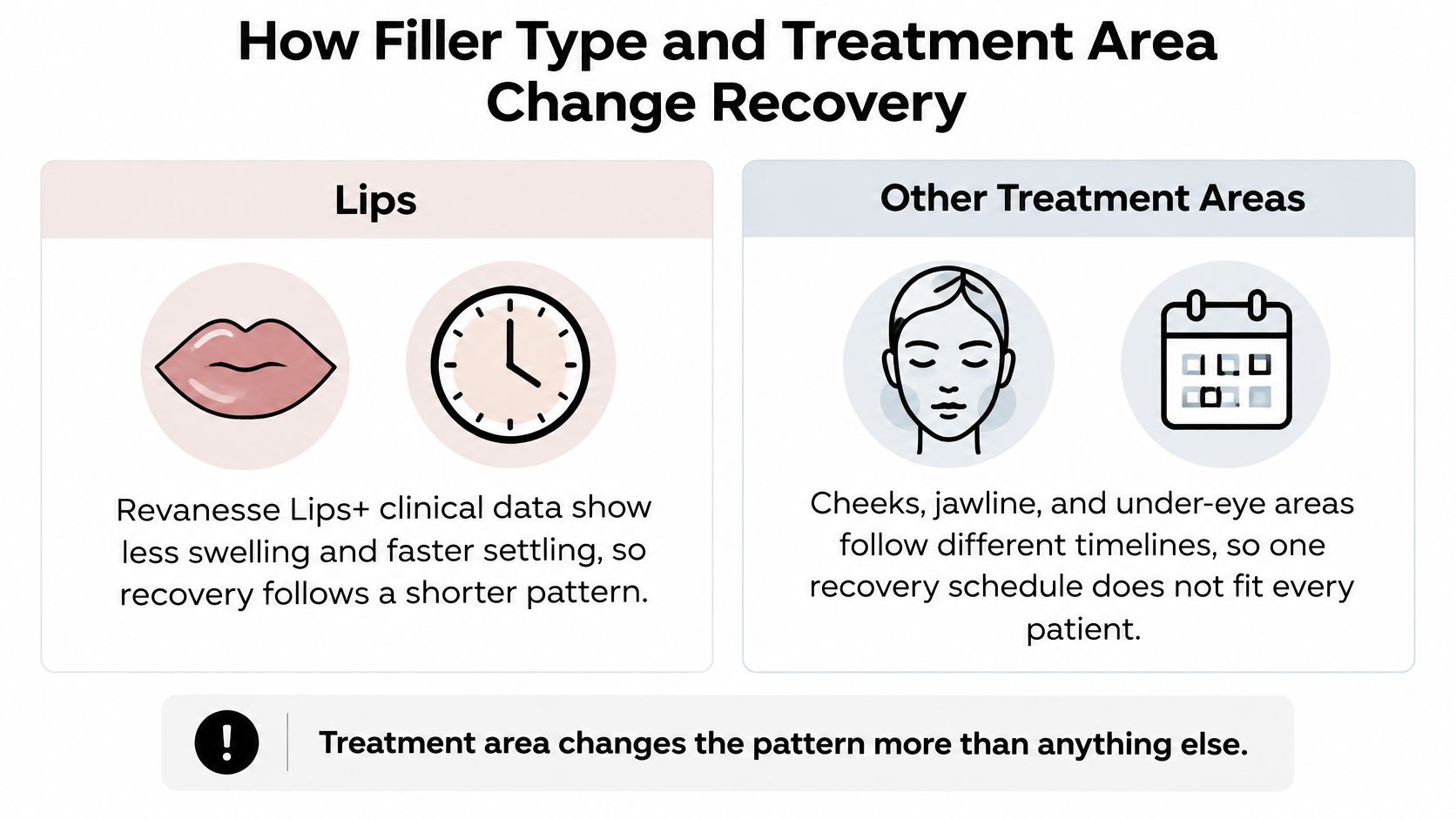
Lips often swell readily and visibly. In FDA-reviewed Revanesse Lips+ study information, injection-site swelling occurred in 88% of participants. Most adverse events lasted 30 days or less, although a small number of swelling events lasted 53 days or were still ongoing when the study ended (Revanesse Lips+ patient information).
| Treatment area | Typical resolution | Pattern to watch |
|---|---|---|
| Lips | Most events within 30 days; a few lasted 53 days in Revanesse Lips+ data | Swelling still visible after a few days warrants a call to the clinician |
| Under the eyes | Short-term swelling in 51% of cases | Prolonged periorbital edema in about 23.5% of one study, averaging 5.4 months |
| Cheeks and mid-face | Usually within 1-2 weeks | Malar edema can be prolonged |
| Jawline and chin | Generally within 1-2 weeks, similar to cheeks | Use the two-week check as the reference point |
Under-eye swelling can follow a longer course than swelling in other areas. A 7-year retrospective review of hyaluronic acid treatments for infraorbital hollows found short-term swelling in 51% of cases. Trained evaluators identified delayed or long-term swelling in about 19%, including mild cases patients did not notice. In a separate study of 51 patients, 12 had clinically significant prolonged periorbital edema, roughly 23.5%, lasting an average of 5.4 months (review of infraorbital HA filler outcomes).
For cheeks and mid-face, swelling usually resolves within 1-2 weeks, though malar edema may last longer. Jawline and chin swelling generally follows a similar timeline, making the two-week check a useful reference point. Individual recovery still varies by treatment area and product.
A longer timeline in the lips or under the eyes does not automatically mean there is a complication. Track changes against the expected pattern for the treated area, and contact your clinician if swelling is not improving as expected. Product choice also matters: this guide to the types of dermal fillers explains how different materials behave in tissue.
Why Early Swelling Peaks and How to Speed Settling
In the first days after filler, the treated area can look fuller than the final result. Hyaluronic acid gel binds water, contributing to the filling effect (FDA on approved dermal fillers). Meanwhile, needle punctures cause minor tissue trauma and an inflammatory response that brings fluid to the area. These two processes overlap, then settle at their own pace.
What the first 72 hours are doing
During the first few days, swelling can make the result appear uneven or overly full. Day one is too soon to judge symmetry, especially in the lips, where swelling may differ from one side to the other. Pressing or rubbing to check the area can add irritation.
A home routine that helps it settle
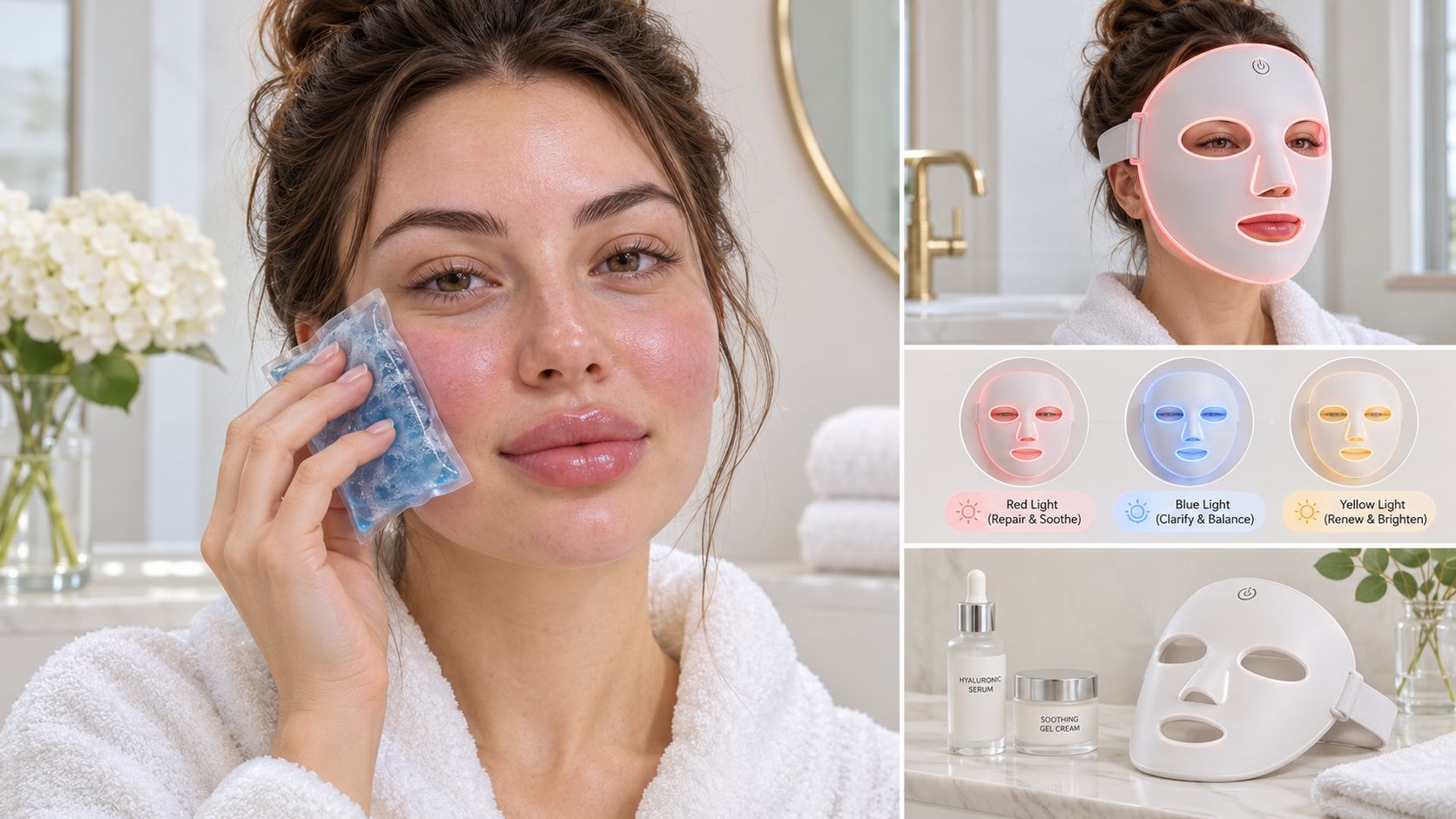
- Cool it, don't freeze it. If your injector recommends it, apply a cloth-wrapped cold pack for 15 to 20 minutes. The cold therapy guide for athletes explains on-and-off cold-pack timing.
- Sleep slightly propped up for the first few nights to help limit fluid pooling.
- Keep your hands off. Avoid pressing, rubbing or massaging injection sites unless your injector specifically advises it.
- Skip heat and hard exercise for the first few days. Saunas, hot baths and strenuous workouts can increase blood flow to the face.
- Use only products your injector approves on the treated area. Follow your aftercare instructions, and see this dermal filler aftercare guide for general day-one care.
Once your injector clears the area, a gentle, painless at-home LED mask routine may fit into your skincare care. Red light penetrates the skin to help stimulate collagen production, reduce the look of inflammation and support skin healing. It is not a substitute for aftercare, and you should not use it over fresh injection sites without clinical approval.
Wait until swelling has settled before deciding whether you need a touch-up. That is usually after the first week or at your injector's review appointment. Adding volume while the face is still puffy can leave you with more filler than you intended.
Delayed Swelling After Illness, Vaccines or Dental Work
Here's the question most patients never think to ask: can a cold, a vaccine or a dental cleaning make filler swell weeks or months later? Yes. FDA-approved filler labeling identifies delayed-onset inflammation at the treatment site as a recognized event after viral or bacterial illness, infection, vaccination or dental procedures, and notes it may respond to treatment or resolve on its own (FDA filler labeling on delayed inflammation).
That timing matters because it's often misread. Swelling that shows up after a trigger, rather than in the first days, usually doesn't mean the filler was placed incorrectly or has migrated. Your immune system reacted to something else and the treated area joined in.
Trigger log, three lines: the date of the cold, vaccine, dental work or infection; the date swelling started; whether the area feels softer or firmer than it did before.
Delayed inflammation isn't automatically harmless, though. The same labeling lists nodules, granulomas, infection and allergic reactions among possible complications, and some need medical treatment. Don't dig into leftover medication from a previous procedure, and don't assume it will pass because the first round did. Call the clinician who treated you, and if there's severe pain, skin injury or any vision change, treat it as urgent.
The practical rule: trigger-linked swelling that is softening and settling is less worrying than swelling that is hard, painful or growing.
When Swelling Signals a Problem, Not Normal
Swelling should generally be easing, not intensifying, as the days pass. If it remains after two weeks, contact your injector for advice. The FDA's general filler safety information describes possible risks and advises patients to contact a health care provider about swelling or other symptoms that persist beyond 14 days (FDA on dermal fillers and soft tissue fillers).
Some signs need faster attention.
Possible vascular emergency. Skin that turns pale, blue, dusky or cool, severe or worsening pain, vision changes, or neurologic symptoms require urgent evaluation. Rare but serious filler complications can include skin death or vision loss. Seek emergency care for these signs rather than waiting for a routine reply.
Possible infection or significant inflammation. Spreading redness, warmth, drainage or fever warrants prompt contact with your clinician. They can assess whether you need an examination or treatment.
| Pattern | What it may indicate | Action |
|---|---|---|
| Swelling steadily shrinking after day 3 | Settling post-injection swelling | Continue home care and monitor the trend |
| Swelling still present past 14 days | Persistent swelling needing review | Contact your injector |
| Spreading redness, warmth, drainage or fever | Possible infection or inflammation | Contact your clinician promptly |
| Pain that is severe or escalating | Possible vascular complication | Seek urgent evaluation |
| Skin turning pale, blue, dusky or cool | Possible vascular emergency | Seek emergency care immediately |
| Vision changes or neurologic symptoms | Possible serious complication | Seek emergency care immediately |
| Hard lump or nodule appearing weeks or months later | Possible delayed reaction | Arrange a clinical assessment |
The direction of change matters. Gradual improvement is reassuring, even if swelling has not fully settled. If it stops improving and remains beyond 14 days, call your injector. If symptoms worsen at any point, seek advice promptly instead of waiting for a scheduled check.
Have this ready for the call: photos taken at the same time each day in the same light, your treatment date, the filler product name if you know it, your symptoms, and any medications you take.
For more detail on possible reactions and when to seek care, read this guide to dermal filler side effects.
Confirm Your Swelling Timeline With Your Injector
Three things in the next 24 hours will make the rest of your recovery easier. Write down your treatment date and the exact areas treated. Take one photo a day in the same light, same angle, no filter. Save your injector's direct number and your aftercare sheet where you'll find them at 11 p.m.
Then plan two checkpoints. At day 7, ask whether the swelling has shrunk on schedule. At day 14, ask whether it has kept shrinking. If both answers are yes, keep doing what you're doing. If either answer is no, or if anything has changed shape, hardened or turned tender, book a review rather than talking yourself out of it.
BotoxBarb offers injectable services including Botox, Dysport and Restylane, so patients who want their treatment and their follow-up in one place can arrange both in a single clinic visit.
The clinician who treated your face decides what's normal for your face. Doubt about any warning sign is itself a reason to call, not a reason to wait another week. Write down your treatment date and book your day-7 check.
BotoxBarb pairs injectable treatments with the aftercare guidance that makes recovery predictable, from Restylane and Dysport appointments to LED light therapy that supports skin healing between visits. If you'd like a clinician to map your own swelling timeline and check your progress at day 7 and day 14, BotoxBarb makes it easy to book your in-clinic visit.