Botox vs Dysport Reviews Honest Comparison Guide
You're scrolling through Botox vs Dysport reviews before your first appointment, and the advice seems impossible to reconcile. One person praises Dysport for acting faster and spreading beautifully across the forehead. Another insists Botox gives better control around the brows. A third compares the products by unit price, even though the units don't measure the same thing.
That confusion is understandable. Botox and Dysport are both botulinum toxin type A neuromodulators, and both temporarily relax targeted muscles to soften expression lines. The meaningful differences come from their formulations, dosing systems, tissue behavior, treatment area, and the injector's technique. A review describing an excellent forehead result may tell you very little about what will happen around your crow's feet or lip flip.
This guide reads reviews through a clinical lens. Instead of treating star ratings as a contest, it focuses on dose conversion, onset, duration, diffusion, anatomy, and total cost per treatment area. That's the information a first-time patient needs before choosing between products at BotoxBarb.
Introduction Why Botox vs Dysport Reviews Confuse First Time Patients
A first-time patient recently told me she'd narrowed her decision down to two comments. One review said Dysport looked natural and started working quickly. Another said Botox was more predictable and lasted longer. She wanted a simple answer, but neither review included the details that determine the result: the number of units used, the injection pattern, the strength of her muscles, the dilution, or the exact areas treated.
That's the central problem with Botox vs Dysport reviews. Patients often describe a product as if it works independently of the person injecting it. In practice, the brand is only one part of the treatment. The same neuromodulator can look subtle and balanced in one face and too strong or uneven in another if the assessment and placement aren't appropriate.
Practical rule: Read the treatment plan behind the review, not just the rating attached to it.
Botox, formally onabotulinumtoxinA, and Dysport, formally abobotulinumtoxinA, share the same core purpose. They interrupt nerve signals that tell selected muscles to contract, which temporarily reduces the movement responsible for dynamic lines. Their formulations are different, however, and the products use separate unit systems. A Botox unit is not a Dysport unit, so a lower Dysport price per unit doesn't automatically mean a lower total treatment cost.
Reviews also reflect expectations. Someone who wants a quick, softer effect across a broad forehead may appreciate Dysport's reported diffusion pattern. Someone seeking careful brow shaping or conservative treatment near the eyes may value the localized control associated with Botox. Neither preference makes one product universally superior.
The useful question isn't “Which brand wins?” It's which formulation, dose, and injection strategy are most predictable for your anatomy and goal. That's the standard I use when discussing both options with patients.
Understanding How Botox and Dysport Work
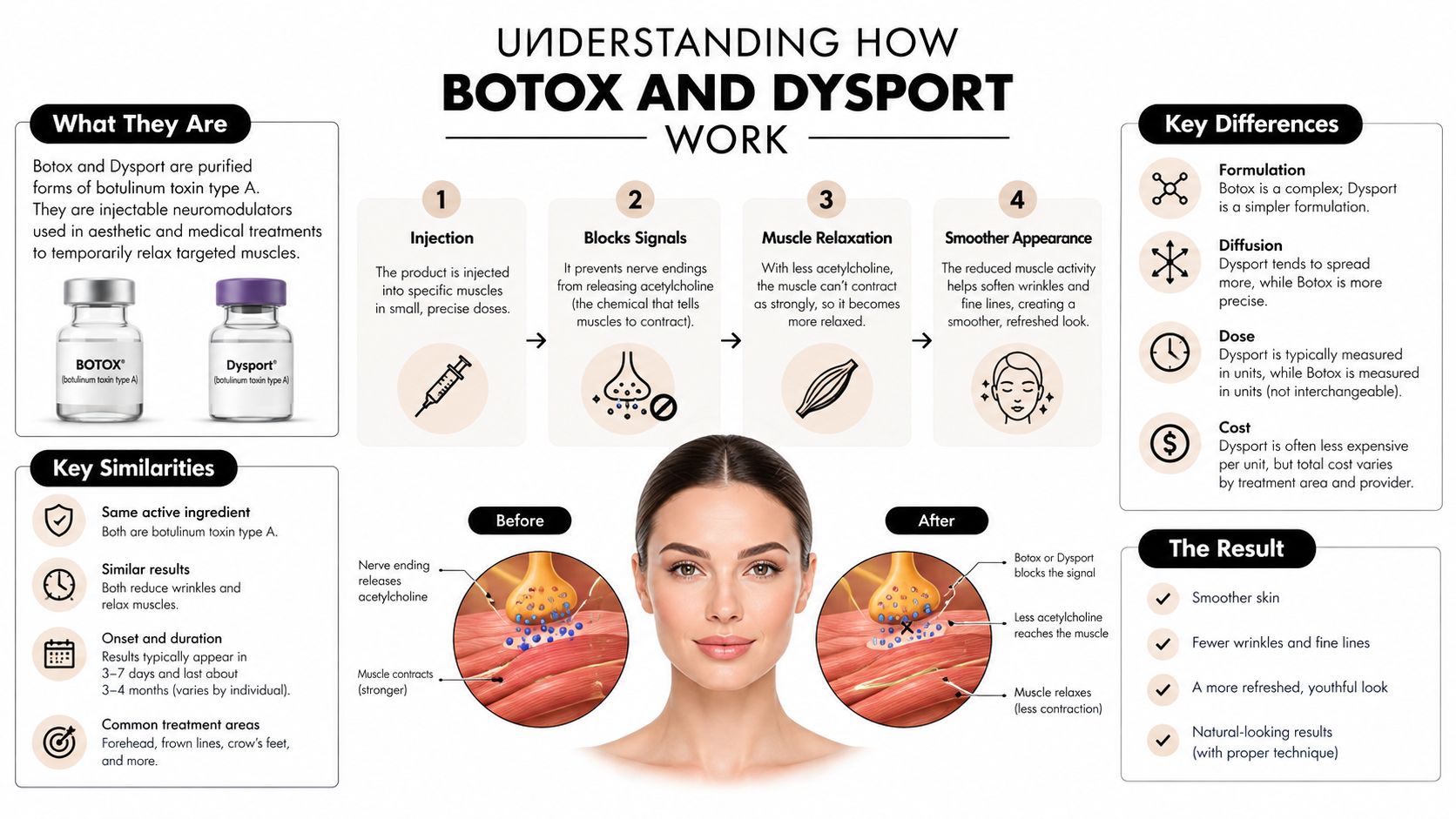
Both products treat dynamic wrinkles, the lines created or deepened by repeated muscle movement. A clinician places small amounts of botulinum toxin type A into selected muscles. The toxin temporarily reduces communication between the nerve and muscle, so the muscle contracts less forcefully. As movement softens, the overlying skin can appear smoother.
This effect is temporary. Muscle activity gradually returns, and maintenance treatment may be appropriate for patients who want to preserve the result. The treatment doesn't replace skincare, restore lost volume, or erase every static line. It addresses movement first.
Why formulation affects the experience
Dysport and Botox have distinct formulations, and clinicians often discuss Dysport as having a tendency toward broader diffusion or earlier visible onset in some patients. Botox is commonly selected when a more localized, deliberate treatment pattern is useful. Those are tendencies, not guarantees. Dilution, injection volume, needle placement, muscle strength, and facial anatomy can change the practical result as much as the product choice.
The FDA labeling also makes the dosing distinction clear. Dysport is supplied in 300-unit or 500-unit single-dose vials, as stated in the FDA Dysport prescribing information. The products aren't dosed interchangeably, even when a clinician treats a similar cosmetic area.
For glabellar lines, the labeled dosing examples differ substantially. Botox is labeled at 20 units divided across five injection sites, while Dysport is labeled at 50 units divided across five sites, according to this glabellar dosing comparison. That difference doesn't mean Dysport is weaker or Botox is stronger. It means the unit systems reflect different product formulations and potencies.
What proper dosing changes
A well-designed treatment starts with the muscles, not the vial. The injector assesses how strongly you animate, how your brows move, whether you recruit the forehead to compensate for heavy lids, and how much movement you want to retain. The product is then selected and dosed within that plan.
That's why two reviews can appear contradictory while both remain genuine. One patient may have needed controlled placement for a delicate brow balance. Another may have benefited from a broader distribution across a strong forehead. Safety and effectiveness are broadly similar when each product is appropriately dosed and administered by a qualified injector, but the technique must fit the anatomy.
Head to Head Comparison of Onset Duration Dosing and Diffusion
患者評價要拆開解讀。起效速度、維持時間、單位換算、擴散範圍與不良事件,回答的是不同問題。某產品可能較早出現變化,卻不代表效果維持更久。較廣的擴散,也不等於更適合細小或需要精準控制的治療區域。
Clinical comparison at a glance
| Criteria | Botox | Dysport |
|---|---|---|
| Product type | OnabotulinumtoxinA, a botulinum toxin type A neuromodulator | AbobotulinumtoxinA, a botulinum toxin type A neuromodulator |
| Labeled glabellar example | 20 units across five sites | 50 units across five sites |
| Unit relationship | Units aren't interchangeable with Dysport | Units aren't interchangeable with Botox |
| Duration in a long-running comparison | 11.2 ± 5.8 weeks among responding patients without booster treatment | 13.3 ± 5.9 weeks among responding patients without booster treatment |
| Booster treatment in that comparison | 12% | 23% |
| Adverse events in that comparison | 47% | 50% |
| Diffusion discussion | Can provide localized placement, depending on technique and volume | May provide broader diffusion, depending on technique and volume |
| Practical selection tendency | Often considered for controlled shaping and smaller areas | Often considered when broader coverage or earlier perceived onset is useful |
以上表格中的單位不能直接互換。前文已說明,眉間的標示劑量不同,表格則用來比較這些差異如何影響起效、維持時間與不良事件。若想仔細了解單位等效性的限制,可參考我們的 Dysport 與 Botox 單位換算指南。
起效速度只是結果的一部分
患者常問哪一款「更快起效」。Dysport經常被描述為較早出現可見變化,但個人反應仍會受到肌肉活動、注射位置、稀釋方式與治療區域影響。較早開始出現效果,不代表最後效果一定更自然、更理想或維持更久。
治療時間也會影響選擇。若要配合活動或拍攝,應詢問完整的反應時間表,而不是只追求最早可能看到的變化。預約時也要保留足夠時間,讓注射者評估最終效果,並討論是否需要調整。
維持時間與耐受性
一項長期直接比較研究載於 FDA clinical material,研究在採用4:1換算比例時,發現兩種產品的臨床療效與耐受性相近。在沒有接受追加治療且有反應的患者中,Dysport平均維持13.3 ± 5.9週,Botox則為11.2 ± 5.8週。
同一研究中,Dysport患者接受追加治療的比例為23%,Botox為12%。不良事件則分別為50%與47%。這些結果不能直接當成每位美容治療患者的預測,因為患者族群、治療目的、劑量安排與研究設計都會影響結果。看到「某產品維持更久」的評論時,應先確認使用的換算比例,以及是否包含追加治療。
另一項與FDA相關的比較,描述一項支持Dysport核准的隨機、多中心、雙盲、安慰劑對照兒科試驗,納入235名2至17歲患者。同一來源也描述一項2026年第四期成人上肢痙攣研究,研究在美國、法國與加拿大的72個中心進行,結果顯示Dysport相對Botox達到非劣性。不良事件為20.3%對23.0%,維持時間為14.2對13.8週,詳見這份 FDA-related market comparison。這些是治療性資料,不是面部美容效果的保證,但可協助說明,正確比較時,兩種產品的表現可能相近。
換算不是固定公式
一項納入79名志願者的劑量研究,估算Dysport與Botox的生物等效性約為每1個Botox單位對應1.57個Dysport單位。研究的95%信賴區間為0.77至3.20,詳見 PubMed study on abobotulinumtoxinA and onabotulinumtoxinA。區間寬廣,代表換算結果會受到研究設計、稀釋、注射技術與評估終點影響。
實際治療時,請不要把Botox的單位數帶到Dysport療程,要求使用相同數字。注射者應根據目標肌肉、治療部位、肌肉力量與希望保留的活動度,制定產品專用的劑量方案。
擴散取決於標籤以外的因素
網路評論常把「擴散」當成單一產品特性,實際上它也受到劑量、注射體積、稀釋方式、針尖位置與肌肉解剖影響。一項前額研究在六個月內的配對比較中,Dysport有**93%**的比較出現較大的無汗區域。另一篇回顧則指出,在受控或等效體積下,兩種產品可能呈現相近的擴散,某些模型甚至顯示Botox的作用範圍更大。這份 review of botulinum toxin diffusion 說明,劑量比例、注射體積與選用的評估終點,都會改變觀察結果。
因此,「Dysport擴散太廣」與「Dysport覆蓋更均勻」可以同時出現在真實評論中。對額頭、眉間與魚尾紋等不同部位,注射位置和稀釋方式往往比單看品牌評分更能解釋結果。單位價格也不能單獨代表價值,應連同治療範圍、所需總量、維持時間與注射者的解剖判斷一起評估。
What Real World Reviews and Case Notes Actually Show
A patient may describe Dysport as smoother across a broad forehead, while another calls Botox more controlled around the eyes. Both experiences can be accurate. Reviews reflect the treatment area, dose conversion, dilution, injection depth, muscle strength, and injector technique, not just the product in the vial.
Patient reviews are useful for assessing comfort, communication, appointment experience, and whether expectations were met. They are weaker evidence that one neurotoxin is universally superior. Reviewers rarely know the exact Botox-to-Dysport conversion, the dilution, the injection map, or whether treatment was performed within the product's labeled indication.
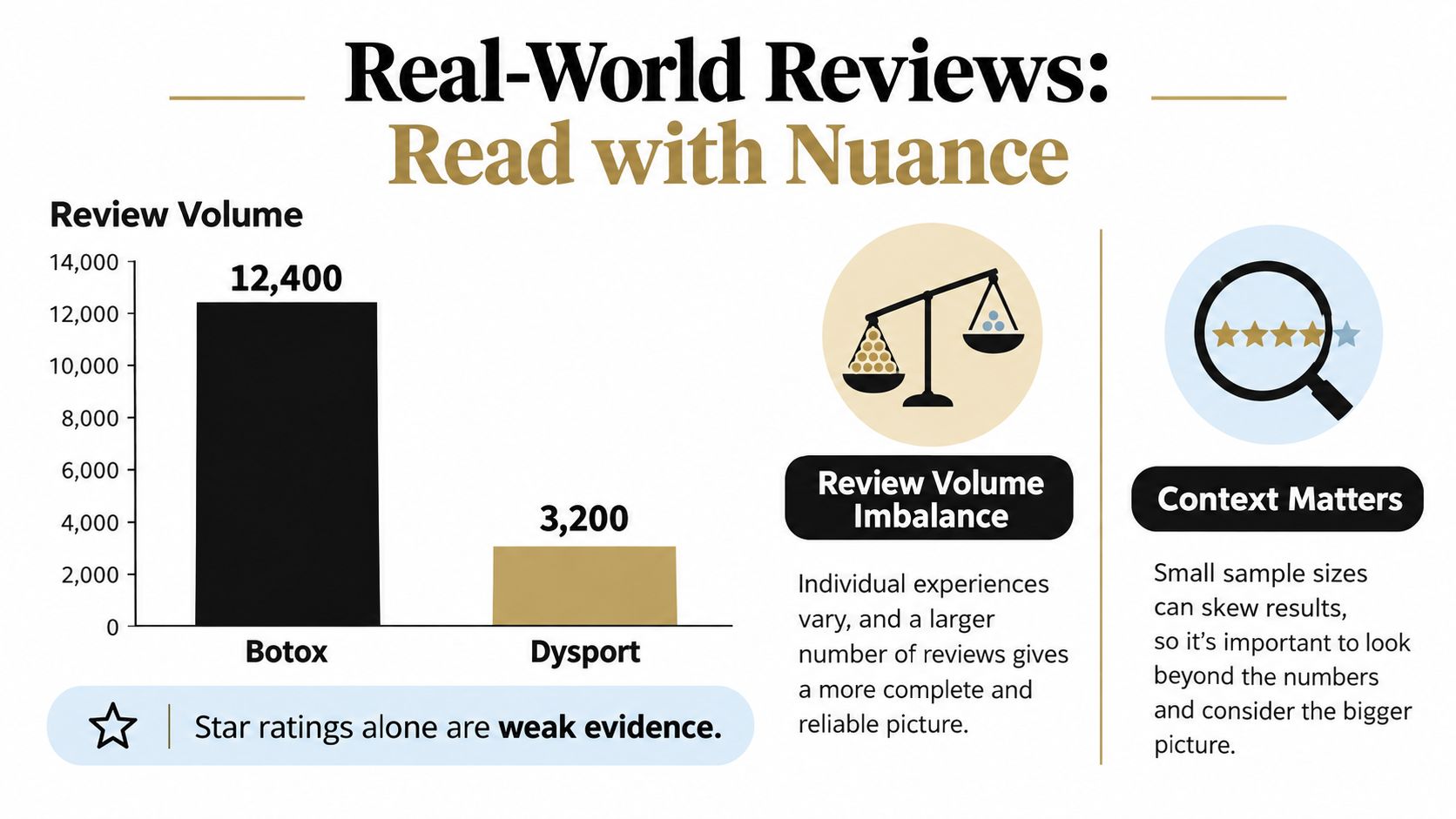
Drug review data show Botox has hundreds of user reviews while Dysport has very few Botox and Dysport review comparison. That uneven volume makes direct star-rating comparisons unstable. A larger review pool may reflect broader use rather than better performance, while a small pool can be shaped by a few unusually positive or negative experiences.
What forehead reviews may be signaling
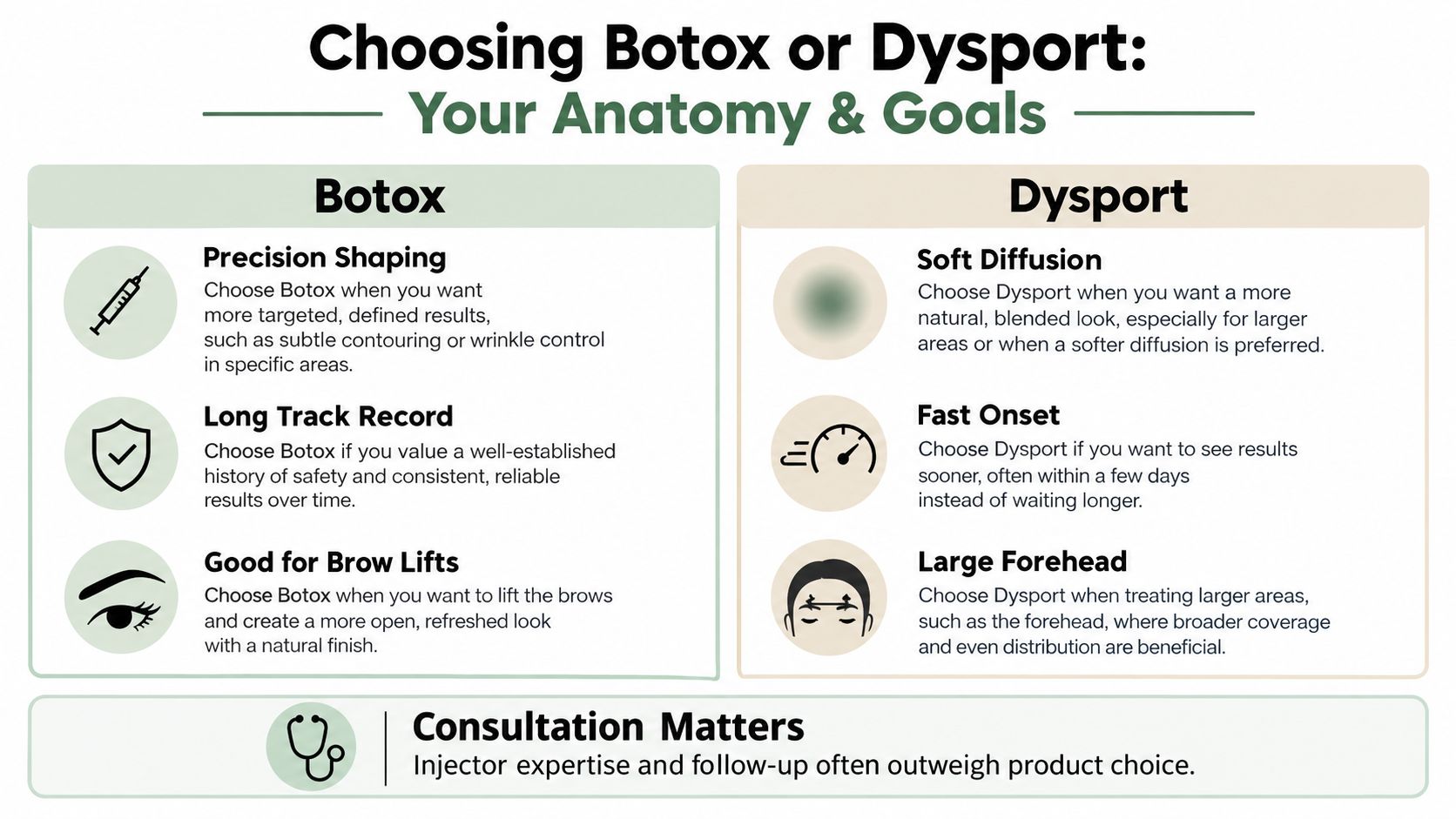
Patients with a broad forehead and strong frontalis movement may prefer Dysport when they want a softer, more distributed result. That broader effect still requires control. Brow position, frontalis compensation, and the relationship between the forehead and glabellar muscles must be assessed before setting the dose and injection pattern.
A Botox review describing “precision” may reflect the injector's placement, depth, and dosing rather than a guaranteed brand property. A conservative map can produce controlled movement with either product. See real patient examples in our Dysport injections before and after gallery to compare how treatment area and dosing influence visible outcomes.
Why eye and lip reviews need extra caution
Crow's feet and lip flips involve small, anatomically sensitive muscles. A review praising a dramatic result may not match a patient who wants to preserve expression or avoid a noticeable change in the smile. In these areas, how precisely the injector can modulate small muscles often matters more than a general claim about diffusion.
Lip-flip outcomes also depend on lip anatomy, muscle strength, smile pattern, and expectations. A result that looks elegant on one face may feel too strong on another. Online comments rarely include enough clinical detail to separate product behavior from injection strategy.
For first-time patients, use reviews to ask practical questions:
- Was the consultation individualized? Did the injector assess movement at rest and during expression?
- Was the product and dose explained? Botox units and Dysport units should be distinguished.
- Did the review identify the treatment area? Forehead, glabella, crow's feet, and lips require different placement decisions.
- Was follow-up available? An early assessment can clarify whether adjustment is appropriate.
- Were expectations realistic? The first visible change does not determine the final result.
The strongest signal is not a five-star rating. It is evidence that the clinician matched the formulation, converted the dose appropriately, and adjusted technique to the patient's anatomy.
Choosing the Right Product for Your Anatomy and Goals
There isn't a universal winner because the same face can contain areas that call for different treatment logic. A broad forehead may benefit from a carefully distributed approach, while the lateral eye area or upper lip may reward tighter control. The goal is not to maximize relaxation. It's to reduce unwanted movement without disrupting facial balance.
A practical decision matrix
| Your priority | Anatomy or situation | Product discussion | What to ask |
|---|---|---|---|
| Controlled brow shaping | Uneven brows, heavy-lid compensation, or a desire to preserve expression | Botox may be considered when precise placement is central to the plan | How will you protect brow position and forehead support? |
| Broad forehead softening | Larger treatment field with strong frontalis movement | Dysport may be discussed when broader diffusion is appropriate | How will you prevent unwanted brow or eyelid effects? |
| Small, delicate area | Crow's feet or lip flip where millimeter-level placement matters | Botox may be preferred by some injectors for localized control | What degree of movement will remain? |
| Earlier perceived onset | A patient has a short scheduling window | Dysport may be worth discussing | What timeline should I expect, and when will you assess the final effect? |
| Switching products | Prior treatment with the other neuromodulator | Either can be used, but the dose must be recalculated | What conversion approach will you use for this area? |
| Cost-sensitive planning | Comparing prices by unit | Compare the total plan for the area, not the unit price | How many product-specific units are likely to be needed? |
This matrix isn't a prescription. It's a way to make your consultation more specific. The Cleveland Clinic discussion of Dysport and Botox also emphasizes that the products are broadly similar in safety and effectiveness, while unit conversion and approved indications require care.
Diffusion can be helpful or inconvenient
A little broader distribution may help a clinician cover a larger field with fewer injection points, but that advantage depends on the anatomy. On a forehead, the injector must account for the frontalis muscle's role in lifting the brows. Around the eyes, unwanted spread can be less forgiving. In a lip flip, precision matters because the orbicularis oris influences lip posture and function.
That's why I don't choose Dysport because a patient read that it spreads more, and I don't choose Botox because a review called it more precise. I look at the movement pattern, the desired endpoint, and the amount of control the area demands.
Think in total treatment cost
Per-unit comparisons mislead because the units aren't interchangeable. Dysport's labeled glabellar example uses 50 units, while Botox's uses 20 units, so a lower Dysport price per unit may be offset by higher unit requirements. The relevant financial question is the total cost for your specific area and treatment plan, not which vial appears cheaper on a menu.
Ask for a product-specific estimate and clarify whether the plan includes a follow-up assessment. A transparent discussion should explain why the dose was selected and what might change if your muscle strength or treatment goal differs from the standard pattern.
For many patients, the choice becomes clearer after discussing trade-offs. Choose the option that gives your injector the most predictable control for your anatomy, not the one with the most persuasive online slogan.
Practitioner Factors Aftercare and Enhancing Results at BotoxBarb
The injector's assessment begins before the needle touches your skin. A careful consultation examines your resting expression, animation, brow position, muscle strength, asymmetry, prior toxin history, medications, and the result you want to preserve. The plan should identify the muscles being treated and the muscles that need to remain active for support and expression.
Dilution and injection mapping also matter. Two practitioners can use the same product and produce different outcomes because they select different injection points, depths, volumes, and doses. Good technique makes the product behave in service of the anatomy.
At BotoxBarb, Barb N.P. offers both Botox and Dysport alongside dermal fillers, PRP treatments, and LED light therapy. The relevant value for this comparison is the ability to discuss the products within an anatomy-specific plan rather than forcing every patient into a single brand preference.
After treatment, follow the individual instructions you receive. Avoid rubbing or pressing on injection sites, and contact the practice if you develop an unexpected or concerning symptom. For a practical review of post-treatment guidance, see these Botox aftercare instructions.
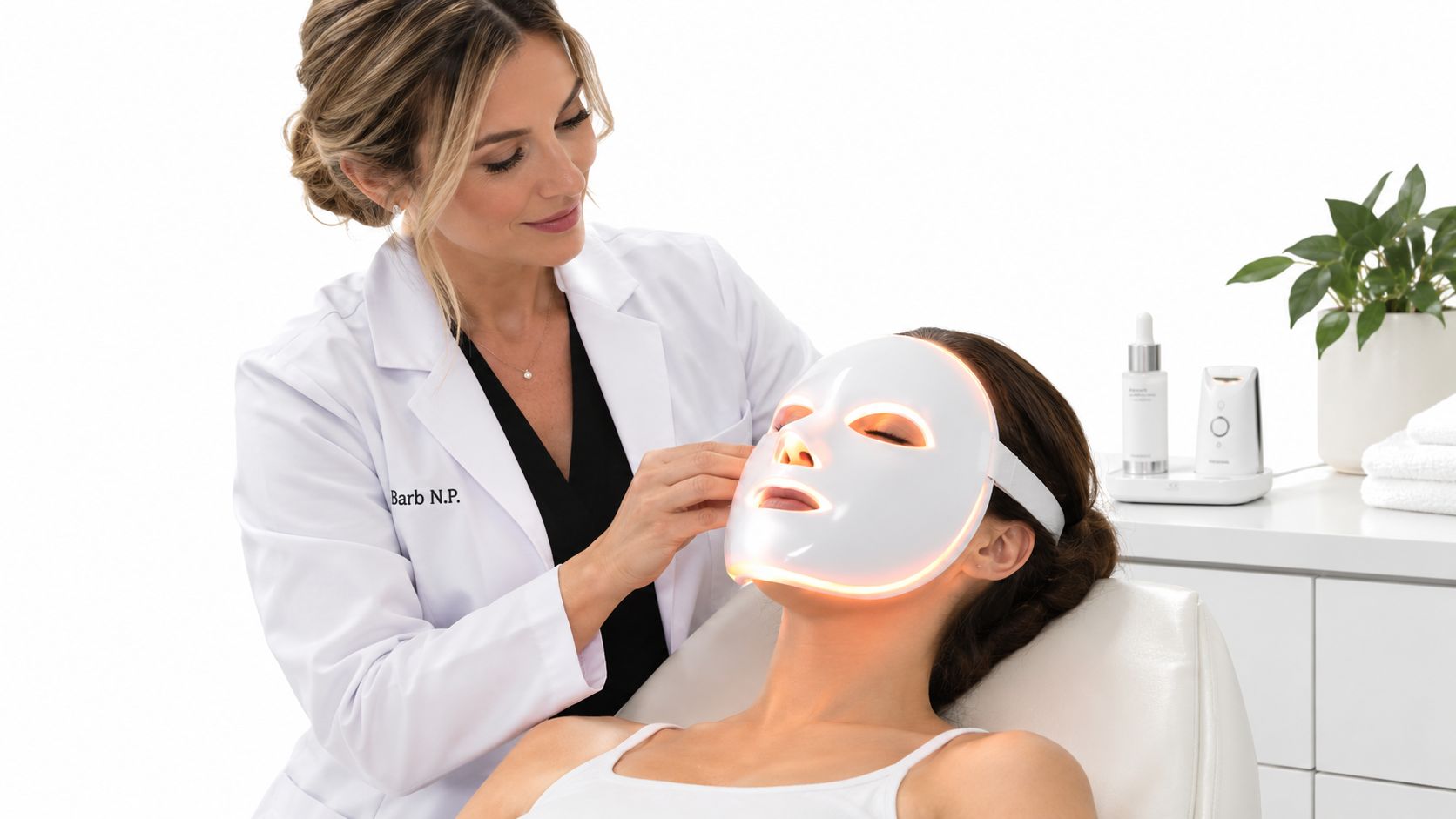
Adding LED support between appointments
Neuromodulators change muscle movement. They don't replace a routine for skin texture, acne support, or general radiance. The Barb N.P. Facial Mask can complement an at-home skincare plan with a wireless design, a comfortable fit, and three lighting settings for different treatments.
A randomized, evaluator-blinded study lasting 12 weeks used combined 445 nm blue light and 630 nm red light and found the device effective for mild-to-moderate acne vulgaris, with no adverse events reported and FDA clearance for home use, as described in this LED facial mask study. That evidence concerns the studied light device and acne outcome, so it shouldn't be presented as proof that an LED mask prolongs Botox or Dysport.
Use LED as a non-invasive skin-quality support, not as a substitute for injectable treatment. Follow the device instructions, keep expectations realistic, and combine it with medical-grade skincare and sun protection when appropriate.
Final Recommendation and Next Steps for Your Treatment Plan
If your priority is precise control, conservative brow shaping, or a delicate area such as crow's feet or a lip flip, discuss whether Botox gives your injector the most predictable placement. If you want broader coverage or place a high value on earlier perceived onset, Dysport may be a sensible option to evaluate. Neither choice removes the need for careful dosing.
The clinical evidence supports a balanced conclusion. When conversion is appropriate, Botox and Dysport can provide broadly comparable efficacy, tolerability, and duration. Reviews become more useful when you compare the treatment area, dose system, injector skill, and expectations instead of treating star ratings as direct evidence.
At your consultation, ask for the expected total cost per area, the product-specific unit plan, the anticipated onset, and the follow-up process. Track how your face moves before and after treatment, and use that information to refine future dosing rather than switching brands based on one review.
BotoxBarb offers Botox, Dysport, personalized consultations, LED light therapy, and medical-grade skincare options for patients building a thoughtful aesthetic plan. Visit BotoxBarb to compare treatment options, book an appointment, and discuss which product best fits your anatomy and goals.